
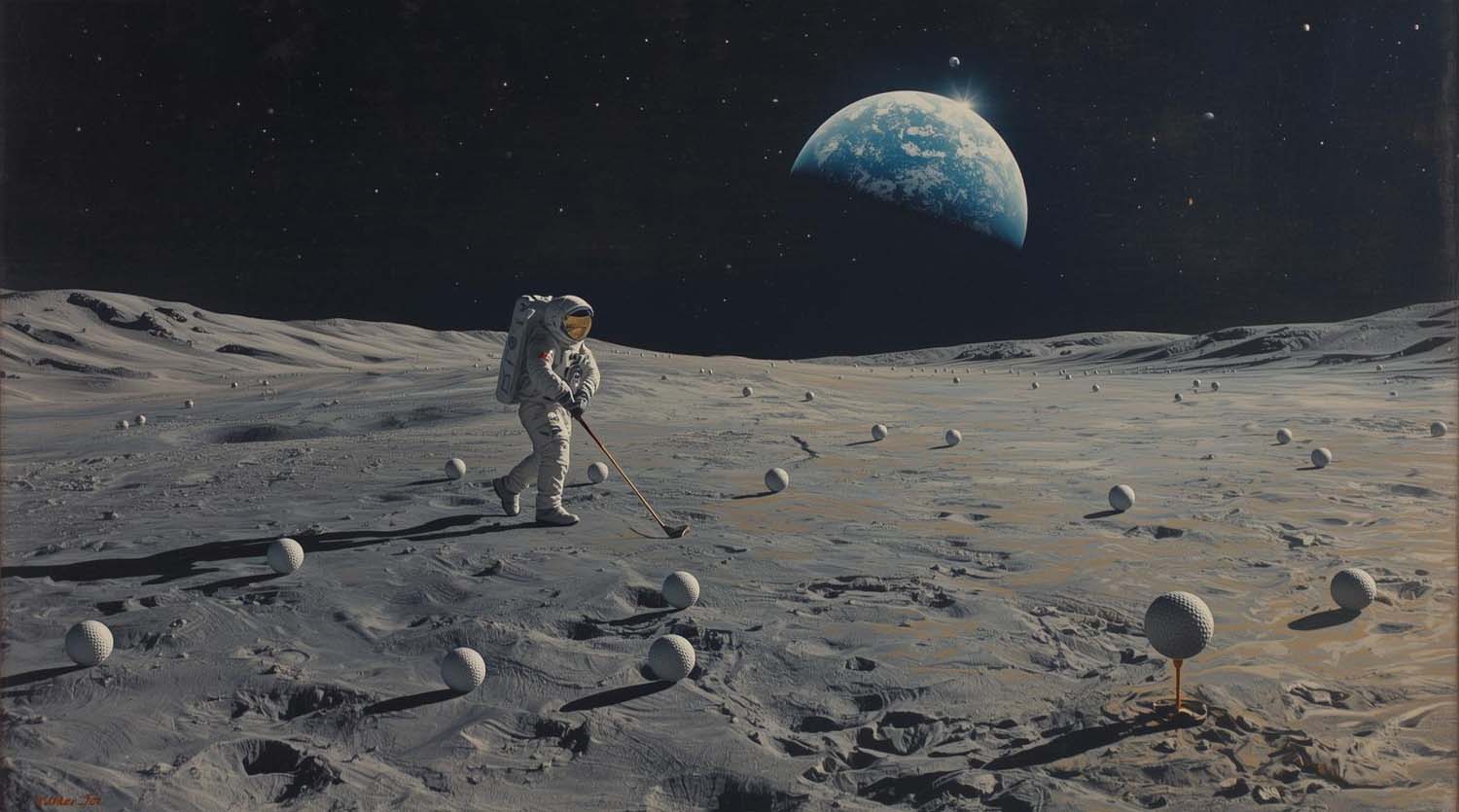
Have you ever looked up at the Moon and wondered about the strange things left behind by astronauts? One question pops up more than most. It is a mix of sports, science, and space history. People want to know: how many golf balls are on the Moon?
You may have heard a wild story about millions of golf balls being there. That story is not true. The real answer is simpler, and much more interesting.
This article will give you the definitive answer. We will explore the true story of the only person ever to play golf on the Moon. We will explain the science of his famous swing. And we will clear up the myths once and for all. Get ready to learn the facts behind one of space travel’s most fun moments.
How Many Golf Balls Are On the Moon?
Let us not wait. The mystery is easy to solve when you know the facts.
There are two golf balls on the Moon.
This is not a guess. It is a number based on solid historical evidence. The two balls were left there over fifty years ago. They are still there today, sitting in the Moon’s dust. They will likely stay there for millions of years because the Moon has no wind or water to wash them away.
Why This Number is Correct
The reason we know there are two balls is simple. Only one person ever took golf balls to the Moon. He was astronaut Alan Shepard. He brought three golf balls with him. He hit two of them during a live broadcast from the lunar surface. The third golf ball was not hit, so he brought it back to Earth as a souvenir. That third ball is now in a museum in the United States.
So, the math is clear:
- Golf balls taken to the Moon: 3
- Golf balls hit and left on the Moon: 2
- Golf ball returned to Earth: 1
- Total golf balls on the Moon today: 2
The Man Who Hit the Golf Balls: Alan Shepard
You need to know the man behind the club to understand the story.
Who Was Alan Shepard?
Alan Shepard was a true American hero. He was one of the first astronauts selected by NASA. In 1961, he became the first American to travel into space. A decade later, he commanded the Apollo 14 mission. His job was to land on the Moon and explore its surface. He was a serious and skilled pilot. But he also had a fun and clever side.
The Secret Plan for a Golf Shot
Shepard came up with the idea to hit a golf ball on the Moon. He thought it would be a great way to show people the differences between Earth and the Moon. It would demonstrate the Moon’s weaker gravity in a way anyone could understand. However, this was not an official NASA experiment. It was a surprise.
He had to get permission from the space agency. He also worked in secret with a professional to design the golf club. He could not take a full-sized club, so he made a special one. He took the metal head from a 6-iron golf club. He modified it so it could be attached to the handle of a tool for collecting moon samples. This way, the club head could be folded up and hidden in his space suit until the right moment.
The Famous Golf Shot on the Moon
The big moment happened on February 6, 1971. Shepard and his crewmate, Edgar Mitchell, were near the end of their second walk on the Moon.
The Live Television Broadcast
Near the end of their work, Shepard reached into his suit pocket. He pulled out the golf club head and attached it to the tool handle. The millions of people watching on live television were amazed. He held the club with one hand because his bulky space suit made it impossible to use both hands.
He dropped a golf ball onto the ground. He then took a swing. The first swing was not very good. He mostly just scraped the top of the dust. The ball rolled into a nearby crater. He then dropped a second ball. This time, he connected much better. He hit the ball solidly. As it sailed away into the black sky, he famously said, “Miles and miles and miles!”
What Really Happened to the Golf Balls?
Shepard’s “miles and miles” comment was a bit of fun. He was excited. But how far did the balls really go?
The first ball, which he hit poorly, did not go far. It likely only rolled a few dozen feet into the crater. The second ball, which was a much better hit, flew through the vacuum of space. Without air to slow it down, it traveled much farther than it could on Earth.
Based on an analysis of the video and the physics, experts believe the second ball traveled between 200 and 400 yards. That is about the length of four football fields. It was an incredible shot, especially with one hand and a stiff space suit.
The Science of Hitting a Golf Ball on the Moon
Why could the golf ball go so far? The answer lies in two big differences between the Earth and the Moon.
The Moon’s Weak Gravity
Gravity is the force that pulls everything down. Earth has very strong gravity. The Moon’s gravity is much weaker—it is only one-sixth as strong as Earth’s. This means a golf ball on the Moon falls to the ground much more slowly than on Earth. It has more time to travel forward, so it can fly much farther.
No Air Resistance
On Earth, air pushes against a moving ball. This is called air resistance or drag. It slows the ball down. The Moon has no air. It is a vacuum. This means there is nothing to slow the golf ball down once it is hit. It can keep its speed for a much longer time and distance.
How Far Could a Pro Golfer Hit a Ball on the Moon?
This is a fun question to think about. With the weak gravity and no air, a golf ball would fly incredibly far. A professional golfer could hit a ball for several miles using a proper club and a two-handed swing. Some physics estimates suggest a well-hit ball could travel over a mile (1.6 kilometers) before landing.
The table below compares a golf shot on Earth to a theoretical perfect shot on the Moon.
Factor On Earth On the Moon
Gravity Strong (1g) Very Weak (1/6th of Earth’s)
Atmosphere Full of air No air (Vacuum)
The effect on the ball’s air slows it down, and gravity pulls it down quickly. Nothing slows it down; gravity pulls it down slowly.
Pro Golfer’s Drive About 300 yards Over 1 mile (theoretically)
Shepard’s Actual Shot Not Applicable About 200-400 yards
Debunking the Myth: There Are Not Millions of Golf Balls
One of the most common and incorrect stories about the Moon is that it is covered in millions of golf balls. This is completely false.
Where Did This Myth Come From?
This wild story started from a piece of science fiction or a misunderstood joke. Some people thought that NASA did a secret experiment to see how golf balls would behave on the Moon. The story grew, suggesting they sent thousands or even millions of balls. There is no truth to this. NASA has never done such an experiment.
The Facts That Prove the Myth Wrong
The evidence against this myth is very strong.
- Only One Mission: The Apollo 14 mission was the only time golf was ever played on the Moon. No other astronauts took clubs or balls.
- Limited Cargo Space: The Apollo spacecraft was very small, and every item brought to the Moon had a purpose, usually scientific or for survival. There was no room to pack millions or even hundreds of golf balls. It would have been impossible.
- The Third Ball is on Earth: We know that Shepard brought three balls and that one is back on our planet. This alone proves that the number of balls left behind was small and specific.
The idea of millions of golf balls is a fun story, but it is pure fiction.
Where Are the Golf Balls and the Club Now?
What happened to the equipment after that famous day?
The Golf Balls on the Moon
The two golf balls that Shepard hit are still right where they landed. They are sitting in the fine gray dust of the Fra Mauro highlands on the Moon. Because the Moon has no weather—no wind, no rain, no snow—the balls have not moved or decayed. They are preserved exactly as they were in 1971. You would likely see them if you could go to that spot today.
The Golf Club and the Third Ball on Earth
Shepard did not leave the golf club on the Moon. He detached the club head, packed it, and returned it to Earth. After the mission, he donated the club head to the US Golf Association Museum. You can still see it on display in Liberty Corner, New Jersey.
The third, an unhit golf ball, is also displayed in the same museum. It is proof that the third ball never stayed on the Moon.
Frequently Asked Questions
Here are answers to other common questions about golf on the Moon.
Could You Hit a Golf Ball Around the Moon?
No, you could not. To make a ball circle the Moon, you must hit it so fast that it reaches orbital speed. This speed is about 3,300 miles per hour. The fastest a human has ever hit a golf ball on Earth is about 210 miles per hour. It is physically impossible for a person to swing a club fast enough to put a ball into orbit around the Moon.
Did Any Other Astronauts Play Sports on the Moon?
No other astronauts played golf. However, on the Apollo 16 mission, astronaut John Young did a special jump while saluting the American flag. It looked like a small hop, but it was not a sport. Alan Shepard remains the only person who has played a sports-like game on the lunar surface.
Are the Golf Balls Still Visible?
We do not know for sure. The cameras on the Lunar Reconnaissance Orbiter, a NASA spacecraft that maps the Moon, have taken detailed pictures of the Apollo landing sites. We can see the landers and the paths the astronauts walked. However, the golf balls are too small for the camera to see from orbit. The only way to know if they are visible would be to go back and look.
What Kind of Golf Balls Were They?
Shepard used standard golf balls that were available at the time. They were not specially made for space. The only special equipment he designed was the collapsible club head.
Conclusion: Two Balls and a Lasting Memory
So, the next time someone asks you how many golf balls are on the Moon, you can tell them the true story. The answer is two.
This number is not just a piece of trivia. It represents a wonderful human moment during a serious scientific mission. Alan Shepard’s golf shot was a brilliant way to connect the complex space exploration science with people back on Earth. It was a moment of joy, curiosity, and genius that showed the human side of our journey to the stars. Those two simple golf balls are a lasting symbol of that spirit.