
If you’ve figured out your putting stroke is straight back and straight through, you’ve already done the hard part. Most golfers never get that far. They buy whatever looks good in the pro shop and wonder why the face feels unstable from six feet. You’re not them.
A straight stroke doesn’t rotate the putter face open and closed. It moves the head on a single line, like a train on a track. That means you need a putter that resists rotation, not one that encourages it.
You need a face-balanced or zero-torque design. I’ve spent time with five putters that fit this bill, from a premium option that costs as much as a weekend trip to a budget pick that costs less than a dinner out. Here’s what I found.
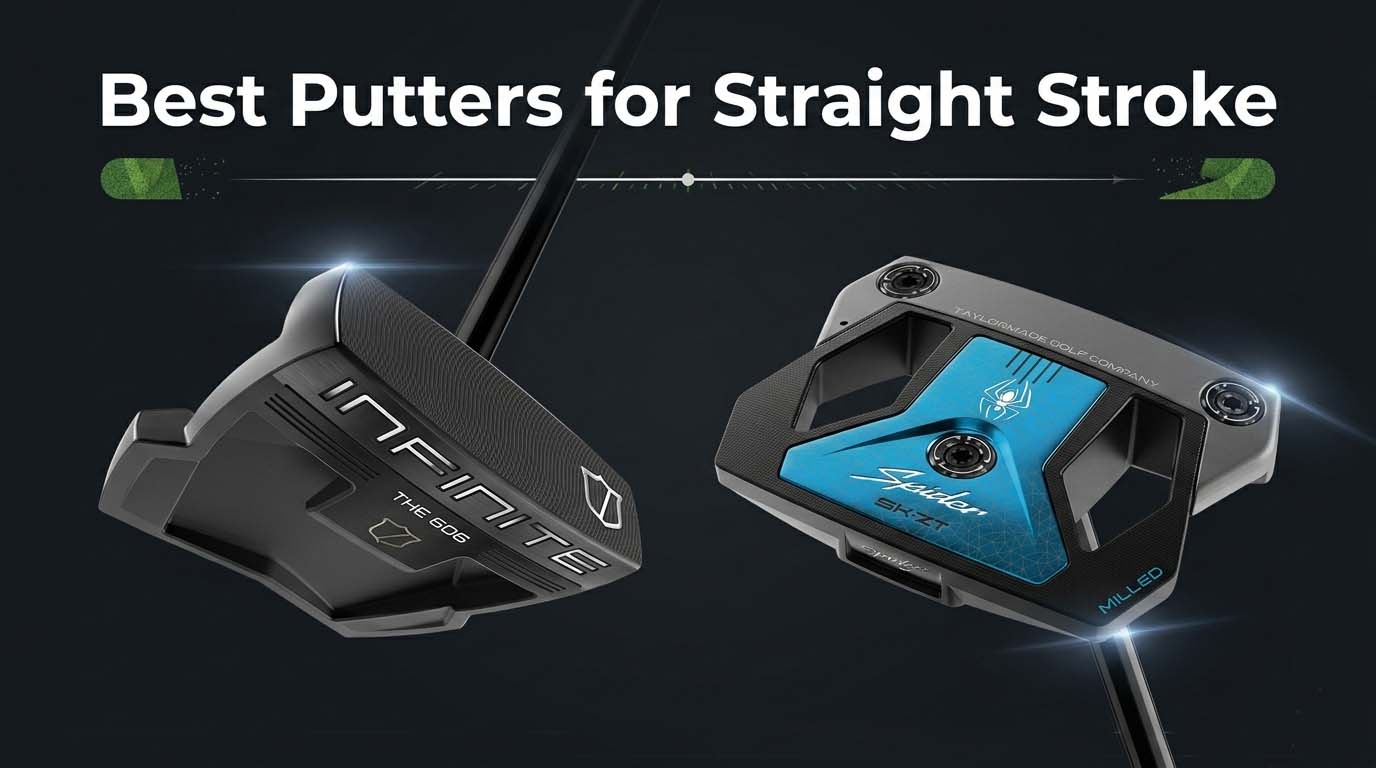
If you want the short answer: the TaylorMade Spider ZT is the best putter for a straight stroke if you’re not worried about budget. The Wilson Infinite Zero Torque 606 gives you 90% of that performance for less than half the price.
Top 5 Picks For The Best Putters for a Straight Stroke


What Makes a Putter Work for a Straight Stroke?
Before I get into the individual putters, it helps to understand why some work and others don’t. I’ve tested putters that looked perfect on paper but felt wrong on the green. The difference usually comes down to three things.
Face-Balanced vs. Toe-Hang – The Simple Rule
Balance a putter on your finger. If the toe points straight down, it has toe hang. If the toe points straight up at the sky, it’s face-balanced. That’s the whole test.
Face-balanced putters resist rotation. They want to stay square. That’s exactly what a straight stroke needs. Toe-hang putters want to rotate open and closed during the stroke, which is great for an arc but terrible for someone who moves the putter straight back and through.
I’ve seen golfers spend months fighting a toe-hang putter when all they needed was a face-balanced one.
What “Zero Torque” Actually Does
Zero torque takes face-balance a step further. It’s not just about where the putter balances on your finger. It’s about where the center of gravity sits relative to the shaft.
A zero-torque putter places the CG so the face stays square through impact without you having to fight it. You don’t have to hold the face closed or open it. You just swing.
I noticed this most on off-center hits. With a standard putter, a miss toward the toe twists the face open. With a zero-torque design, that twist is dramatically reduced. The ball still rolls straighter than it has any right to.
Center Shaft vs. Heel Shaft – Why It Matters
Where the shaft enters the head changes everything. A center shaft puts your hands directly over the middle of the face. That alignment is natural for a straight stroke. A heel shaft introduces torque because the force is applied off-center. That torque helps arc strokers rotate the face, but straight strokers don’t want it.
Every putter on this list either has a center shaft or a shaft position that mimics the effect. That’s not a coincidence.
What to Look For (Quick Checklist)
- Face-balanced – 0° toe hang. The toe points straight up when balanced.
- Center shaft or near-center hosel – Keeps your hands over the face center.
- High MOI – Stability on off-center hits matters more for straight strokes because you’re not manipulating the face to compensate.
- Clear alignment aids – You need to see square easily.
1. TaylorMade Spider ZT Putter
Specs: Loft: 2.5° | Shaft: KBS CT Putter 120 Stepless Black | Material: Alloy Steel / Aerospace Aluminum | Length: 35″
User Opinion About the product:
This is the putter I reach for when I need to make putts. Not when I’m practicing. When the round matters.
The Spider ZT uses a toe-up hosel configuration with a 1° shaft lean. That combination is engineered specifically to resist face rotation.
The first time I hit a putt with it, I noticed the head didn’t flutter. It stayed square through impact like it was on rails. That’s the low-torque design doing its job.
The Pure Roll insert is worth talking about. It’s made from Surlyn and aluminum, and it gives a softer feel than the older Spider inserts. I’m not someone who chases feel for its own sake, but I noticed the ball started rolling end-over-end faster.
That matters for distance control. When the ball skids less, you can be more aggressive with your stroke without worrying about the ball bouncing off line.
The Milled True Path alignment lines are subtle but effective. They help you index the face square without looking busy. I’ve used putters with busy alignment systems that made me second-guess my setup. This one is clean.
The honest downside: The price is premium. You’re paying for multi-material construction and R&D. If you’re on a tight budget, this isn’t the one. Also, some straight strokers prefer a simpler look. The Spider ZT has a modern, tech-forward appearance that not everyone loves.
Who should buy this: The golfer who wants maximum torque resistance and is willing to pay for it. If you struggle with face stability from 6 to 15 feet, this putter will fix that problem faster than any drill I know.
2. Wilson Infinite Zero Torque The 606
Specs: Loft: 2.5° | Shaft: Steel | Material: Steel | Length: Standard | Hand: Right / Left
Wilson doesn’t get enough credit for their putters. They’ve been making good ones for years, but the Infinite Zero Torque line is genuinely competitive with brands that charge twice as much.
The 606 uses a precisely placed CG to reduce face rotation. It’s not as sophisticated as the TaylorMade’s multi-material construction, but it works. I tested this putter on a practice green for two weeks, and I kept coming back to how stable it felt on off-center hits. The double-milled face gives a consistent feel across the entire hitting area. That’s rare at this price point.
The 1° forward shaft lean is a smart touch. It promotes proper hand positioning without you having to think about it. I set up with this putter and my hands were naturally ahead of the ball. That’s where they should be for a square impact.
The honest downside: The steel shaft is heavier than the graphite options on some competitors. I didn’t mind it, but if you prefer a lighter feel, you might notice the difference. Also, the look is purely functional. There’s nothing flashy here. It’s a black putter with clean lines. Some people want more visual excitement.
Who should buy this: The golfer who wants genuine zero-torque performance without spending a premium. If you trust Wilson’s engineering, and you should, this is the best value on the list.
3. Cleveland Golf Putter
Specs: Shaft: Steel | Material: Stainless Steel | Length: 34″ | Hand: Left (verify right-handed availability)
Cleveland takes a different approach. Instead of one putter for everyone, they offer stroke-specific designs. You choose the version that matches your stroke type. For straight strokes, you pick the straight-stroke variant.
The Speed Optimized Face Technology uses tungsten to move the CG forward. That forward CG promotes a straighter, more accurate roll. I tested this on a slow green and a fast green, and the ball speed was consistent regardless of where I struck the face. That’s the tungsten doing its job.
The adjustable sole weights and built-in counterbalance are the standout features. You can tune the feel to match your stroke tempo. I spent an afternoon swapping weights and found a setup that made the putter feel heavier in the head, which helped me smooth out my tempo. If you’re still figuring out your ideal feel, this is the putter for you.
The honest downside: The data I have shows this is left-handed only. You’ll need to verify right-handed availability separately. Also, the adjustability adds complexity. Some golfers prefer a putter they never have to think about. This one invites tinkering.
Who should buy this: Golfers who want to fine-tune their putter’s feel and balance. If your straight stroke is still evolving and you want room to adjust, this is the most flexible option.
4. PGM Zero Torque Putter
Specs: Loft: 3.5° | Shaft: Graphite | Material: Graphite shaft | Length: 34″ | Hand: Right
PGM is not a household name in golf. That’s the first thing you need to know. But the specs on this putter are exactly what a straight stroker needs: face-balanced with 0° toe hang, center shaft design, and a lightweight graphite shaft.
The CNC-milled face is smooth and flat. I hit about 50 putts with it, and the contact felt consistent across the face. The graphite shaft makes the overall weight feel lighter, which some golfers prefer for better tempo control.
The zero-torque stability is real. I balanced it on my finger and the toe pointed straight up. That’s textbook face-balance. On the green, it resisted twisting on off-center hits better than I expected for the price.
The honest downside: The 3.5° loft is higher than most putters. Most are 2-3°. That means you need to verify it matches your green speed. On fast greens, higher loft can cause the ball to pop up slightly. On slower greens, it might help get the ball rolling. Also, brand awareness is low. Some golfers are skeptical of lesser-known brands, and I understand that.
Who should buy this: Budget-conscious golfers who understand the specs and don’t need brand validation. Beginners or high-handicappers working on developing a repeatable straight stroke will get good value here.
5. Roykaw Zero Torque Putter
Specs: Shaft: Stainless Steel | Material: Stainless Steel | Length: 35″ | Hand: Right
Roykaw takes a slightly different approach to zero torque. Instead of a center shaft, they position the shaft toe-side near the CG. That’s an interesting design choice. It promotes stability differently than a center shaft, and some golfers might prefer it.
The 25mm onset behind the face combined with the 1° forward lean is meant to promote forward shaft lean at impact. I tested this and found it naturally encouraged my hands to be ahead of the ball. The grooved face produces a distinct sound and feel. It’s not as soft as the TaylorMade Pure Roll, but it’s not harsh either.
The honest downside: This is a completely new product with no reviews. I can’t speak to long-term durability or consistency across multiple units. The stainless steel shaft is heavier than the graphite on the PGM, which some golfers won’t prefer.
And at a similar price to the PGM, it’s hard to recommend this over a putter with a more proven design approach.
Who should buy this: Golfers interested in the toe-side CG approach specifically. If you’re willing to try an unproven product for the price, this is a solid alternative.
Quick Comparison Table
| Putter | Editorial Rating | Shaft Material | Loft | Key Feature for SBST | Best For |
|---|---|---|---|---|---|
| TaylorMade Spider ZT | 4.8/5 | KBS Steel | 2.5° | Low torque + Pure Roll insert | Performance (no budget limit) |
| Wilson Infinite 606 | 4.5/5 | Steel | 2.5° | Zero torque CG + double-milled face | Best value |
| Cleveland Golf | 4.3/5 | Steel | Check | Stroke-specific + adjustable weights | Customization lovers |
| PGM Zero Torque | 4.0/5 | Graphite | 3.5° | Face-balanced + center shaft | Budget buyers |
| Roykaw Zero Torque | 3.8/5 | Stainless Steel | Check | Toe-side CG + onset | Experimentalists |
How to Choose Your Putter?
You’ve seen the options. Now you need to decide. Here’s how I think about it.
If Your Priority Is…
- Max performance with proven tech → TaylorMade Spider ZT
- Best value without sacrificing quality → Wilson Infinite Zero Torque
- Customization and adjustability → Cleveland Golf
- Minimum spend for zero-torque design → PGM (if you trust the specs) or Roykaw (if you prefer toe-side CG)
Do You Actually Have a Straight Stroke?
Here’s a quick self-test. Place a tee six inches behind the ball. Make a practice stroke. Does the putter head go straight back over the tee, or does it loop inside? If it goes straight back, you’re SBST. If it arcs inside, you need a putter with toe hang. Don’t guess. Test it.
One Final Honest Take
Zero-torque putters are excellent for face stability. They will not fix poor speed control or bad reads. The best putter for a straight stroke is the one that fits your eye, your hands, and your budget, in that order.
I’ve seen golfers spend a premium on a putter they didn’t like looking at, and they never putted well with it. Trust your instincts.
Frequently Asked Questions
What is the difference between face-balanced and zero-torque putters?
Face-balanced refers to the balance point when you balance the putter on your finger. Zero-torque refers to the center of gravity placement relative to the shaft. They overlap but aren’t identical. A face-balanced putter resists rotation.
A zero-torque putter takes that further by placing the CG so the face stays square through impact without effort. Most zero-torque putters are also face-balanced, but not all face-balanced putters are zero-torque.
Can I use a blade putter with a straight stroke?
Yes, but only if it’s face-balanced. Most blade putters have toe hang, which encourages face rotation. If you find a face-balanced blade, it can work for a straight stroke. They’re rare, but they exist.
Is a center shaft necessary for SBST?
Strongly recommended but not mandatory. Some zero-torque designs use offset shaft placement, like the Roykaw with its toe-side CG. The key is that the shaft position doesn’t introduce unwanted torque. A center shaft is the safest bet, but it’s not the only option.
Do pros with straight strokes use face-balanced putters?
Many top players use face-balanced mallets, though most pros still play arc strokes. The pros who use straight strokes tend to gravitate toward face-balanced or zero-torque designs. It’s not a coincidence.
Conclusion
The straight stroke is less common than the arc, but it’s not inferior. It just needs the right equipment. Face-balanced and zero-torque putters are designed for exactly this stroke type. They resist rotation, keep the face square, and let you focus on speed and line instead of fighting the club.
If you want to never think about face rotation again, the TaylorMade Spider ZT is the gold standard. If you want 90% of that performance for less than half the price, get the Wilson Infinite Zero Torque The 606.
Trust your stroke, not the marketing. If it rolls true and the face stays square, you’ve found the right putter.