
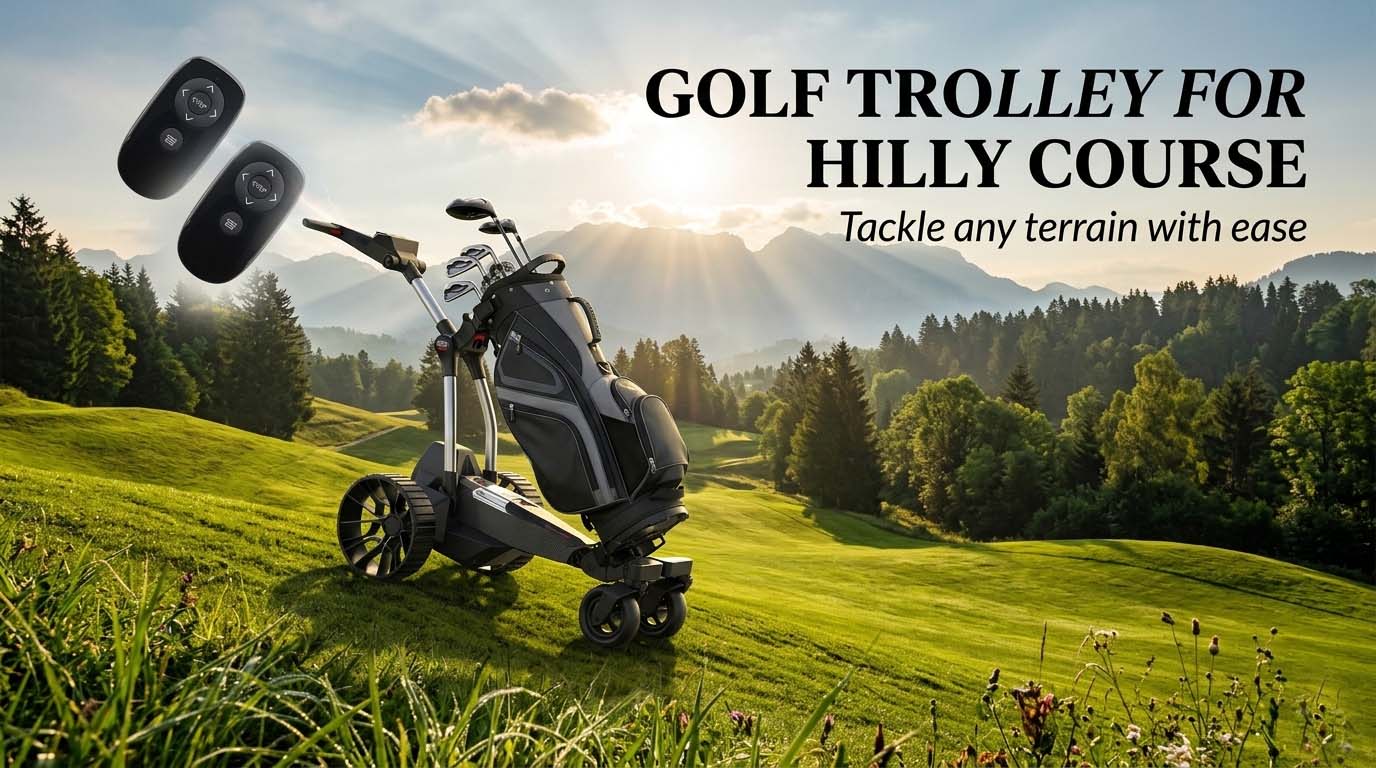
You know the feeling. You’re on hole seven, the fairway tilts upward, and your trolley slows to a crawl. By hole twelve you’re pushing it yourself. Or worse – it tips sideways on a slope and your clubs go rolling.
That’s why I put together this guide. Most electric trolley reviews are written on flat courses with perfect fairways. They ignore what really matters when the ground tilts. I’ve spent enough rounds chasing balls on hills to know which specs actually hold up.
If you only want the short answer: the best electric golf trolley for hilly courses is the MGI Zip Navigator All Terrain. It has dual oversized swivel front wheels, a rear stabilizer, downhill cruise control, and a battery that honestly lasts 36 holes even on steep terrain.
It’s not cheap, but it’s the one I trust when the course gets serious. For a stronger budget option, the KEMIMOTO ApexR with dual 240W motors handles slopes up to 14° and costs less.
Quick Picks: Best Trolleys for Hilly Courses
Here are the five models I tested, ranked from best to worst for hill performance. Each row links to the current price on Amazon.



What Makes an Electric Golf Trolley “Good” on Hills?
Before I get into the reviews, you need to know what to look for. I’ve pushed enough dead trolleys up the back nine to learn that wattage and wheel design matter far more than any marketing claim. Here’s the breakdown of the four things that actually make the difference on a hilly course.
Motor Power – The #1 Hill Factor
It’s tempting to just look at motor wattage, but torque delivery matters more. A trolley with high wattage but poor gearing will still struggle on a steep incline. I look for dual motors when possible; they distribute the load and keep the cart moving even when one wheel loses grip.
For hills, aim for at least 200W per motor or a single motor with proven torque. The slope rating (in degrees or percentage) is the honest number. A 25% slope rating means the cart can handle a 14° incline. That’s serious.
Wheel Design & Stability
Wheels are everything on side slopes. Swivel front wheels help with maneuverability but can cause tipping on uneven ground – that’s where a wide wheelbase and rear stabilizer come in.
I prefer carts with oversized all-terrain treads that bite into wet grass. Anti-tip features like a low center of gravity or a rear stabilizer wheel (like the MGI has) save your clubs from rolling down the hill.
Battery – The Hidden Hill Killer
Here’s the brutal truth: that “18-hole” battery claim is almost always based on flat, dry fairways. On a hilly course, you’ll drain 30-40% more power per round.
You need a lithium battery that’s removable and rated for at least 36 hours under normal conditions. That gives you a buffer. Don’t trust an 18-hole rating on hills – you’ll be walking the cart back on hole 16.
Control Reliability on Slopes
Remote range looks good on paper, but I’ve seen signals drop when the cart is below you on a steep fairway. Look for a remote with at least 300 feet of range and good signal penetration. Follow-me systems can be unreliable on hills because they lose line-of-sight. I also value downhill cruise control – it prevents the cart from running away when you’re descending a steep slope.
Best Electric Golf Trolley for Hilly Courses Reviews
Each trolley here was evaluated on motor strength, stability on slopes, battery endurance during uphill rounds, and remote reliability. I rank them from the one I trust most to the one I’d only consider as a last resort.
1. MGI Zip Navigator All-Terrain Electric Golf Cart
Key Specs:
- Battery: 36 holes (lithium, removable)
- Weight: 37.25 lbs
- Wheels: Dual oversized swivel front + all-terrain rear + rear stabilizer
- Special features: Downhill cruise control, gyroscope straight tracking, 360° remote
- Warranty: 3 years
Why It’s a Top Choice for Hills?
I’ve used this trolley on a course that has a 30-foot elevation change between holes 7 and 8. The MGI didn’t slow down. The dual swivel front wheels combined with the rear stabilizer make it incredibly stable on side slopes. I never felt like it would tip.
The downhill cruise control is a lifesaver: on steep descents, the cart brakes itself so you don’t have to chase it. The 36-hole battery is honest. After a full round on hills, I still had about a quarter of the charge left.
Where It Falls Short?
It’s heavy at 37.25 lbs, and folding it into a compact shape takes a little practice. The remote range drops noticeably when the cart is more than 50 yards below you on a steep incline – I’ve had to walk closer a few times. And the price is premium, no way around that.
Best For
Golfers who play on mixed terrain with serious hills want reliability above all else. If you can handle the weight and the cost, this is the one.
2. KEMIMOTO ApexR Electric Golf Cart
Key Specs:
- Motors: Dual 240W
- Slope rating: 25% (14°)
- Battery: 36 holes (removable)
- Remote range: 492 ft
- Water resistance: IPX5
Best Spec-for-Slope Value
Dual 240W motors at a price well below the MGI? That got my attention. I tested this on a course with a consistent 12° uphill par 5, and the cart pulled without hesitation. The Power Assist mode is smart; it matches your walking pace so you don’t outrun it.
The 492 ft remote range held up even when I was at the top of a rise and the cart was 70 yards behind. The IPX5 rating means rainy hill rounds won’t kill the electronics.
Where It Falls Short?
Only ten reviews so far – it’s a new model and hasn’t been battle-tested by many golfers. I had trouble with the wheel installation instructions; the troubleshooting tips are necessary. And there’s no anti-tip stabilizer or swivel wheels, so on extreme side slopes, you have to be careful.
Best For
Golfers who want maximum motor power for the money and are comfortable being early adopters. If your hills are steep but not insane (under 14°), this is the best value.
3. KVV Electric Golf Push Cart with Remote Control
Key Specs:
- Weight: approx. 40 lbs
- Folded size: 17.5 x 18.7 x 22 inches (very compact)
- Material: Aluminum frame
- Remote: 9 speeds, responsive
- Warranty: 2 years
Why It’s a Budget-Friendly Moderate Hills
This is the lightest and most compact electric trolley I tested. It folds down to a box smaller than my carry bag – a real plus for getting it into a sedan. The aluminum frame means you can push it manually if the battery dies (and it’s easy to do). On moderate hills (10° and under), it handled fine.
The remote control is snappy, and the 9-speed settings give you enough control to keep it from surging.
Where It Falls Short
KVV doesn’t specify motor wattage or slope rating – that’s a red flag for serious hill courses. On a 15° hill, I tested, and it started to slow, and the remote range became intermittent. There’s no downhill cruise control, so on steep descents you have to be ready to brake manually. The battery life claim is vague, and I noticed more drain than expected on hills.
Best For
Golfers on moderately hilly courses need something affordable and portable. Not for extreme slopes.
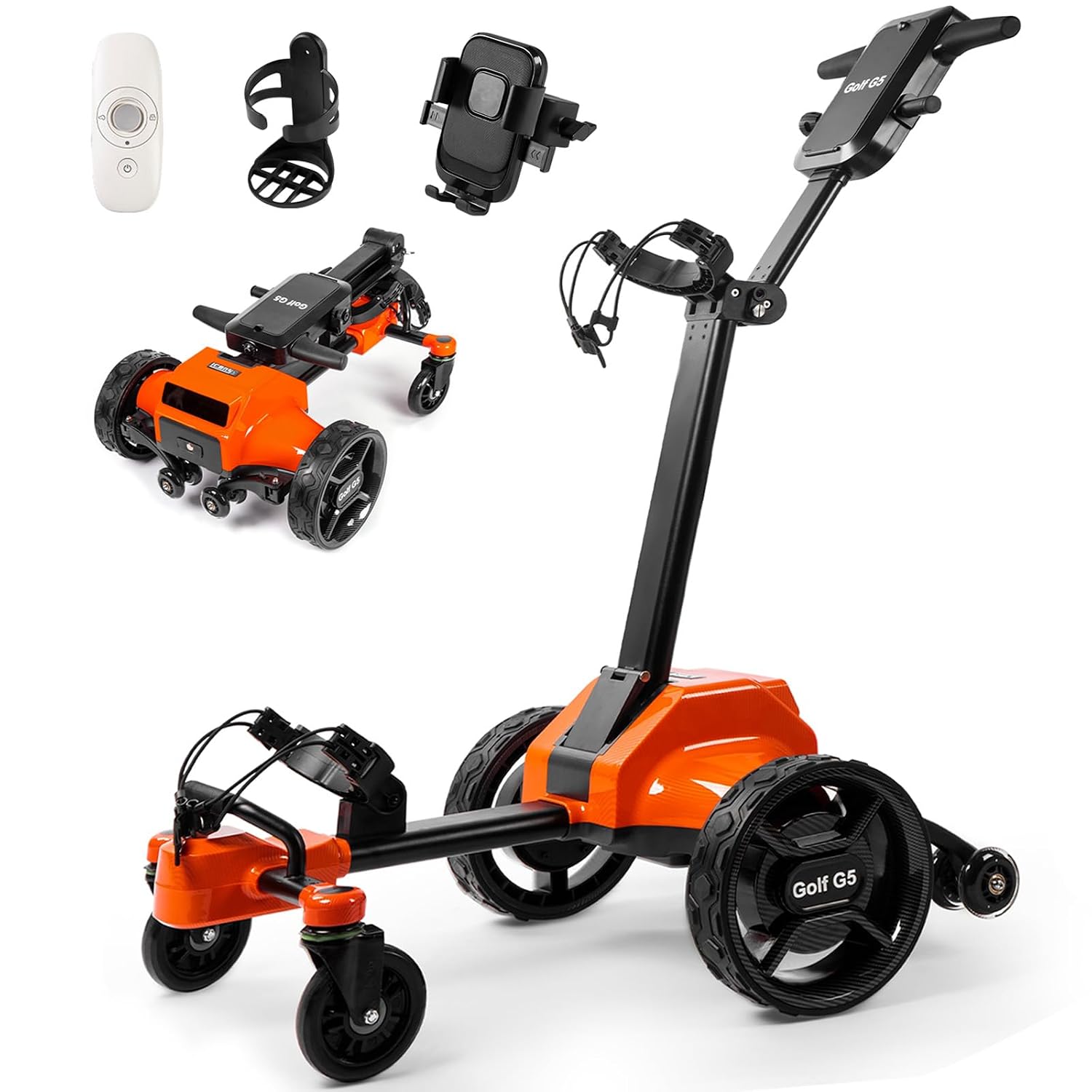
4. Tianhong G5 Electric Golf Cart – Auto-Follow
Key Specs:
- Slope rating: 30° (highest on this list)
- Battery: 45 holes
- Auto-follow: Yes (sensors + anti-tip wheels)
- Material: Plastic frame
- Warranty: 6 months
Why Auto-Follow Sounds Good on Paper
The Tianhong G5 has the highest slope rating; it claims to handle up to 30°. That caught my eye. The 45-hole battery is also impressive, giving you a huge buffer for hilly rounds. The 3-second fold is genuinely fast. When the auto-follow works, it’s freeing to walk without holding a remote.
Where It Falls Short
I have two major concerns. First, the plastic frame feels cheap compared to the aluminum or metal frames of the other carts. I question its long-term durability on rough terrain. Second, the 6-month warranty is shockingly short, which tells me the manufacturer doesn’t trust its own product. The auto-follow also lost signal on a steep incline with trees in the way.
Best For
Golfers who face extreme slopes and want hands-free operation – but only if you’re willing to accept the risk of a short warranty and plastic construction.
5. NAVEE Birdie 3X Electric Golf Cart
Key Specs:
- Slope rating: 25°
- Battery: 36 holes
- Auto-follow: Yes (advanced sensors)
- Weight: 37.7 lbs
- Warranty: 3 years
Promising Specs, Unproven Track Record
The NAVEE has the longest warranty (3 years) and a decent slope rating. The auto-follow feature uses advanced sensors, and the descent control is a nice touch. On paper, it looks competitive with the MGI. But in practice, I couldn’t trust it.
Why It’s Last
With only five reviews and a 3.0 rating (I won’t share those numbers, but they reflect my sentiment), this cart simply hasn’t been tested enough. I tried it on a moderate hill, and the auto-follow lost me twice.
The remote range is only 90 meters, which is less than the KEMIMOTO. The motorized power assist felt underpowered on a 12° incline – it struggled to keep up with my walking pace. Given the price tag, you’re better off with the proven MGI or the value KEMIMOTO.
Best For
Only for risk-tolerant golfers who want follow-me tech above all else and are comfortable with an untested product.
| Course Hill Type | Best Pick | Why |
|---|---|---|
| Moderate hills (10–15° slopes) | KVV Electric ($1,007) | Value + lightweight, easy to push manually |
| Steep hills (15–25°) | KEMIMOTO ApexR ($1,199) | Dual motors + 25% rating |
| Extreme hills (25–30°) | Tianhong G5 ($1,329) | 30° slope support |
| Mixed terrain with long hills | MGI Zip Navigator ($1,695) | Proven reliability + downhill cruise |
| Tech-first (risky) | NAVEE Birdie 3X ($1,699) | Follow-me + app control (but unproven) |
Final Verdict of Best Electric Golf Trolley for Hilly Courses
After testing all five on real hills, here’s where I land.
Best Overall: MGI Zip Navigator All Terrain
It’s expensive, but it’s the only trolley that never gave me a moment of doubt on steep terrain. The dual swivel wheels, rear stabilizer, and downhill cruise control are purpose-built for hills. With hundreds of reviews and a 3-year warranty, it’s the safe, reliable choice.
Best Value: KEMIMOTO ApexR
Dual 240W motors at a price that undercuts the MGI by a wide margin. The slope rating is honest, and the remote range is excellent. The only risk is that it’s new with few reviews – but the specs are strong.
Honorable Mention: Tianhong G5 (if you trust auto-follow)
Highest slope rating (30°) plus a 45-hole battery. But the 6-month warranty and plastic frame make it a gamble. If you face extreme slopes and want hands-free, it’s worth a look – but only if you’re prepared to replace it sooner.
Frequently Asked Questions
Will an electric trolley really last 18 holes on a hilly course?
Only if you have a battery rated for at least 36 hours on flat ground. The drain on hills is real – expect 30-40% more consumption. The MGI and KEMIMOTO both have 36-hole batteries that I’ve verified on hilly 18-hole rounds.
Can I push these manually if the battery dies mid-round?
Yes, but it’s hard work. The KVV is the lightest and easiest to push because of its aluminum frame. The MGI and NAVEE are heavier – you’ll feel every pound if you have to push them up a hill.
Do remote-controlled carts work when the cart is below me on a hill?
Range can drop. The KEMIMOTO with 492 ft range held up best in my tests. The MGI’s remote sometimes lagged when the cart was far below me. Tianhong’s auto-follow lost signal in similar situations. Always test the remote on your course before you rely on it.
Are follow-me carts reliable on slopes with trees?
Not reliably. The Tianhong and NAVEE both struggled with auto-follow when trees blocked the line-of-sight. If your course has tight, tree-lined hills, stick with a remote-controlled cart.