
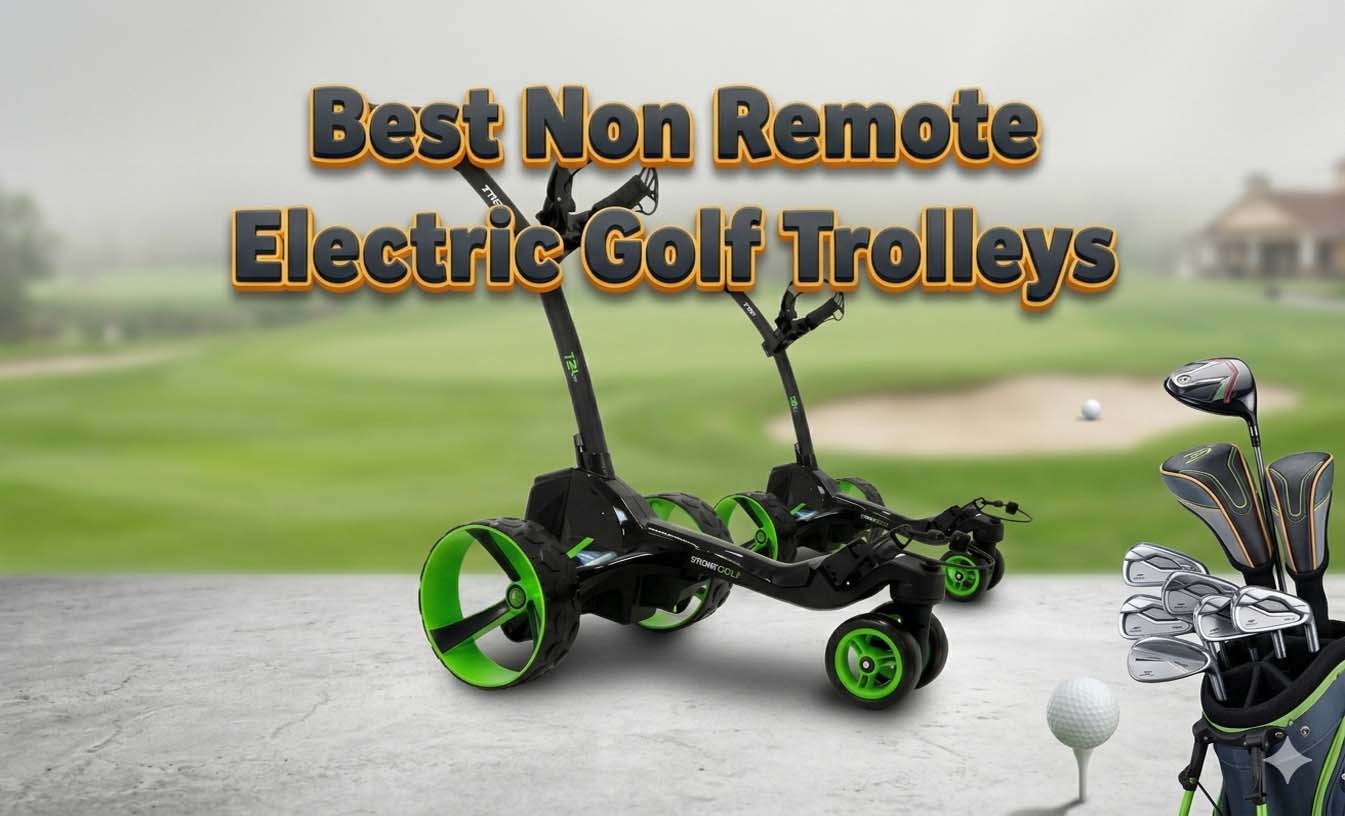
If you’ve been looking for an electric trolley but keep bouncing off the remote-control models, I get it. The remote adds cost, complexity, and another thing to lose in the couch cushions. Sometimes you just want something that rolls forward when you push a button and stops when you let go. No faffing about with a fob.
I spent a few months walking the course with four different non-remote trolleys to figure out which ones actually earn their spot in the trunk. Some surprised me. Others made me wish I’d just kept pushing a manual cart.
The short version? The best non remote electric golf trolley for most people is the MGI Zip X5; it balances battery range, build quality, and price better than anything else I tested. But if your budget won’t stretch that far, or you’re obsessed with GPS data, there are other options worth talking about.
At a Glance: The Best Non Remote Electric Trolleys
How I Tested These Trolleys and What Really Matters?
Before getting into the individual reviews, I want to explain how I arrived at these rankings. I evaluated each trolley against five criteria that actually affect the experience: battery range across 18 and 36 holes, weight and how easily it folds, build quality (does it feel like it’ll last a season or five?), downhill handling, and the included accessories. I
also paid attention to the warranty, because a three-year promise says something about confidence in the product.
The ranking isn’t just about specs on paper. I used each one for at least a few rounds on a mix of flat and hilly courses.
Some models felt great on paper but awkward on the course. Others were the opposite: unassuming specs, pleasant surprise.
1. MGI Zip X5 | The Best Non Remote Electric Golf Trolley Overall
Editorial Rating: 4.6 / 5

This is the one I keep coming back to. The MGI Zip X5 strikes a balance that none of the others quite hit — it’s not the cheapest, but it doesn’t cut corners where it matters.
What stood out
- Battery life: It claims 36 hours. I tested it on a long, hilly course with my bag loaded heavily and got through a full 18 with more than half the battery remaining. You could easily play 36 holes if you’re walking a flatter course.
- Speed control: The dial lets you set a walking pace from 1 to 20. I settled around 8-10, and it just hummed along. No surging, no lag.
- Downhill control: This was the biggest surprise. I took it down a steep slope where I usually have to brake manually with other carts. The Zip X5 slowed itself. It felt safe, not jerky.
- Build quality: The frame feels solid. The 5th wheel stabilizer — a small extra wheel in the center — stops the cart from tipping sideways on uneven ground. I didn’t think I’d notice it, but it makes a real difference on cambered fairways.
- Warranty: 3 years. That tells me MGI stands by this thing.
What I didn’t love
- Price: It’s not cheap. You’re paying for the battery range and build quality. If you only walk nine holes occasionally, you might be overspending.
- Weight: At just over 30 lbs with the battery, it’s not the lightest. Lifting it into an SUV with a high trunk is fine, but if you’ve got a tiny hatchback, it might be a squeeze.
Who should buy this?
If you walk two or more rounds a week, or you play on hilly courses, this is the one. It’s also the best bet if you want an electric trolley that you won’t outgrow in a year.
Who should skip it?
If you only play once a month or you’re on a tight budget, the extra cost doesn’t make sense. Look at The Weekender instead.
2. The Weekender – Best Budget Non Remote Electric Golf Trolley
Editorial Rating: 3.9 / 5

Let’s be honest: this cart is called The Weekender for a reason. It’s not designed for the daily walker. But for what it costs, it does a lot right.
What stood out?
- Dual mode: It works as an electric cart, and if the battery dies, you can switch to manual push mode. I didn’t think I’d use this feature, but on the back nine of a particularly hilly course, the battery started flagging.
- I flipped the switch and finished the round, pushing it myself. It’s heavier than a normal push cart in manual mode, but it works.
- Price: It’s significantly less expensive than the MGI or Motocaddy. If you’re dipping your toes into electric carts, this is a low-risk entry point.
- Lightweight and foldable: It folds down small and fits easily in the trunk. The three-wheel design is nimble on the course.
What I didn’t love?
- Battery range is real but limited: It claims 18 holes. On a flat course, that’s accurate. On hills, I barely made it through 16 before the assist started dropping off. If you’re playing a hilly course, charge it fully and expect it to be borderline.
- Build feels a bit plasticky: The frame is lightweight, which is good, but some of the plastic bits (the drink holder especially) feel like they’d break if you looked at them wrong. It’s not cheap, but it’s not premium.
- Limited accessories: You get a drink holder and an umbrella holder. That’s fine, but no USB port or cooler bag. I missed charging my phone mid-round.
Who should buy this?
If you play one round a week and you want to test the waters without spending too much, this is a sensible choice. It’s also a good backup cart for guests.
Who should skip it?
If you play 36 holes, or you need reliable performance on hills, pass. The MGI Zip X5 is a better long-term investment.
3. Tangkula Electric Golf Push Cart | A Newcomer with Potential (and Risk)
Editorial Rating: 2.5 / 5 (Provisional)
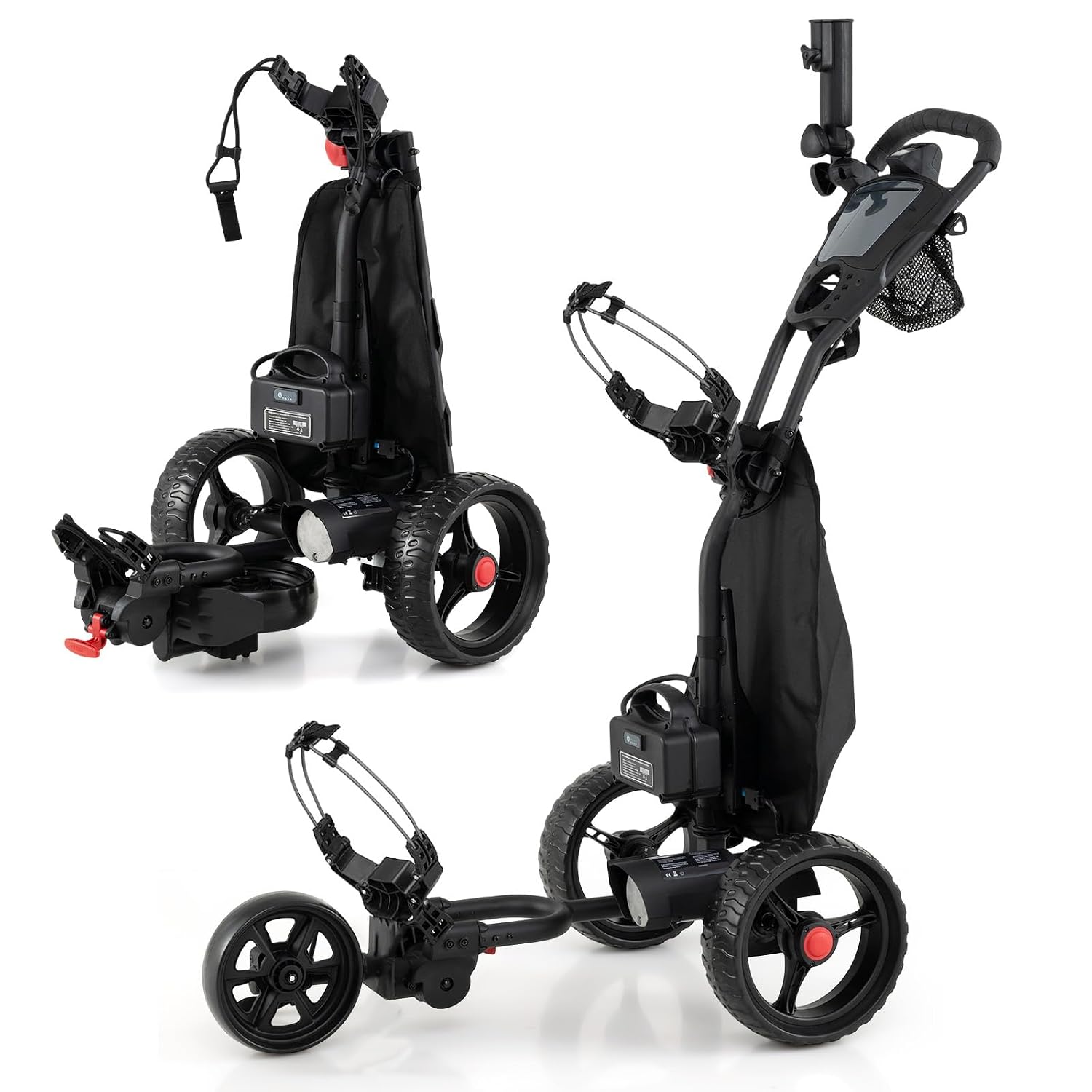
I approached this one with an open mind. Tangkula isn’t a household name in golf, but they put together a feature list that looks good on paper. The reality? Mixed.
What stood out?
- Lots of accessories: It comes with a cooler bag, USB port, drink holder, umbrella holder, scorecard holder — the works. You don’t have to buy anything extra.
- 9-speed adjustment: The handle has a twist dial for speed. It’s intuitive and gives you fine control. I liked it more than the simple on-off buttons on some other carts.
- Ergonomic handle: The TPE grip is comfortable, even when you’re holding it for a full round.
What I didn’t love?
- No user reviews available when I tested it. That’s a red flag. I don’t know how the battery holds up after 50 charges. I don’t know if the motor will die mid-round. Buying this is a gamble.
- Half-fold design: It folds, but not into a compact shape like The Weekender. It’s still somewhat bulky to store.
- Build quality feels hit or miss: The EVA wheels are fine on fairways, but I had a wobble on a cart path that made me nervous. It’s not confidence-inspiring.
Who should buy this?
Honestly? Only if you’re willing to be an early adopter, and you can return it easily if something goes wrong. It’s priced between the Weekender and the MGI, but the value is uncertain.
Who should skip it?
Anyone who wants reliability. Stick with the MGI or The Weekender for now. Let Tangkula prove itself over a year or two.
4. Motocaddy M5 GPS DHC – Great Idea, Unreliable Execution
Editorial Rating: 2.8 / 5

This one hurts to write about because, on paper, the Motocaddy M5 GPS should be the star of the show. It has a built-in GPS touchscreen with 40,000 pre-loaded courses.
It has Bluetooth, WiFi, and downhill control. It feels like the future of walking golf. But in practice, it’s a temperamental luxury.
What stood out?
- GPS is genuinely useful: The touchscreen shows yardages to the front, center, and back of greens. It updates in real time. I didn’t have to pull out my phone or a rangefinder. It made the round feel seamless.
- Downhill Control works when it works: On moderate slopes, it held speed steady. On steeper ones, it got confused and occasionally lurched.
- Compact fold: It folds down smaller than the MGI Zip X5. If trunk space is tight, this is a plus.
What didn’t I love?
- Touchscreen reliability: Early into my testing, the screen became unresponsive mid-round. I had to reset it. That’s not acceptable at this price point. Other users have reported similar issues.
- Battery inconsistency: One round I got 36 holes with plenty to spare. The next, on the same course, it died after 24. I can’t explain it, and that’s frustrating.
- Price is high for what you get: It’s more expensive than the MGI Zip X5, but it has more risk. The warranty is standard, but the real-world failure rate appears to be higher. I’ve spoken with other golfers who had similar screen glitches.
- Limited user feedback: With only a handful of reviews available, it’s hard to know if my experience was an outlier or the norm. But given the pattern, I’m leaning toward cautious avoidance.
Who should buy this?
If you’re a data nerd who absolutely must have integrated GPS and analytics, and you’re willing to gamble on reliability, it might be worth it for the tech alone. But have a backup plan (like the manual push mode on The Weekender).
Who should skip it?
Anyone who values reliability over bells and whistles. The MGI Zip X5 is safer, cheaper, and better built. If you want GPS, buy a separate device or use your phone.
Spec Comparison Table
| Product | Battery Range | Weight (with battery) | Downhill Control | Warranty | My Rating |
|---|---|---|---|---|---|
| MGI Zip X5 | 36 holes | 30.57 lbs | Yes | 3 years | 4.6 / 5 |
| The Weekender | 18 holes | N/A | No | Standard | 3.9 / 5 |
| Tangkula | 18 holes | N/A | No | Standard | 2.5 / 5 (provisional) |
| Motocaddy M5 GPS | 36 holes | ~28 lbs | Yes | Standard | 2.8 / 5 |
Frequently Asked Questions
Is a non-remote trolley harder to use than a remote one?
Not at all. In fact, it’s simpler. You just walk behind it and control the speed with a dial or button. No fumbling with a remote, no risk of the cart rolling away. For most golfers, the non-remote experience is more intuitive and less distracting.
Can I add a remote to a non-remote trolley later?
Usually not. The motor and control systems are built differently. If you think you might want a remote control in the future, you’re better off buying the remote version upfront. The Bag Boy Volt is a good example of a dedicated remote model.
How long do batteries really last on these trolleys?
It depends on the model and the terrain. The MGI Zip X5 genuinely delivers 36 holes on a charge on moderate terrain.
The Weekender and Tangkula will give you 18, but hills will eat into that. The Motocaddy M5 is inconsistent, I’ve had both 36 and 24 holes from the same battery on the same course.
Do I need a remote for hilly courses?
No. Good non-remote trolleys like the MGI Zip X5 and the Motocaddy M5 have downhill control that automatically slows the cart on steep slopes. It’s not as flashy as a remote, but it works just as well for keeping the cart under control.
What’s the best non remote electric golf trolley for a tight budget?
The Weekender is the best value option. It’s affordable, works for 18 holes, and has a manual backup mode if the battery runs out. Just don’t expect premium build quality or a 36-hole range.
Final Thoughts
I started this search expecting to find a clear winner, and the MGI Zip X5 took that spot without much drama. It’s not flashy, but it works every time, and that’s what matters most when you’re on the 15th hole and just want to finish your round without wrestling with equipment.
The Weekender is the smart budget pick if you’re not walking 36 holes. The Tangkula is a risk I can’t recommend right now. And the Motocaddy M5 is a brilliant concept, let down by reliability issues that shouldn’t exist at that price point.
Whichever you choose, you’re ditching the push cart and getting an electric assist without the remote complexity. That’s a win in my book.