
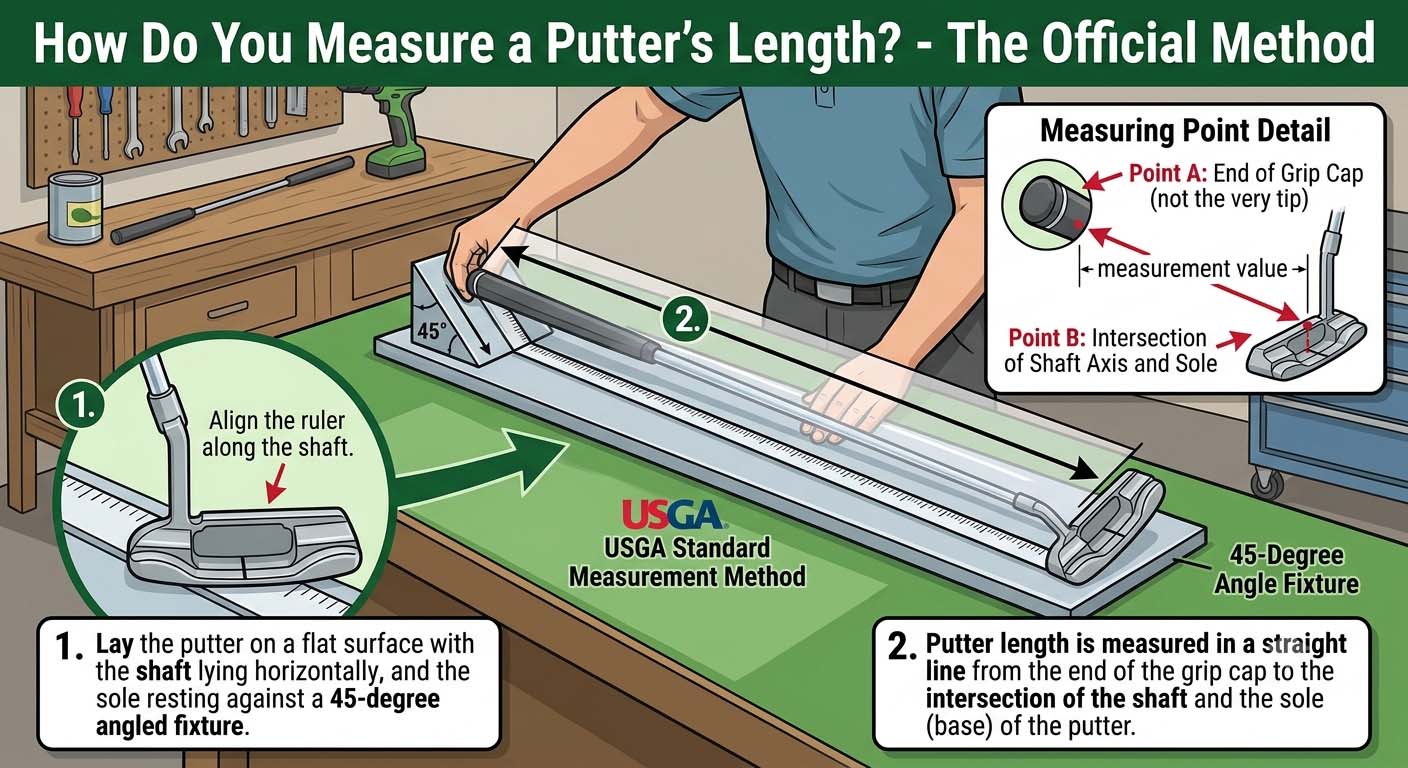
Measuring a putter sounds straightforward. You grab a ruler, line it up, and write down the number. But if you do it wrong, you can end up with a putter that feels off no matter how much you practice.
The problem is that there are two different ways to measure, and most sources do not explain the difference clearly.
The Only Accurate Way to Measure a Putter
There are two definitions of putter length, and mixing them up is the most common source of confusion.
Overall putter length is the distance from the top of the grip cap to the bottom of the clubhead sole. You measure this with the putter lying flat on a table, ruler placed against the sole and running straight up the shaft.
Playing length is the distance from the top of the grip cap to the ground contact point at address. You measure this with the putter sitting in its natural lie angle, just like it would be when you are about to putt.
Manufacturers almost always use playing length. When a putter is listed as 34 inches, that is the playing length. The difference between the two measurements can be up to 1.5 inches depending on the lie angle of the putter.
Here is how to measure your putter correctly at home. You need a tape measure or a long ruler, and preferably the putter itself or a picture of it at address.
- Set the putter on a flat surface in its address position. The sole should touch the ground the same way it does when you are standing over a putt.
Place the end of the tape measure on the ground directly under the golf putter head, at the point where the sole meets the turf.
- Run the tape measure straight up along the shaft. Do not follow the angle of the grip or the shaft if it bends. Keep the tape vertical.
- Read the measurement at the top of the grip cap. This is the playing length.
If you measure the putter flat on a table instead, you get the overall length. That number is always shorter than the playing length because the lie angle causes the head to sit higher off the ground when measured flat.
Why Your Wrist Height Measurement Is Only Half the Picture
You have probably seen the standard method. Stand up straight, have someone measure from the ground to your wrist, subtract two inches, and that is your putter length. This method works as a starting point, but it has three hidden flaws.
Arm angle variation. When you relax your arms, they naturally hang with a slight bend at the elbow. If you force them straight for the measurement, you add 0.5 to 1 inch to the reading. Your playing posture almost always has that slight elbow bend, so the measurement is off from the start.
Shoes matter. Measuring barefoot versus wearing your golf shoes changes the result by 0.5 to 1 inch. Golf shoes have thicker soles and sometimes cleats. Always measure in the shoes you play in.
Body asymmetry. Your dominant arm might hang slightly differently than your non-dominant arm. If only one wrist is measured, you could get a reading that favors one side of your body.
To get a more reliable number, measure three times on different days, all while wearing your playing shoes. Average the three readings. Then do a dynamic posture test. Stand in your putting posture and let your arms hang naturally. Have someone note where your lead wrist falls relative to your belt line.
Compare this to where your wrist was during the standing measurement. The difference is your effective reach, and it is often 0.5 to 1 inch shorter than the standing measurement suggests.
Matching the Measurement to Your Stroke
Getting a number is only the first step. The real question is whether that number works with the way you actually putt.
Your stroke type changes the ideal putter length.
Straight back, straight through stroke. If your stroke has almost no arc, you can tolerate a putter that is close to your wrist-to-floor measurement. There is minimal face rotation, so you do not need extra clearance for the toe to swing open and closed.
Moderate arc stroke. Most golfers fall here. You need a putter that is 1 to 2 inches shorter than your wrist-to-floor measurement. This gives the toe room to rise naturally on the backswing without making you manipulate the face.
Strong arc stroke. If your putter swings inside and then back inside with a clear arc, you may need a putter that is 2 to 3 inches shorter. Anything longer forces you to stand too upright, which fights the natural rotation of the stroke.
Lie angle interacts with length in a direct way. A putter that is too long forces you to stand more upright. That changes the lie angle so the toe points up at address. Too short, and you bend over more, causing the heel to lift. Both positions ruin your aim.
You can test this without a professional fitter. Set your putter on a flat surface in its natural address position. Slide a piece of paper under the toe. If the toe lifts the paper, the putter is too upright for your setup. If the heel lifts the paper, it is too flat. The correction is either a lie angle adjustment or a length change.
Testing Your Measurement on the Green
Before you cut a shaft or buy a new putter, run three simple tests with your current club.
Eye position test. At address, your lead eye should sit directly over the ball or slightly inside the ball line. If your eye is outside the ball, the putter is likely too long. If it is way inside, the putter might be too short. Use a mirror or have a friend check.
Arm hang test. With the putter soled naturally, your arms should hang with a slight elbow bend. Not locked straight, not cramped with elbows tucked into your ribs. If you feel tension in your shoulders, the putter is too long. If your elbows are pinned to your sides, it is too short.
Impact consistency test. Hit 20 putts from the same distance. Mark where the ball contacts the face each time. Consistent heel strikes suggest the putter is too long. Consistent toe strikes suggest it is too short. Center strikes with good dispersion mean you are in the right range.
Grip thickness and extra tape wraps can change the feel of the putter by 0.25 to 0.5 inches without cutting the shaft. If you are on the edge between two lengths, a thicker grip or an extra wrap can shift the effective playing length just enough to dial it in.
Common Measurement Mistakes That Cost You Strokes
Mistake: My height alone determines putter length.
Two golfers who are both 5 feet 10 inches can need different putter lengths. Arm length, torso length, and posture preferences all affect the number. A height chart is only a rough starting point.
Mistake: Pro putter lengths are ideal to copy.
Rory McIlroy uses a 35-inch putter. Jordan Spieth uses 33.5 inches. Tiger Woods uses 35.25 inches. Their lengths vary even though they are all elite players. Your length has to fit your body and stroke, not theirs.
Mistake: I can eyeball it by holding the putter next to my leg.
Visual parallax makes this unreliable. The angle you hold the club and the distance you hold it from your leg can create a 2- to 3-inch error. Always measure with a tape measure on a flat surface in the address position.
A less obvious mistake involves knee bend. When people take a measurement, they often bend their knees more than they do during a real putting stroke.
This artificially reduces the measurement, leading to a putter that is too short for actual play. Stand as you would normally stand on the course, not as you think you should stand for a measurement.
Frequently Asked Questions
Do 34-inch and 35-inch putters have different performance characteristics beyond length?
Yes. Longer putters typically have more head weight to maintain swing weight balance. A 35-inch putter will feel slightly heavier in the head than a 33-inch version of the same model because the longer shaft changes the balance point.
Can I shorten a putter myself without ruining it?
If the shaft has no taper at the butt end, you can cut it with a hacksaw and install a new grip. But many modern putters have shaft tapers where the grip section is thicker. Shortening can create a thinner section that feels different. Counterbalanced putters also lose their intended balance point when cut.
How do belly putters and long putters differ in measurement?
Belly putters are measured the same way as standard golf putters, from grip end to sole, but they are typically 41 to 43 inches. Long putters that anchor to the chest measure 46 to 48 inches. These lengths are specific to the anchoring rules and are not comparable to standard putter measurements.
Does putter length affect ball roll?
Indirectly. Length affects your posture, which affects your eye position, which affects your ability to see the line. A length mismatch forces compensation in head movement during the stroke, leading to inconsistent contact and roll.
What if my measured length does not match any standard size?
Order a custom length putter. Most manufacturers offer half-inch increments at no additional cost. A 33.5-inch putter is common and often preferred by golfers between the standard sizes.