
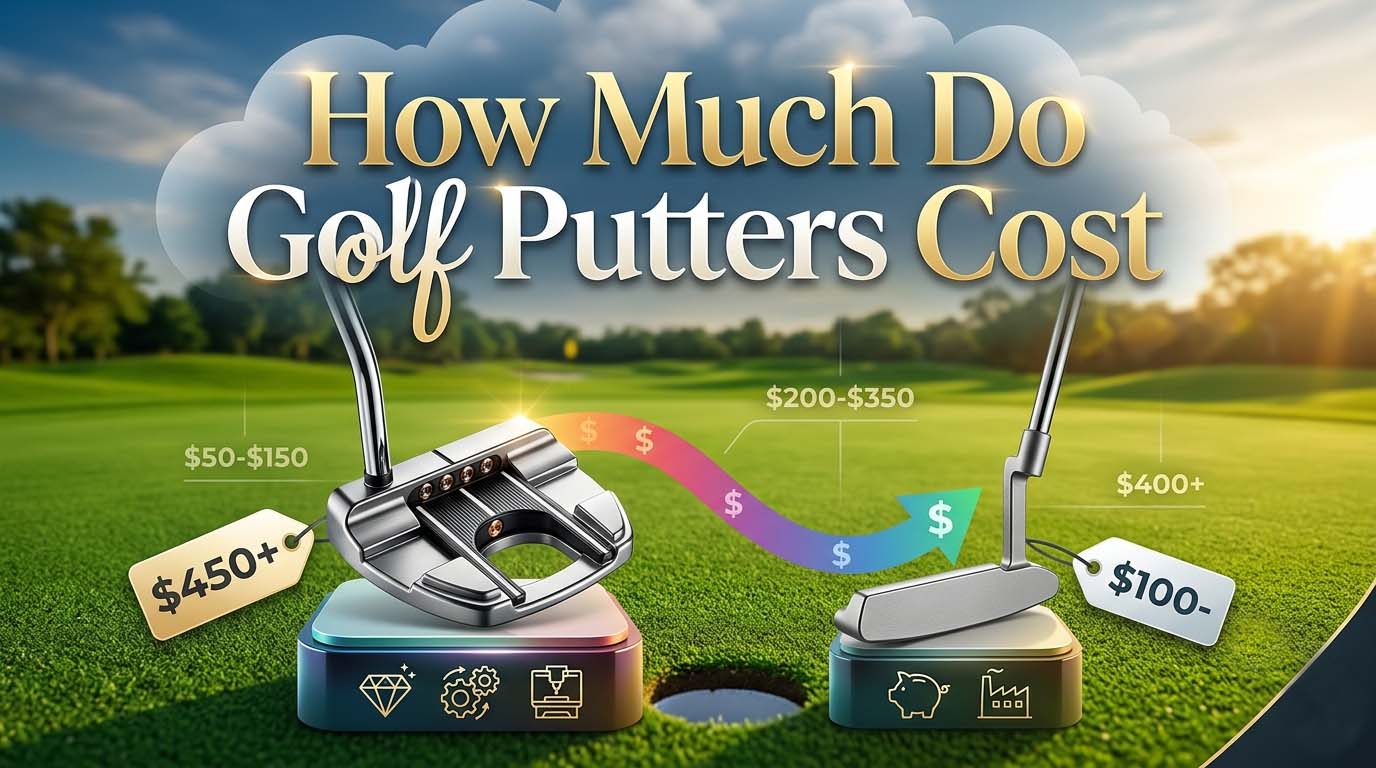
If you’re asking how much do golf putters cost, the short answer is anywhere from $40 to over $2,000. But that range is almost useless without context. The real answer is that 90% of golfers will find everything they need between $100 and $500.
Spending more doesn’t automatically lower your score, but it can improve consistency, feel, and confidence when you know what you’re paying for.
I’ve been around putters long enough to know that the price tag alone tells you nothing about whether a putter fits your stroke. I’ve seen a $200 fitted putter outperform a $500 off-the-rack model for the same player. The key is understanding what each dollar buys and where the value stops.
The Four Tiers of Putters and What Each Dollar Buys
Putters break into four clear price bands. Each tier uses different materials, manufacturing methods, and levels of customization.
Entry Level: $40 to $100
This is where you find putters from brands like Wilson, Ray Cook, and entry-level lines from major manufacturers. The heads are usually cast aluminum or stainless steel. The face insert is basic, often a polymer that softens the feel but wears out quickly.
The grip is a stock rubber that lasts about one season. The shaft is a standard steel or economy graphite.
These putters work for absolute beginners who need to get on the course cheap. But they lack the consistency and feel that help a player develop a repeatable stroke. I’ve seen a $60 putter with a scratched face and a loose grip cause more missed three-footers than poor technique.
Core: $100 to $250
This is the sweet spot for most golfers. You get quality cast or milled heads from brands like Cleveland, Ping, TaylorMade, and Odyssey. The face insert is better, often a mid-grade urethane or a precision-milled aluminum face. The grip is a standard but durable design. The shaft is usually made of high-quality steel or basic graphite.
At this price, you can find models with adjustable weighting or alignment aids. For example, the Cleveland Huntington Beach series uses a precision-milled 304 stainless steel head and costs around $150.
The Ping Sigma 2 offers adjustable-length shafts and a soft-feel insert for about $200. The TaylorMade Spider GT, a mallet with high MOI, sits around $230.
I’ve used the Spider GT for two seasons, and it’s still as consistent as the day I bought it. For a 15-handicap, this tier is often all you need.
Premium: $250 to $500
This is where the big names live: Scotty Cameron, Bettinardi, Evnroll, and high-end Odyssey models. The heads are made from 303 stainless steel or even carbon steel, milled to tight tolerances.
The face is either a precision-milled insert or a one-piece milled face. The grip is a premium leather or a high-tack rubber. The shaft is often made of high-quality steel or custom graphite.
You also get more adjustability: interchangeable sole weights, adjustable hosels, and custom alignment markings.
The premium tier also includes most tour-inspired designs. For example, the Scotty Cameron Select Newport costs around $400. The Bettinardi Studio Stock 28 runs about $450.
The biggest difference between this tier and the $200 tier is consistency across the face. A premium putter’s sweet spot is larger than the price suggests, but the real gain is in how the ball comes off the face on off-center hits. For a scratch golfer, that consistency matters in pressure moments.
Elite: $500 and Above
These are custom putters from brands like LAB Golf, Piretti, and completely custom builds from Scotty Cameron’s Custom Shop or Bettinardi’s Custom Program. The head is milled from a single block of 303 or 6061 aluminum, often with a unique finish like black oxide or gunmetal.
The shaft is a premium lightweight option like a UST Mamiya or a Fujikura. The grip is a custom leather wrap.
You also get a full fitting: the putter is built to your exact stroke type, length, lie angle, head weight, and alignment preference. For example, a LAB Golf Mezz.1 starts at $449 and goes up to $650 with a custom paint job and weighting. A fully custom Scotty Cameron can cost $1,000 or more.
If you have the budget and you’ve been playing for years, this tier gives you the last few percentage points of improvement. But for most players, the $300 to $400 tier offers better value.
Where the Extra Money Actually Goes: Material, Craft, and Technology
The jump from $100 to $400 isn’t just about brand names. Here’s what changes.
Face Insert vs. One-Piece Milled Construction
A $100 putter usually has a cast head with a glued-in insert. The insert softens feel but can wear unevenly, causing inconsistent ball speed. A $400 putter often has a milled face, either as part of a one-piece head or a precision-fitted insert.
Milling gives you a consistent texture across the entire face, which means the ball leaves the face at the same speed every time.
Adjustable Weighting and Alignment Aids
Premium putters let you swap sole weights to change the head weight and swing weight. This is not a gimmick. A heavier head helps on slow greens, a lighter head helps on fast greens.
The alignment aids on premium models are also more precise, with lines and dots that are milled into the metal rather than painted on.
Premium Grip and Shaft Options
A $100 putter’s grip is a standard rubber that wears out in a year. A $400 putter’s grip is a premium leather or a high-tack rubber that lasts three to five years. The shaft on a premium putter is often a lighter, stiffer material that reduces vibration and improves feel.
Brand R&D and Tour Pedigree Markup
Scotty Cameron and Bettinardi spend a lot on research and tour relationships. If you see a pro on TV using a putter, the brand charges a premium because that putter has been tested and refined by the best players in the world.
The markup is real, but for some golfers, the confidence of using a tour-proven design is worth the extra cost.
The $200 vs. $400 Putters | Can You Feel the Difference?
I’ve done my own blindfold tests with friends. I took an Odyssey White Hot OG (about $200) and a Scotty Cameron Select Newport (about $400). Both are blades with similar head shapes. I had each player putt 20 balls from 10 feet, then swap putters.
The results: most amateurs shot the same score with both. The difference was in feel. The Scotty Cameron had a softer, more muted sound at impact. The Odyssey had a slightly louder click. But the ball rolled the same line.
The real difference showed up on mis-hits. The Scotty Cameron’s sweet spot was larger, so off-center putts lost less distance.
For a 15-handicap, the $200 putter often scores the same as the $400 model. For a scratch golfer, the $400 model’s consistency matters — especially on fast greens where a 1% difference in ball speed can mean a six-foot miss instead of a two-foot tap-in.
The key takeaway: if you can’t consistently hit the sweet spot, a $400 putter won’t fix your stroke. A $200 putter that fits your alignment and length will help more.
The Hidden Cost of a Cheap Putter — What You Sacrifice
A $100 putter looks like a bargain, but it costs more over time. Here’s why.
The grip on a cheap putter starts to wear after one season. If you play 30 rounds a year, you’ll need a new grip every 12 months. A decent grip costs $15 to $20. The face insert on a budget putter can crack or lose its softness after two seasons. The head may develop rust or paint chips.
Meanwhile, a $400 putter with a milled head and a premium grip can last a decade. I’ve seen a 10-year-old Scotty Cameron with a replaced grip that still rolls the ball exactly like new. The resale value is also higher. A used Scotty Cameron in good condition sells for 60% to 70% of its original price. A used $100 putter sells for $20.
Do the math: if you buy a $100 putter every three years and replace the grip after one year, you spend about $170 in three years. If you buy a $400 putter and keep it for 10 years with one regrip ($20), you spend $420 over 10 years. That’s $42 per year vs. $57 per year. The premium putter is actually cheaper in the long run.
When Paying More Hurts Your Game
The biggest mistake I see is someone buying a $500 putter because it looks cool, only to find out it doesn’t match their stroke. A putter’s head shape, weight, and toe hang need to fit your natural putting motion. If you buy a blade with a lot of toe hang, but your stroke is straight back and through, the putter will fight you.
I’ve watched a friend spend $450 on a Bettinardi blade only to three-putt every round because his stroke was a slight arc. He sold it for $250 and bought a $200 mallet with a face-balanced design. His putting improved by two strokes almost immediately.
The fitting cost offset is real. A $300 fitted putter — where a professional measures your stroke and adjusts the length, lie, and weight — often outperforms a $500 off-the-rack putter for the same golfer. Most golf shops offer a basic putter fitting for $50 to $100, and some apply that cost to the purchase. Always get fitted before you spend premium money.
Frequently Asked Questions
How much do golf putters cost in Canada?
In Canada, prices are typically 15% to 25% higher than U.S. retail due to import duties and exchange rates. A putter that costs $200 in the US is usually $250 to $300 CAD. You can find deals at Golf Town and online at Amazon.ca, but expect to pay a premium for the same models.
Is Tiger Woods’ putter worth more than $500?
Tiger uses a custom Scotty Cameron Newport 2 GSS with a unique neck and weighting. The retail version of that putter, the Scotty Cameron Select Newport 2, costs about $400. But Tiger’s actual putter is a one-off piece made for his stroke. If it were sold at auction, it would fetch tens of thousands. For normal players, the $400 version is all you need.
What is the #1 putter on tour?
Currently, the most used putter on the PGA Tour is the Scotty Cameron Newport 2 series, followed by Odyssey’s #7 mallet. Both sit in the $350 to $450 range. Tour pros use these because they offer consistent feel and precise alignment that matches their strokes.
Can I get a good putter for under $150?
Yes. Three solid options: the Cleveland Huntington Beach (about $150), the TaylorMade Spider GT (about $230 on sale, but sometimes under $200), and the Ping Sigma 2 (about $200 on discount). The Cleveland is a milled blade with a classic feel. The TaylorMade is a high-MOI mallet. The Ping is a versatile mallet with adjustable length. All three will serve you well.
How much should a beginner spend on a putter?
I recommend $100 to $200, but with a cheap fitting. A beginner’s stroke is still developing, so a fitted putter that matches your natural tendency (straight or arc) will build confidence. Skip the $50 putter from a big box store — it will feel inconsistent and slow your progress. A $150 putter with a 10-minute fitting is a better investment.