
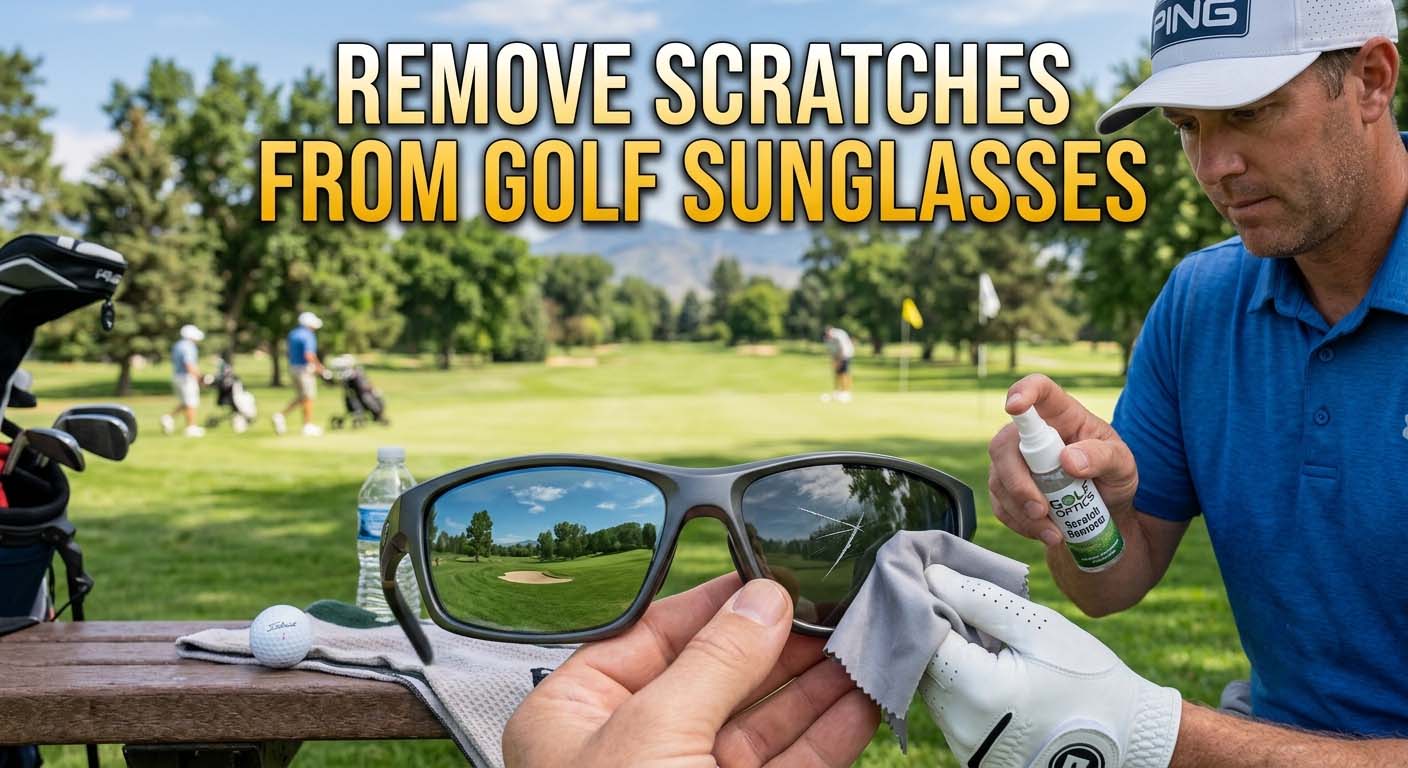
Most online advice for removing scratches from golf sunglasses is dangerous for your specific eyewear. That toothpaste method everyone swears by? It acts like sandpaper on the specialized contrast-enhancing coatings you paid a premium for. Before you try anything, you need a quick triage system to identify your lens type and the severity of the scratch. Here is exactly how to determine what you are working with and which approach, if any, is actually safe for your optics.
Know Your Lens Type Before You Touch a Scratch
Golf sunglasses are expensive because of the layers built into them. Contrast tints, mirror coatings, anti-reflective layers, and polarization. Applying a generic scratch repair method without knowing your lens construction is a gamble you will lose.
Quick Identification Checklist
Check for Reflections: Look at the lens surface under a light. Do you see purple, green, or blue reflections? That means anti-reflective or mirror coatings. Gold or amber reflections usually mean contrast-enhancing layers like Oakley Prizm or Smith ChromaPop. No reflection at all usually means basic uncoated polycarbonate.
Know Your Material: Check the inner frame arm for markings. Most golf eyewear uses polycarbonate or Trivex. Glass is rare in sports eyewear. CR-39 is a basic plastic found in cheap shades. This matters because glass tolerates heavier abrasives, while polycarbonate does not.
Test for Polarization: Hold your glasses at a 45-degree angle to a digital screen. If the lens darkens significantly against the screen, they are polarized. Scratch repair on polarized lenses carries a risk of delamination, where the layers separate. This is usually a death sentence for the lens.
Check the Brand: If you own Oakley Prizm Golf, Smith ChromaPop, or Maui Jim, check their warranty and care guides. Most of these brands specifically warn you against using abrasive compounds. Doing so voids the warranty on their proprietary tints.
Scratch Depth Classification Guide
Not all scratches are equal. There is a big difference between a surface-level coating scratch and a deep gouge into the lens material. Rubbing a deep scratch will make it worse. Here is how to categorize your specific damage.
Level 1: Coating Scratch Only
You can see the scratch, but you cannot feel it with your fingernail. The base lens material is intact. This is the best-case scenario and can often be minimized.
Level 2: Light Lens Surface Damage
You can feel the scratch with your fingernail, but it does not catch. The polycarbonate or Trivex is slightly compromised. Repair is possible, but it will change how the lens transmits light, which can affect contrast.
Level 3: Deep Lens Scratch
The scratch catches your fingernail and creates visible distortion when you look through the lens. Do not try to fix this. Any attempt to polish out a deep scratch on a golf lens will ruin the optics completely. Replacement is the only safe option.
Level 4: Delamination or Fracture
If the scratch has caused the lens layers to separate, or if the glass or polycarbonate is cracked, the lens is structurally compromised. Replace it immediately. Worn cracked lenses offer poor UV and impact protection.
Safe Scratch Removal Methods for Golf Sunglasses
If you have a Level 1 or Level 2 scratch and you know your lens type, you can try a specific method. If you have a coated lens, your options are extremely limited. The safest way to approach removing scratches from golf sunglasses is to match the method to the material.
Warning: Methods to Never Attempt on Golf Lenses: Toothpaste (contains hydrated silica, similar to sandpaper), baking soda (crystalline abrasive), car scratch removers (chemically aggressive), and WD-40 or oils (temporary fill that attracts dust and smears constantly). These destroy coatings.
For Coated Lenses (Level 1 Only)
The only safe approach is a non-abrasive lens polish designed specifically for coated optics. Look for products like Polywatch or an eyeglass-specific polymer polish that fills microscratches rather than sanding them down.
How to apply it: Clean the lens with a microfiber cloth and lens cleaner. Apply a very small drop of the polymer polish to the scratched area. Buff gently in one direction (not circular) with a clean microfiber cloth for 60 seconds. Inspect the area. You can repeat this once more, but doing it more than twice risks uneven clarity.
For Uncoated Polycarbonate/Trivex (Level 1-2)
Uncoated lenses can tolerate a very mild polishing compound. Use a plastic lens polish specifically for polycarbonate. Never use a Dremel or rotary tool on golf eyewear unless you are a professional optical lab technician. Hand buffing is safer.
Process: Apply a dedicated plastic polish. Work in one direction only—circular motions create micro-swirls that are obvious on a sunny course. Check your progress every 20 seconds. Stop immediately if you see a cloudy haze.
For Glass Lenses (Level 1-2)
Glass tolerates heavier compounds. Cerium oxide paste is the standard. Apply it with a felt pad using medium pressure in a circular motion for 2–3 minutes. Rinse completely. Glass lenses are very rare in sports eyewear, but if you have them, this works well.
Common Scratch Repair Myths Among Golfers
The internet is full of well-meaning advice that will ruin your performance optics. Let me clear up a few persistent myths.
“Toothpaste Works on Everything”
Toothpaste contains hydrated silica. That is the same abrasive used in commercial scratch removers. On a coated golf lens, you are essentially wet-sanding the lens. You will remove the scratch and the entire contrast-enhancing coating simultaneously. You end up with a cloudy patch instead of a scratch.
“I Can Buff the Whole Lens to Make It Even”
Uniformly removing a coating by hand is impossible. You will leave visible buffing marks and inconsistent light transmission. The lens will look worse in direct sunlight than the original scratch did.
“A Generic Scratch Kit Works on All Sunglasses”
Consumer scratch removal kits are designed for basic polycarbonate or glass. They do not account for the interference coatings used in golf lenses to enhance contrast. The kit might remove the scratch, but it will also strip away the reason you bought those glasses in the first place.
“The Local Optician Can Fix Any Scratch”
Many optical shops will refuse to polish coated sports lenses specifically because they cannot guarantee the optical quality afterward. If an optician says yes, ask them directly if they have experience with your specific lens brand. If they hesitate, walk away.
When Scratch Repair Damages Golf Performance
Even if you successfully remove the scratch, you might ruin your optical performance. This is the part most generic guides do not mention. You do not just wear golf sunglasses for UV protection. You wear them to see the break in a putt and the texture of the fairway.
Optical Clarity Compromise
Polishing changes the micro-curvature of the lens. Standard sunglasses can tolerate this. Performance golf lenses, engineered for precise contrast enhancement, will shift how greens, fairways, and skies separate. You might remove the scratch but introduce a subtle distortion that makes the course look “wrong.”
Polarization Degradation
Abrasive polishing near the polarization layer creates optical stress points. Under the bright sun of a golf course, this shows up as rainbow distortion or hot spots. This directly impacts depth perception and glare reduction.
Uneven Coating Removal
If you only polish the scratched area, you create a non-uniform surface. Light refracts differently through the polished patch versus the surrounding area. This creates visual noise that can be distracting during your swing.
Hydrophobic Layer Removal
Many modern golf lenses have a water-shedding layer for fog and morning dew. Polishing strips this layer. Now your lenses smear easily when you are playing in humid conditions or light drizzle.
How to Prevent Scratches on Golf Sunglasses
Prevention is easier than repair. Here is how to protect your investment specifically for the golf environment.
On-Course Protection Habits
- Never set your glasses face-down on a cart dash, bench, or towel. This is the most common way golf lenses get scratched.
- Use a retainer strap. Let the glasses hang around your neck instead of shoving them into a pocket full of tees, ball markers, and coins.
- Keep a microfiber pouch clipped to your bag. Never loose in a pocket.
Cleaning Protocol for Coated Lenses
- Rinse with water first. Dry wiping a dirty lens grinds debris into the coating.
- Use a lens cleaner or mild dish soap. Never use Windex, alcohol, or ammonia-based products. They eat coatings.
- Air dry or pat dry. Do not rub aggressively.
Case Selection
A hard case is mandatory. Soft pouches do not prevent compression damage from being squished in a golf bag or carry-on. If your golf bag has a “glasses pocket,” check that it is padded and not shared with divot tools or a rangefinder.
When to Accept Replacement
If the scratch sits in your central field of vision, if it is deeper than Level 2, or if your performance feels compromised, replace the lenses. Most major brands sell replacement lenses for less than the cost of new frames. Replacing them is cheaper than misreading a par save because of lens distortion.
Frequently Asked Questions
Can I use a car headlight restoration kit on golf sunglasses?
No. Car headlight kits use progressively abrasive sandpapers that are designed to remove heavy UV degradation. This aggressiveness will obliterate your lens coating and remove significant amounts of plastic. The result is hazy, optically compromised lenses. There is no safe crossover application here.
Will my golf sunglasses warranty cover scratches?
Not usually. Standard warranties cover manufacturing defects like coating delamination or bubbles, but not user-inflicted scratches, drops, or improper cleaning. However, some premium brands offer free lens replacement within a specific period for any reason. Check your specific brand’s warranty page. You might be surprised.
I used toothpaste before reading this. What do I do now?
You very likely damaged or removed your coating. Look for a cloudy or matte patch where you applied the toothpaste. If you see it, the coating is gone. You have a few options: accept the haze if it is outside your vision, strip the remaining coating (professional job only), or replace the lenses. Realistically, replacing the lenses is the best path forward and a cheap lesson learned.
How much does professional scratch repair cost compared to new lenses?
Professional optical shops charge $25 to $60 for scratch removal on coated lenses, with zero guarantee of optical integrity. Replacement lenses for something like Oakley Prizm Golf run $70 to $130 for a pair. Given that golf performance depends on perfect optics, the safer investment is buying new lenses. Saving $40 is not worth compromised depth perception on a $600 round.
Do prescription golf sunglasses scratch differently?
Yes. Prescription sports lenses have different base materials and additional layers like AR coatings and blue-light filters. Polishing a prescription lens can shift the optical center, affecting your prescription alignment. Always consult your prescribing optician before attempting any repair on prescription sports eyewear. Do not try home repair on prescription lenses.