
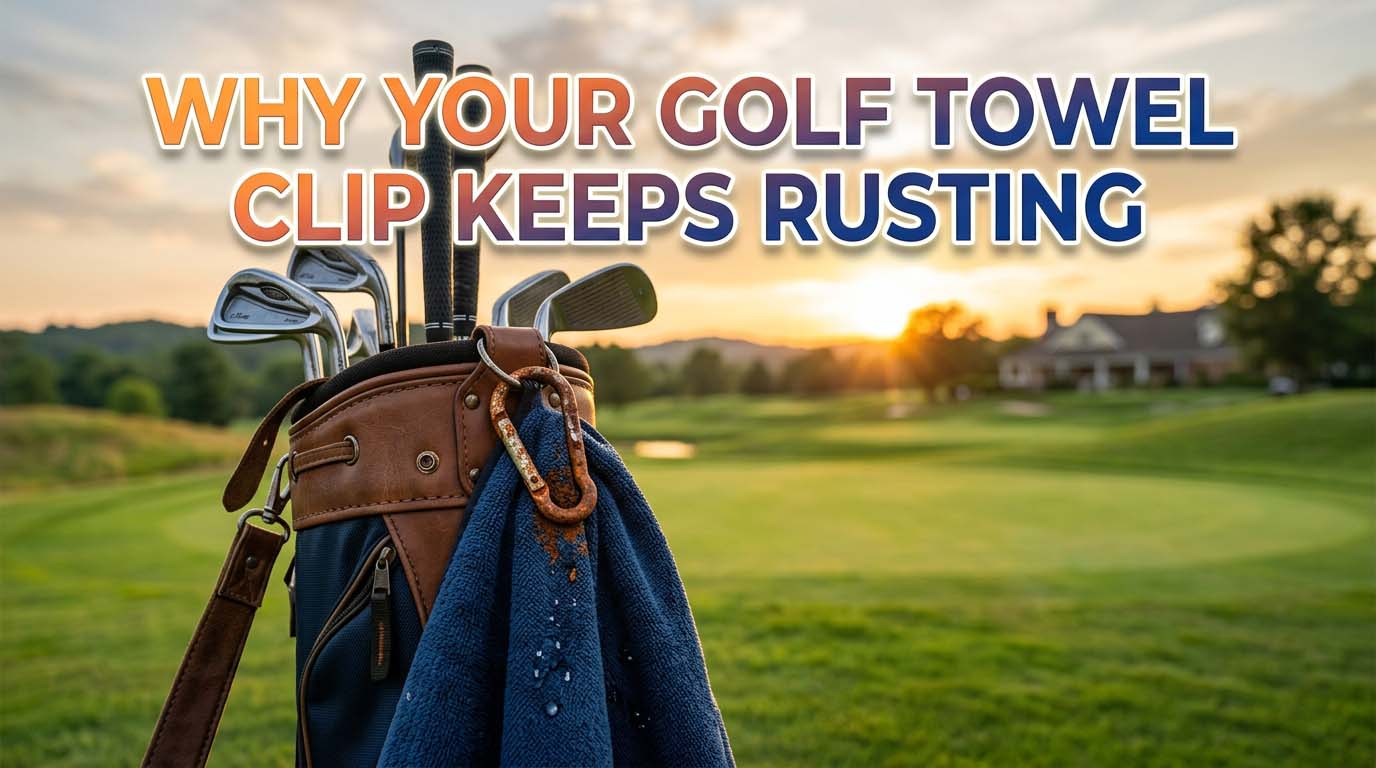
If you’ve ever pulled your golf towel off the bag and found orange specks around the clip, you’re not alone. Almost every golfer hits this frustration. You bought a towel that said “rust-proof,” and a few weeks later the clip looks like it came off a scrap pile. Let me tell you the real reasons behind this and exactly what to do about it.
Why the Clip Rusts Even When the Box Says “Rust-Proof”
The short answer: most golf towel clips are not made of solid stainless steel. They are made of carbon steel or zinc alloy that has a thin protective coating, often nickel, chrome, or black paint. That coating wears off at the spots that get the most friction: the hinge, the eyelet where the towel attaches, and the spring. Once the raw metal is exposed, moisture and oxygen do the rest.
“Rust-proof” is a marketing term, not a material science promise. True rust resistance comes from alloys like 316 stainless steel, which are expensive. Most budget clips use cheaper materials and rely on a coating that will eventually fail.
The Three Failure Points on Every Clip
- The hinge pin. Every time you clip and unclip, the pin rubs against the housing. The coating grinds off quickly.
- The eyelet (the metal ring or hole). The towel’s fabric and moisture sit right there. The coating wears from constant rubbing and never fully dries.
- The spring mechanism. Inside the clip, moisture gets trapped. Springs are often made from plain steel, not coated at all.
Why Your Storage Habits Don’t Always Help
You might keep your towel indoors, but the rust still comes. That’s because golf courses leave a chemical film on your towel. Fertilizers, iron sulfate, and fungicides contain salts that act as electrolytes.
When a damp towel touches the clip, those salts get transferred to the metal. Even in a dry garage, the salts keep eating away at the plating. Rinsing the towel with fresh water after each round makes a huge difference, but most golfers skip it.
The Hidden Cause: Galvanic Corrosion
Here is a fact that almost nobody talks about: your clip may rust faster because of the metal it touches. If your golf bag has a steel D-ring and your clip is aluminum or zinc, or if your towel has a brass grommet and the clip is steel, you have created a small battery.
When moisture (dew, rain, sweat) connects the two metals, one of them eats away faster. This is galvanic corrosion. It explains why a clip can look fine for months and then suddenly turn orange after one rainy round.
How to Check for Galvanic Corrosion?
Look at the points where the clip touches the bag’s ring and where the grommet touches the clip. If you see rust concentrated exactly at those contact spots, galvanic corrosion is the cause.
The only fix is to isolate the metals; either use a plastic ring on your bag or switch to a clip made from the same metal as the bag’s attachment point.
How to Tell What Kind of Clip You Have
You can diagnose your clip in ten seconds with a magnet. Grab a small refrigerator magnet or any magnet from a kitchen tool.
- Strongly magnetic — the clip is made from carbon steel or a low-grade stainless (like 430). It will rust easily.
- Weakly magnetic or not at all — the clip is likely 304 or 316 stainless steel. These are much more rust-resistant, though not completely immune.
- Non-magnetic but heavy — could be zinc alloy. Zinc doesn’t rust like steel, but it oxidizes into a white, powdery mess that can still jam the clip.
How to Remove Rust From Your Current Clip?
If the rust is just surface spotting, you can fix it. If the clip has pitted or the spring is stiff from corrosion, replace it. Here is the process that works:
- Soak in white vinegar (not apple cider) for 15 minutes. Vinegar dissolves rust without damaging the remaining coating too much.
- Scrub with an old toothbrush and a paste of baking soda and water. The paste is mild enough not to scratch the good plating.
- Rinse with fresh water and dry immediately with a paper towel.
- Seal the bare spots with a dab of clear nail polish or a thin coat of car wax. This prevents moisture from hitting the exposed metal again.
Do not use WD-40 for rust removal. It displaces water but does not remove rust. After cleaning, a quick spray of WD-40 silicone (not the standard formula) on the hinge helps keep the spring moving, but only after rust is gone.
How to Choose a Clip That Will Not Rust?
Stop buying towels based on the word “rust-proof.” Look for these specific details instead:
| Feature | What to Look For |
|---|---|
| Metal type | 316 stainless steel or brass. Brass never rusts; it develops a patina. |
| Coating | If it uses a coating, choose black oxide or PVD (physical vapor deposition). These are more durable than chrome or nickel plating. |
| Hinge design | Look for clips with a solid metal body that hides the spring from the outside. Less exposed spring equals less rust. |
| Magnetic alternative | A magnetic towel system removes the metal clip entirely. The magnet is encased in rubber or plastic, so nothing rusts. Just make sure the magnets themselves are nickel-coated and waterproof. |
The Myths That Keep Golfers Rusting
Myth: “Stainless steel never rusts”
400-series stainless (used in many cheap clips) is magnetic and can rust. Only 304 and 316 are truly rust-resistant for outdoor use, and even they can spot if exposed to salt or fertilizer constantly.
Myth: “Keeping it dry is enough”
As we covered, fertilizer salts hide in the towel’s fabric. Dryness helps, but rinsing the clip and towel with fresh water is the real answer.
Myth: “Spray it with clear coat, and you’re done”
Clear coat works on the clip’s flat surfaces, but the hinge and spring still move. The coating cracks and fails there first. You are better off switching to a clip with fewer moving parts.
One Habit That Changes Everything
You can stop most rust by doing one simple thing: after each round, unhook the towel from the bag, give both the towel and the clip a quick rinse under the garden hose, then hang the towel separately somewhere that gets airflow: a hook in the garage, a clothesline, over a shower rod.
Do not leave it clipped to the bag with the damp towel wadding up around the metal. That single change adds years to your clip’s life.
Frequently Asked Questions
Can I use a clear coat spray on the clip to prevent rust?
Yes, but only if you clean the clip first and avoid spraying the hinge or spring. Use a Rust-Oleum clear enamel and mask off the moving parts. The coating will wear off at friction points eventually, so it’s a temporary fix.
Will a magnetic golf towel clip eliminate rust?
Most magnetic clips use neodymium magnets encased in nickel and plastic. The magnet housing can still corrode if the nickel is scratched, but magnetic systems have fewer friction points and no hinge, so they rust much slower. It’s a solid upgrade.
Is it safe to put the clip in the dishwasher?
No. Dishwasher detergents are caustic and will strip the coating. Hand wash with mild dish soap and dry immediately.
Does the color of the clip affect rust resistance?
Not really. Black oxide and parkerized finishes do provide better corrosion resistance than painted or polished chrome, but only because the black finish is a chemical conversion layer, not a paint that chips. Still, it wears off at the hinge just like anything else.