
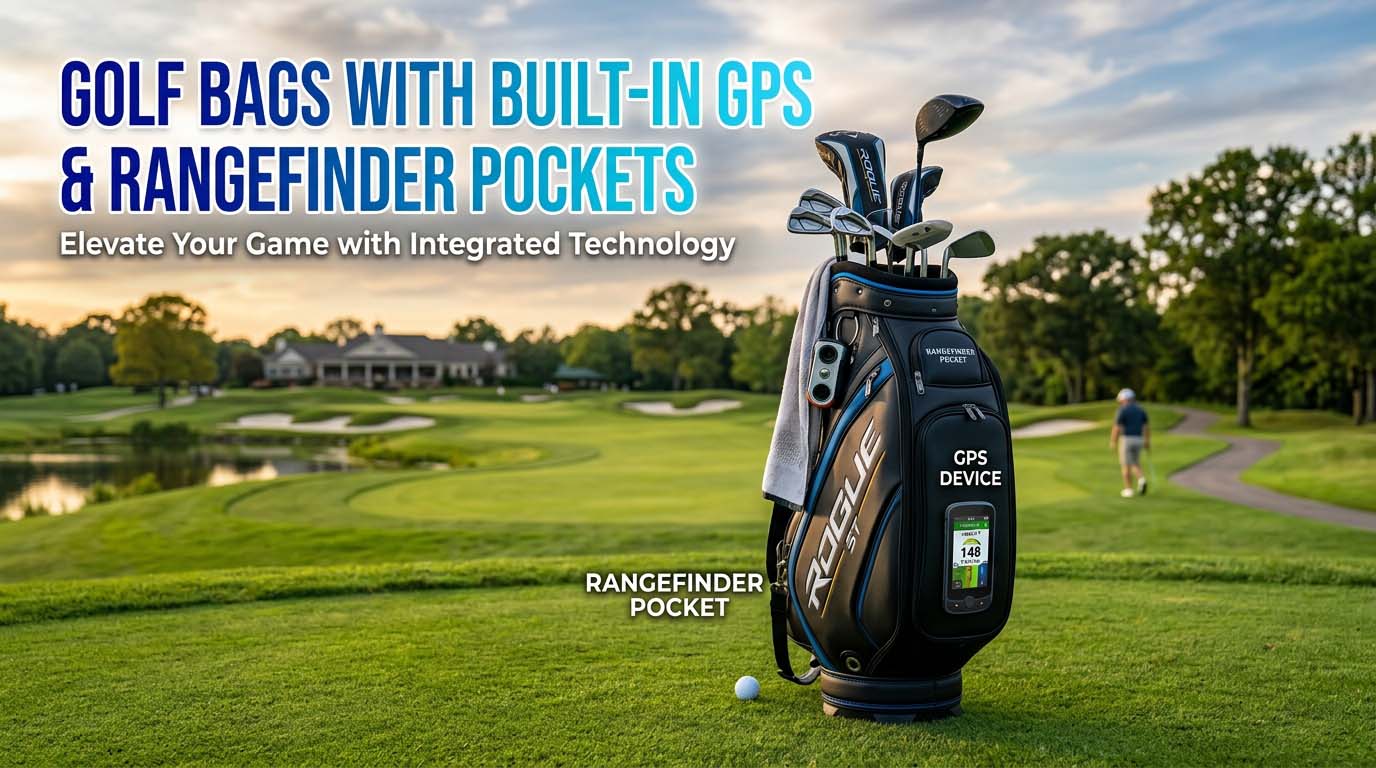
If you searched for this, you probably want a straight answer. Here it is: Yes, you can find golf bags with a dedicated pocket for your rangefinder on almost every modern bag. But a bag with a built-in GPS screen that shows yardage without a separate device? That is much less common and almost always comes on an electric trolley, not a carry bag.
The confusion happens because people use the words “built-in GPS” and “rangefinder pocket” as if they mean the same thing. They do not. One is a storage spot for your device. The other is a device built into the bag itself. Knowing the difference will save you time and money.
Most Golf Bags Just Have a Pocket for Your Rangefinder
Let’s start with what is common. When a company says a bag has a “rangefinder pocket,” they mean a small, padded compartment designed to hold your handheld laser rangefinder. This is standard on most bags that cost over $150. It is not a GPS.
These pockets come in a few styles:
Magnetic close pockets. These are the best for quick access. You pull the flap open, grab your rangefinder, and the magnet snaps it shut. The MNML MR2 uses magnets on all its pockets, including the rangefinder slot. It works well and feels premium.
Zippered pockets. These are more secure but slower to open and close. Many classic bags like the Ping Hoofer use a zippered rangefinder pocket.
Velcro or clip pockets. Some budget bags use Velcro or a small fabric loop. They work but wear out faster.
The location of the pocket matters just as much. On walking bags, the best rangefinder pockets sit on the lower spine of the bag, near the hip pad. This keeps the weight low and does not interfere with club retrieval.
The MNML MR2 places its rangefinder pocket there. On cart bags, the pocket is often on the side or front, which is fine because you are not carrying the bag.
Which Bags Have the Best Rangefinder Pockets?
Here are a few standouts based on real use:
MNML MR2 – This bag has a magnetic rangefinder pocket on the lower spine. It is easy to access while walking and stays out of the way of your clubs. It does not have built-in GPS, but the pocket design is excellent.
Vessel Player V Pro – This premium bag uses a padded, magnetic pocket placed on the front of the bag. It feels secure and looks clean.
Ping Hoofer Lite – A walking classic with a zippered rangefinder pocket on the side. It is simple and works.
Sun Mountain C-130 – A cart bag with a large, easy-access rangefinder pocket on the front panel. Great if you ride.
If you walk, prioritize a bag with the pocket on the lower spine. If you ride, almost any location works.
The Rare Case of True Built-in GPS in a Golf Bag
Now let’s talk about the real built-in GPS. This means the bag has a screen or GPS module sewn into it that shows yardage without needing a separate device. These are rare.
Electric trolleys are where you find them. The Motocaddy M1 GPS is the best example. It has a built-in GPS screen on the handle that shows distances to the front, middle, and back of the green. It also tracks your shot distances. This is a powered cart, not a carry bag.
CaddyTek Climber – Some models include a GPS module, but again, this is an electric trolley.
Hybrid cart bags with a GPS pocket – Some high-end cart bags, like the Titleist StaDry, include a padded pocket designed to hold a GPS unit like the Garmin Approach G80. But this is a pocket for your device, not a built-in screen.
Why carry bags do not have built-in GPS screens. A screen adds weight, requires a battery, and needs charging. Carry bags are designed to be light. A built-in GPS screen would make the bag heavier and more expensive. Most golfers who walk prefer to use a handheld rangefinder or a phone app.
Could solar change this? The MNML MR2 has a solar panel that charges a phone. It is easy to imagine a future where a bag like that powers a small GPS module. But as of now, no carry bag has that feature.
How to Choose – Pocket or Built-in GPS
Use this table to decide what you actually need.
| Your Situation | Best Choice |
|---|---|
| You walk and use a handheld rangefinder | A carry bag with a magnetic rangefinder pocket on the lower spine. The MNML MR2 or Vessel Player V are good options. |
| You ride and want a built-in GPS screen | An electric trolley like the Motocaddy M1 GPS or a cart bag with a GPS holder pocket. |
| You want the lightest possible setup | Skip built-in GPS. Use a free phone app for yardage and a bag with a small rangefinder pocket. The Ping Moonlite or Sun Mountain 2.5+ work well. |
| You play in a cart and dislike using your phone | A cart bag with a dedicated screen pocket or an electric trolley with GPS. |
Do You Really Need a Built-in GPS?
Let’s be honest. Most golfers do not need a built-in GPS screen on their bag. Here is why:
Your phone already does this. Apps like 18Birdies, Golfshot, and TheGrint give you yardages for free. They are accurate and require no extra hardware.
A handheld rangefinder is faster. Point and click. No charging, no syncing, no screen glare. Most serious walkers prefer this.
Built-in GPS adds weight and cost. A trolley with GPS costs over $500. A good carry bag with a rangefinder pocket costs under $200.
When it makes sense. If you hate using your phone on the course, or if you play in a cart and want a screen that is always there, a built-in GPS is nice. But it is a convenience, not a necessity.
Best alternative. Get a magnetic phone mount for your bag strap. The Quad Lock system works perfectly. You get GPS from your phone without the bulk of a built-in screen.
Frequently Asked Questions
What is the best golf bag with a rangefinder pocket for under $200?
The Sun Mountain 2.5+ and the Ping Moonlite both have small, functional rangefinder pockets. They are light walking bags that do not break the bank.
Can I use a rangefinder in a bag with no dedicated pocket?
Yes. You can clip it to a strap, use a small pouch, or put it in a valuables pocket. But a dedicated pocket is safer and more convenient.
Do any golf bags have both a built-in GPS and a rangefinder pocket?
Not really. The Motocaddy M1 GPS has a small storage pocket, but it is not designed specifically for a rangefinder. You would need to buy a separate pouch.
Are there solar-powered golf bags with GPS?
Not yet. The MNML MR2 has solar charging for phones, but no GPS module. It is a possible future feature, but nothing exists right now.
Where should I put a rangefinder on a golf bag?
On a carry bag, the best spot is the lower spine near the hip pad. On a cart bag, any side pocket works. Avoid placing it near the club handles where it can cause a tangle.
Are GPS golf watches legal for tournament play?
Yes, as long as they only measure distance. Watches that measure wind or slope are not allowed in most tournament play. Check your local rules.