
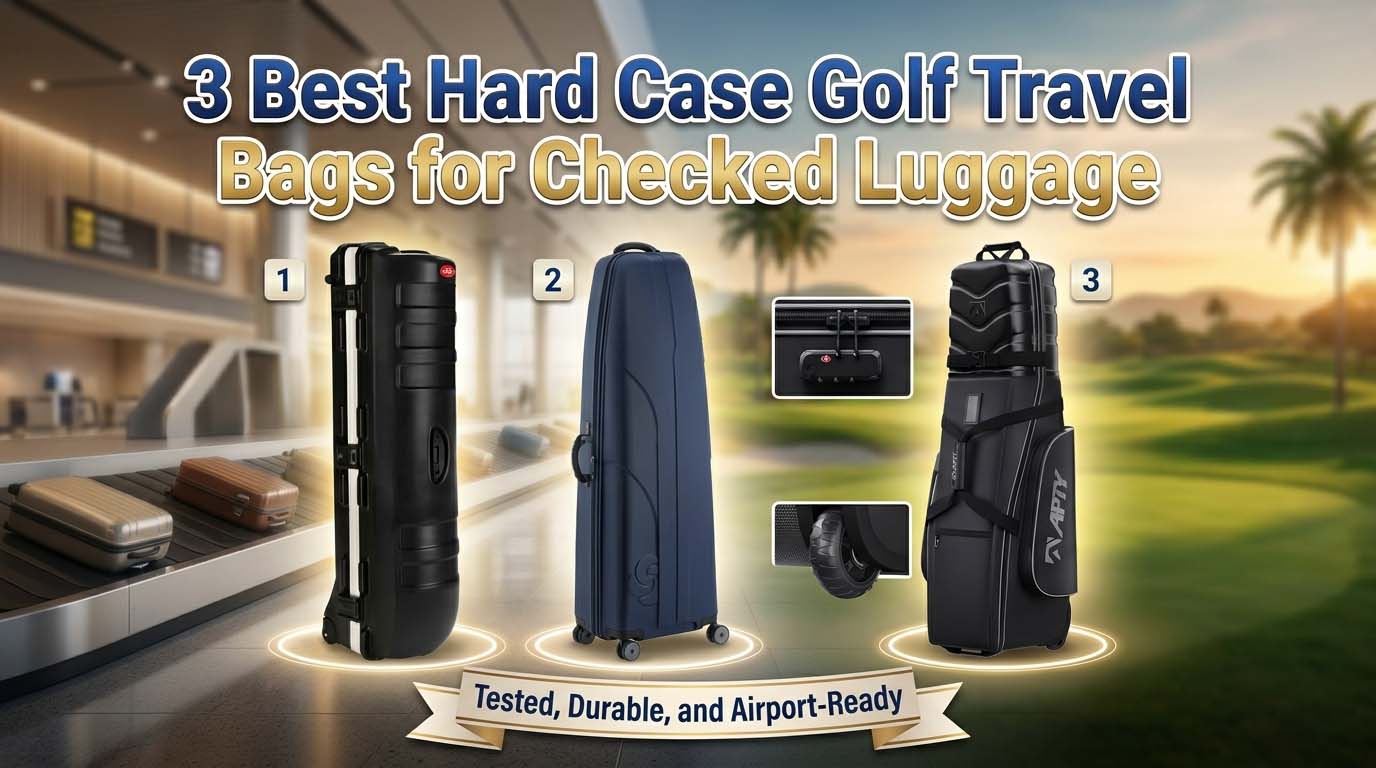
You’ve heard the stories. A $1,500 driver snapped in half because a soft bag got flattened by a suitcase in the cargo hold. That fear is what drove me to hard cases years ago, and I’ve never looked back.
If you’re reading this, you’ve already decided hard is the way to go. You want protection that actually works when baggage handlers treat your clubs like cargo.
After comparing weight, material thickness, wheel quality, and real-world security across dozens of trips, one thing is clear: the SKB Staff ATA is the only true “set it and forget it” case for anyone serious about club protection. But it’s not for everyone.
The Samsonite Tour Deluxe wins for the golfer who values maneuverability over absolute brute force. And the APTY is the surprising budget hero that covers the basics without breaking the bank. All three are hard cases.
This isn’t about hard vs. soft. This is about which hard case is actually worth the baggage fee weight penalty.


Why Hard Cases Are the Only Choice for Checked Luggage (And 1 Trade-Off You Can’t Ignore)
Before getting into which case wins, it’s worth understanding why hard cases dominate for checked luggage in the first place. I’ve traveled with soft bags. I’ve seen the zipper failures.
I’ve watched a buddy’s graphite shaft snap at the ferrule because a suitcase landed on just the wrong spot. Hard cases solve that by spreading impact force across a rigid shell instead of letting it concentrate on one point.
The Protection Argument
Not all hard cases are built the same. The material makes a massive difference. High-molecular-weight polyethylene, which SKB uses, is the same stuff found in industrial cutting boards and bulletproof panels.
It absorbs impact by flexing slightly, then bouncing back. ABS plastic, which Samsonite and APTY use, is lighter and more affordable but behaves differently. ABS can crack under extreme point pressure, whereas polyethylene tends to deform and recover. That doesn’t mean ABS cases are junk.
It just means you need to match the material to your risk tolerance. If you fly once a year to a resort, ABS is probably fine. If you’re connecting through Denver, Chicago, or Atlanta multiple times a year, polyethylene starts looking like cheap insurance.
The Weight Penalty (The Real Issue)
Here’s the part most reviews gloss over. The best hard case golf travel bag for checked luggage is only useful if you can actually stay under the airline weight limit. Most domestic carriers cap checked bags at 50 pounds. Do the math with me.
Take the SKB. It weighs 17 pounds empty. Add a standard cart bag at around 5 pounds. Add 14 clubs at roughly 8 to 10 pounds total. You’re at about 32 pounds before you pack a single shoe, a rangefinder, a dozen balls, or a rain suit.
That leaves you 18 pounds of wiggle room, which is actually fine for most trips. But if you’re the type who packs a full change of clothes, golf shoes, two pairs of shorts, and a travel umbrella inside the case, you can hit 50 pounds faster than you think.
The Samsonite weighs 14 pounds. That 3-pound difference doesn’t sound like much until you’re at the check-in counter and the scale reads 51.
The APTY comes in at around 9 pounds, which is a serious advantage for anyone flying on budget airlines with strict weight limits. Weight matters more than most buyers realize, and it should drive your decision as much as protection does.
#1. The Best Hard Case for Maximum Airline Abuse: SKB Staff ATA
Key Specs: Material: High-molecular-weight polyethylene | Weight: 17 lbs | Interior: 15.5″L x 12.25″W x 49.625″H | Max driver length: 49″ | Wheels: 2 | Lock: TSA integrated
I’ve owned my SKB Staff ATA for about three years now, and it’s been through roughly 20 flights. It looks almost the same as the day I bought it.
A few scuffs on the corners, sure, but no cracks, no broken latches, no structural issues at all. That’s not luck. That’s what happens when you mold a case from high-molecular-weight polyethylene instead of ABS.
The first time I used it, I was nervous. I packed my clubs, closed the TSA latches, and handed it over at the curb. When I picked it up at baggage claim, I half expected to see some damage. Nothing. Not a scratch that went deeper than the surface.
The case had clearly been slid, dropped, and probably stacked under something heavy, but the shell handled it all.
The Polyethylene Difference
This is the main event. Polyethylene doesn’t crack like ABS. It dents and scuffs, but it holds its shape.
I’ve seen the aftermath of a baggage cart running over an ABS case — cracked shell, exposed clubs. I’ve never seen that with the SKB. The TSA locking system is another win. You don’t need a separate padlock.
The integrated latches are TSA-approved, which means agents can open the case without breaking it. That’s a small thing until you come back from a trip and find your padlock missing or cut off. It hasn’t happened to me with this case because there’s nothing to cut.
The Fit Warning
Here’s the honest catch. The SKB is contoured to fit cart bags. If you have a massive tour bag with a 14-way divider top and a bulky stand mechanism, check the interior dimensions before buying. The interior measures 15.5 inches long by 12.25 inches wide.
My Ping Hoofer fits fine. My buddy’s Taylormade FlexTech with the legs extended was a tight squeeze. We had to rotate the bag to get it in, and even then the lid closed with only a couple of millimeters to spare.
Also, this case is heavy. At 17 pounds empty, you feel it when you lift it into the trunk. If you’re traveling alone and don’t have someone to help you load it, that’s a real consideration.
Who Should Buy This
If you fly six or more times a year and your clubs are worth more than $2,000, this is the only case I’d trust. The weight penalty is real, but the protection is unmatched. It’s also the right pick if you drive yourself to the airport and can handle the lifting.
If you have custom clubs, rare shafts, or just a set you’d rather not replace, the SKB pays for itself the first time it saves a broken driver.
#2. The Best Lightweight Hard Case for Maneuverability: Samsonite Tour Deluxe
Key Specs: Material: ABS plastic | Weight: 14 lbs | Dimensions: 17″L x 14″W x 57″H | Max driver length: 48″ | Wheels: 4 multi-directional spinner | Lock: External interlocking zippers
I bought the Samsonite Tour Deluxe for a trip where I knew I’d be connecting through three airports and hauling my gear through a train station on the other end.
The four-wheel spinner system was the deciding factor, and honestly, it made that trip bearable. Gliding through a terminal with this case feels like pulling a good piece of luggage, not dragging a boat anchor.
The SKB, by comparison, uses two fixed wheels that require you to tilt and pull. The Samsonite rolls upright on all four wheels and moves in any direction with one finger.
The Wheel Advantage
This is the Samsonite’s superpower. Most hard golf cases use two inline skate wheels because they’re cheaper and simpler.
The Samsonite uses four multi-directional spinner wheels, the same kind you’d find on a high-end suitcase. You can push it beside you, pull it behind you, or roll it through a crowded aisle without constantly adjusting your grip.
In a busy terminal, that convenience adds up fast. I’ve navigated the Samsonite through narrow jetways, rental car shuttles, and even a packed metro station without once feeling like I was wrestling a piece of equipment.
The trade-off is the ABS shell. It’s lighter than polyethylene, which helps with the weight limit, but it’s not as impact-resistant.
The interior has a padded quilted lining and extra foam cushioning on top for the club heads, which helps. The internal compression straps kept my bag from shifting during the flight.
But I know that if a heavy suitcase lands directly on a corner of this case, the shell could crack. It hasn’t happened to me, but I’ve seen enough ABS luggage failures to know it’s possible.
Weight and Size Check
At 14 pounds, the Samsonite saves you 3 pounds compared to the SKB. That matters more than I expected. On a recent trip to Florida, I packed my golf shoes, a light jacket, a dozen balls, and a rangefinder inside the case and still came in at 48 pounds.
With the SKB, I would have been over. The Samsonite fits clubs up to 48 inches, which covers most players but not all. If your driver is 48.5 inches or longer, you’re at the limit; measure before you buy.
Who Should Buy This
This is for the golfer who travels for business and sneaks in a round on the side. It’s for anyone who has to navigate public transit, rental car shuttles, or long terminals with a tight connection.
If you value your shoulders and your back, and you’re willing to accept slightly less brute-strength protection for a much better airport experience, the Samsonite is the smarter choice.
It’s also the better pick if you tend to pack heavy because the lighter case gives you more room under the 50-pound limit.
#3. The Best Budget Hard Case: APTY Hard Case Top

Key Specs: Material: ABS hard top + 1680D oxford fabric base | Weight: ~9 lbs | Lock: Integrated TSA combo lock | Wheels: Grooved two-wheel system | Interior: Padded top shell, inner strap
The APTY isn’t a full hard case. I want to be upfront about that because the name implies it is. The top half is a crush-resistant ABS shell that protects the club heads, the most vulnerable part of any set.
The bottom half is made of heavy-duty 1680D Oxford fabric, which is tough but not rigid. That hybrid design is both the strength and the limitation of this case.
The Hybrid Design
For the price, the APTY does something smart. It focuses protection on the part of the bag that gets damaged most often: the top of the clubs.
The hard ABS top shell is thick and padded. I dropped a 25-pound dumbbell on it from about waist height (don’t ask, curiosity got the better of me), and the shell absorbed the impact with only a small scuff.
The fabric base, meanwhile, keeps the weight down and makes the case easier to store when not in use. You can fold it flatter than a full rigid case, which is a big deal if you live in an apartment and don’t have a garage.
The grooved wheels are a nice touch. They grip better on wet pavement than standard smooth wheels. I rolled it through a rainy parking lot and didn’t feel it slip once.
The integrated TSA combo lock works the same as the SKB’s system; agents can open it without breaking it. The inner strap keeps the bag from shifting around, which reduces the chance of scuffs during transit.
The Honest Limitations
The fabric base can be slashed or punctured. That’s the reality of any hybrid design. If a sharp-edged piece of cargo gets jammed against the bottom of the case during a flight, your bag could get damaged.
I haven’t had that happen, but I also wouldn’t check this case on a trip where I was carrying clubs I couldn’t afford to replace. The APTY is best for occasional use, one to two trips a year, where the risk is lower and the cost savings justify the compromise.
It’s also not the best fit for giant tour bags. The interior is designed for standard cart bags, and the strap system works best when your bag doesn’t have a lot of bulky attachments.
Who Should Buy This
This is for the golfer who flies a couple of times a year, doesn’t own $3,000 custom clubs, and wants better protection than a soft bag without spending SKB money. It’s also a great backup case.
I keep mine in the closet for when a friend needs to borrow a good travel bag or when I’m taking a short domestic trip where I’m less worried about damage.
If you’re shopping on a tight budget and you understand the trade-offs, the APTY delivers solid value. Just know that it’s not in the same protection class as the SKB, and that’s okay — it’s not trying to be.
The Final Verdict | Which Hard Case Should You Actually Check?
There’s no perfect case for everyone. The right choice depends on how you travel, what you carry, and how much risk you’re willing to accept. Here’s how I break it down after using all three extensively.
If you fly more than six times a year or your clubs are worth more than $2,000: Get the SKB Staff ATA. The protection is unmatched, and the polyethylene shell will outlast any ABS case on the market. Just be ready for the weight.
You’ll need to pack smart to stay under the 50-pound limit, but that’s a small price to pay for knowing your clubs will arrive intact.
If you fly two to six times a year and hate dragging a heavy case through airports, get the Samsonite Tour Deluxe. The four-wheel spinner system transforms the airport experience.
You sacrifice some brute strength, but for most travelers, the convenience gain is worth more than the marginal protection difference. Plus, the lighter weight gives you more packing flexibility.
If you fly once or twice a year or you’re on a tight budget: Get the APTY Hard Case Top. It’s not a full hard case, but it protects the most important part of your clubs — the heads — and does so at a fraction of the cost. Just know the limitations and don’t expect it to survive a direct hit from baggage equipment.
Hard cases are an investment. Don’t cheap out if the clubs are expensive. Don’t overspend if you rarely fly. Pick the one that matches your travel frequency, not your ego.
The best hard case golf travel bag for checked luggage is the one that actually fits your life, and these three cover the spectrum well enough that there’s a right answer for almost anyone.
Frequently Asked Questions
Can I fit a 48-inch driver in the Samsonite Tour Deluxe?
Yes, but just barely. The Samsonite accommodates clubs up to 48 inches. If your driver measures 48.5 inches or longer, you may need to remove the head or consider the SKB, which handles up to 49 inches.
Does the SKB Staff ATA require a separate padlock?
No. The SKB has integrated TSA-approved locking latches. You don’t need to buy or carry a separate lock. The latches are built into the case and can be opened by TSA agents with their master key without damaging the case.
Is the APTY case fully rigid?
No. The APTY has a hard ABS top shell that protects the club heads and a heavy-duty 1680D Oxford fabric base. It’s a hybrid design, not a fully rigid case. The top is impact-resistant, but the base can be punctured or slashed by sharp cargo.
How do I keep my clubs from shifting inside a hard case?
Use the internal compression straps that come with most hard cases. For extra security, wrap a towel around the club heads, use a Stiff Arm or similar shaft protector, and pack soft items like clothing or towels in the gaps around the bag to prevent movement.
Which hard case is lightest for flying on budget airlines?
The APTY is the lightest of the three at roughly 9 pounds, which helps with strict weight limits. The Samsonite is 14 pounds, and the SKB is 17 pounds. If you’re flying an airline with a 40-pound or 50-pound limit and you want to pack extra gear, the APTY gives you the most remaining weight.