
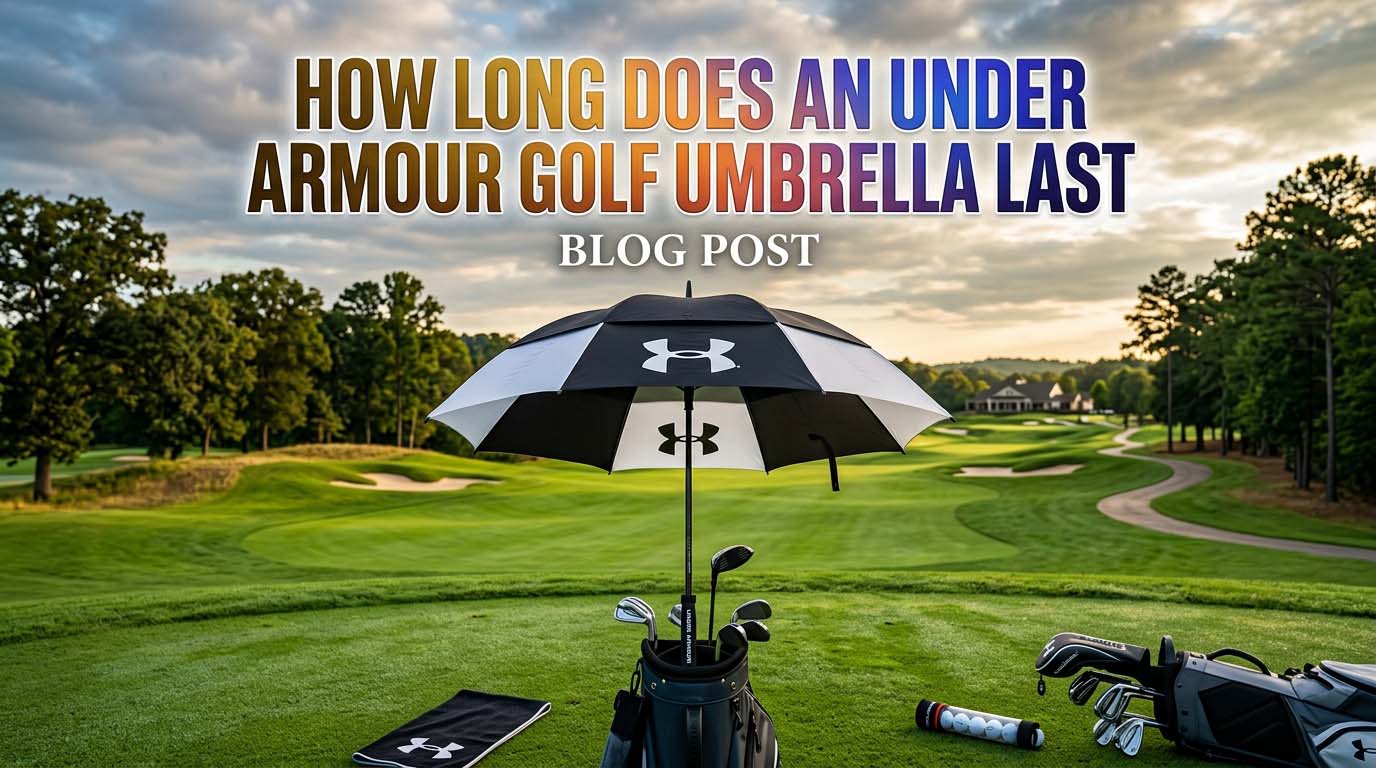
If you’re wondering how long does an Under Armour golf umbrella last, here’s the honest answer: between 3 and 7 years with normal care. That’s a wide range because the umbrella’s lifespan is shaped mostly by three things: how often you use it, how you store it, and the weather you play in.
I’ve owned these umbrellas for years, and I’ve watched the same model last two seasons for one golfer and eight for another. Neither one was a defect. It was usage.
Here’s a quick snapshot before we break everything down:
| Usage Pattern | Expected Lifespan |
|---|---|
| Occasional golfer (1–2 rounds a month) | 5 to 7 years |
| Weekly golfer (1–2 rounds a week) | 3 to 5 years |
| Daily or competitive player | 2 to 4 years |
| Any pattern in a high-wind region | Subtract 1 to 2 years |
Now let’s get into why these numbers move and how you can push your umbrella toward the longer end of that range.
What Your Under Armour Umbrella Is Made Of
The lifespan only makes sense if you understand what you’re holding. Under Armour’s golf umbrella uses a 100 percent nylon double canopy. The double layer is what keeps heavy rain from soaking through and adds rigidity without adding much weight.
Nylon is strong, but it has a weakness: sun exposure breaks it down slowly over time. The canopy is the first part of this umbrella to show its age.
The frame uses fiberglass, which bends under gusty winds instead of snapping the way aluminum does. That’s good for longevity in normal conditions. But fiberglass has its own limit; it can only flex so far before the joints start to loosen or the ribs crack at the stress points.
The handle is a textured rubber grip. Rubber handles sweat and rain well, but it can dry out and crack after years of UV exposure or extreme heat. The mechanical part is the dual-action opening system; one push opens the canopy in two stages.
This is the most complex part of the umbrella and the most likely thing to wear out before anything else.
Realistic Lifespan Benchmarks by Usage
Lifespan isn’t one number. It’s four numbers, because each component wears out on its own schedule.
| Component | Typical Lifespan | What Kills It |
|---|---|---|
| Canopy (water repellency and tear strength) | 3 to 5 years | UV exposure, heavy use |
| Fiberglass frame | 4 to 7 years | Strong wind, forced opening |
| Dual-action opening mechanism | 3 to 6 years | Mechanical wear, dirt in the shaft |
| Rubber handle | 5 to 8 years | UV, heat, drying out |
The pattern here is simple. The canopy and the mechanism are your realistic limiting parts. If you get past five years, the frame is usually still fine; the canopy and the opening system are what push you toward replacement.
How Climate and Play Style Change Lifespan
Two golfers can buy the same golf umbrella on the same day and get completely different lifespans. The difference is almost always climate and playing habits.
Wind is the single biggest killer. Even though the fiberglass frame is designed to flex, every gust stresses the joints and the fabric attachment points.
A golfer who plays in an exposed, windy coastal region will see frame looseness in half the time of someone who plays in sheltered, calm conditions.
UV exposure is the second killer. Golf umbrellas spend most of their lives tucked in a bag, but when they’re open, they take direct sun.
The water-repellent coating is the first casualty; after a couple of seasons of regular play, water starts soaking through instead of beading off. The nylon itself holds up longer, but the coating is what makes the umbrella actually useful in rain.
Heat matters more than people expect. Leaving the umbrella in a car trunk through a summer can soften the resins in the frame joints and dry out the rubber handle. This is a common, avoidable cause of early failure.
Play style has a quieter effect. The way you open the umbrella matters. Forcing the dual-action mechanism, yanking it open with one hand, or using the umbrella as a walking stick on wet ground puts stress on the ribs and the handle that they weren’t designed for. Over three years, these small habits add real wear.
How to Care for It So It Lasts
Care is where you have the most control. I’ve seen a weekly golfer get six years out of an umbrella that a careless friend ruined in two. The difference was routine, not luck.
- Dry it before you store it. After playing in rain, open the umbrella fully at home and let it air dry for a few hours. Storing it wet traps moisture inside the canopy folds, which leads to mildew and corrodes the metal parts.
- Never store it compressed while damp. The sharp creases in the fabric will weaken over time, and the damp shaft promotes rust.
- Keep it out of hot spaces. A closet or a cool room is better than wherever you tossed it after the round. Heat is the quiet killer.
- Open and close it with two hands. One hand on the handle, one hand guiding the canopy as it opens. This takes pressure off the ribs and the mechanism.
- Don’t use it as a walking stick. It’s designed for overhead coverage, not supporting your weight. The tip and the lower shaft take damage quickly.
- Wash the canopy once a year. Use mild soap and cool water, rinse thoroughly, and let it dry open. This removes dirt and pollen that slowly break down the water-repellent coating.
None of these steps take more than a minute. They just have to become habits.
Signs Your Umbrella Is Nearing the End
There’s a difference between normal wear and the umbrella actually being done. Here’s how to tell one from the other.
Normal wear: The water-repellent coating has faded, and water takes a few seconds longer to bead off. The opening mechanism feels a little gritty but still works smoothly. The canopy has crease marks along the folds where it’s been compressed. All of this is fine; the umbrella still has years left.
End of life: Water soaks through the canopy quickly, even after re-waterproofing spray. A fiberglass rib cracks or pokes a hole through the canopy fabric. The frame wobbles noticeably at a joint; this means the connection is loose enough to keep loosening.
The dual-action mechanism sticks mid-open, or the umbrella won’t snap closed when you push it. Any one of these is a real signal that the umbrella is done serving its purpose.
One thing I’ll say from experience: don’t wait until the canopy fails mid-rain to make the call. A leaking umbrella is not only useless, but it’s also a sign the frame is stressed. Replace it on a clear day, not during a downpour on the course.
Under Armour’s Warranty on Golf Umbrellas
Under Armour’s standard warranty covers defects in materials and workmanship for the useful life of the product. In plain terms: if the frame snaps the second time you open it, or the handle separates from the shaft out of the box, that’s a defect and Under Armour will typically replace it with a valid proof of purchase.
What the warranty does not cover is normal wear and tear. A canopy that leaks after three years of weekly play is wear, not a defect.
A wobbly frame after a season of strong gusts is wind damage, not poor workmanship. Under Armour’s warranty is fair but limited; it protects you from a bad product, not from the natural aging of a good one. Check the specific policy for your region before buying, but treat “useful life” as eight to ten years of light use, not a lifetime guarantee.
The Repair vs Replace Decision
This is the question nobody actually answers. Can you repair it? Sometimes. Should you? Rarely, once the umbrella is past year three.
A gritty opening mechanism can be fixed with a light silicone spray on the shaft. A loose screw at a joint can be tightened. These are ten-minute, two-dollar fixes and they’re worth doing.
But a torn canopy, a cracked fiberglass rib, or a bent frame is not worth repairing. Replacing a canopy alone runs close to what the whole umbrella costs. Under Armour golf umbrellas typically retail in the $30 to $60 range. When a repair eats up half the replacement cost, replacement is the practical call.
Here’s a simple rule: if the umbrella is under two years old and the problem is mechanical, try a repair. If it’s over three years old and the canopy or the frame has failed, replace it. The money math simply doesn’t work the other way.
Real User Reviews (Mixed Opinions)
Positive:
Reviewers describe the umbrella as well-built and sturdy; the flexible poles are tough and should last, and it’s held up fine even after a few rough brushes with low-hanging branches.
Negative (an important caution):
One customer said their repaired umbrella broke the same day again under normal conditions, calling it not durable at all.
A Trustpilot reviewer, however, found it sturdier than their old ClickGear Silver (which snapped within 12 months) and good value in windy conditions, though the shaft height caused fit issues on a golf trolley mount.
Frequently Asked Questions
a) What does Under Armour’s warranty actually cover on golf umbrellas?
It covers defects in materials and workmanship for the useful life of the product. In practice, that means factory faults, a rib that snaps on first use, a handle that separates, a mechanism that never worked correctly. Normal wear from regular use is not covered, and damage from wind or forced opening is not covered.
b) Can you replace the canopy on a UA golf umbrella?
Officially, no. Under Armour does not sell replacement canopies for its golf umbrellas. Third-party repair shops can re-cover an umbrella frame, but the cost is close to the price of a new umbrella. For most people, replacement is the smarter option.
c) Does UV exposure degrade the water-repellent coating?
Yes. UV light breaks down the coating before it breaks down the nylon itself. After two or three years of regular sun exposure, the coating loses most of its effectiveness and water starts soaking through.
Re-waterproofing sprays can extend the canopy’s useful life by a season or two, but they’re not a permanent fix.
d) How do heat and cold affect the umbrella materials?
Heat is the worst enemy. High temperatures soften the frame resins and dry out the rubber handle, which leads to joint looseness and cracking. Cold makes the nylon canopy stiffer and more likely to tear at stress points when opened quickly.
Avoid storing the umbrella in a car trunk during summer, and open it gently in cold weather.
e) How does the UA canopy compare to other golf umbrella brands at the same price?
The double canopy gives excellent coverage, and the water repellency is genuinely good out of the box. Compared to brands like Titleist and GustBuster in the same price range, the canopy holds its own, but the frame is the weakest link.
Under Armour’s frame handles normal play fine, but in heavy wind it’s the first thing to go. If you play somewhere with constant gusts, a wind-rated frame from a specialist brand might last longer.