
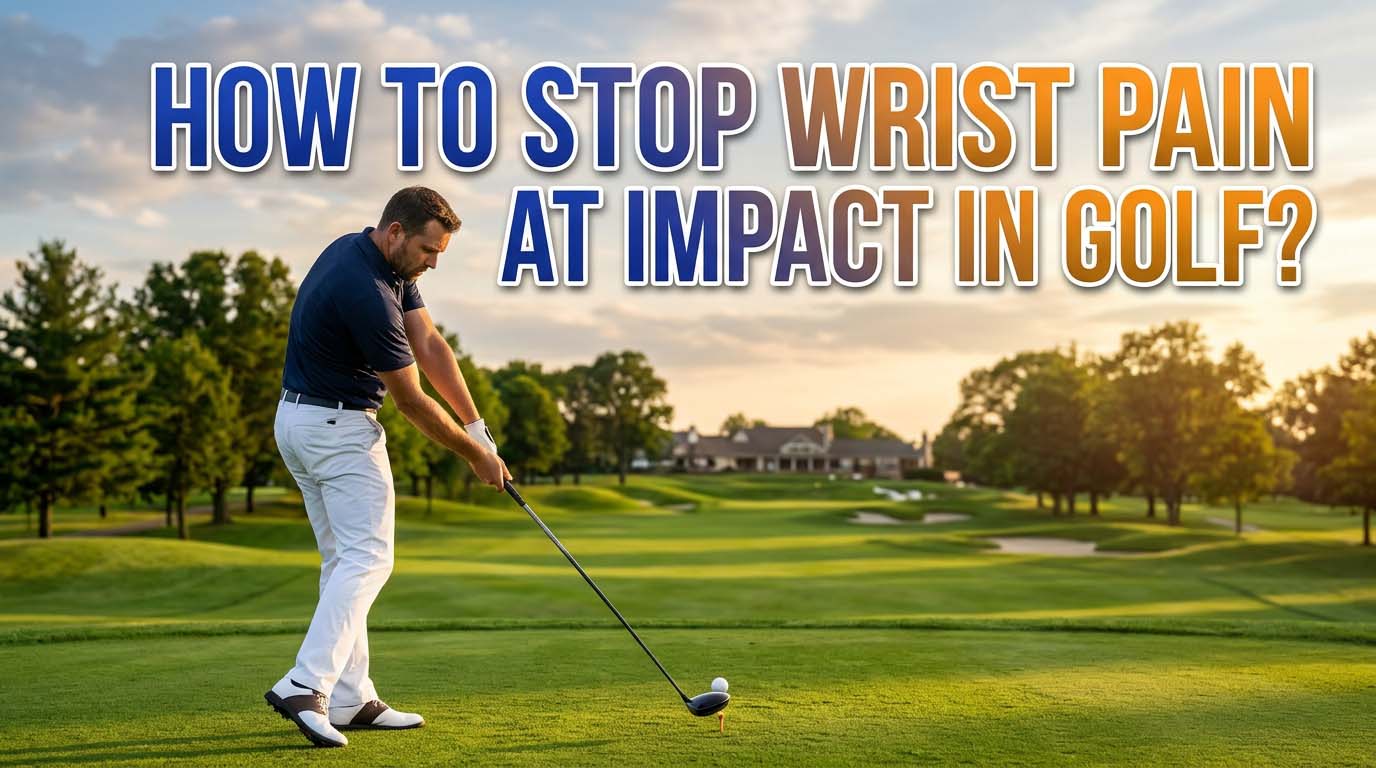
If your wrist hurts right when the club meets the ball, you are dealing with a specific mechanical failure. This is not general soreness from playing too much. This is a shock wave that hits your hand at the exact moment of impact. Wrist circles and forearm curls will not stop this pain. You have to triage the source.
Most cases are solved by correcting one of three things: your swing path (you are casting the club), your grip pressure (you are choking the club), or your equipment interface (your club is fighting you). Here is how to diagnose which one is making your wrist scream, and how to stop it.
The Diagnostic Test: Is It Your Swing, Grip, or Gear?
Before you buy a brace or start a drill, you need to know exactly what is causing the impact pain. Do these three tests.
Test for Swing Failure (The Flip)
Take a slow-motion video of your downswing. Pause it just before the club reaches the ball. If your lead wrist is already straight, meaning the club has fully released before impact, you are casting.
The club is decelerating against your wrist instead of transferring energy through the ball. This loads the joint with shear force.
Test for Grip Failure (The Crush)
At address, try to wiggle your fingers. At the top of the backswing, try again. If your grip pressure is a 10 out of 10 from the start, your forearm muscles are already locked tight. Locked muscles cannot absorb shock. The force travels straight into the bone.
Test for Equipment Failure (The Interface)
Look at your golf glove. Does it wear out on the pad of your thumb or the heel of your hand? Do you feel vibration mainly in your pinky knuckle? These are signs of a grip size mismatch or a shaft that is too stiff for your swing speed.
Fixing Impact Pain Caused by Technique (The Swing Lever)
This is the most common cause, and the one most general fitness articles miss. They tell you to do wrist curls, but your swing is jamming your wrist into a bad position at the moment of truth. You need two specific drills.
The Pump Handle Drill (for Compression)
Most amateurs lose pressure into the ground through impact. They pull up instead of pushing down. This drill teaches you to create compression through impact. Stand without a club. Get into your golf posture. Pump your trail arm down toward the ground like you are pushing a stake into the dirt.
The feeling is a push down through the target line. Do this ten times, then hit a ball trying to recreate that push feeling. You will feel the load come off your wrist and go into the ground.
The Soft Hands Drill (for Deceleration)
Wrap a towel around the grip of your club. Hit balls holding the club as loosely as you can without dropping it. The club will try to fly out of your hands. Your brain will learn to stay soft until the exact moment of truth, then firm up just enough.
This absorbs the shock at impact instead of blocking it with a locked wrist. Do it for ten swings on the range.
Fixing Impact Pain Caused by Interface (The Hand and Equipment Lever)
Even with a perfect swing, the wrong equipment can cause pain at impact.
The Wrist Widget and TFCC Pain
If your pain is on the pinky side of your wrist, it is likely your Triangular Fibrocartilage Complex (TFCC). The Wrist Widget brace works specifically for this. It creates a compression strap that offloads the ulnar shear at impact.
I used one for a full season. It stops the pain at impact so you can finish a round. But it does not fix a casting swing. Use it as a splint while you fix the technique, not as a permanent cure.
Grip Dynamics
An interlocking grip can jam the pinky knuckle during a fat shot. If you have ulnar pain, try switching to a 10-finger grip for a few rounds. It distributes the force across more fingers and takes direct pressure off the joint.
Shaft Flex and Shock
A stiff shaft with a moderate swing speed transfers vibration directly into your wrist. A softer shaft dampens that shock at impact.
| Shaft Flex | Shock Transfer | Best For |
|---|---|---|
| Stiff (S, X) | High | Fast swing speeds (105+ mph) |
| Regular (R) | Medium | Moderate swing speeds (85–104 mph) |
| Soft (A, L, Senior) | Low | Slower swings or existing wrist pain |
| Counterbalanced | Dampened | Sensitive wrists, helps smooth tempo |
Grip Size
If your grip is too small, you squeeze harder to control the club. Squeezing locks your wrist. A locked wrist cannot rotate or absorb impact. Try a midsize grip. It fills your hand better and lets you hold the club with less pressure. This one change can drop your grip tension significantly.
Fixing Impact Pain with Loading (Strength as a Buffer)
Strength does not cure a bad swing, but it builds a buffer against the forces that a bad swing creates. If you cannot fix the swing right now, strengthening the connective tissue keeps you playing.
The Eccentric Foundation
The main risk at impact is the explosive yank on your wrist. Do a standard wrist curl but take five full seconds to lower the dumbbell back down. This slow negative builds the resilience in the connective tissue to handle that stretch. Do three sets of ten, twice a week.
Grip Endurance for Late-Round Safety
Wrist pain often emerges on the 14th hole. Your grip gets tired, so you squeeze harder to compensate for the fatigue. Farmer carries and dead hangs build the endurance to keep your hands dynamic throughout the round. Three minutes of carries after your workout is usually enough.
The Tyler Twist for Tendonitis
If your pain is on the top of the wrist or thumb side, you likely have extensor tendonitis. The Tyler Twist is the specific exercise for this. You use a bar with a rope and weight, twist it up to your hands, then lower it down slowly. It loads the exact tendons that scream during a bad shot. It is the single best exercise for that specific pain.
The Scottie Scheffler Trap (Myth vs. Reality)
Scottie has extreme mobility, flexibility, and eccentric strength. He can handle the massive wrist hinge because he has the control to keep it stable. Amateurs copy the deep hinge without having the strength to control the unhinge.
The result is a violent snap at the bottom of the swing where the club rips the wrist into extension.
For most golfers, the fix is taking less hinge, not more. You want an active wrist that holds its angle through impact, not a passive one that flops around trying to generate speed. Think of your wrist like a stable platform, not a whip.
Frequently Asked Questions
Can I play golf if I have carpal tunnel syndrome?
Yes, but you have to manage it closely. Use a larger grip to reduce the squeeze pressure. Soften your shaft flex to dampen vibration. Keep your grip pressure light throughout the swing. Also, consider slowing your swing tempo. The violent stop at impact is the main trigger for carpal tunnel flare-ups.
Does the Wrist Widget stop all wrist pain?
No. It is designed to offload the TFCC ligament on the pinky side of the wrist. If your pain is on the thumb side (De Quervain’s tendonitis) or the top of the wrist (extensor tendinopathy), the brace will not help. It also cannot fix a swing casting issue.
How do I know if my grip is too tight?
Look at your lead hand calluses. If you have a thick callus right under your middle finger knuckle, you are squeezing too hard. Also, if your knuckles turn white at address, you are choking the club. A tight grip locks the wrist and prevents shock absorption.
What is the difference between casting and holding the angle?
Casting is when you release the wrist angle early, straightening the club before impact. It looks like you are throwing the club head at the ball. Holding the angle is maintaining that wrist bend through impact. It creates speed and keeps the wrist in a structurally strong position that handles force without pain.
What is the best shaft flex for sensitive wrists?
Generally, a regular or soft flex pattern works best. A counterbalanced shaft also helps because it reduces the vibration frequency. If you swing below 90 mph, a stiff shaft is likely transferring too much shock into your hands and wrist bones.
Wrist pain at impact is a signal that something in your system is off. It is not a sign that you need to quit golf. Use the diagnostic test above to find the exact lever, swing, grip, or gear, then apply the specific fix. That is how you stop the pain at impact.