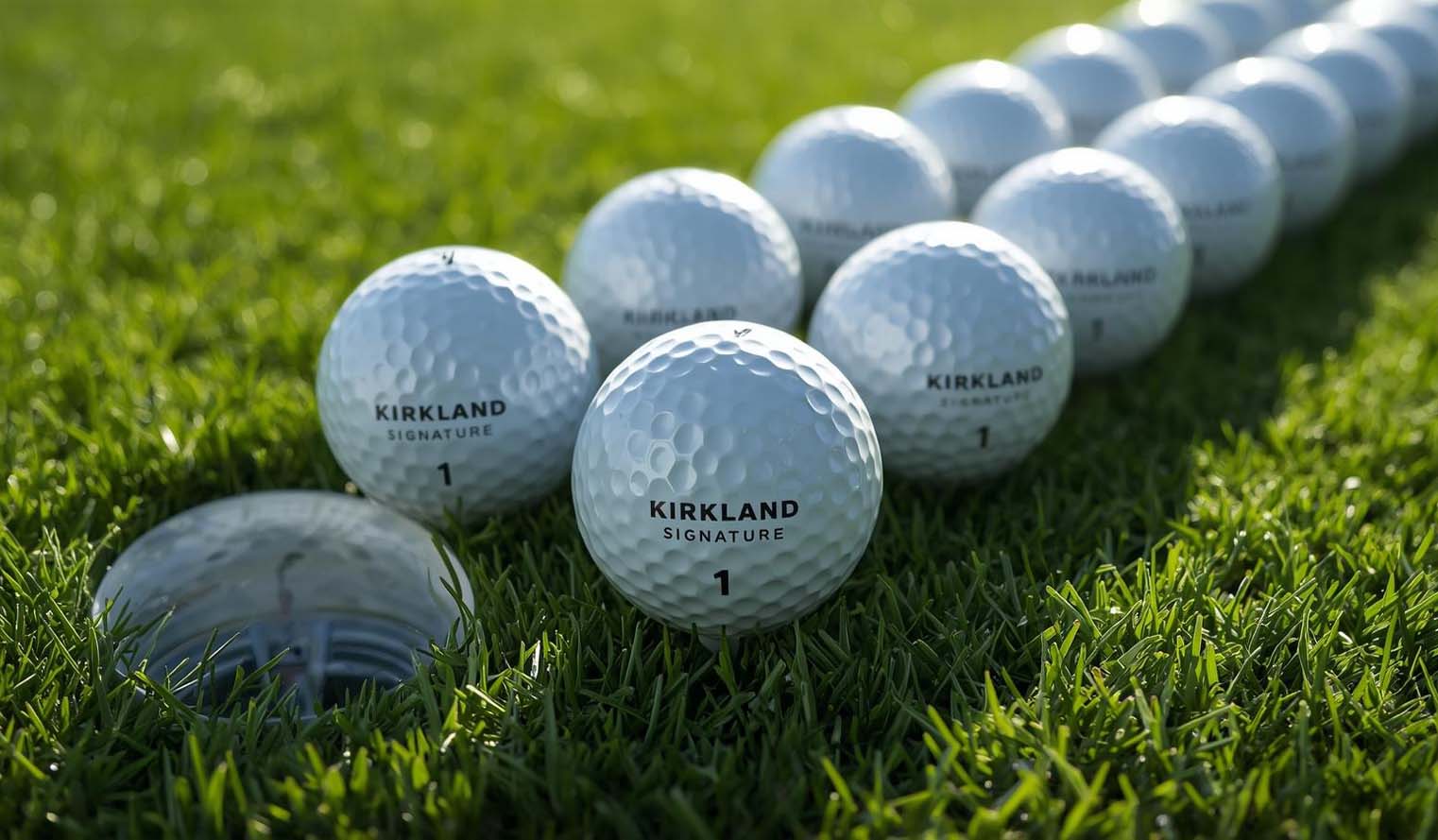
No, Titleist does not make Kirkland golf balls.
Kirkland golf balls are Costco’s private-label products, manufactured by independent third-party factories under contract. Titleist has never produced Kirkland balls, and the two brands do not share manufacturing facilities, materials, or production oversight.
That fact alone clears up the question—but not the confusion. The misunderstanding exists because Kirkland balls were intentionally engineered to compete in the same performance category as premium tour balls, not because they share a common origin.
Why Golfers Still Believe Titleist Is Behind Kirkland?
This belief persists because golfers tend to compare outcomes rather than processes.
When the original Kirkland Signature 4-piece ball launched, it produced launch, spin, and feel numbers that were unusually close to tour-level balls at a fraction of the price. For many players, the simplest explanation was shared manufacturing. In reality, it was shared performance intent, not shared production.
Another factor most competitors overlook is Costco’s brand behaviour. Kirkland products across multiple industries often match or exceed national brands in blind testing, yet the manufacturer remains undisclosed. That pattern trained consumers to assume a hidden premium source.
Who Actually Manufactures Kirkland Golf Balls? (With Context Competitors Miss)
Nassau Golf produced the original Kirkland 4-piece ball in South Korea, a factory with legitimate experience producing multilayer urethane balls for global brands. This mattered because Nassau already had tooling capable of creating thin urethane covers and complex mantle layers—something few factories could do at scale in 2016.
Modern Kirkland balls, including the Performance+ models, are manufactured by Qingdao SM Parker in China. This shift was not purely about cost. It was also about scalability, legal insulation, and batch control.
What competitors rarely explain is that Costco does not lock itself into a single factory in the long term. The company rotates manufacturers to reduce supply-chain risk and to leverage pricing. That strategy slightly affects consistency—but protects the retail model.
The Titleist–Costco Lawsuit: The Part Most Articles Oversimplify
The lawsuit filed by Acushnet (Titleist’s parent company) in 2017 is often described as proof that the balls were “too similar.” That framing is incomplete.
The legal issue centred on specific patented design elements, not overall performance. Golf ball patents cover features such as layer thickness ratios, core compression gradients, and dimple edge angles—not distance or spin numbers.
Costco did not lose the case outright, nor did a court rule that the balls were copies. Instead, Costco chose to discontinue the 4-piece ball and redesign future models to avoid prolonged legal exposure.
This decision explains why Kirkland balls changed construction, not why they stopped “copying” anyone.
Why Kirkland Balls Are Not Rebranded Titleist Balls?
One misconception competitors often ignore is how tightly controlled premium ball manufacturing actually is.
Titleist produces Pro V1 balls in company-owned facilities with proprietary rubber compounds, in-house urethane chemistry, and internal tolerance standards that reject balls consumers would never notice. These standards are expensive, slow, and incompatible with Costco’s volume-first retail model.
Even if a factory could replicate those processes, it would violate exclusivity contracts long before a ball reached a shelf. The idea of simple “overruns” does not align with how modern golf ball supply chains operate.
Kirkland vs Pro V1: Where the Differences Really Show Up
Most comparisons focus on launch monitor numbers, which tell only part of the story. The bigger separation appears over time and across conditions.
Kirkland balls tend to produce slightly higher driver spin, which stabilises flight for moderate swing speeds but costs distance for faster players. Around the greens, spin is strong, but consistency varies more from ball to ball. This is where manufacturing tolerance matters more than raw design.
Durability is another quiet divider. Kirkland’s urethane covers scuff faster, especially on full wedge shots. Pro V1 covers retain performance longer because of more advanced curing processes and stricter surface inspection.
None of this means Kirkland performs poorly. It means performance is less repeatable, which only matters if your game is sensitive to it.
Why Price Alone Doesn’t Explain Kirkland’s Value?
Most competitors stop at “cheap but good,” which misses the real reason Kirkland succeeds.
The value proposition is not the price per dozen—it’s the price per acceptable outcome. For golfers who lose several balls per round, marginal consistency gains offer no real benefit. For them, Kirkland’s performance ceiling is high enough that the trade-offs never surface.
This is why many mid-handicap players score the same with Kirkland balls as they do with premium balls, despite measurable technical differences.
The Retail Strategy Nobody Talks About
Costco’s decision to sell golf balls is not about competing with Titleist. It’s about reinforcing member value.
Kirkland balls are priced to:
- Drive foot traffic
- Increase basket size
- Reinforce trust in the private label
Profit per dozen is low by design. That economic reality shapes everything from material choices to quality control thresholds.
How Temperature Affects Golf Ball Performance? (And Why Kirkland Behaves Differently)
One underreported factor is how temperature affects golf ball performance.
In colder conditions, golf balls lose compression efficiency, reducing ball speed and carry distance. Lower-compression balls, like most Kirkland models, tend to retain a softer feel and a more usable launch in cold weather, while high-compression tour balls can feel harsh and unresponsive.
According to USGA equipment research, colder air also increases drag, compounding distance loss. This makes mid-compression balls more forgiving for average players during early-morning or winter rounds.
Reference: USGA Golf Ball Testing & Equipment Standards
The Myth of “One Perfect Ball for Everyone”
Competitors often frame the debate as a winner-takes-all comparison. Real fitting data doesn’t support that.
Golf balls are tools, not trophies. A Pro V1 is engineered for maximum consistency at elite levels. A Kirkland ball is engineered for broad, scalable use.
Neither goal is superior. They are simply different.
FAQ
1. Are Kirkland golf balls made by Titleist?
Answer: No — Kirkland golf balls are not made by Titleist. They are produced under Costco’s Kirkland Signature brand and manufactured by third-party golf ball producers, most commonly SM Parker and similar OEMs, rather than Titleist.
2. Who actually manufactures Kirkland golf balls?
Answer: While Costco doesn’t build golf balls itself, it contracts third-party manufacturers to produce them. Reports identify SM Parker (Qingdao SM Parker) as a key manufacturer, with past versions linked to suppliers like Nassau Golf. Titleist/Acushnet is not involved in making Kirkland balls.
3. Why do people think Titleist makes Kirkland golf balls?
Answer: The rumour persists because Kirkland balls have performance traits—like urethane covers—that resemble those of premium balls such as the Titleist Pro V1. A high-profile lawsuit from Titleist’s parent company over patent claims reinforced this association, even though the balls were never Titleist-made.
Bonus FAQ
Are Kirkland golf balls as good as Titleist Pro V1?
Many reviews find Kirkland balls offer impressive performance for the price and can rival higher-end balls in specific metrics. Still, Titleist balls generally lead in consistency, spin control, and advanced technology.
Final Verdict: Clearing the Confusion Completely
Titleist does not make Kirkland golf balls.
Kirkland balls are independently manufactured, legally distinct, and strategically positioned to deliver strong performance at unmatched value.
The reason the comparison persists is not secrecy or imitation—it’s that Costco succeeded in narrowing the performance gap far enough that, for many golfers, the difference no longer matters.
That understanding—not brand loyalty—is what leads to better decisions on the course.