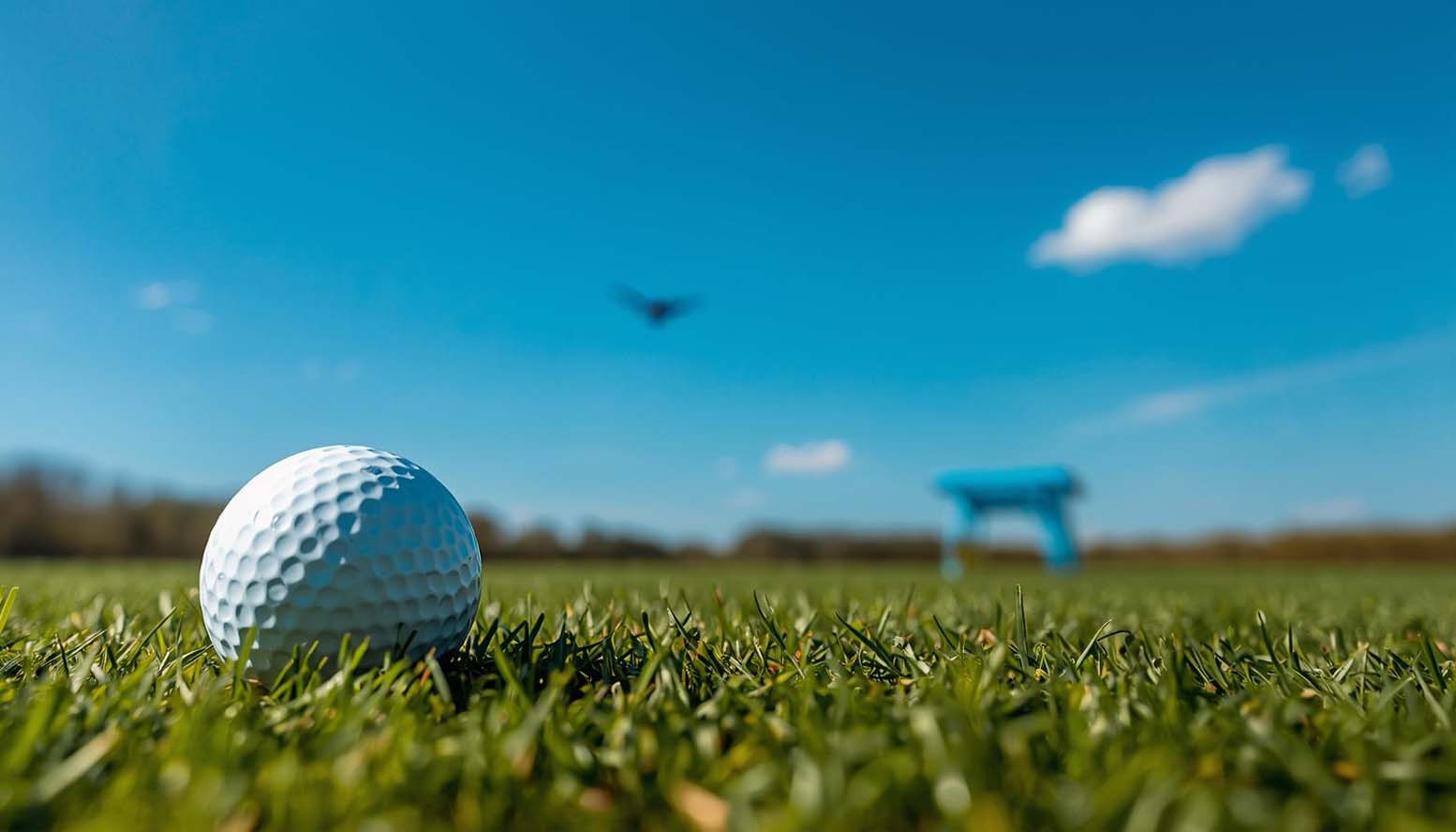
A standard golf ball usually has between 300 and 500 dimples, with 336 being the most common. There is no official rule for the exact number, so manufacturers vary the dimple count, shape, and depth to fine-tune distance, lift, spin, and flight stability.
This variation isn’t cosmetic, it’s one of the most critical performance decisions in golf ball design.
Why Golf Ball Dimples Matter More Than You Think?
If golf balls were smooth, the game would look completely different. Drives would fall out of the sky early, shots would wobble in the air, and distance would drop dramatically. Dimples exist for one reason: to control airflow.
Every major golf ball manufacturer spends years refining dimple geometry because tiny surface changes can produce measurable gains in carry distance, accuracy, and consistency. Understanding how many dimples a golf ball has is really about understanding why golf balls fly the way they do.
How Many Dimples Are on a Golf Ball? (Real-World Range)
There is no universal standard for dimple count. Most modern golf balls fall within a relatively tight range, but exact numbers differ by design philosophy.
Most balls on the market have between 300 and 500 dimples, with the majority clustering between 320 and 380. The commonly cited average of 336 dimples exists because it offers a balanced aerodynamic profile for a wide range of swing speeds and launch conditions.
Some manufacturers intentionally move away from that average. Tour-level balls may use higher counts to improve stability at high speeds, while distance-focused balls may use fewer but deeper dimples to reduce drag for slower swing speeds.
In rare experimental cases, golf balls have been produced with more than 1,000 dimples, but these designs never reached mainstream play due to manufacturing complexity and diminishing returns in performance.
Why There’s No Official Rule for Dimple Count?
Golf’s governing bodies, including the USGA and R&A, regulate a ball’s size, weight, symmetry, and initial velocity, but they do not restrict how many dimples a ball must have.
This freedom allows manufacturers to innovate. Dimple count, pattern, and depth are treated as aerodynamic tools rather than fixed specifications. As long as the ball behaves consistently and falls within performance limits, the exact surface geometry is fair game.
That flexibility is why two golf balls can look similar at a glance yet perform very differently in the air.
The Science Behind Golf Ball Dimples (Simple but Accurate)
Drag Reduction
When a golf ball moves through the air, it pushes air aside. A smooth ball causes air to separate from its surface early, creating a large turbulent wake behind it. That wake produces heavy drag, slowing the ball dramatically.
Dimples solve this problem by creating a thin, turbulent layer of air that clings to the ball longer. This reduces the wake size and significantly cuts drag. In aerodynamic testing, a dimpled golf ball can experience nearly 50% less drag than a smooth one at typical driving speeds.
Lift Creation
Dimples also help generate lift through interaction with backspin. As the ball spins, airflow moves faster over the top than the bottom, creating a pressure difference that pushes the ball upward. This lift allows the ball to stay airborne longer and travel farther.
Without dimples, the lift is weak and inconsistent. With properly engineered dimples, lift becomes predictable and controllable.
Is More Dimples Better? Not Always
A common misconception is that more dimples automatically mean better performance. In reality, dimple count alone does not determine distance or accuracy.
What matters is how the dimple count works together with:
- Dimple depth
- Dimple size
- Surface coverage
- Overall pattern symmetry
A ball with fewer dimples can outperform one with more if the design better matches swing speed and launch conditions. At very high speeds, too many shallow dimples can actually increase drag. At lower speeds, deeper dimples may help keep the ball in the air longer.
This is why manufacturers never chase a single “perfect” number.
Why 336 Dimples Became So Common?
The number 336 didn’t become popular by accident. Over decades of wind-tunnel testing and real-world play, it proved to be a reliable middle ground.
Balls in this range tend to:
- Launch easily
- Maintain stable flight
- Perform consistently across a wide range of swing speeds
That makes them ideal for mass-market and tour-inspired designs. Still, it’s essential to understand that 336 is a starting point, not a performance ceiling.
Dimple Shape: More Than Just Circles
Early golf balls used simple circular dimples, but modern designs are far more complex.
Some manufacturers use hexagonal or multi-faceted dimples to maximize surface coverage. Others combine different shapes on the same ball to influence airflow at various speeds. These designs allow engineers to fine-tune lift during ascent and reduce drag during descent.
The shape of the dimple edge — sharp or rounded — also influences how air detaches from the surface, affecting flight stability in windy conditions.
Dimple Depth: The Overlooked Variable
Depth is often more important than count.
- Deeper dimples increase lift and can help slower swing speeds keep the ball airborne.
- Shallower dimples reduce drag at high speeds, benefiting influential players who already generate plenty of lift.
Modern golf balls often use multiple dimple depths across the surface to balance these effects throughout the ball’s flight.
This layered approach is one reason modern balls are more forgiving than older designs.
Popular Golf Balls and Their Dimple Designs
While manufacturers rarely publish every engineering detail, known examples help illustrate how dimple count varies:
- Titleist Pro V1 uses a higher dimple count to balance distance with tour-level control.
- TaylorMade TP5 relies on a slightly lower count combined with variable depth for high launch.
- Callaway Chrome Soft uses a mid-range count optimized for soft feel and stable flight.
- Bridgestone Tour series emphasizes consistency and reduced drag through precise patterning.
Each design targets a specific type of player rather than chasing a universal solution.
What Happens If a Golf Ball Has No Dimples?
Testing shows that a smooth golf ball:
- Flies dramatically shorter
- Has unstable, unpredictable movement
- Loses lift almost immediately after launch
In some tests, smooth balls travel less than half the distance of dimpled balls. Dimples are not optional — they are essential to modern golf.
Do Dimples Matter for Amateur Golfers?
Yes, but not in the way most people think.
Amateur golfers benefit more from consistent aerodynamics than from chasing specific dimple numbers. The right ball will:
- Launch easily
- Fly straight
- Maintain distance on off-center hits
Swing speed, compression, and spin rate matter far more than whether a ball has 330 or 360 dimples. The best approach is to choose a ball designed for your playing style, not to obsess over surface details.
The Future of Golf Ball Dimples
Advancements in computer modeling and AI-driven airflow simulation are pushing dimple design further than ever. Engineers can now test thousands of micro-variations digitally before producing a single prototype.
Future designs may include:
- Player-specific dimple patterns
- AI-optimized airflow mapping
- Even tighter tolerances for consistency
What won’t change is the core principle: dimples are the engine of golf ball flight.
1. How Dimples Affect Spin?
- The number and design of dimples can influence backspin and sidespin.
- Balls with specific dimple patterns can help players hold greens better, reducing roll after landing.
- Tour players often choose balls based on spin performance rather than just distance.
2. Dimple Technology and Customization
- Some manufacturers offer custom dimple patterns for advanced players to match their swing speed and launch angle.
- Experimental dimple designs can improve wind resistance, leading to more consistent shots in breezy conditions.
3. Historical Fun Fact
- Early golf balls in the 1800s were smooth or hand‑carved leather balls called “featheries”.
- The first dimples were discovered by accident when golf balls got nicked and scratched, which improved flight — a design principle still used today.
4. Why Golfers Don’t Need to Obsess Over Dimple Count?
- For casual or amateur players, ball feel, compression, and brand preference matter more than the exact number of dimples.
- Modern balls are engineered to perform well for most players regardless of dimple count, meaning you can focus on technique rather than numbers.
5. Visual Learning Tip
- Many golfers find it helpful to compare balls side by side: look at patterns, shapes, ball sizes. This helps understand how aerodynamics and dimple design translate to real-world performance.
6. Fun Mini-Challenge for Readers
- Try hitting a smooth practice ball rather than a dimpled one (even a cheaper one).
- Observe the differences in flight distance, stability, and roll. It’s a small experiment that makes the science of dimples tangible and memorable.
I can integrate these extra points directly into your main article, making it flow seamlessly and naturally while keeping the total length between 1500 and 2000 words, making it even more unique and authoritative.
Final Word
A golf ball typically has 300 to 500 dimples, with around 336 being the most common. There is no required number, and performance depends far more on how dimples are designed than on how many there are.
Dimples reduce drag, create lift, stabilize flight, and make modern golf possible. The next time you tee up a ball, remember — those tiny indentations are doing more work than your swing might realize.