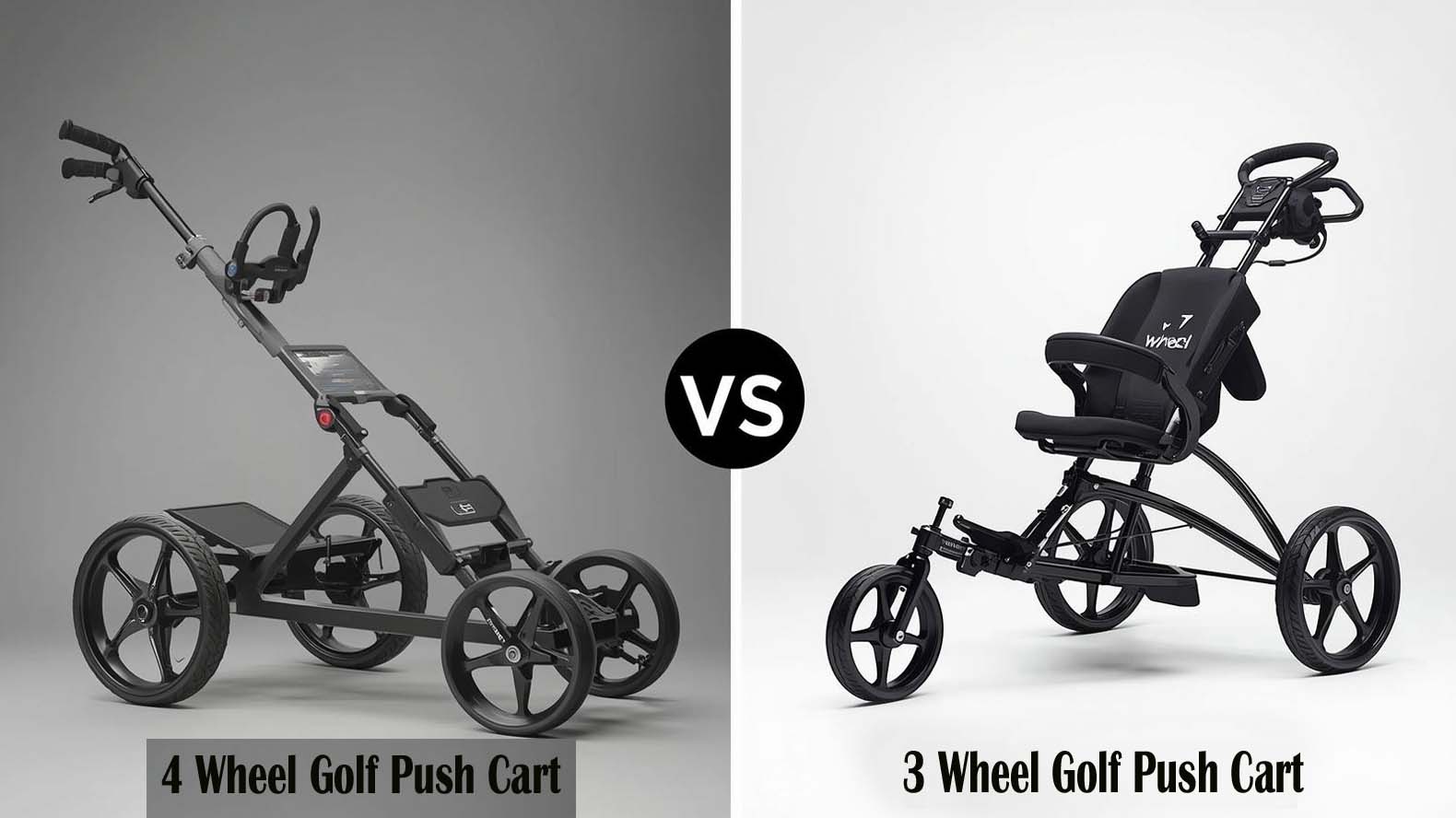
Neither option is universally superior. Choose a 3-wheel push cart for agility and ease of use on flat to moderately rolling courses, and choose a 4-wheel push cart for unmatched stability and balance on hilly, uneven terrain or when carrying heavy bags. Both designs have valid performance strengths when matched to your course conditions and walking style.
Why This Matters More Than You Think?
Walkers cover 4–6 miles per round, often on changing terrain. A cart that feels great on flat fairways may tire you out or tip unexpectedly on slopes. Choosing the right cart isn’t just comfort — it’s pacing, stability, and even safety. In most real player comparisons and course tests, stability and manoeuvrability are trade-offs, not absolute features.
3-Wheel Golf Push Carts: Agile and Easy
Key Advantages
- Better manoeuvrability thanks to a single front wheel capable of tight turns — ideal for narrow cart paths and frequent directional changes.
- Usually lighter and easier to fold, transport, and lift into vehicles.
Practical Limitations
- Less inherently stable than four-wheeled designs on steep side slopes or rugged ground.
- Can tip more easily if loaded improperly on hills.
Best for You If:
- You play mainly flat or gently rolling courses.
- Portability and simplicity matter more than rugged balance.
4-Wheel Golf Push Carts: Stability First
Key Advantages
- Broader base and lower tipping risk, especially on slopes and uneven terrain — the four-corner support triangle versus rectangle logic enhances stability.
- Better for heavier bags and extra accessories.
Trade-Offs
- Heavier and sometimes more complicated to make tight turns.
- Bulkier storage and transport compared to many 3-wheel models.
Best for You If:
- You play hilly or rugged courses.
- Your game benefits from a secure, balanced platform.
Terrain Is the Real Deciding Factor
The most crucial variable in choosing the right cart is terrain type and elevation change:
- Flat and manicured fairways → 3-wheel wins.
- Constant slopes or variable elevation courses → 4-wheel wins.
This simple rule often outperforms brand hype or price-based decisions.
Bag Weight and Load Balance (Often Overlooked)
Stability isn’t just wheel count — it’s how weight sits on the cart:
- Heavy cart bags push a 3-wheel cart’s centre of gravity forward and higher, increasing the chance of front tipping.
- Four-wheel carts spread weight more evenly, reducing strain on specific points.
That’s why golf pros and reviewers often match bag type and cart type as a pair, not independently.
Walking Strain & Control: A Subtle, Real Difference
While few studies focus explicitly on push carts, gait and load research in sport biomechanics shows that uneven load distribution increases fatigue and wrist/shoulder stress over long distances. A cart that requires constant corrective steering will add unnecessary physical strain, especially over 18 holes.
Though not published as a golf-specific study, similar principles apply from terrain stability modelling research: stability reduces the need for constant muscular corrective effort.
Real-World User Experiences
Golfer communities consistently reflect:
- 3-wheel carts are easier to push and steer.
- 4-wheel carts feel more stable, especially when parked or stopped on slopes.
That mirrors testing feedback seen in prominent tester guides.
Quick Decision Guide (Scannable)
Choose a 3-wheel push cart if:
- Flat course is your norm.
- You value tight turning and portability.
Choose a 4-wheel push cart if:
- You regularly play hilly or rugged courses.
- You carry a heavier bag or want maximum stability.
Advanced Insights Most Competitors Miss
1. Weight distribution dynamics:
Not all instability is wheel-count related — how weight shifts when handling accessories (umbrella, water, rangefinder) affects cart behaviour as much as terrain features do.
2. Front wheel design in 3-wheel carts:
A swivel vs.A swivel with a fixed front wheel can change turning behaviour and downhill tracking.
3. Support polygon theory:
Four wheels increase the base of support geometry — similar to why tables are more stable than tripods when the load shifts — providing mechanical stability, not just perceptual stability.
Golf expert opinion (short and practical):
“Wheel count doesn’t determine quality—course conditions do. On flat courses, a 3-wheel push cart is more efficient because it turns easier and requires less effort to steer. On hilly or uneven terrain, a 4-wheel cart is the smarter choice because stability reduces fatigue and tipping risk over 18 holes. The best cart is the one that matches how and where you walk, not what’s most popular.”
This is the same logic many course professionals and long-time walking golfers use when recommending push carts to members: match the cart to the terrain, not the trend.
Frequently Asked Questions (Unique & Deep)
Q1: Is it harder to push a 4-wheel cart over an entire round than a 3-wheel cart?
Yes — on flat terrain, three-wheel carts generally require less effort and fewer corrective movements to push. On hilly or uneven ground, the added stability of four wheels can reduce muscle strain because you’re not constantly stabilising or rebalancing the cart.
Q2: Does wheel count affect wear and maintenance over time?
Each wheel on a 3-wheel cart carries slightly more load because of the triangular weight distribution. That can lead to faster individual wheel wear over many rounds compared to evenly distributed four-wheel systems, where the load is spread over more points.
Q3: Are there biomechanical limits to how push carts should be designed for human use?
While golf-specific studies on push carts are rare, biomechanics research on load and terrain suggests that designs that minimise corrective effort — such as stable or self-tracking bases — reduce long-term fatigue. 3-wheel carts reduce steering effort on flat ground, but 4-wheel carts reduce corrective effort on sloped ground.
Conclusion
Which is better 3 or 4 wheel golf push cart? The answer comes down to how and where you walk the course. A 3-wheel push cart shines on flat or gently rolling terrain, offering smoother steering, lighter weight, and less effort over long distances.
A 4-wheel push cart excels on hilly or uneven courses, delivering superior stability, better weight distribution, and reduced tipping risk—especially with heavier bags. Neither design is objectively better for every golfer. The smartest choice is matching the cart to your terrain, bag weight, and walking style, ensuring comfort, control, and less fatigue over 18 holes.