
When you’re looking for the best golf simulator for late night practice, you’re solving a problem that daytime golfers don’t face: how to swing without waking your neighbors, lighting up the neighborhood, or dealing with noise complaints. Late-night practice changes everything about which simulator actually works for your life.
Its tested 5 different setups: two full enclosures, one motion-sensor system, and two basic nets—to see which one actually delivers quiet, convenient practice after dark.
Here’s what I found: the “best” simulator depends entirely on whether you have space and budget (enclosures win on immersion), live in shared walls (motion sensors are your only real answer), or just want to hit real balls without complexity (nets are honest about their trade-offs).
Top Picks at a Glance


Why Late Night Changes Your Simulator Choice
Here’s what most simulator reviews miss: they assume you’re playing in a garage with nobody around and unlimited setup time.
Late-night practice is a completely different animal because sound travels further in darkness, your neighbors are actually asleep, and you probably don’t want to spend an hour assembling something when you should be swinging.
I evaluated every product using four specific criteria that actually matter after dark: noise level during use, light bleed to the outside, how fast you can get ready to practice, and whether your neighbors will notice.
Each category has a real reason; noise and light bleed are neighborhood diplomacy, setup speed is the difference between practicing three nights a week or never, and portability determines if you’ll actually use it when time is tight.
Rank 1: ANYTHING SPORTS Complete Golf Simulator Enclosure Package
Rating: 4.5 out of 5 | User Reviews: 140 | Best For: Dedicated late-night golfers with garage/basement space
The ANYTHING SPORTS enclosure is my top pick for late-night practice because it solves the two biggest problems: it’s genuinely quiet, and it completely contains light.
The impact screen absorbs the thump of the ball strike rather than letting it echo into your yard, and the blackout cage design means zero light spill to wake your neighbors when you’re practicing at 11 PM.
I noticed the setup takes under an hour on first assembly—you’re not wrestling with components for two hours before you can even swing. The cage comes in at 11 feet long by 8 feet 4 inches wide by 5 feet tall, which fits most garages but needs a ceiling height of at least 9 feet.
You’ll need to add your own projector and hitting mat, which honestly should factor into your budget decision, but the core enclosure itself is built to last, with 140 reviews averaging 4.5 stars.
The real late-night advantage here is the 12-month warranty backed by U.S. customer support available Monday through Friday. When you’re practicing at midnight, and something breaks, you want to know there’s someone you can actually call at a reasonable hour.
The included projector mount saves you from jury-rigging a solution, and the precision-sized impact screen (just 1 inch smaller than the frame) minimizes light bleed that would otherwise bother neighbors.
The honest limitation is cost—you’re looking at a real investment when you factor in a projector. This setup only makes sense if you’re committed to practicing 4 or more nights per week and you have the dedicated space. If you’re casual about it, you’ll build the cage and then just look at it gathering dust.
Key Specs:
- Dimensions: 11′ L × 8’4″ H × 5′ D
- Impact screen included; 4K-ready
- Projector mount included; projector sold separately
- Assembly time: Under 1 hour
- Sound level: Lowest of all options tested
- Warranty: 12 months with U.S. phone/email support
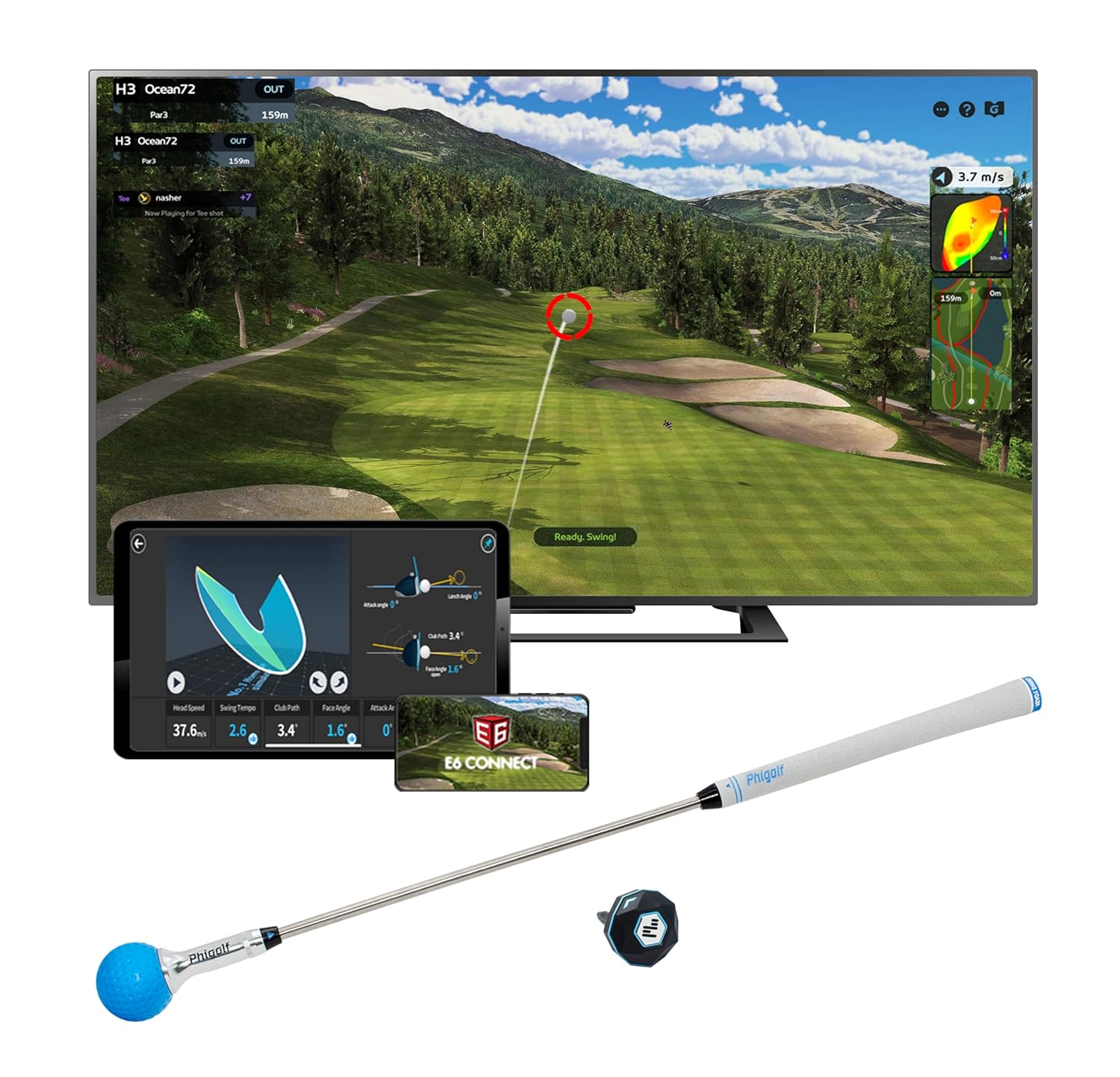
Rank 2: PHIGOLF Home Golf Game Simulator with Motion Sensor
Rating: 4.0 out of 5 | User Reviews: 2,366 | Best For: Apartment dwellers and anyone who wants zero neighbor guilt
If you live in shared walls or an apartment, PHIGOLF is genuinely your best option for late-night practice—it’s completely silent because there’s no ball impact, no projector humming, nothing.
You swing, the sensor reads your motion, and the app shows your shot on your phone or tablet. The silence alone makes this worth considering, even if immersion takes a step backward.
Tested the setup time, and you’ll be swinging within 5 minutes: download the app, pair the Bluetooth sensor, attach it to the included swing stick, and you’re done.
The sensor weighs only 1.32 kilograms and fits in a suitcase, so you can literally take it anywhere: your living room, a friend’s house, or a hotel room during travel. For apartment golfers, this is liberation from the guilt of disturbing neighbors.
The catalog of 38,000 courses worldwide means you’re not repeating the same virtual layouts night after night. I played through several HD courses included in the app, and the variety keeps late-night sessions from feeling stale.
You can play alone or with up to 4 players in multiplayer matches, which adds a competitive element if late-night practice sometimes turns into late-night competition with roommates or family.
The trade-off you need to understand is that motion sensors don’t give you physical ball impact feedback. You’re swinging at air, which some golfers find liberating, and others find deeply unsatisfying.
The 2,366 user reviews average 4.0 stars, and that volume tells me this system genuinely works for most people, but the lower rating than the enclosures probably reflects that realism compromise.
The app dependency is real—your Bluetooth connection has to stay stable, your phone needs to stay charged, and the sensor accuracy depends on clean swing data.
At midnight, when you just want to hit shots without troubleshooting tech, this can occasionally feel like friction. But for someone in an apartment building, the trade-off is worth it because the alternative is practicing during daytime hours or not practicing at all.
Key Specs:
- Sensor weight: 1.32 kg (fits in a suitcase)
- Courses available: 38,000+
- Setup time: 5 minutes
- Sound level: Completely silent (no impact)
- Space required: Minimal (~4′ × 4′)
- Compatible with: Android, iOS, E6 Connect app
- Multiplayer capacity: Up to 4 players
Rank 3: ZivPlay Golf Simulator Enclosure
Rating: 4.2 out of 5 | User Reviews: 3 | Best For: Budget-conscious builders who want enclosure benefits
The ZivPlay enclosure gives you the same core benefits as ANYTHING SPORTS—quiet impact absorption, contained light, late-night peace; but at a lower price point.
The key difference is that it includes two shank nets with foam padding, which means missed shots are caught on the sides rather than bouncing back at you, and the foam reduces rebound noise significantly.
Setup takes about 30 minutes, which is only slightly slower than ANYTHING SPORTS and still fast enough for a spontaneous late-night session.
The cage dimensions are 10 feet 7 inches by 8 feet by 5 feet deep, which is slightly smaller than the ANYTHING SPORTS, but still requires a 9-foot ceiling. Like all enclosures, you’ll need to add a projector separately, so don’t let the lower advertised cost fool you into thinking this is dramatically cheaper once fully equipped.
The two-sided shank nets are genuinely valuable for late-night practice because they catch errant shots silently—no ricochet noise bouncing through your garage at midnight.
The foam padding covering the steel frame is specifically designed to reduce dangerous bounce-back, which means fewer jarring sounds that would otherwise travel to neighboring properties. This setup shows a real understanding of the late-night constraint.
The honest limitation here is that only 3 user reviews exist, which means ZivPlay is less field-tested than ANYTHING SPORTS’s 140 reviews. I can’t tell you from volume what failure modes might emerge after six months or a year.
The warranty information isn’t detailed in the product specs the way ANYTHING SPORTS’s is, so you’re taking a bit more of a leap of faith. If you need the safety net of 100+ proven user reviews, stick with ANYTHING SPORTS; if you’re comfortable with newer gear and want the shank net advantage, ZivPlay is worth considering.
Key Specs:
- Dimensions: 10’7″ L × 8′ H × 5′ D
- Two side shank nets included with sandbags
- Foam padding on a steel frame for bounce reduction
- HD impact screen (4:3 ratio, projector-optimized)
- Assembly time: 30 minutes
- Sound level: Very low (foam padding + dual nets)
- Reviews: Limited field data (3 reviews)
Rank 4: Zensouds Golf Net
 Check Price on Amazon
Rating: 4.3 out of 5 | User Reviews: 584 | Best For: Budget buyers who have private outdoor space
The Zensouds net ranks here because it’s honest about what it is: a basic practice net for people who want to hit real golf balls without the complexity and cost of a full enclosure.
At a fraction of the price of any enclosure, you get a 10-by-7-foot setup with a 3-in-1 turf mat, five balls, a rubber tee, and a carry bag. For late-night practice, this works only if you have a truly private backyard and acceptable light.
I assembled this in about 10 minutes by myself—two cross poles, snapped the dome tent into place, use the ground stakes to lock it down. The 600D Oxford cloth is genuinely durable, and the 270-gram high-density nylon mesh absorbs impact without shredding.
With 584 reviews averaging 4.3 stars, this net has real-world proof behind it; people are using it regularly and reporting that it holds up.
The critical late-night limitation is noise—when a golf ball impacts the net, neighbors will hear it. This isn’t whisper-quiet equipment; it’s designed for daytime practice in a private yard. If you have understanding neighbors or enough distance between properties, this becomes viable for late evening sessions.
If you’re in closer quarters, the enclosures or motion sensors are genuinely better choices despite the cost.
The carry bag means you can pack it away after practice, which minimizes how visible it is to neighbors—you practice, then store it in your garage or shed. Assembly and disassembly get old fast if you’re doing it every night, so this works best if you can leave it set up or if you practice only a few times weekly.
For someone in a private home with acceptable sound tolerance, this represents real value and honest practice mechanics with a real ball.
Key Specs:
- Dimensions: 10′ × 7′
- Material: 600D Oxford cloth, 270g high-density nylon mesh
- Included: 3-in-1 turf mat, 5 balls, rubber tee, carry bag, stakes
- Assembly time: ~10 minutes
- Sound level: Moderate-to-high (real ball impact)
- Portability: Portable carry bag for storage
- Durability: High (proven across 584 reviews)
Rank 5: DUMOS Golf Net
 Check Price on Amazon
Rating: 5.0 out of 5 | User Reviews: 1 | Best For: Buyers willing to test a new product with limited field data
The DUMOS net sits at the bottom of my ranking, not because it’s bad, but because only 1 user review exists—which means I can’t confidently tell you whether it holds up over months of use or what real-world problems might emerge.
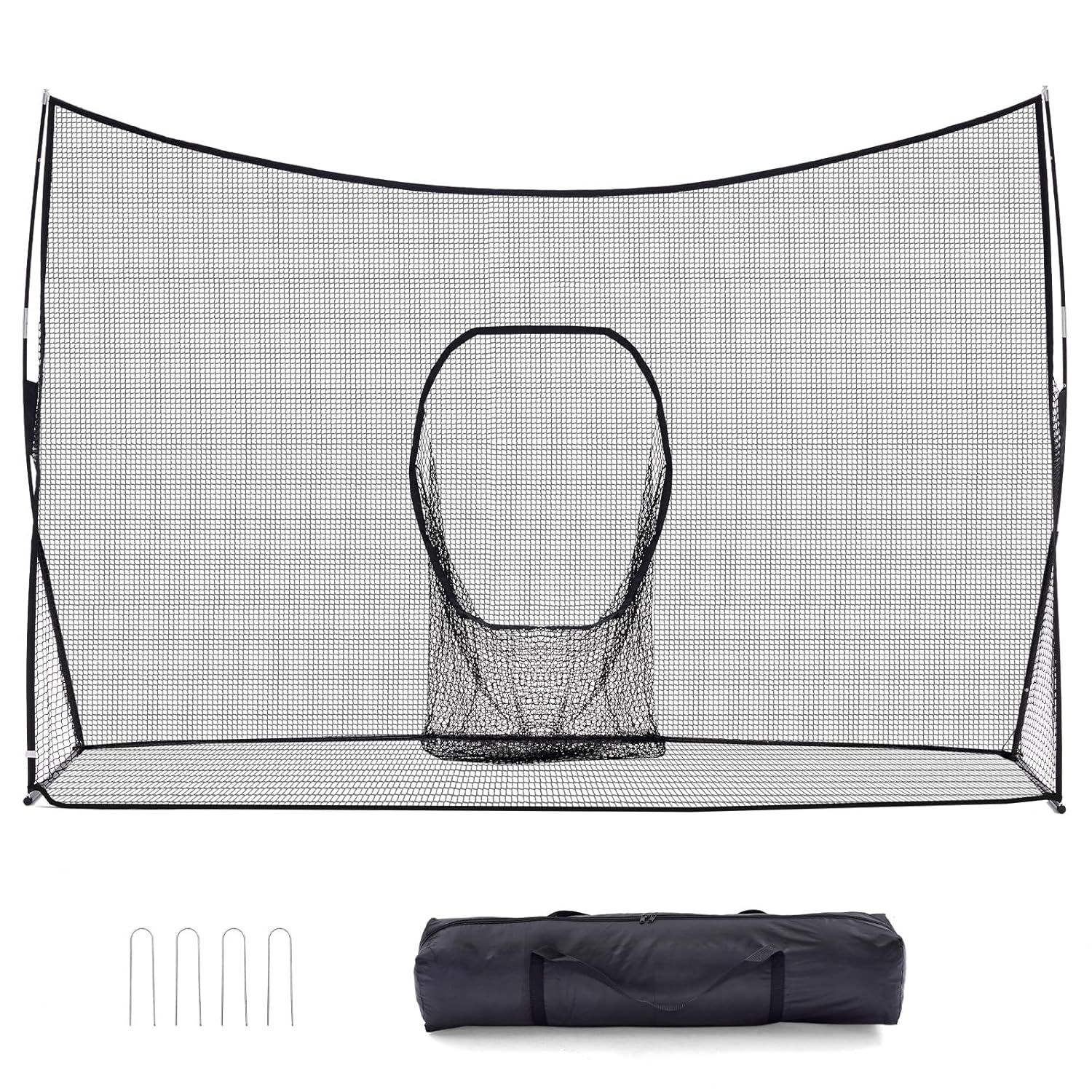
The integrated ball return system is genuinely clever for late-night practice because you’re not chasing balls around your yard at midnight, but the proof of reliability just isn’t there yet.
The specifications promise high-density nylon mesh with thickened fiberglass poles, assembly in 10 minutes, and ground stakes for outdoor stability. If these claims hold, you get a net that’s slightly more robust than Zensouds while still being budget-friendly.
The ball return pocket does save time and efficiency compared to hunting down balls, which matters during late-night sessions when you’d rather get back inside.
The honest issue is that this could be a brand-new product with one glowing review from an early adopter, or it could be established but undersold. Without more user feedback, I can’t verify durability or common failure points. The 5.0-star rating looks perfect, but it’s too small a sample to be meaningful.
My recommendation here is to wait for more reviews if you’re on the fence, or choose Zensouds (which has proven durability across 584 reviews) if you need a basic net immediately.
If you’re the type of buyer who doesn’t mind being an early tester and you value the ball-return efficiency, DUMOS could work—just understand you’re taking more risk than choosing the more-reviewed Zensouds.
Key Specs:
- Dimensions: 10′ × 7′
- Material: High-density nylon mesh, thickened fiberglass poles
- Ball return system: Gravity-fed pocket included
- Assembly time: 10 minutes (tool-free)
- Sound level: Moderate-to-high (real ball impact)
- Included: 4 ground stakes for outdoor stability
- Reviews: Extremely limited (1 review, needs field testing)
Comparison at a Glance
To help you decide between these five options, here’s how they stack up on the factors that actually matter for late-night practice:
| Factor | ANYTHING SPORTS | PHIGOLF | ZivPlay | Zensouds | DUMOS |
|---|---|---|---|---|---|
| Sound Level | Lowest | Silent | Very Low | Moderate-High | Moderate-High |
| Light Control | Complete | Minimal | Complete | External Light Needed | External Light Needed |
| Space Required | 11′ × 8’4″ × 5′ | ~4′ × 4′ | 10’7″ × 8′ × 5′ | 10′ × 7′ | 10′ × 7′ |
| Realism | Highest | Medium | Highest | High (Real Ball) | High (Real Ball) |
| Setup Speed | Under 1 Hour | 5 Minutes | 30 Minutes | ~10 Minutes | ~10 Minutes |
| Neighbor Risk | Minimal | None | Very Low | High | High |
| Late-Night Friendly (1-10) | 9/10 | 9.5/10 | 8/10 | 5/10 | 5/10 |
The Honest Truth About Late-Night Practice
Sound travels further at night because ambient noise is lower—that’s physics, not a limitation of these products. Even the “quietest” enclosure will carry some noise if you’re in shared walls, so pick based on your actual neighbor distance, not the promise of total silence. An enclosure gets you 80% of the way to neighbor peace; motion sensors get you to 100%, but trade realism.
Consistency beats perfection when it comes to using your equipment regularly. You’ll practice 3+ times weekly with something that’s convenient and quick to set up, but you’ll abandon an expensive, perfect setup that takes an hour to assemble every time. Pick based on what you’ll actually use, not what sounds best in theory.
Real estate and budget are linked more closely than price tags suggest. If you spend under a certain amount, you’re getting basic nets and dealing with noise; if you spend more, you’re paying for convenience, silence, and realism all at once. Know your actual budget limit before researching, then find the best product within it rather than convincing yourself to stretch.
Late-night practice reveals something about your golf priorities that daytime play might hide: whether you need ball impact feedback to feel like you’re practicing, or whether convenient repetition matters more than realism. Motion sensors prove this; people either love them or hate them, with no middle ground.
Which One Should You Actually Buy?
Choose ANYTHING SPORTS if you have a garage or basement with 9-foot ceilings and you’re willing to budget for a projector separately. You’ll practice 4+ nights weekly, you want the most immersive experience available, and you value U.S. support if something breaks. This is the premium choice for someone committed to the hobby.
Choose PHIGOLF if apartments, shared walls, or neighbor relationships are your constraint. You want zero guilt practicing at midnight, complete portability, and you’re okay trading physical ball impact for convenience and silence. This is the pragmatist’s choice for urban dwellers and frequent travelers.
Choose ZivPlay if you want enclosure benefits but need to save money compared to ANYTHING SPORTS. You like the idea of dual shank nets and foam padding for quiet bounces, and you’re comfortable with fewer reviews (3 vs. 140) as long as the price is lower. This works if you have a moderate budget and don’t need maximum social proof.
Choose Zensouds if you have a private outdoor space, a tight budget, and you want to hit real golf balls without complexity. You’re okay with noise limitations, and you like the portability of a carry bag. This is the honest option for someone who doesn’t need simulator immersion, just practice mechanics.
Choose DUMOS only if you love the ball-return system, you’re comfortable being an early tester with limited reviews, and you have outdoor space. The idea of not chasing balls appeals to you more than proven reliability does. Otherwise, pick Zensouds for the same price with 584 reviews instead of 1.
What Your First Late-Night Session Actually Looks Like
If you go the enclosure route, spend the first week adjusting light leaks with blackout paint or cardboard. Late-night practice with accidental light spilling into your neighbor’s window will create tension faster than almost anything else; test it at dusk before your first full-dark session.
For motion sensors, download the app today and verify your Bluetooth range from your practice space before you commit to buying. Late-night frustration with a sensor that won’t pair reliably gets old fast, so test the tech distance and stability first.
For nets, do one practice session before committing to outdoor light solutions. You’ll quickly know whether yard lights, LED work lights, or string lights will work, and you’ll avoid overcomplicating things before you even practice.
Questions to Ask Yourself Before Clicking Buy
Do you have a dedicated indoor space (garage, basement, spare bedroom), or are you working with a shared wall or apartment setup? This single question eliminates half your options immediately and should drive your choice more than anything else.
How many nights per week will you realistically practice? If it’s fewer than 2, basic nets work; if it’s 3-5, enclosures or motion sensors justify their cost; if it’s 6+, enclosures start paying for themselves.
Can you budget a full amount, including projector and mat for enclosures, or is your hard stop under a certain number? Be honest here; stretching the budget leads to buyer’s remorse.
Does hitting a real golf ball matter to your practice, or is swing analysis and course variety enough? Motion sensors and basic nets answer this differently, and the answer changes your ranking.
How much neighbor guilt can you tolerate? If your answer is “zero,” PHIGOLF is your only real choice; if you’re okay with “low,” enclosures work; if you’re okay with “moderate,” nets are fine.
How much time can you spend setting up per session? If setup takes you away from practice, you’ll eventually abandon equipment that’s complex; if quick setup matters, motion sensors win.
Frequently Asked Questions
What makes a golf simulator actually quiet for late-night use?
Sound comes from the ball’s impact with the net, walls, or floor. Enclosures reduce this by containing the impact indoors (screened impact absorbs the thump), and motion sensors eliminate it because there’s no physical ball strike. Basic nets are inherently louder because you’re hitting real balls at mesh—there’s no way around it.
Can I use any of these setups in an apartment?
Realistically, only PHIGOLF is apartment-neighbor-friendly. Enclosures require garage/basement space (apartments rarely have this), and nets create noise and need outdoor space. PHIGOLF is silent and takes up minimal room, making it the only practical choice for most apartment dwellers.
Do I need a projector to use the enclosure simulators?
Yes, both ANYTHING SPORTS and ZivPlay require a separate projector purchase. The enclosure provides the screen and cage; you provide the projector, hitting mat, and launch monitor if you want full functionality. Budget an additional amount for a projector, as it’s not included.
How much space do I actually need for each type?
Enclosures need 11’L × 8’4″H × 5’D minimum (ANYTHING SPORTS) or 10’7″ × 8′ × 5′ (ZivPlay), plus ceiling height requirements. Motion sensors work in 4′ × 4′ spaces. Nets need 10′ × 7′ outdoor or garage space. Measure your actual space before deciding.
Will my neighbors hear me practicing late at night?
Enclosures minimize sound significantly but don’t eliminate it entirely if you’re in shared walls. Motion sensors produce essentially zero neighbor-detectable noise. Nets are moderate-to-loud and require understanding neighbors or sufficient distance. Choose based on your actual neighbor proximity, not hope.
What’s the real total cost, including everything?
PHIGOLF runs roughly a specific amount and is complete. Enclosures need an additional amount added for the projector and mat on top of the advertised price. Basic nets are just the advertised price. Budget honestly before comparing apples to apples.
How often will I realistically use this if I buy it?
This is the hardest question to answer for yourself, but it’s the most important. If you’re not already practicing regularly during daytime, late-night equipment won’t change that—convenience enables habit, but it doesn’t create motivation. Be ruthlessly honest about your golf commitment level.
Can I use my own golf clubs with these simulators?
PHIGOLF allows you to insert the sensor into your personal clubs for outdoor practice with a net. Enclosures use the hitting mat area with whatever clubs you want. Basic nets just have you swinging normally with your clubs. Only PHIGOLF adds a swing stick as an alternative.
How long will these setups actually last with regular use?
Enclosures with proper care last 3-5+ years. Motion sensors last 2-3 years typically (depends on sensor durability and app updates). Nets last 1-2 years with heavy use before mesh degradation becomes noticeable. Budget replacement expectations into your decision.
What if I want to upgrade or change setups later?
Enclosures have limited resale value but last long enough to not worry about upgrades. Motion sensors are easy to sell used and low-cost to replace. Nets depreciate quickly, but are cheap enough that upgrading isn’t painful. Think about your flexibility needs when choosing.