
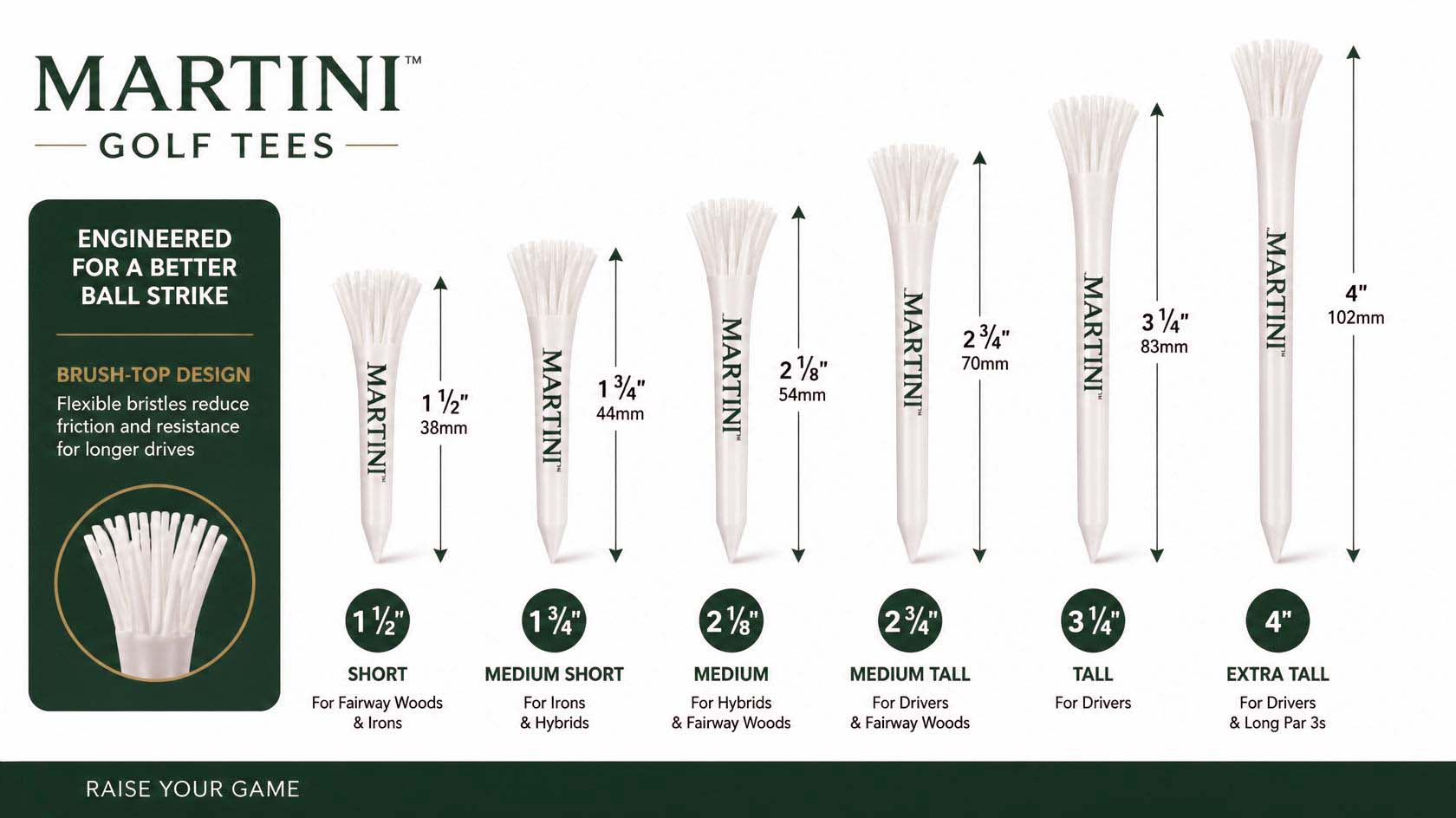
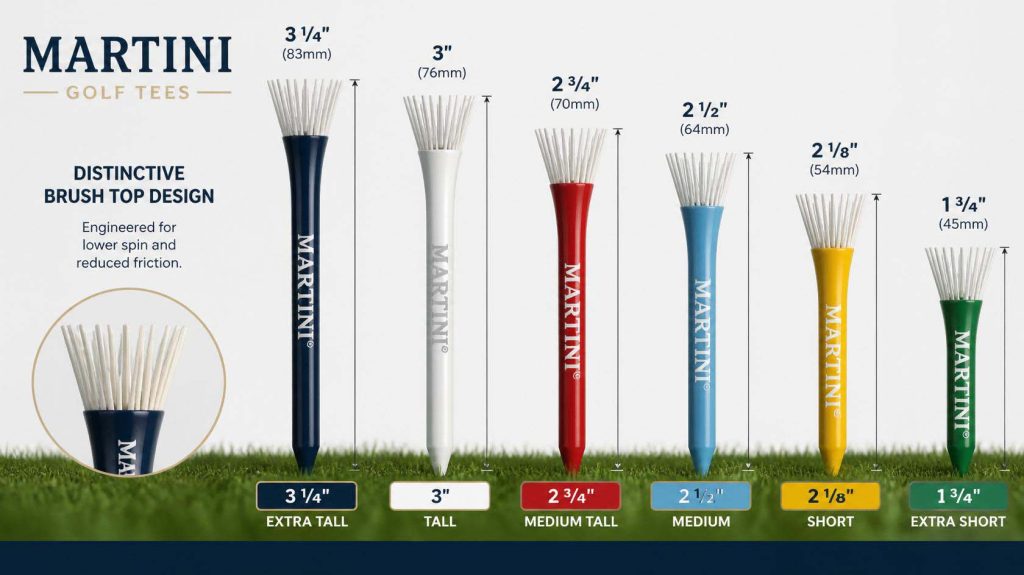
If you have ever asked, “How tall are Martini golf tees?”, the direct answer is: they come in three sizes. The Standard is 2.75 inches (70 mm). The Mid is 3.25 inches (83 mm). The Extra Tall is 4 inches (102 mm). But the real story is not just the length of the tee.
It is about the three-step platforms on every Martini tee and how deep you push it into the ground. Those two things decide the actual height your ball sits off the turf.
Martini Tee Heights by Model
Each Martini model has three steps. The steps are not evenly spaced. The bottom step is closest to the ground, the middle step is the most common choice for drivers, and the top step puts the ball highest. Here are the raw lengths of each model:
- Standard Martini: 2.75 inches (70 mm)
- Mid Martini: 3.25 inches (83 mm)
- Extra Tall Martini: 4 inches (102 mm)
Those numbers are the total length of the tee from the tip of the prongs to the bottom of the flange. The flange is the flat base that sits on the ground. Because the flange is wider than a normal tee, it resists sinking into soft turf more than a pointed wooden tee.
What does each step mean for Ball Height?
The effective ball height depends on which step you use. With a typical insertion depth of about half an inch (the flange is set so it rests on the ground), here is the ball height you get from each step on a Standard Martini:
| Step | Ball Height (approx.) |
|---|---|
| Bottom step | 1.5 inches |
| Middle step | 1.75 inches |
| Top step | 2.25 inches |
The Mid and Extra Tall models scale those numbers up. On a Mid, the middle step gives about 2.25 inches. On an Extra Tall, the middle step gives about 3 inches.
How Insertion Depth Changes Your Effective Ball Height?
The raw tee length is only half the equation. The ground you play on changes everything. On firm turf or when the ground is dry, you cannot push the flange all the way down. On soft turf after rain, the flange may sink deeper.
Insertion depth typically varies from 0.25 inches to 0.75 inches. That means the same Standard Martini can produce ball heights anywhere from 1.25 inches to 2.5 inches, depending on how deep you set it and which step you choose.
If you want consistent height, you need to control two things: always use the same step, and press the tee until the flange touches the ground. Do not force it deeper. The flange is designed to stop the tee from sinking further. That is the main reason Martini tees deliver repeatable height.
Martini Heights Compared to Traditional and Competitor Tees
Most golfers are used to wooden tees that come in three generic sizes: standard (2.75 inches), long (3.25 inches), and extra long (4 inches). The lengths look the same as the Martini sizes, but the effective ball height is different. A wooden tee has a pointed tip that digs in more.
If you push a 2.75-inch wooden tee into soft ground, it can go in 0.75 inches or more, leaving the ball lower than you intended. A Martini tee stops sinking because the flange flattens on the turf.
Here is a comparison of effective ball height when using the middle step of a Martini versus a wooden golf tee of the same length, assuming moderate turf firmness:
| Tee Type | Length | Ball Height (middle step / typical insertion) |
|---|---|---|
| Wooden standard | 2.75 inches | 1.5 – 1.75 inches |
| Martini Standard | 2.75 inches | 1.75 inches (stable) |
| Wooden long | 3.25 inches | 1.75 – 2.25 inches |
| Martini Mid | 3.25 inches | 2.25 inches (middle step) |
| Wooden extra long | 4 inches | 2.5 – 3 inches |
| Martini Extra Tall | 4 inches | 3 inches (middle step) |
Compared to other specialty tees like Zero Friction (which come in 3.0, 3.25, and 4.0 inches) or brush tees (which adjust with a sliding collar), the Martini gives you three fixed heights with no moving parts. The trade‑off is less adjustability but more durability.
Choosing the Right Step for Your Driver
To get the most out of your Martini tee, match the step to your driver’s face height. Here is a simple guide:
- Bottom step: Use with fairway woods, hybrids, or drivers that have a shallow face (under 1.5 inches of face height). The ball sits low, which helps if you tend to hit down on the ball or if you want to avoid sky marks.
- Middle step: Best for most modern 460cc drivers with a face height of around 2 inches. The ball sits near the center of the face, which optimizes launch angle and spin. This is the default step for most players.
- Top step: Use when you want a very high tee, typically with deep‑face drivers (2.5 inches or more) or if you have a shallow angle of attack. This step raises the ball high enough to catch the upper portion of the face, which can lower the spin.
If you are switching from a 3-inch wooden tee, the Martini Mid on the middle step will feel familiar. If you used a 2.75-inch wooden tee, the Martini Standard on the middle step is your match.
Common Myths About Martini Tee Height
Myth 1: All three steps are evenly spaced. They are not. The bottom and middle steps are closer together than the middle and top steps. The design prioritizes mid‑range heights that work best for drivers.
Myth 2: A long wooden tee gives the same height as a Martini Extra Tall. Not true, because the flange changes insertion depth. The Martini holds the ball higher for the same total length.
Myth 3: You have to buy a different Martini for every club. You can use one size for everything. The Standard works for driver, fairway wood, and even long irons if you choose the bottom step. The Mid is strictly for driver and maybe a 3‑wood if you tee it low.
Myth 4: Martini tees break in rocky ground. They do not snap like wood. They can bend or deform if you jam them into hard soil, but twisting the tee gently as you insert it prevents damage.
Frequently Asked Questions
Are Martini Golf Tees legal for tournament play, including PGA and USGA events?
Yes, they are fully legal. The Rules of Golf (Rule 6.2 and the Equipment Rules) allow tees of any shape or material as long as they do not artificially control ball height or assist the player in alignment. Martini tees do neither. They are just a durable alternative to wooden tees.
What tee height does Rory McIlroy use if he were to use a Martini?
Rory uses a 2.875-inch wooden tee inserted shallow — around 0.25 inches deep. That puts his ball about 2.6 inches off the ground.
The Martini Standard on the top step gives about 2.25 inches, which is a bit lower. The Martini Mid on the middle step gives about 2.25 inches as well. So he would likely need the Mid on the top step or the Extra Tall on the middle step to match his preferred height exactly.
How does the Martini height affect ball flight compared to a traditional tee?
The height itself does not change flight. What changes is consistency. Because you always get the same ball height, your strike location becomes more repeatable. That leads to tighter spin and launch numbers. The wider flange also reduces ground interference, so the ball stays clean.
Can I use Martini tees with a 3-wood or driving iron?
Yes, but stick with the Standard size and use the bottom step. The lower height (about 1.5 inches) is appropriate for fairway metals and long irons. The Mid or Extra Tall will sit the ball too high for those clubs, leading to sky marks or thin strikes.
How do I prevent breaking Martini tees on rocky or hard ground?
Do not force the tee straight down. Instead, twist it gently while applying light pressure. Let the flange settle on the surface. If the ground is extremely hard, wet the tee tip or choose a different spot. Unlike wood, a bent Martini can be straightened with your fingers.