
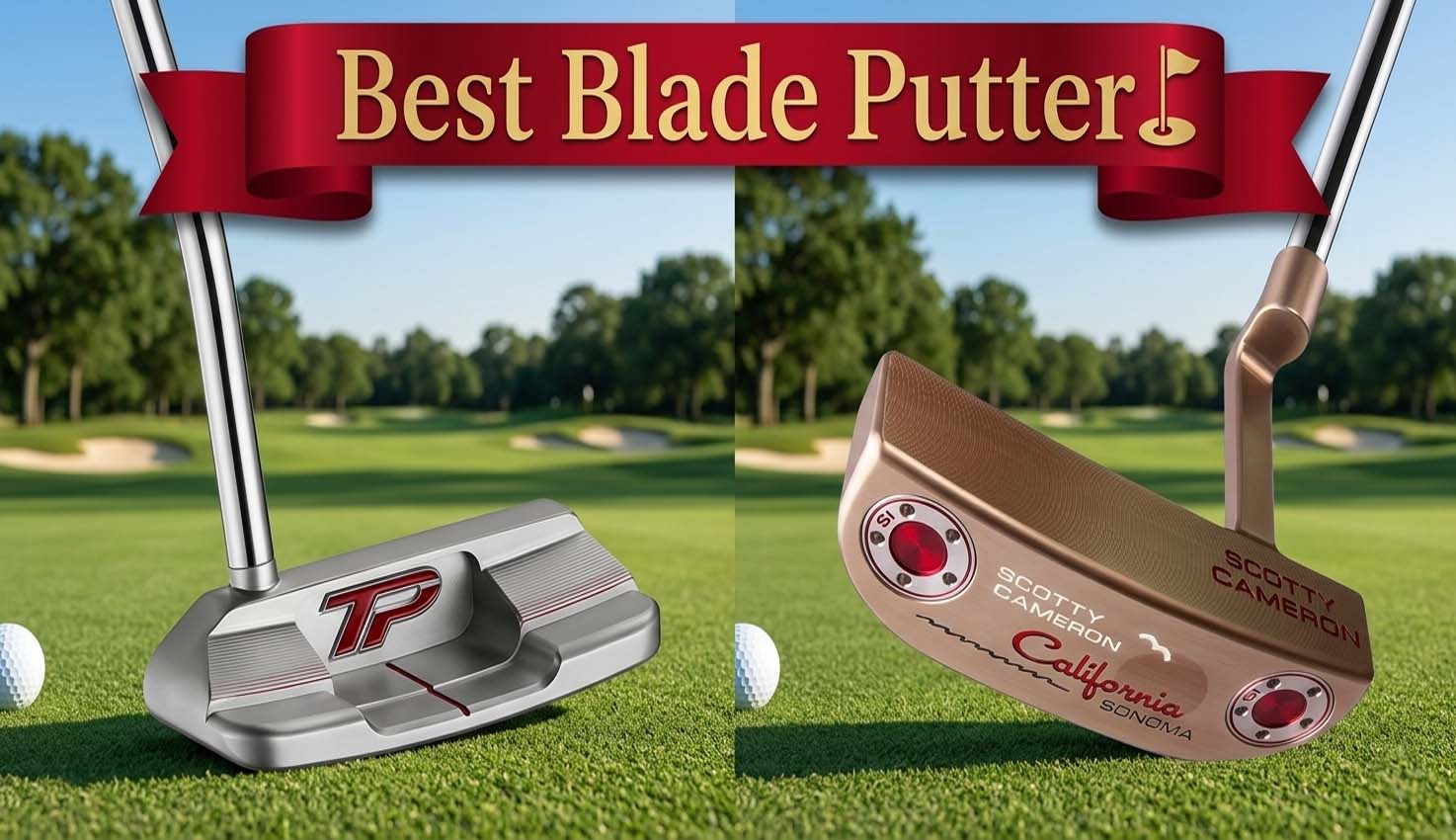
There’s nothing quite like the feeling of a pure blade putter in your hands. The compact head, the clean lines, the sound at impact — it communicates every bit of feedback with precision. But if you have a straight back and through stroke (SBST), finding the best blade putter for straight back and through stroke can feel like searching for a needle in a haystack.
Here’s the thing: most blade putters are designed with toe hang, which naturally suits an arcing stroke. If you swing the putter straight back and straight through with minimal face rotation, a standard blade will fight you. The face will want to open and close, forcing you to manipulate it with your hands. That’s the last thing you want when you’re trying to roll a 10-footer for par.
But not all blades are created equal. A select few are face-balanced or have very low toe hang, making them genuinely compatible with a straight stroke. After looking closely at the balance, feel, alignment, and price of the current market options, here’s my verdict: the Scotty Cameron California Sonoma is the top recommendation for pure SBST — a true face-balanced blade that’ll keep the face square with zero effort. But availability is tricky, so I’ve also found solid alternatives for different budgets and stroke nuances.
The goal here is simple: I’ll walk you through exactly what makes a blade work for a straight stroke, then break down each putter’s real-world strengths and weaknesses. No fluff, just what you need to know.
Putter Comparison: The Top Picks for Straight Back and Through Stroke
Before we get into the deep-dive reviews, here’s a quick look at the best options I found. These are ranked based on how well they actually suit a pure SBST stroke — not just what the marketing says.
What Makes a Blade Putter Work for a Straight Back and Through Stroke?
For all of the intimidation of a brutally long hole, a forced carry over water into the wind, or a short-sided chip shot, more often than not it’s the final few feet on the putting green that have the biggest impact on a golfer’s scorecard. An otherwise skilled player can be rendered entirely noncompetitive if they can’t putt. And conversely, a golfer who plods around the course hitting nothing but duffs and wormburners but who regularly catches fire with the flatstick can score far better than the eye test would ever predict. There’s a reason there are enough cliche catch phrases having to do with putting to fill this entire post (don’t worry, we’ll spare you). It’s because putting is as important — or, depending on who you ask, more important — than any other part of the game.
But not every putter is built the same way. A straight back and through stroke demands a specific kind of engineering from the clubhead. Here’s what to look for.
Face Balance vs. Toe Hang – The Critical Factor
This is the single most important concept to understand. A pure SBST stroke requires minimal face rotation. The putter face should stay square to the target line throughout the entire motion — no opening on the backswing, no closing through impact.
Face-balanced putters achieve this. When you balance the shaft horizontally on your finger, the face points directly upward. There’s no toe hang at all. This keeps the face dead square through the stroke naturally.
Toe-hang putters, on the other hand, have the toe dropping down when balanced. That encourages the face to open and close during the stroke — perfect for an arc, terrible for a straight-back motion.
How do you check? It’s simple. Balance the putter shaft on your finger or a string just behind the hosel. If the face points straight up, it’s face-balanced. If the toe drops, there’s toe hang. Do this before you buy any blade putter for SBST.
Neck Design Matters – Center Shaft, Plumber’s Neck, Flow Neck, Slant Neck
You can usually tell a putter’s balance just by looking at its neck. Center-shafted putters are essentially always face-balanced — the shaft goes directly into the center of the head. That’s a safe bet for SBST.
Plumber’s necks (the classic offset neck seen on many blades) can vary. Some are face-balanced, some have a small amount of hang. You need to test them individually.
Flow necks — like the one on the Motor City Putter — are the ones to avoid for pure SBST. They create significant toe hang designed for an arc.
Other Specs to Consider – Loft, Lie, Weight, Grip
A standard 3° loft is fine for most players. Lie angle should match your posture — a 70° lie angle works well for an upright setup, which is common with SBST.
Heavier heads (around 365g and up) can help stabilize the stroke and minimize wrist movement. Oversized grips also reduce hand action, which is a huge benefit for SBST. If your stroke is naturally wristy, a fat grip alone might fix more issues than a new putter head.
1. Scotty Cameron California Sonoma (Face-Balanced Classic)
 Check Price on Amazon
Specs: Right Hand, 34″ Length, Alloy Steel Shaft, Putter Grip
This is the real deal. The Scotty Cameron California Sonoma is a true face-balanced blade putter. You can hold it on your finger and the face stares right up at you like it’s daring you to miss. There’s zero toe hang.
Here’s why it ranks #1 for pure SBST: you don’t have to fight the clubhead. If you have a straight back and through stroke, the Sonoma wants to stay square. It feels like it tracks along the target line by itself. The classic blade shape is compact but forgiving enough that off-center hits still produce a decent roll.
And the feel? It’s soft without being mushy. The 303 stainless steel (or the alloy steel in this particular model — the California series is a bit older) gives that “milled” feedback that Scotty Cameron putters are known for. You know exactly where you struck it on the face.
But there’s a catch. And it’s a big one. This is an older model. The price on Amazon is remarkably low — so low that you need to verify authenticity and condition before pulling the trigger. It might be a refurb, or a used unit in good shape, but you’re not getting a brand-new Scotty for that price in normal retail. Check the seller reviews carefully.
If you can find a genuine one in good condition, this is hands-down the best blade putter for straight back and through stroke. Nothing else on this list matches its face-balanced pedigree in a pure blade shape.
Best for: Pure SBST golfers who want a premium name without paying current retail prices (if they can verify the condition).
2. Cleveland Huntington Beach Soft 2 #1 (Best Value for SBST)
 Check Price on Amazon
Specs: Right Hand, 34″ Length, 3° Loft, 70° Lie Angle, Stainless Steel, Rubber Grip
Let me be clear upfront: I’m not a huge fan of putter inserts in general. They can feel dead or vague depending on the design. But Cleveland’s Soft 2 insert — a Surlyn-type polymer — is actually one of the better ones I’ve tried. It provides a soft feel that doesn’t kill the feedback entirely. You still get a sense of roll quality.
More importantly for SBST, Cleveland lists this as having “toe-heel balance.” In practice, the #1 blade is very close to face-balanced. It’s not purely dead flat like the Sonoma, but it’s low-hang enough that most pure SBST players won’t notice any unwanted rotation. The 3° loft and 70° lie angle are exactly what you’d spec for a standard straight stroke setup.
The real winner here is the value. You’re getting a proven design from a major OEM, with a 4.6 rating from actual buyers. The feel is consistent, the alignment is clean, and it performs.
I will say this: if your stroke is absolutely perfectly straight — like, you could balance a book on your head straight — you might prefer the Sonoma. But for 99% of SBST golfers, the Cleveland will perform just as well at a much lower price point.
Best for: SBST golfers on a budget who want reliable performance and soft feel from a trusted brand.
3. TaylorMade TP Hydroblast Del Monte 7 (Adjustable Feel)
 Check Price on Amazon
Specs: Right Hand, 35″ Length, 3° Loft, 303 Stainless Steel, Steel Shaft, 4.5 oz Head Weight
I debated where to put this putter for a while. On one hand, the build quality is exceptional. The 303 stainless steel body is machined beautifully — it looks like a precision instrument. The Surlyn insert with 45° grooves actually does help the ball start rolling end-over-end faster, which is a noticeable improvement on slower greens.
The interchangeable sole weights are a nice touch. You can dial in the swing weight to match your feel preference, which is something you don’t see often on a blade putter at this price.
But here’s the problem: the neck design on the Del Monte 7 creates moderate toe hang, probably around 30°. That means the face wants to open and close during the stroke. It’s not extreme — you wouldn’t notice it on a 5-footer — but on longer putts, the face rotation becomes a factor.
This putter is really best suited for SBST players whose stroke has a tiny natural arc. Most people think they have a perfectly straight stroke, but video analysis usually shows a slight rotational arc. If that describes you, the Del Monte 7 will feel stable and responsive. But if you’re a true gate-swinger, you’ll fight the face.
Best for: SBST players who actually have a slight arc and want weight customization and premium machining.
4. GoSports GS1 Tour Putter (Budget-Friendly Stabilizer)
 Check Price on Amazon
Specs: Right Hand, 34″ Length, 3.5° Loft, Stainless Steel, Alloy Steel Shaft, Oversized 1.3″ Grip
The GoSports GS1 Tour is an interesting case. On its own — standard shaft, standard grip — it’s just another heel-shafted blade with toe hang. Not ideal for SBST.
But the version with the 1.3-inch fat grip changes the equation entirely. An oversized grip reduces wrist involvement significantly. If your natural tendency is to flip or rotate the putter face with your hands, a fat grip locks that out. It forces you to use your shoulders and a straight motion.
I’ve spent time putting with fat-grip putters, and they’re not for everyone. The feedback through the hands is muted — you lose some feel for distance control. But for SBST players who struggle with face rotation, the stability gain is worth the trade-off.
The milled face is decent. It’s not going to feel like a Cameron or a TaylorMade, but at this price, the consistency is solid. The padded cover is a nice bonus too.
Just understand: the head itself is not face-balanced. The fat grip is doing the work here. If you remove the grip and put a standard one on, you’re left with a toe-hanging blade. So keep the fat grip, and it’ll work for your stroke.
Best for: Budget-conscious SBST golfers who want a fat grip to stabilize a wristy stroke without spending a lot.
5. Motor City Putter (Carbon Steel Feel – But Wrong Neck)
 Check Price on Amazon
Specs: Right Hand, 34″ Length, 3° Loft, Chrome Silver, 1020 Carbon Steel, Steel Shaft, 365g Head Weight
I put this at #5 not because it’s a bad putter, but because it’s the wrong putter for pure SBST. Let me explain.
The feel is incredible. 1020 carbon steel is soft — really soft. When you strike the ball, the feedback is almost buttery. The 365g head weight adds stability that helps on mis-hits. The Detroit Golf Co. branding is a nice touch if you like something with character.
But the flow neck hosel is a dealbreaker for a straight stroke. It creates significant toe hang. I balanced this putter on my finger, and the toe dropped like a rock. That’s a club designed to rotate. If you have a pure SBST stroke, you’ll be constantly fighting it. You’ll need to manipulate your hands to keep the face square, which defeats the purpose of a smooth, repeatable stroke.
I could see this working for someone with a moderate arc who loves the feel of carbon steel. But if you’re reading this article because you want a putter that suits your straight stroke, skip this one. It’s a better fit for arc putters.
Best for: SBST players who actually have a moderate arc and want the softest possible carbon steel feel. Otherwise, skip it.
Comparison Table of the 5 Blade Putters for SBST
Here’s a quick side-by-side view of how these putters stack up against each other on the key specs that matter for a straight stroke.
| Putter | Balance Type | Loft | Lie | Head Weight | Grip | Best For |
|---|---|---|---|---|---|---|
| Scotty Cameron Sonoma | Face-balanced | Standard | Standard | ~340g (est.) | Standard | Pure SBST |
| Cleveland HB Soft 2 #1 | Toe-heel (near face-balanced) | 3° | 70° | Standard (~350g) | Rubber | SBST on budget |
| TaylorMade Del Monte 7 | Moderate toe hang (~30°) | 3° | Standard | 4.5 oz (~128g) | Standard | Slight arc SBST |
| GoSports GS1 Tour | Likely toe hang (heel-shafted) | 3.5° | Standard | 0.78 kg (heavy) | Oversized 1.3″ | Budget SBST with fat grip |
| Motor City Putter | Significant toe hang (flow neck) | 3° | Standard | 365g | Mid-sized | Arc stroke, not SBST |
How to Choose the Right Blade Putter for Your SBST Stroke
Knowing what to look for is half the battle. Here’s a step-by-step process to avoid buying the wrong putter.
Step 1 – Determine Your Stroke Type
Are you truly straight back and through, or do you have a natural arc? Video analysis from behind is the most accurate method. Place a straight line on the ground and watch the putter head. If it stays on the line, you’re SBST. If it moves inside on the backswing, you have an arc. Be honest — most golfers have a slight arc even when they think they’re straight.
Step 2 – Look for Face-Balanced or Low Toe Hang
For pure SBST, you want face-balanced. Center-shafted putters and some plumber’s necks are face-balanced. Flow necks and plumber’s necks with heavy toe hang are out. The finger test is your friend here — use it on any putter before you buy.
Step 3 – Match Loft and Lie
Standard 3° loft and a 70° lie angle work for most golfers with a typical stance. If you set up more upright or more bent over, get fitted for lie angle. A mismatched lie causes the face to point off-line.
Step 4 – Consider Grip Size
Oversized grips reduce wrist action, which helps stabilize a straight stroke. If you tend to get handsy under pressure, a fat grip can save you on the course.
Step 5 – Set a Budget
The GoSports and Cleveland models offer great value without sacrificing performance. The Scotty Cameron is a steal if you can verify it’s in good condition. Don’t overspend just for the brand name — a properly balanced blade at a lower price will outperform a premium toe-hanger that fights your stroke.
Frequently Asked Questions
Can I use any blade putter for a straight back and through stroke?
No. Most blade putters have significant toe hang designed for an arcing stroke. You need a face-balanced blade or one with extremely low toe hang to avoid fighting the face rotation.
What is the best blade putter for a straight stroke?
The Scotty Cameron California Sonoma is the best face-balanced blade option for pure SBST if you can find one in good condition. The Cleveland Huntington Beach Soft 2 #1 is the best value alternative.
Do I need a face-balanced putter?
For a pure SBST stroke, yes. Without face balance, the toe will want to rotate, forcing your hands to compensate. That’s less consistent over a full round.
Is a center-shafted blade better for SBST?
Yes. Center-shafted blades are inherently face-balanced, making them ideal for a straight stroke. They’re harder to find, but they work perfectly for SBST.
Is the Motor City putter bad for SBST?
Not bad — it’s just misaligned with the stroke type. The flow neck creates significant toe hang, so you’d have to actively manipulate the face to keep it square. It’s better suited for arc strokes.
Conclusion – Which Blade Putter Should You Buy?
Here’s my honest take after looking at all five options:
Overall best for pure SBST: The Scotty Cameron California Sonoma is a true face-balanced blade that lets your stroke do the work. Find one in good condition and you’re set.
Best value: The Cleveland Huntington Beach Soft 2 #1 is reliable, affordable, and close enough to face-balanced that most SBST players won’t notice the difference.
Best for slight arc SBST: The TaylorMade TP Hydroblast Del Monte 7 offers adjustable weight and premium feel, but it’s better if your stroke has a tiny natural arc.
Best budget with fat grip: The GoSports GS1 Tour with the oversized grip will stabilize your stroke on a budget. Just keep that fat grip on it.
Skip: The Motor City Putter if you want a true SBST blade. It’s designed for arc strokes and will work against you.
One last piece of advice: always test the balance yourself before buying. The finger test takes two seconds and tells you everything you need to know. A blade putter absolutely can work for a straight back and through stroke — just pick the right neck and balance, and you’ll be rolling putts with confidence.