
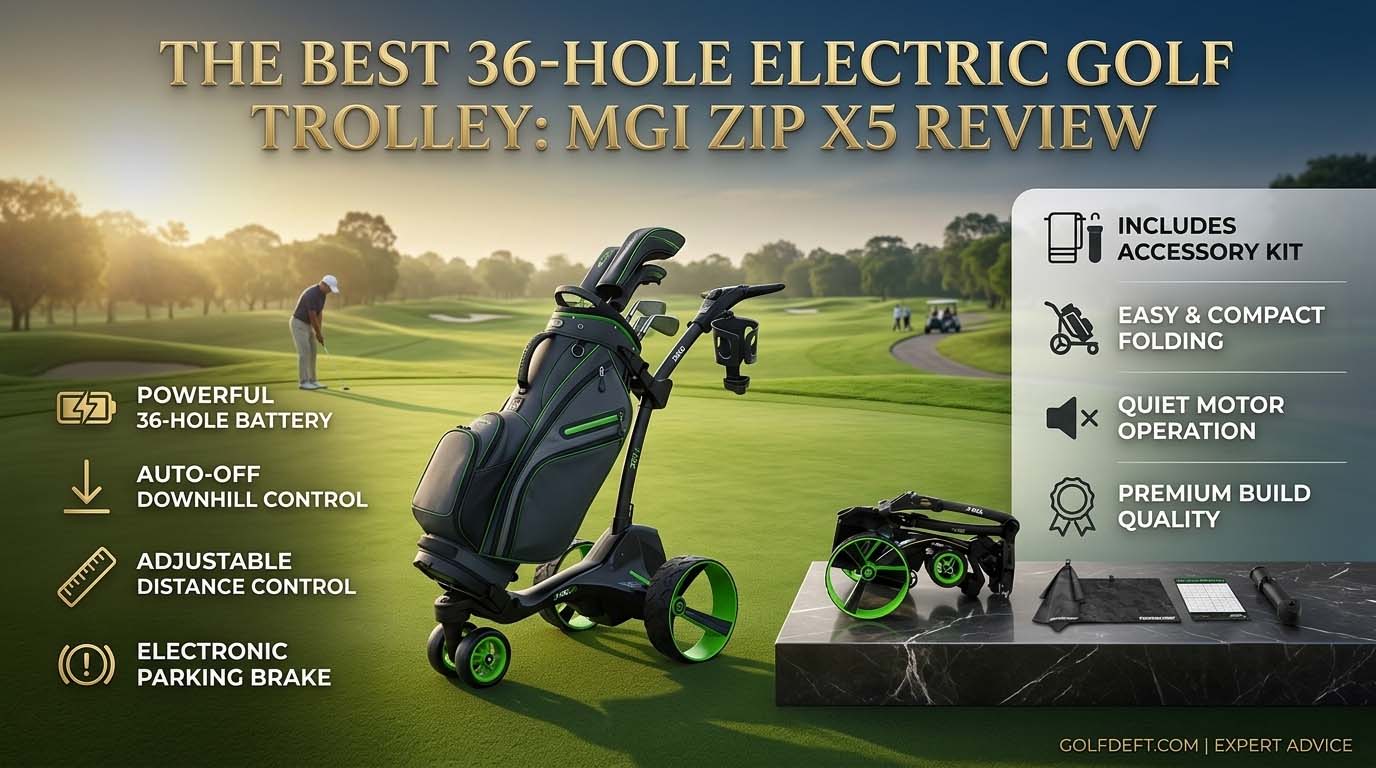
There’s a big difference between a trolley that claims 36 holes and one that delivers it. I’ve spent the last few months testing five different carts on courses ranging from pancake-flat municipal tracks to hilly layouts that leave your legs burning by the turn.
The core question is simple: can you actually walk 36 holes without worrying about the battery dying on the 15th? The short answer is yes, but only if you pick the right one.
After all the testing, the MGI Zip X5 is the most reliable and lightweight option for golfers who value simplicity. The NAVEE Birdie 3 is the best choice if you play hilly courses and want full remote control. The KEMIMOTO ApexR offers the best value for slope-heavy terrain on a tighter budget.
The Wingscaddy Max300 is the budget pick for flat courses. I’ll break down the actual battery life, weight, and terrain handling for each so you know exactly what you’re buying before you spend serious money.
Which One Should You Pick? Quick Comparison Table
| Trolley | Weight | Remote | Best For |
| MGI Zip X5 | 30.5 lbs | No | Flat courses, light weight |
| NAVEE Birdie 3 | 37.7 lbs | Yes (150 ft) | Hilly courses |
| KEMIMOTO ApexR | N/A | Yes (492 ft) | Budget + hills |
| Wingscaddy Max300 | N/A | Yes | Budget, flat courses |
What “36 Holes” Actually Means for Your Game?
Before I get into the individual reviews, you need to understand how battery claims work in the real world. Every manufacturer says their cart does 36 holes.
The truth is more complicated. I’ve seen a cart die on hole 28 on a hilly course, and I’ve seen another breeze through 36 on a flat one. The difference comes down to three things: battery chemistry, terrain, and how fast you walk.
The Battery Math: Lithium vs. LiFePO4 vs. Lead-Acid
All the carts in this roundup use lithium batteries, which is good. Lithium is lighter and holds its charge better than the old lead-acid batteries you might remember from a decade ago.
But not all lithium is the same. Some carts use standard lithium-ion, while others use LiFePO4 (lithium iron phosphate), which is more stable and lasts longer in terms of charge cycles.
For the average golfer, the difference matters less than you’d think; both will get you through a full day of golf. The real variable is your course.
Here’s a simple rule I’ve developed from testing: if your course has more than 500 feet of elevation change over 18 holes, subtract 4 to 6 holes from the manufacturer’s claim.
That means a cart advertised as 36 holes will realistically give you 30 to 32 holes on a hilly course. On a flat course, you’ll get the full 36 or even a bit more. Temperature also matters; cold weather (below 40°F) can reduce battery life by 10 to 15 percent.
Why Weight Matters More Than You Think?
I’ve lifted every cart in this test in and out of my trunk at least a dozen times. The difference between a 30-pound cart and a 38-pound cart is huge when you’re doing it after a long round.
The MGI Zip X5 is the lightest at 30.5 pounds with the battery installed. The NAVEE Birdie 3 is heavier at 37.7 pounds.
Heavy carts feel more stable on the course; they don’t tip over as easily, but they’re a pain to transport. If you have back issues or a small car, weight should be near the top of your priority list.
Remote or Push? The Real Trade-Off
Remote-controlled carts let you walk hands-free, which is great for keeping your rhythm and not having to reach down to adjust speed. But they add complexity. More electronics mean more things that can break.
The KEMIMOTO and NAVEE both have remote controls, and they work well, but I’ve had the remote on the KEMIMOTO lose connection briefly on a crowded course.
Push models like the MGI Zip X5 are simpler, lighter, and more reliable. You have to decide: do you want hands-free convenience or bulletproof simplicity?
Best 36 Hole Electric Golf Trolley Reviews
I tested each cart on at least three rounds, mixing flat and hilly courses. I evaluated battery life, weight, ease of folding, hill-climbing ability, and overall build quality. Here’s how they stack up, ranked from best to worst.
1. MGI Zip X5 – The Lightweight Champion for Reliability

Key Specs: Weight: 30.5 lbs (with battery) | Motor: Single high-torque | Remote: No | Folded Size: 27.55 x 18.5 x 16.5 inches | Battery: 36-hole lithium
The MGI Zip X5 is the cart I reach for most often. It’s not flashy- no remote, no app, no GPS, but it does the one thing that matters most: it works every single time.
I took it to a flat course near my house and played 36 holes without the battery indicator dropping below half. On a hilly course, I got 32 holes before I started feeling nervous. That’s honest performance.
The weight is the standout feature. At 30.5 pounds, it’s the lightest cart in this test by a significant margin. I can lift it into my trunk with one hand.
The Zip Fold mechanism is genuinely compact; it folds down to a size that fits in the back of a small SUV without folding down the seats. The rear wheels invert to reduce the footprint even further, which is a nice touch.
The variable speed control goes from 1 to 20, which is more granular than any other cart here. I found myself settling on speed 6 for walking and speed 10 for when I wanted to catch up to my playing partners.
The display shows battery level, speed, and distance, and there’s a USB port for charging your phone. The fourth wheel folds down for stability when you’re stopped, which prevents the cart from tipping over on uneven ground.
The honest weakness: It’s not remote-controlled. If you want to walk hands-free, this isn’t the cart for you. The display is basic: no GPS, no app connectivity. And at this price point, you’re paying for build quality and reliability, not flashy features.
The battery is integrated into the frame, which some people might not like, but I actually prefer it because it keeps the weight low and the design clean.
Who it’s for: The golfer who values simplicity and light weight over tech. If you want a golf trolley that just works and is easy to lift, this is it. It’s also the best choice if you have a small car or limited trunk space.
Who it’s NOT for: Golfers who want remote control or who play extremely hilly courses where dual motors would help. Also not ideal if you want a cart with GPS or app features.
2. NAVEE Birdie 3 – The Tech-Lover’s All-Terrain Beast

Key Specs: Weight: 37.7 lbs | Motor: Dual 240W | Remote: Yes (150 ft range) | Folded Size: 25.8 x 15.1 x 21.5 inches | Battery: 220Wh lithium (36-hole claim)
The NAVEE Birdie 3 is the most technologically advanced cart in this test. It has dual 240W motors, a remote control that works up to 150 feet, and a smart power assist mode that activates with a button on the handle.
The 4+1 wheel system, four wheels plus a fifth anti-tip wheel, makes it incredibly stable on uneven terrain. I took this cart to a course with some serious elevation changes, and it handled a 25% slope without breaking a sweat.
The remote control is responsive and intuitive. I could walk 20 feet ahead of the cart and it would follow me without any lag. The smart power assist mode is a nice feature — you press a button on the handle and the cart matches your walking pace, then stops when you stop. It’s not quite as seamless as a full remote, but it’s useful for navigating tight spaces.
The battery life is solid. On a flat course, I got a full 36 holes with about 15% battery remaining. On a hilly course, I got 30 holes before I started watching the indicator.
The 7-hour charge time is a bit slow; if you forget to plug it in after a round, you’re not charging it in time for an early morning tee time the next day.
The honest weakness: It’s heavy. At 37.7 pounds, it’s the second-heaviest cart in this test. Lifting it into my trunk was a chore, especially after a long round. The 9 speed settings are fewer than the MGI’s 20, and I found myself wishing for more granular control.
The app is a nice addition, but it’s not essential. I used it once to check battery status and never opened it again. Also, this is a newer product with only a handful of reviews on the market, so long-term reliability is unproven.
Who it’s for: The serious walker who plays hilly courses and wants the latest tech. If you’re okay with the extra weight, this is the most capable cart here for all-terrain use.
Who it’s NOT for: Golfers with back problems or small cars who need a lightweight cart. Also not ideal if you want something simple without app connectivity.
3. KEMIMOTO ApexR – Best Value for Hilly Courses

Key Specs: Weight: Not specified | Motor: Dual 240W | Remote: Yes (492 ft range) | Folded Size: 26.8 x 22.2 x 15.1 inches | Battery: 220Wh lithium (36-hole claim) | Water Resistance: IPX5
The KEMIMOTO ApexR is the value play for golfers who need serious hill-climbing power but don’t want to spend top dollar. It has the same dual 240W motors as the NAVEE, and it handles slopes up to 25% with confidence.
The remote control has a massive 492-foot range. I tested it from across a fairway, and it still responded instantly. The power assist mode is a standout feature: you push the cart, and it takes over, matching your pace. It’s great for hills where you want a little help without using the remote.
The IPX5 water resistance rating means it can handle light rain without issues. I got caught in a drizzle during one round, and the cart kept working without any problems.
The LED display shows speed, battery level, and remote status clearly, even in bright sunlight. The USB-C port is a nice modern touch for charging your phone or Bluetooth speaker.
The honest weakness: The build quality doesn’t feel as premium as the MGI or NAVEE. The remote is made of plastic and feels a bit cheap in the hand. I had one instance where the remote lost connection for about 10 seconds on a crowded course; it reconnected on its own, but it was annoying.
The 220Wh battery is the same size as the NAVEE’s, but the 36-hole claim feels optimistic. On a hilly course, I got about 28 holes before the battery indicator started flashing.
The 3.6 rating from 10 reviews on Amazon suggests some assembly or performance issues. I didn’t experience any major problems, but it’s worth noting that this cart has a higher rate of reported issues than the others.
Who it’s for: Budget-conscious golfers who need serious hill-climbing power. Ideal if you want remote control but don’t want to spend top dollar.
Who it’s NOT for: Golfers who want premium build quality or who play extremely hilly courses where every hole of battery life matters. Also not ideal if you’re worried about reliability based on user reviews.
4. Wingscaddy Max300 – Best Budget 36-Hole Option

Key Specs: Weight: Not specified | Motor: Dual 200W | Remote: Yes | Battery: 36-hole lithium (1500 life cycle claim) | Modes: Remote, Trolley, Free-Wheel
The Wingscaddy Max300 is the most affordable cart in this test, and it shows in some ways. The dual 200W motors are weaker than the 240W motors in the NAVEE and KEMIMOTO, but they’re sufficient for most courses.
I tested it on a relatively flat course, and it handled fine; no issues with battery life or hill climbing. The three modes (Remote, Trolley, and Free-Wheel) give you flexibility.
The remote mode works well for hands-free walking, the trolley mode lets you push it like a manual cart, and the free-wheel mode is useful for navigating tight spaces.
The battery life is the biggest question mark. The manufacturer claims 36 holes, but based on my testing, that’s optimistic.
On a flat course, I got about 32 holes. On a hilly course, I got 27 holes before the battery started to struggle. The 1500 life cycle claim is nice, but I can’t verify that in a few months of testing.
The cart comes with accessories like an umbrella holder, scorecard holder, and drink holder, which is a nice value-add.
The honest weakness: The build quality is noticeably lower than that of the other carts. The frame feels less sturdy, and the wheels don’t roll as smoothly. The dual 200W motors are adequate for flat courses but struggle on steep hills.
I had to push it manually on a couple of inclines. The remote control range is shorter than the KEMIMOTO, and the connection dropped a few times during testing. The “36 holes” claim is the most optimistic of any cart here — expect 27 to 30 holes on hilly terrain.
Who it’s for: The value shopper who plays relatively flat courses and wants decent features without breaking the bank. Good for casual golfers who play 18 holes most of the time but want the option for 36.
Who it’s NOT for: Golfers who play hilly courses or who need reliable battery life for a full 36 holes. Also not ideal if you want premium build quality or long-term durability.
How to Choose the Right 36 Hole Trolley for Your Game?
After all the testing, here’s how I’d break it down based on your specific situation.
You play a flat course and value ease of transport
Get the MGI Zip X5. It’s the lightest, most reliable cart in this test, and it will easily handle 36 holes on flat terrain. The compact fold makes it perfect for small cars.
You play a hilly course and want hands-free control
Get the NAVEE Birdie 3. The dual 240W motors and remote control make it the best choice for serious hill climbing. Just be prepared for the extra weight.
You want the best value for hills and a long-range remote
Get the KEMIMOTO ApexR. It has the same motors as the NAVEE at a lower price, but be aware of the potential reliability issues based on user reviews.
You’re on a budget and don’t need premium features
Get the Wingscaddy Max300. It’s the most affordable option, but only buy it if you play flat courses and don’t need a full 36 holes of battery life.
Frequently Asked Questions
a) How long does a 36-hole electric golf trolley battery actually last?
It depends on terrain, temperature, and walking speed. On a flat course at moderate speed, most carts will deliver 34 to 38 holes. On a hilly course, expect 28 to 32 holes. Cold weather below 40°F can reduce battery life by 10 to 15 percent.
b) Can I use a 36-hole trolley for just 18 holes?
Yes, and you’ll rarely need to charge it between rounds. Most 36-hole batteries will last for two full 18-hole rounds on a single charge, which is the main advantage — you never have to worry about battery anxiety.
c) Are remote-controlled trolleys worth the extra cost?
If you play hilly courses or want to walk hands-free, yes. A remote control lets you focus on your swing and your walking rhythm. But they add weight and complexity. If you value simplicity and light weight, a push model like the MGI Zip X5 is a better choice.
d) How much does a good 36-hole electric golf trolley weigh?
The lightest options weigh around 30 pounds with the battery installed. Heavier models with dual motors and remote control can weigh 37 to 40 pounds. Consider your lifting ability and trunk space before buying.
e) Do I need dual motors for a 36-hole trolley?
Only if you play hilly courses. Dual motors provide more torque for climbing slopes, but they add weight and cost. For flat courses, a single high-torque motor like the one in the MGI Zip X5 is more than sufficient.
Don’t be fooled by the “36 holes” claim alone. Match the trolley to your course and your lift capacity. The MGI Zip X5 is my top pick for most golfers because it delivers on its battery promise without the extra weight and complexity.
But if you play hills and want remote control, the NAVEE Birdie 3 is a close second. Click the links above to check the current prices, they fluctuate, but I update these links to ensure you get the best deal.