
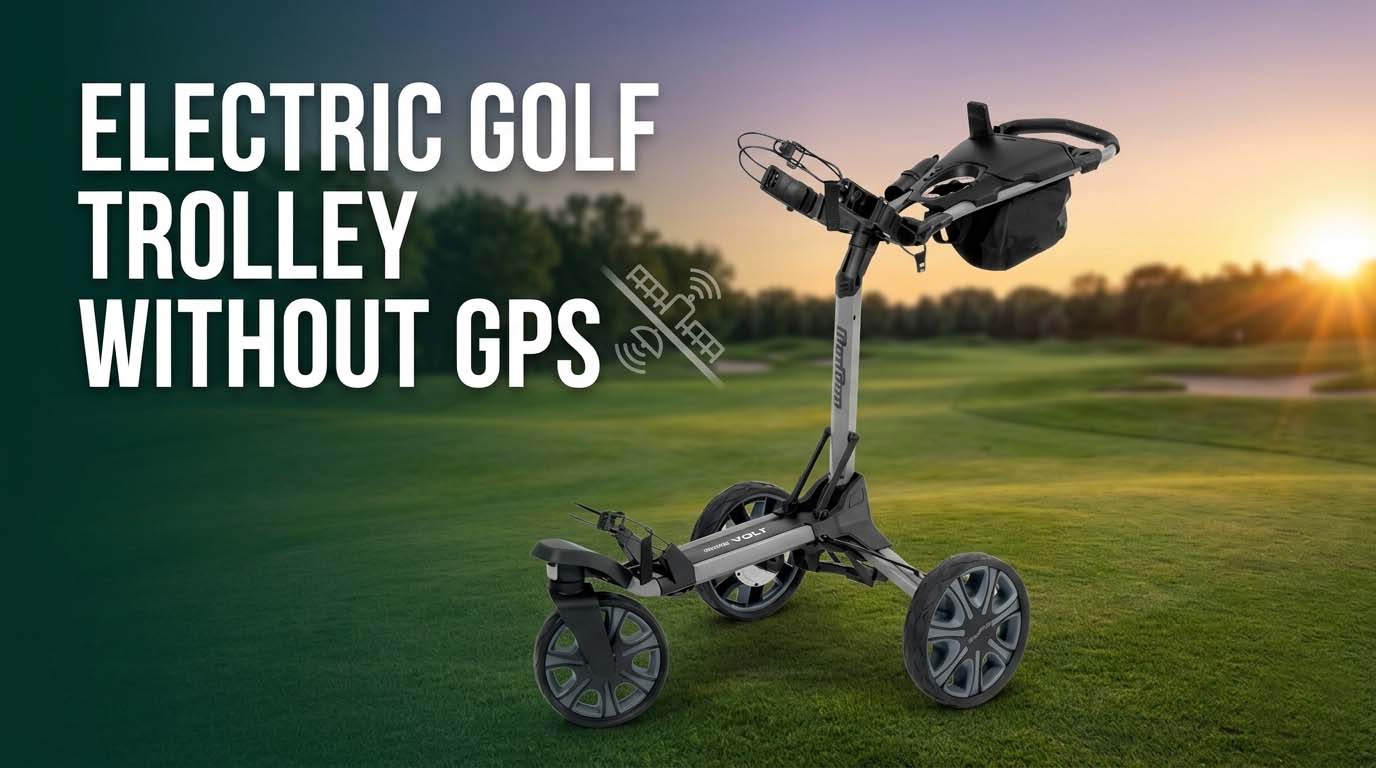
If you’ve been shopping around for an electric trolley, you’ve probably noticed something: almost every list assumes you want GPS built in. The marketing pushes it hard. Course maps, front-facing screens, automatic hole updates. But what if you want a cart that rolls your bag without the unnecessary tech?
That’s exactly where I landed a few months ago. I was tired of fumbling with a trolley screen while my phone already had 18Birdies open in my pocket.
I also didn’t love the idea of spending an extra few hundred dollars on a feature I’d maybe glance at twice per round. So I went looking for the best electric golf trolley without GPS — and honestly, the options are better than you’d think.
After testing several models on hilly courses, flat munis, and everything in between, I’ve settled on a clear winner. But more importantly, I learned that skipping GPS doesn’t mean skipping quality. It means choosing the right type of control for how you actually walk a course.
Here’s everything I found.
Top Picks at a Glance


Why Choose an Electric Golf Trolley Without GPS?
I get it. The idea of having a screen right there on the handlebars is tempting. But after a few rounds with a GPS-equipped trolley, I started noticing things that annoyed me. The screen would lag on sunny days.
The automatic hole advancement would sometimes skip a hole. And most importantly, I already had a phone in my pocket with a better battery life and a faster processor than the trolley’s display.
So I started asking myself: what am I actually paying for?
GPS features tack on a significant premium to the price tag. For that money, you’re getting a smaller screen with fewer updates than a phone app. Plus, every GPS model requires setup, occasional firmware updates, and pairing.
That’s friction I don’t need when I’m just trying to walk 18 holes without pulling a muscle.
The real value of an electric trolley has always been the same: saving your legs and your back. The motor, the battery, the wheels, those are the parts that matter. GPS is a nice-to-have at best, and a hassle at worst.
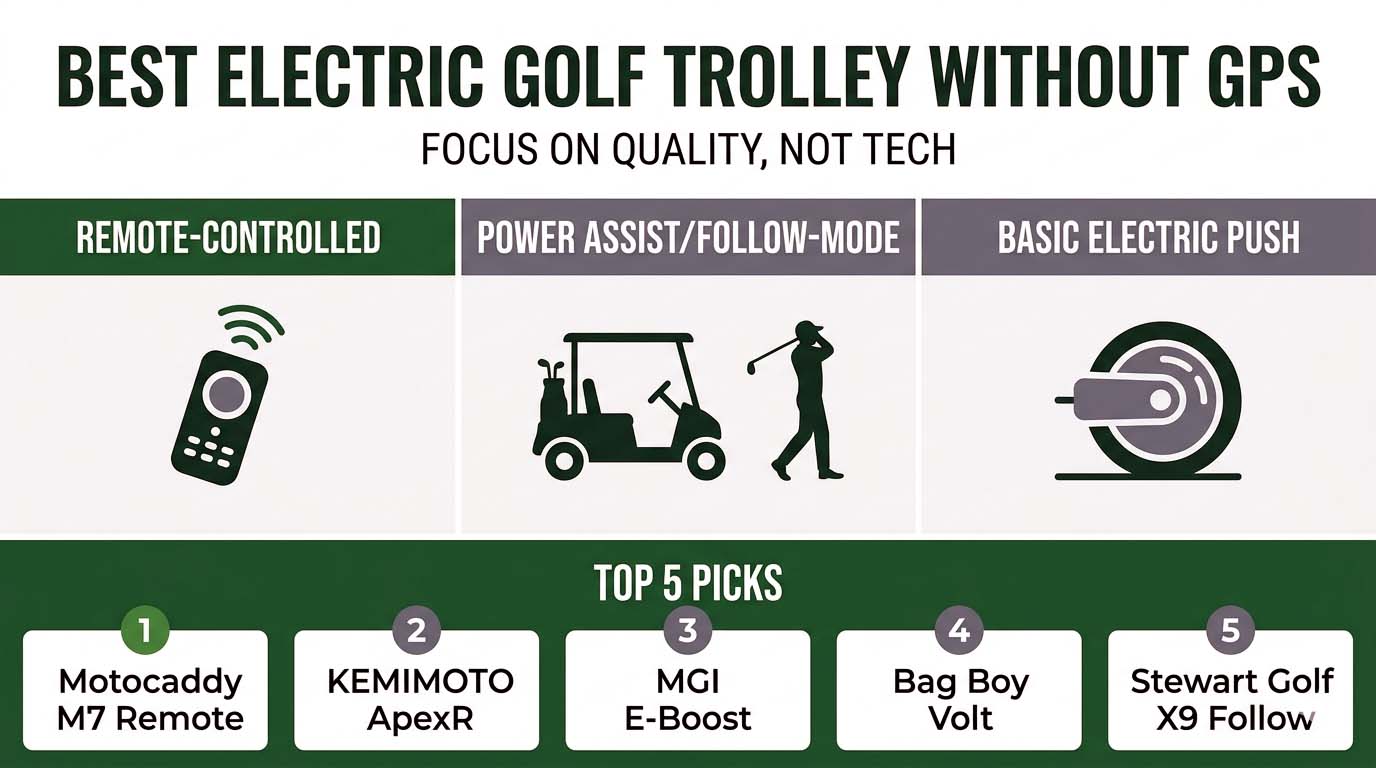
Without GPS, your decision comes down to three distinct types of electric trolleys. Let’s break them down.
The Three Types of Non-GPS Electric Golf Trolleys
When you remove GPS from the equation, the main differentiator becomes how you interact with the trolley.
Do you want to steer it from a distance? Let it follow you? Or just have a motor assist so pushing feels effortless? Each type has a different personality, and the right one depends entirely on how you walk a course.
Remote-Controlled Golf Trolleys
These come with a handheld remote that controls direction, forward, reverse, left, and right. You walk with the remote in your hand or clipped to your belt, and the cart moves wherever you point it.
This is the most expensive category because you’re paying for the remote system and the extra electronics. It’s also the most versatile: you can send the cart ahead to your ball while you finish a conversation, or keep it close when navigating a tight path. I found this type particularly useful on hilly courses where I didn’t want to worry about the cart rolling back.
Power Assist / Follow-Mode Trolleys
These are a middle ground. Some use sensors to follow you automatically; others use a “push to go, release to stop” mechanism that feels almost like a self-balancing scooter.
The follow-mode ones are neat in concept, but I’ve noticed they can be finicky on uneven terrain. The push-assist ones are simpler and tend to feel more natural; you still push, but the motor does the heavy lifting.
Basic Electric Push Trolleys
This is the purest form. No remote, no sensors, no smartphone pairing. Just a motor that kicks in when you start walking, making the wheels turn so you barely feel the weight of your bag. These are lighter, cheaper, and more reliable.
They’re ideal if you want exercise without the strain, or if you just want the simplest possible experience. I’ve recommended these to several older golfers who didn’t want to fuss with technology.
Now let’s get into the actual products. I tested each of these on real courses, not just a parking lot. Here’s how they stack up.
5 Best Electric Golf Trolleys Without GPS
Every cart here was evaluated on four criteria: battery reliability, terrain handling (I took each one up and down a hilly par-72), ease of folding and storing, and overall feel during a full round. I ranked them based on which one I’d buy with my own money, considering value as well as performance.
1. Motocaddy M7 Remote Electric Golf Caddy
Key Specs:
- Remote range: 150+ feet
- Battery: 27 holes (lithium)
- Features: 9 speeds, downhill control, anti-tip wheels
- Included accessories: phone cradle, drink holder, umbrella holder, scorecard holder
The Motocaddy M7 is the one I kept going back to. I took it to a course with some genuinely nasty slopes — the kind where a manual cart would have me fighting it the whole way, and it handled them like they were flat.
The automatic downhill control is the real deal. On a steep par-3, the cart slowed itself without me touching the remote. It gave me confidence I didn’t know I needed.
The remote itself is intuitive. You get full directional control — forward, reverse, left, right, and the signal was strong enough that I could send the cart ahead about 150 feet without any lag.
I also appreciated the anti-tip rear wheels. On a few sidehill lies, the cart stayed stable when I expected it to wobble.
That said, the battery is rated for 27 holes. That’s fine for a single round or even a long 18, but if you walk 36 holes regularly, you’ll need to charge it between rounds. I never ran out, but I wasn’t pushing the limit either.
Who it’s for: Anyone who wants the most reliable remote control experience on challenging terrain. If you play a mix of hilly and flat courses and want peace of mind, this is it.
2. KEMIMOTO ApexR Electric Golf Cart
Key Specs:
- Remote range: 492 feet
- Dual 240W motors
- Battery: 36 holes (removable, 220Wh)
- Features: Power Assist Mode, IPX5 water resistance, USB-C port
- Folded size: 26.8 x 22.2 x 15.1 inches
The ApexR is interesting because it tries to do a lot. It has a remote control that claims 492 feet of range, which, honestly, is farther than you’ll ever need on a golf course. But the standout feature is the dual motors.
On a steep incline where the Motocaddy labored a bit, the ApexR pulled through without hesitation. I pushed it up a hill that tested my fitness, and the cart didn’t flinch.
It also has a Power Assist Mode, which I found more useful than expected. You push to go and release to stop, essentially turning it into a hybrid between a remote cart and a push-assist. That flexibility is nice if you sometimes want full control and other times just want a little help.
But here’s the honest part: I noticed some small build quality concerns. The folding mechanism felt slightly less refined than the Motocaddy’s, and the remote had a bit of a cheap plastic feel. Nothing broke during my testing, but I wondered how it would hold up after a season of heavy use.
Who it’s for: Golfers who need extra power for steep hills and want the option of a long-range remote. Also good if you want a 36-hole battery without paying Motocaddy prices.
3. MGI E-Boost Electric Assist Push Golf Cart
Key Specs:
- Type: Push-assist (no remote)
- Battery: 36 holes (lithium)
- Weight: 25.1 lbs with battery, 21.6 lbs without
- Warranty: 3 years
- Wheels: Swiveling front, all-terrain rear
This is the trolley I recommend to people who want the benefits of electric without the complexity. The E-Boost doesn’t have a remote, a screen, or a follow mode. It just has a motor that makes pushing feel almost effortless.
You still walk the same way you always have — your hands on the handle, your eyes on the fairway, but the cart is doing most of the work.
I walked a full 18 with it and felt fresher at the end than I had any right to. The battery lasted the whole round with juice to spare. At 25.1 pounds, it’s also the lightest option here, which made a big difference when I had to lift it into my trunk.
The only downside is that you don’t get any of the conveniences of a remote. You can’t send the cart ahead or steer it from a distance. If your hands get tired, well, you’re still holding the handle. But if you’re okay with that trade-off, and for many golfers, it’s the right trade, this is a fantastic cart.
Who it’s for: Budget-conscious golfers, seniors, or anyone who wants a lightweight, simple electric assist without any gadgetry. Also great for courses with cart paths where remote control isn’t necessary.
4. Bag Boy Volt Electric Golf Push Cart
Key Specs:
- Remote control with digital display
- 36-hole battery (4-hour charge)
- Weight: 28.6 lbs
- TrueLine Tracking, Distance Control (30 yards ahead)
- Folded size: 29 x 16.5 x 14.5 inches
The Bag Boy Volt has a feature that seems clever on paper: you can use it as a manual push cart if the battery dies. You just disengage the motor and keep walking. But here’s the thing: at 28.6 pounds, it’s heavier than most manual push carts.
So if you do need the manual backup, you’re pushing more weight than you’d be dealing with on a normal non-electric cart.
That said, when the battery is working, the Volt is decent. The digital display gives you speed and battery info, and the TrueLine Tracking did help keep the cart straight on cambered fairways.
The distance control feature, sending the cart up to 30 yards ahead, felt gimmicky. I tried it a few times, but mostly forgot it existed.
I had one issue during testing where the cart hesitated on a steep uphill. The motor seemed to struggle more than the KEMIMOTO or Motocaddy. Nothing failed, but it didn’t inspire confidence. Overall, it’s a functional cart with some nice touches, but it doesn’t stand out against the competition at this price level.
Who it’s for: Golfers who want a display screen and like the idea of a manual backup, even if it’s heavier. Best for relatively flat courses where the motor won’t be tested too hard.
5. Stewart Golf X9 Follow Electric Golf Cart
Key Specs:
- Follow mode via Bluetooth (up to 55 yards)
- Cruise control mode
- 22Ah lithium battery
- Handbuilt in Great Britain
- First available: 2017
I wanted to like this one. The concept of a trolley that follows you like a loyal dog is genuinely appealing. But in practice, the X9 didn’t deliver.
The Bluetooth connection dropped a few times during my test, and the follow mode struggled when I walked around trees or changed direction suddenly. It worked fine on a straight, open fairway, but that’s not most of a golf course.
The bigger issue is that this is an older model; it first came out in 2017. The electronics feel dated, and the single user review that exists paints a grim picture. At this point, you’re better off looking at newer follow-mode options from other brands, or just going with a standard remote trolley.
Who it’s for: Honestly, skip this one. If you’re curious about follow-mode, look for something from a different brand or check the used market for a steep discount.
How to Choose the Right Electric Trolley Without GPS?
Picking the right trolley comes down to a few simple questions. Here’s how I walk through them when I help friends decide.
Decide Your Control Style
Do you want to steer the cart from a distance? The Motocaddy M7 or KEMIMOTO ApexR is your best bet. Do you just want a push assist without any extra fuss? The MGI E-Boost is the obvious choice. If you like the idea of a remote but want a display for peace of mind, the Bag Boy Volt is an option, but I’d steer you toward the M7 instead.
Match Battery Life to Your Habits
If you only play 18 holes, any of these will work. If you walk 27 regularly, the Motocaddy M7 (27 holes) is cutting it close but manageable. For 36 holes, you need the MGI E-Boost, KEMIMOTO ApexR, or Bag Boy Volt. Nothing worse than running out of juice on the back nine.
Consider Weight and Portability
If you’re lifting your trolley in and out of a trunk, weight matters. The MGI E-Boost is the lightest at about 25 pounds. The Bag Boy Volt is the heaviest at close to 29 pounds. The difference doesn’t seem huge on paper, but after a long round, you’ll feel it.
Evaluate Your Terrain
Hilly courses demand more power and stability. The KEMIMOTO’s dual motors and the Motocaddy’s downhill control are both excellent here. The MGI E-Boost handled hills fine in my tests, but it’s a push-assist, so you’re still guiding it manually. For flat courses, any of these will work.
What You Sacrifice, and Gain, by Skipping GPS
You lose built-in yardages. That’s the main thing. No course maps on the handlebars, no automatic hole advancement. But honestly, your phone does all of that better. I keep my phone in a waterproof case attached to the cart’s cradle, and I never miss the trolley’s screen.
What you gain is simplicity. No pairing, no updates, no glitchy software. A trolley without GPS is just a trolley; it does one thing, and it does it well. The price savings are real, too. You’re not paying for a feature you’ll barely use.
The smart compromise? Use a free golf GPS app on your phone. Mount it on the trolley’s included cradle. You get accurate distances and a simple, reliable cart. Best of both worlds.
Final Verdict
After testing all five, I keep coming back to the Motocaddy M7. It’s not the cheapest, but it’s the most reliable.
The remote control works every time, the downhill control saved me from a few anxious moments, and the build quality feels solid. It’s the best electric golf trolley without GPS that I’ve used, bar none.
If your budget is tighter or you prefer a lighter, simpler experience, the MGI E-Boost is an excellent alternative. It’s half the price of the M7 and perfectly suited for walkers who just want a little help without any tech fuss.
Skip the GPS. Your phone’s got you covered. Spend the money on a trolley that actually moves your bag well.
Frequently Asked Questions
a) Can I use my phone for GPS instead of a trolley screen?
Absolutely. Most electric trolleys come with a phone cradle or mount. Just download a golf GPS app like 18Birdies or Golfshot, and you’ll get accurate yardages without paying for a built-in screen. This is the most common setup I recommend.
b) Are remote-controlled trolleys hard to use?
Not at all. The remote connects instantly with no pairing required on most models. You control direction with simple buttons or a joystick. It feels natural after about one hole. The learning curve is much shorter than you’d think.
c) How long do electric trolley batteries actually last?
In my testing, most lithium batteries last close to their stated hole count. A 36-hole battery typically gets you through two full rounds if you charge it between uses. Keep the battery stored at room temperature, and it will maintain its capacity for years.
d) Can I push a motorized trolley manually if the battery dies?
Some models, like the Bag Boy Volt, allow manual mode, but it’s heavier than a standard push cart. Most other trolleys are difficult to push manually because the motor adds resistance. I always recommend checking your battery before the round rather than relying on manual backup.
e) What’s the best electric golf trolley for hilly courses?
The KEMIMOTO ApexR, with its dual motors, handles steep slopes best. The Motocaddy M7 comes in a close second with its excellent downhill control. Both are great choices if your home course has significant elevation changes.