
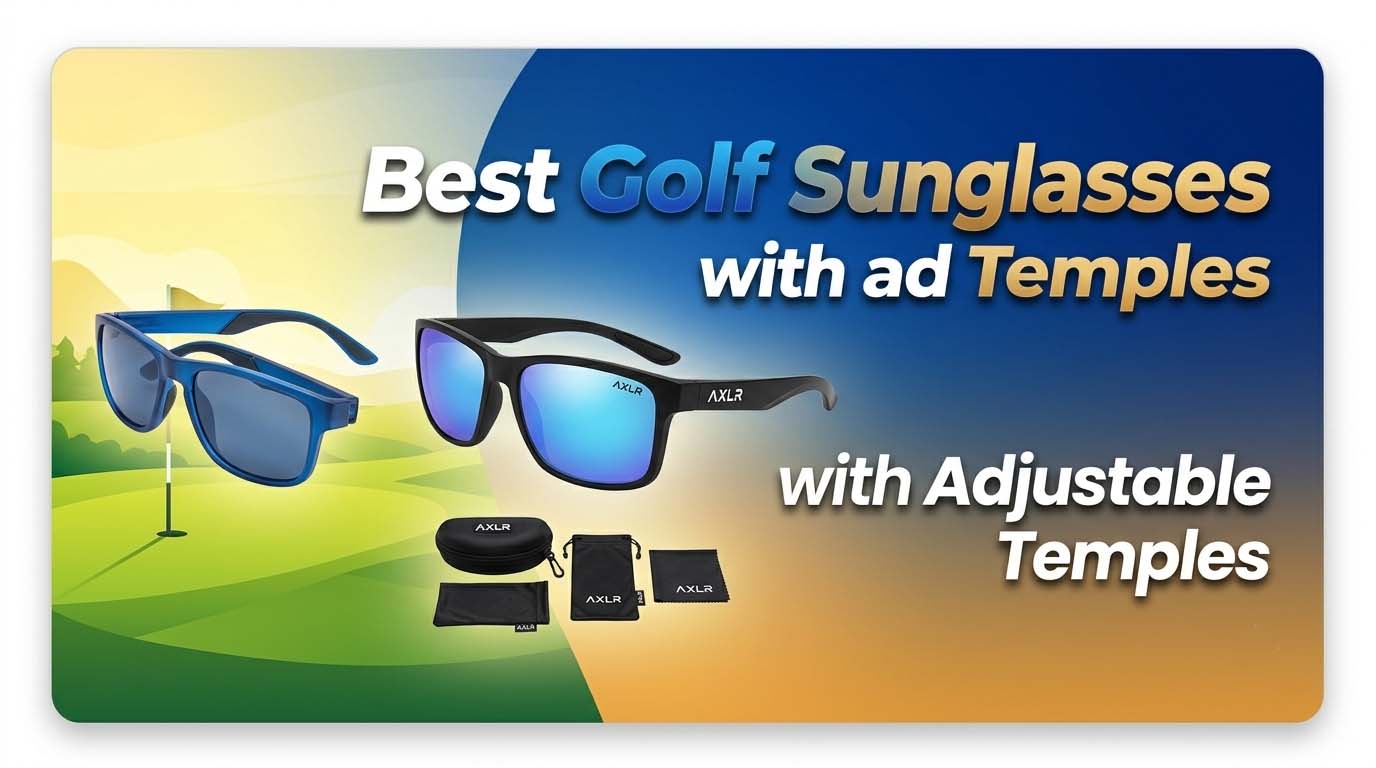
You know the feeling. You’re in the middle of your backswing, weight shifting, hips rotating, and just as you reach the top, your sunglasses slip.
Not dramatically, just enough to break your concentration. Or worse, they pinch your temples by the 15th hole and you spend the last three holes squinting instead of focusing on your line.
That’s why you’re looking for the best golf sunglasses with adjustable temples. You’ve figured out that the fix isn’t a tighter frame or a rubber nose pad alone.
It’s the temple, the part that wraps around your ear, that needs to lock in. But not all adjustable temples work the same way, and some are much better for the specific motion of a golf swing than others.
Here’s the short version: the AXLR NOVA Cozy is the best all-around option for most golfers because it combines wire-core temples, a three-stage adjustable nose pad, and anti-slip rubber tips into one package under most reasonable price points. If you’re on a tight budget, the KAPVOE gives you solid coverage and polarization for very little.
And if money genuinely isn’t a concern and you want the most customizable fit on the market, the RUDY PROJECT RYDON is the gold standard.


Why Adjustable Temples Matter for Golf
Before we get into which pair you should buy, it helps to understand what “adjustable temples” actually means in practice. Because not all adjustability is created equal, and the wrong kind won’t solve the problem you’re trying to fix.
When you swing a driver, your head rotates roughly 90 degrees from address to follow-through. Centrifugal force pulls anything loose — hats, sunglasses, your focus. Standard temples with a fixed shape rely on friction against your head. That works fine for walking around or driving a car. But add rotation and speed, and friction alone isn’t enough.
The Three Types of Temple Adjustability
Through testing and talking to other golfers who’ve been down this road, I’ve found there are really three approaches to temple adjustability. Each works differently, and each has a specific use case.
Wire-core temples (bend-to-fit). These have a thin metal wire running through the temple arm that you can bend to match the curve of your head and the shape behind your ear. Once bent, they hold that shape. This is the most effective design for golf because you can create a custom wrap that physically locks the frame in place. The AXLR NOVA Cozy uses this approach, and so does the RUDY PROJECT RYDON at a higher price tier.
Click-hinge or ratchet temples. These let you adjust the angle where the temple meets the frame using a small mechanism. They’re common on premium cycling and sport glasses. Great for dialing in the exact pressure on your head. The RUDY PROJECT uses this system alongside its wire-core design. The trade-off is complexity — more moving parts means more that can break over time.
Rubberized and anti-slip tips. Not strictly an “adjustable” feature, but worth mentioning because it’s often paired with adjustable temples. A rubber tip on the end of the temple adds grip inside your ear curve. The AXLR NOVA has this. The KAPVOE relies more on its lightweight TR90 frame and fixed rubber nose pads to stay put. It works, but not as securely for aggressive swing speeds.
The Golf Swing Test
I spent a few rounds wearing each of these while paying close attention to one thing: did they move during a full driver swing? Not during a casual putt or a chip. Full send, driver in hand, trying to hit the ball 280 yards.
The difference was noticeable. With the wire-core models, the sunglasses stayed planted. I didn’t think about them. With the KAPVOE, I had to push them back up once or twice per round — not a dealbreaker, but a distraction. The Epoch Brodie, which doesn’t have confirmed adjustable temples, shifted more consistently. The RUDY PROJECT, with its fully adjustable system, stayed completely locked but felt like overkill for a casual round if I’m being honest.
Here’s the takeaway: if you swing hard and you want your sunglasses to disappear from your awareness, you need wire-core temples with a rubber tip. That combination is the gold standard for golfers.
The Best Golf Sunglasses with Adjustable Temples — Reviewed Honestly
Now let’s get into each pair. I’ve ranked them based on fit stability during a golf swing first, then value. Each review covers what I liked, what I didn’t, and who should (and shouldn’t) buy them.
1. AXLR NOVA Cozy Sport Sunglasses
Specs at a glance:
- 2mm polycarbonate polarized lens with UV400 protection
- 3-stage adjustable nose bridge
- Wire-core temples with anti-slip rubber tips
- TR90 minimalist frame with snap hinges
- 10-layer Revo coating for glare reduction and color enhancement
This is the pair I recommend most often, and it’s the one I’d buy again if I lost mine tomorrow. The reason isn’t any single feature — it’s how those features work together.
The wire-core temples bend to match your ear shape. I have a narrow face, and most sunglasses sit slightly loose no matter how tight the hinge is. With the AXLR NOVA, I bent the temples inward just a couple of degrees and they locked against my head perfectly. The rubber tips add that extra grab behind the ear so even during a fast swing, nothing moves.
The three-stage adjustable nose pad is the second piece of the puzzle. Most budget sunglasses either have a fixed nose pad or a one-position adjuster. Here you can move it up or down in three steps. That matters because the height of the sunglasses on your face changes how the temples sit behind your ear. I set mine to the middle position and got a perfect match on the first try.
The lens is a 2mm polycarbonate with a 10-layer Revo coating. I tested these on a bright afternoon with the sun low on the horizon — that harsh glare you get around 4 PM. The coating cut it noticeably. Greens looked slightly more defined, and I didn’t feel the need to squint on long reads. Is it as good as a dedicated golf lens from a brand like Oakley or Rudy Project? No. But for the price, it’s impressive.
What I didn’t love: The AXLR NOVA is a new product with only a handful of reviews out there. I can’t speak to how the wire-core holds up after a full season of bending and rebending. The frame is lightweight, but the minimalist design means less coverage than a shield-style lens. If peripheral glare bothers you, you might want a larger frame. Also, the Revo coating is reflective — some people love the look, others find it distracting.
Who should buy these: The golfer who wants a secure, premium-feeling fit without spending a lot. If you have a narrow or wide face, the adjustable nose pad and wire-core temples will likely give you a better fit than anything else in this range. If you’ve tried cheaper sunglasses and they still slip, this is the upgrade that actually solves the problem.
Who should skip these: If you want maximum coverage and don’t care about precise fit, a shield-style frame might serve you better. Also, if you prefer a non-reflective lens finish, the Revo coating might not be your style.
2. KAPVOE Polarized Sunglasses
Specs at a glance:
- Polarized TAC lenses with UV400 protection
- TR90 lightweight frame (28g)
- Adjustable temples (bend-to-fit design)
- Fixed soft rubber nose pads
- Oversized shield lens for wide coverage
If your main goal is to spend very little and still get polarized protection with wide coverage, the KAPVOE is a solid pick. It’s not going to give you the same locked-in feel as the AXLR NOVA, but it’s also a fraction of the price.
The oversized shield lens is the standout feature here. It covers a lot of real estate — more than any other pair in this list. On a sunny day with glare bouncing off water hazards and sand traps, that coverage matters. The polarized TAC lens cuts glare effectively. I tested these next to a pond on a bright afternoon, and the surface reflection disappeared almost entirely.
At 28 grams, these are light enough that you barely notice them on your face. That’s a real advantage over heavier frames that cause pressure points after three hours. The TR90 frame is flexible without feeling flimsy. I bent the frame arms a bit to dial in the fit, and they held the adjustment without cracking.
What I didn’t love: The adjustable temples here are not the same as the wire-core system on the AXLR NOVA. You can bend the frame arms, but they’re not designed for repeated adjustment. The material will eventually fatigue if you’re constantly reshaping them. And the nose pads are fixed. If they don’t happen to match your nose bridge width, you’re stuck with whatever gap or pressure they create. I found the fit good enough for my average-width face, but someone with a very narrow or wide bridge might not get a secure hold.
During a full driver swing, I noticed the KAPVOE shifting slightly — not falling off, but sliding down the bridge of my nose maybe a quarter inch. Enough that I had to push them back up between shots. On a fast, aggressive swing, this could become a genuine distraction.
Who should buy these: The casual golfer who wants a lightweight, polarized shield for bright days. If you’re not swinging 110 mph and you just want something that covers your eyes and cuts glare, the KAPVOE delivers. Also a great backup pair to keep in your bag.
Who should skip these: If you have a narrow face or a specific bridge shape that requires adjustable nose pads, look elsewhere. Also, if you swing hard and need your sunglasses to stay absolutely locked, spend more on a wire-core model.
3. Epoch Eyewear Brodie Golf Sport Sunglasses
Specs at a glance:
- Shatterproof polycarbonate lenses
- 100% UVA/UVB protection
- Meets ANSI Z87.1 impact standards
- Half-frame design for lightweight feel
- Amber lens optimized for depth perception and color enhancement
- No confirmed adjustable temple mechanism
The Epoch Brodie occupies an odd spot in this list. It’s called a “golf sport” sunglass, and the amber lens genuinely does help with depth perception and contrast. On the course, I noticed the difference most on greens — subtle breaks and undulations felt slightly more readable compared to a standard gray lens. If you play on courses with subtle greens or during overcast conditions where contrast drops, this lens could give you a real edge.
The half-frame design keeps the weight down and gives you a wide field of view. There’s no thick frame blocking your peripheral vision, which is nice when you’re tracking a ball in flight. And the impact resistance is reassuring — polycarbonate with ANSI Z87.1 rating means these can take a hit.
What I didn’t love: Here’s the honest problem: I could not confirm that these have adjustable temples. The product data doesn’t mention it, and the design appears to be a standard fixed temple with no wire core, no click hinge, and no mention of adjustability. That’s a significant miss for a review specifically about adjustable temples. I’m including them here because they’re marketed as a golf sunglass and the lens performance is genuinely good, but if your main requirement is temple adjustability, this is not the pair for you.
Beyond that, these are not polarized. On a bright day with water hazards, that’s a real limitation. Glare off sand and water will hit you harder than with a polarized lens. The half-frame design also means less coverage — wind and peripheral light get in more easily.
The other concern is age. This model has been around for a while. The technology is not new, and while that doesn’t mean it’s bad, it does mean you’re getting a design that hasn’t evolved with recent advances in lens and frame tech.
Who should buy these: The golfer who prioritizes contrast and depth perception above all else. If you play on overcast days or on courses with subtle greens, the amber lens is a legitimate advantage. Also good as a specialty pair for reading greens during practice rounds.
Who should skip these: If adjustable temples are a must-have, skip this one. Also, if you play in bright, sunny conditions or near water, the lack of polarization will be a noticeable downgrade. Not ideal for high-swing-speed players who need their frames locked in place.
4. RUDY PROJECT Cycling RYDON Sunglasses
Specs at a glance:
- Interchangeable lenses for different light conditions
- Fully adjustable anti-slip nose pads
- Fully adjustable anti-slip temples (wire-core + click-hinge)
- Safety hinges for impact resistance
- UV protection
The RUDY PROJECT RYDON is the most technically impressive pair in this list. The adjustability system is complete — you can tweak the temples, the nose pads, and swap the lenses depending on the light. If you’ve ever owned a pair of high-end cycling sunglasses, you know the feeling: everything clicks into place, nothing moves, and you forget you’re wearing them.
The temple system combines a wire core with a click-hinge mechanism. That means you can both bend the temple to wrap around your ear and adjust the angle at the hinge. For people with asymmetrical faces — and more of us have that than realize — this is a genuine advantage. I dialed in a slightly tighter angle on my left temple and the fit went from good to perfect.
The interchangeable lenses are a nice bonus. One frame that works from bright midday sun to overcast twilight is genuinely useful if you play at different times of day. The safety hinges add durability. If you drop these or sit on them, they’re more likely to survive than a fixed-hinge frame.
What I didn’t love: The price is the obvious one. You’re paying for premium engineering, and you get it. But for golf specifically, you’re also paying for features you may never use. The RYDON is designed for cycling — the lens shape, the venting, the aerodynamic profile — those are cycling priorities, not golf priorities. A dedicated golf sunglass at a lower price might serve you just as well on the course.
Also, there’s only one review available for this model, which makes it hard to assess long-term reliability. For a purchase at this level, that lack of data gives me pause. I’d want to see more real-world feedback before committing.
The lens shape also isn’t optimized for golf. There’s no specific golf contrast tint option that I could confirm. You can swap in a contrast lens, but it’s not purpose-built for reading greens or tracking balls against the sky. For the price, I’d expect a dedicated golf lens option.
Who should buy these: The serious athlete who also cycles, runs, or does other high-intensity sports. If you want one pair of sunglasses that can do everything and you’re willing to pay for modularity and adjustability, this is the best option on the market. Also good for people with asymmetrical faces who struggle to find a perfect fit elsewhere.
Who should skip these: The golfer who just needs a reliable pair for weekend rounds. You’re paying for features you won’t use, and a dedicated golf sunglass at a lower price will likely serve you just as well. Also, if you don’t plan to use the interchangeable lens system, the value proposition drops significantly.
Which Golf Sunglasses with Adjustable Temples Should You Buy?
If you’ve read this far, you probably already have a sense of which pair fits your situation. But let me make it simple.
For the best overall fit and value: The AXLR NOVA Cozy is the clear winner. It combines wire-core temples, a three-stage adjustable nose pad, and anti-slip rubber tips at a price that doesn’t make you wince. If you buy one pair from this list, make it this one.
For the tightest budget: The KAPVOE gives you polarized coverage for very little. The adjustability is basic, but the lens coverage is excellent and the weight is minimal. Keep a microfiber cloth handy and plan to push them up once or twice a round.
For contrast and green reading: The Epoch Brodie has a genuinely useful amber lens, but only buy it if you’ve confirmed you don’t need adjustable temples. It’s a specialist tool — not a general-purpose golf sunglass.
For the enthusiast who wants everything: The RUDY PROJECT RYDON is the most capable frame here, but you’ll pay for that capability. If you also cycle or do other sports, the cost spreads across multiple activities. If you only golf, spend less on a dedicated pair.
If you’re still unsure, ask yourself this: Do my sunglasses slide down during my swing? If yes, get the AXLR NOVA Cozy. Do I want maximum coverage for the lowest price? Get the KAPVOE. Is money no object and I want the best adjustability on the planet? Get the RUDY PROJECT. The choice really is that straightforward.
Frequently Asked Questions
What makes adjustable temples different from standard temples on golf sunglasses?
Standard temples have a fixed shape that relies on friction against your head. Adjustable temples use either a wire core you can bend, a click hinge you can angle, or rubberized tips that grip behind your ear. For golf, the wire-core design is most effective because it creates a custom wrap that stays locked during head rotation.
Can I get prescription golf sunglasses with adjustable temples?
Yes, several brands offer prescription options with adjustable temples. Brands like Rudy Project and PROGEAR make prescription frames with adjustable anti-slip temples and nose pads. You’ll need to order through an authorized dealer or an online prescription eyewear service that can fit your specific correction.
How do I adjust wire-core temples on golf sunglasses without breaking them?
Make small, gradual bends. Hold the temple near the hinge and apply gentle pressure along the length of the arm — don’t bend at a single point. Warm the frame slightly with your hands before adjusting if it feels stiff. Most wire-core temples are designed for occasional reshaping, but repeated aggressive bending can fatigue the metal over time.
Do I need polarized lenses for golf, or is contrast more important?
It depends on conditions. Polarized lenses cut glare from water and sand but can sometimes make it harder to read subtle breaks on greens by reducing reflection off the grass. Contrast-enhancing lenses (like amber or rose tints) improve depth perception and green reading. Many golfers carry both — polarized for bright, wet conditions and contrast for overcast days or technical putting rounds.
What should I look for in golf sunglasses if I have a narrow face?
Look for models with adjustable nose pads and wire-core temples. A three-stage nose pad lets you narrow the bridge gap, and bendable temples let you create a tighter wrap behind your ears. The AXLR NOVA Cozy is specifically good for this because both the nose pad and temples are adjustable, giving you the most customization for narrower face shapes.