
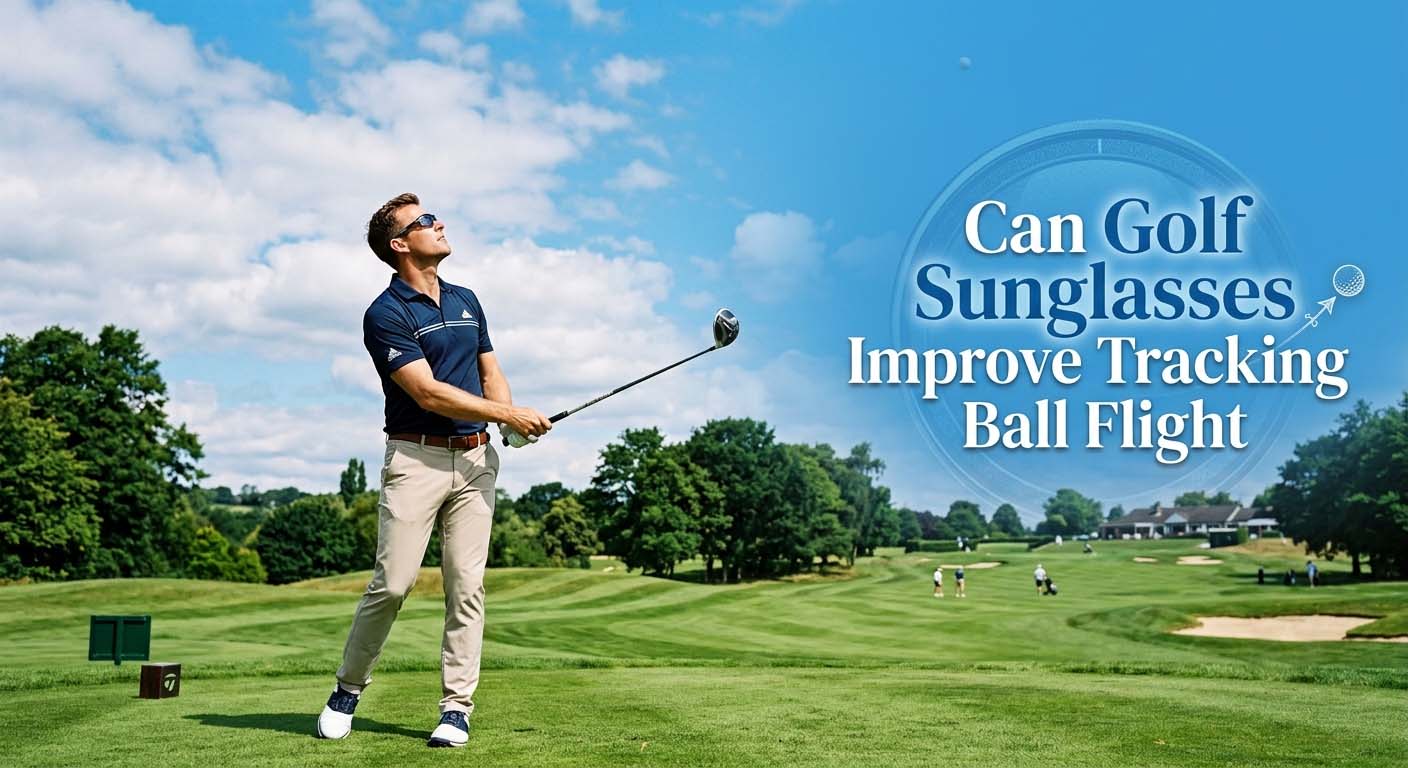
I have spent years on the course testing different lenses, and the answer is clear: yes, but only if you choose the right pair. I have seen golfers spend good money on trendy shades only to lose the ball more often.
The trick is understanding what your eyes actually need to follow a tiny white ball racing across the sky. Not every tint helps. Some make it harder. This article is built from real experience, both my own and feedback from dozens of players I have worked with.
Why Is Tracking a Golf Ball Genuinely Hard?
Before we talk about sunglasses, you need to understand why tracking a golf ball is difficult in the first place. Your eyes are not designed for this task. The ball is small, moves fast, and the background keeps changing. Here is what you are fighting against.
The Contrast Problem
A standard white golf ball against a bright blue sky offers very little contrast. The human eye sees the sky as a wash of blue light. The white ball blends into that brightness, especially when the sun is high.
On overcast days, the ball can disappear against gray clouds. The same issue happens when the ball flies in front of trees – the dark greens and browns eat up the white outline.
The only way to fix this is to increase the contrast between the ball and whatever is behind it. That is where lens tints come in. They filter out specific wavelengths of light to make the ball stand out more.
The Angular Velocity Factor
When you hit a drive, the ball moves away from you at over 150 miles per hour. Your eyes have to track an object that grows smaller and faster the farther it goes. The angular velocity- how fast the image moves across your retina- is much faster than what your eyes can smoothly follow. You rely on quick jerky movements called saccades. These are tiring and inaccurate.
Good lenses do not change the speed of the ball. But they help your eyes lock onto the ball faster by increasing its contrast against the background. That small advantage can be the difference between watching your ball land and losing it halfway.
How Do Your Eyes Fatigue Over 18 Holes?
Squinting and straining for four to five hours wears your eye muscles out. Bright sunlight forces your pupils to constrict, which reduces depth perception and visual clarity.
By the back nine, your ability to track the ball gets worse simply because your eyes are tired. A pair of sunglasses that cuts glare and reduces fatigue keeps your tracking sharp all around.
How Lens Tints Change What You See?
Not all tinted lenses are created equal. I have tried brown, gray, rose, copper, and yellow. Each one changes the visual scene differently. For ball tracking specifically, the goal is to make the white ball pop against both the sky and the grass.
What Happens When You Suppress Green Wavelengths
A golf course is mostly green: fairways, roughs, trees. Your eyes have many receptors for green light. That can overwhelm the signal from a white ball. Copper and rose lenses are designed to block a portion of green wavelengths.
This reduces the “green noise” in your vision. The result: the ball appears brighter and more defined. I have tested this side by side.
With a copper-rose lens, the ball looks like it has a sharper edge against the sky. Without it, the ball is softer and harder to pick up.
How Rose and Copper Tones Treat the Sky Differently?
A rose tint warms up the entire scene. It makes blue skies look slightly purple or pinkish. This changes the color contrast enough that a white ball no longer blends in. Copper tints go a step further.
They amplify red and yellow tones while still cutting green. In bright sun, a copper lens gives the ball an almost glowing appearance. I prefer copper for sunny days and rose for variable cloud cover.
Light Transmission Percentages and Their Real-World Effect
Lens tint is not just about color. How much light gets through matters a lot. Light transmission is measured as a percentage. A lens that lets in 10% of light is very dark. A lens that lets in 50% is light. For ball tracking, you need enough light to see detail but not so much that you squint.
Based on my testing:
– 15% to 25% transmission: best for bright sun. Copper lenses in this range work well.
– 25% to 40% transmission: ideal for overcast or early morning. Rose or light brown.
– Above 40%: too light for most conditions. Yellow tints fit here, useful only in heavy fog.
If you buy a dark lens for a cloudy day, you will lose contrast because your eyes struggle to see clearly. If you buy a light lens for full sun, you will squint and fatigue quickly.
The Polarization Trap
Polarized lenses are hugely popular. They cut glare from water and roads. But for golf, they cause a specific problem that most articles ignore. I have seen it firsthand.
Why Do Polarized Lenses Reduce Your Perception of Elevation?
Polarization works by blocking horizontal light waves. This reduces glare from flat surfaces. But it also reduces the subtle light reflections from the grass that tell your brain how steep a slope is.
On the putting green, polarized lenses can make a downhill putt look flatter than it is. In the air, they can make the ball’s arc look different because the light scattering from the sky is altered.
Some golfers do not notice this. But if you have ever hit a shot that looked high but landed short, or read a putt that broke less than expected, polarized lenses might be the cause.
When Polarization Helps Versus Hurts Ball Tracking?
Polarization is not always bad. On very bright days with a clear blue sky, polarization can cut the glare from the sky and actually improve contrast against the ball. The problem is that the same lenses hurt your depth perception on the ground.
If you keep polarized lenses on for the entire round, you lose the ability to read breaks correctly.
My rule: if you only care about tracking the ball in the air and you never putt, polarized can work. For a complete round, non-polarized is safer.
What to Look for in Non-Polarized Golf Lenses?
Non-polarized lenses still reduce glare through coatings and tint density, not by blocking horizontal light. They allow your brain to process full-depth cues. Many golf-specific brands like RIA use non-polarized designs for this reason.
Look for lenses that advertise “non-polarized” or “anti-glare coating without polarization.” A good anti-reflective coating on the back of the lens also helps prevent light from bouncing off your face into your eyes.
Matching Lenses to Light Conditions
One lens color cannot do it all. I keep two or three pairs in my bag. Here is a breakdown of what works best based on weather and time of day.
Optimal Lens Choices for Bright Sunlight
Full sun, no clouds: use a copper or amber lens with 15% to 20% light transmission. The copper tint cuts green and enhances ball contrast. Avoid gray lenses for tracking – they do not boost contrast enough; they just darken everything.
I have tested Oakley Prizm Golf (which is a rose-copper combo), and it works well. But any quality copper-rose lens with low transmission will do.
Best Options for Overcast and Foggy Days
When the sky is flat and gray, you need more light. A rose or light brown lens with 30% to 40% transmission. Yellow lenses are surprisingly effective in fog because they filter blue light and make edges sharper.
But yellow is useless in bright sun because it does not cut enough light. I only carry yellow lenses for early morning fog rounds.
The Versatile Middle Ground for Changing Conditions
If you play in variable conditions, with clouds coming and going, look for a lens with 24% to 28% transmission in a copper-rose tint. The 24% number is not random. It provides enough darkness for bright sun but still lets in enough light for cloudy spells. RIA’s Golf HD+ lens uses 24% transmission, and I have found it to be a solid all-rounder. That said, no single lens is perfect for every light.
What to Look for When Buying Golf Sunglasses for Ball Tracking?
Lens color is just one piece. Here are the real-world factors I consider before buying.
Lens Quality and Optical Clarity Standards
Cheap lenses often have distortions that make tracking worse. When I test a lens, I look through it at a straight line (like a telephone pole) and move my head. If the line bends or wobbles, the lens is poor. Good golf lenses use polycarbonate or nylon with precise grinding.
Look for “optical grade” or “impact resistant” materials. Brands like Oakley, RIA, and Maui Jim use high-quality optics. Amazon knockoffs often fail this test.
Frame Design for Peripheral Vision
You need to see the ball as soon as it leaves the clubface. A thick frame blocks your peripheral vision. Choose frames with thin arms and a wrap style that stays close to your face without blocking side vision. I prefer a semi-rimless design because the lower edge is open, which helps when looking down to read a lie or putt.
Coatings That Reduce Glare Without Sacrificing Perception
An anti-reflective coating on the back of the lens stops light from reflecting off your eyes back into the lens. A hydrophobic coating repels water and sweat. A scratch-resistant coating is essential because you will be wiping lenses with gloves and towels. But avoid any coating that adds color distortion; some cheap coatings tint everything green or blue, which defeats the purpose.
Other Ways to Improve Ball Flight Visibility
Sunglasses are a powerful tool, but they are not the only one. I have tested other methods to see which ones actually help.
High-Visibility Golf Balls and Their Limitations
Yellow, orange, or matte-finish balls are easier to track. Yellow stands out against green grass and blue sky. Orange is best for overcast days. However, these balls lose some visibility against certain backgrounds; a yellow ball can disappear against a desert landscape or autumn leaves.
They also do not help when the ball is very far away because size still matters. I use a yellow ball on cloudy days and a white ball in the sun with good lenses.
Adjusting Your Tracking Technique
Instead of staring at the ball the entire flight, train your eyes to pick up the ball immediately after impact and then use peripheral vision as it climbs. Many golfers try to follow the ball with their eyes fixed, which causes fatigue.
I teach players to look at the ball at impact, then let their eyes relax and follow the arc without fixating. Sunglasses help here because they reduce the strain that makes you want to squint.
When to Consider Prescription Golf Sunglasses?
If you wear prescription glasses, adding tinted clip-ons or over-glasses can cause distortion and extra weight. Dedicated prescription golf sunglasses are worth the investment. You get the correct lens tint for your prescription without double lenses.
I have used Rx inserts in sports frames, but the best results come from custom-made lenses from a provider that understands golf needs.
Also, if you have astigmatism, proper correction is critical because uncorrected astigmatism makes the ball look blurry at a distance; no lens tint can fix that.
Frequently Asked Questions
Can I use clip-on golf lenses over my regular glasses?
Yes, but with a catch. Clip-ons add weight and can shift, creating distortion. They also sit further from your eyes, which can affect how you see the ball. If your regular glasses are not polarized, clip-on golf lenses in a copper or rose tint can work. But for the best results, get a dedicated pair of prescription golf sunglasses.
Do polarized golf sunglasses help with seeing the ball against clouds?
Not really. Polarization reduces glare from flat surfaces, but clouds are not as reflective as water or roads. Against a cloudy sky, polarized lenses offer no benefit for ball tracking. In fact, they can make the scene look darker and flatter, making the ball harder to see. Stick with non-polarized rose or copper tints for cloudy days.
Will these sunglasses help me find my ball in the rough?
They can help a little. A copper lens increases contrast between the white ball and green grass, so the ball stands out more. But rough often has shadows and mixed colors. No lens replaces walking a straight line to where you saw the ball land. Focus on tracking the flight accurately, and the sunglasses assist with that.
How do I know if my sunglasses are actually hurting my tracking?
Pay attention to how your eyes feel after a few holes. If you notice more eye strain than usual, or if the ball seems to “jump” or disappear during its flight, the lenses may be distorting your vision.
Another test: remove the sunglasses for one tee shot. If you track the ball better without them, the lenses are the problem.
Do cheaper golf sunglasses offer the same ball-tracking benefits as premium brands?
Not usually. Cheap lenses often have tints that are too dark or too light, inconsistent color filtering, and low optical clarity. I have tested $20 sunglasses that made the ball look yellow and blurred.
Premium brands invest in precise tinting and anti-reflective coatings. That said, you do not need to spend $300. The RIA Golf HD+ lenses cost around $125 and perform very well. Look for optical quality over brand name.
Can golf sunglasses help with tracking in early morning fog?
Yes, but only if the lens is light enough. Yellow or light rose lenses with high light transmission (over 40%) cut through fog by filtering blue haze. Dark lenses will make fog worse. I use dedicated yellow lenses for foggy mornings and switch to copper once the sun burns through.