
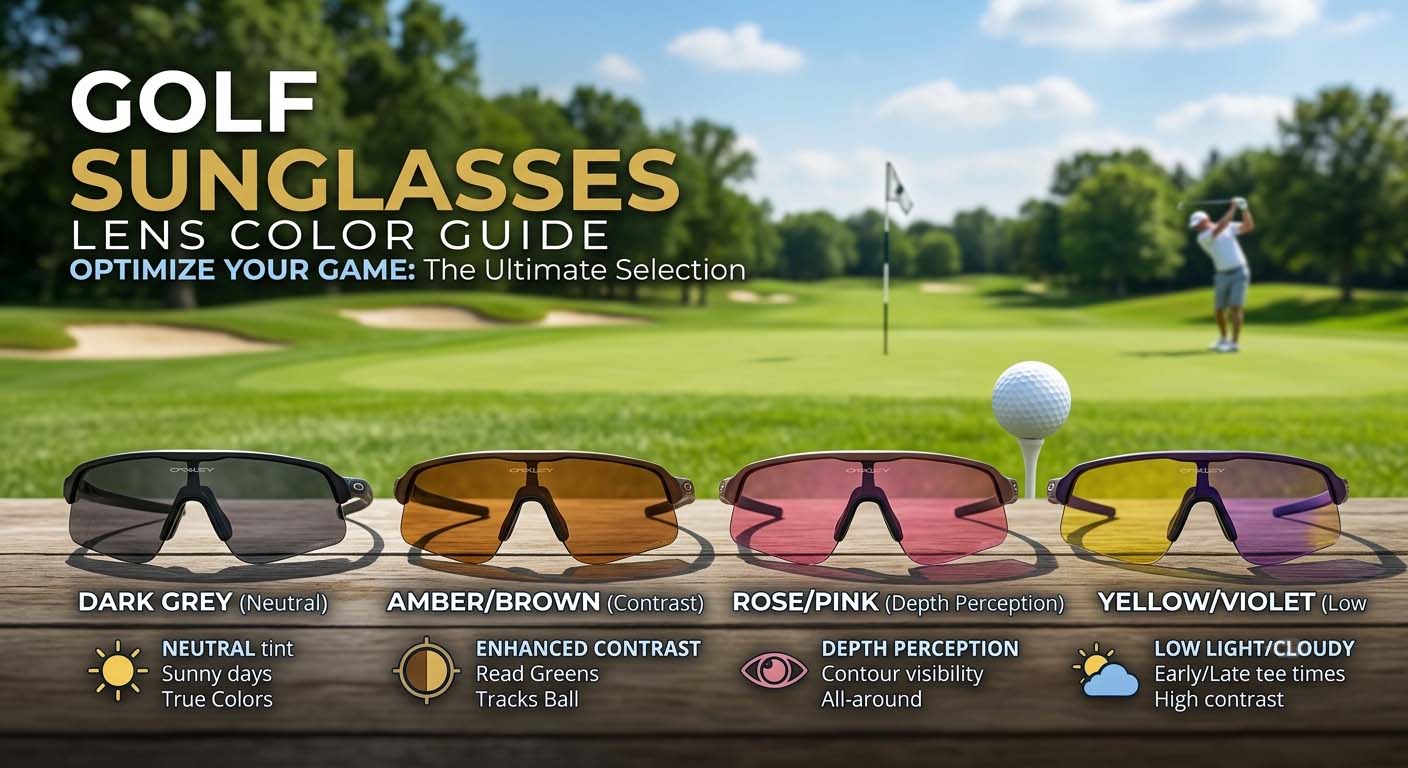
Picking the right lens color for golf sunglasses is one of those decisions that seems simple until you stand in front of a display case with a dozen options. Brown, gray, green, purple, and yellow each promise something different. But there is no single best color for every golfer or every round.
What works on a bright, sunny afternoon can be useless on an overcast morning. What helps a younger player see grain can make an older player feel like they are staring through a fog.
I have tested most of these tints on real courses under real conditions. Here is what I have learned, broken down so you can make a choice that actually helps your game.
How Does Lens Color Affect Golf Performance?
The short version: different lens colors filter out specific wavelengths of light. A golf course is dominated by green — the grass, the trees, the rough. When too much green light reaches your eyes, subtle differences in grass color get washed out. Slopes on the green, the grain direction, even shadows become harder to read.
By blocking certain colors and letting others through, a tint can increase contrast. Brown and copper lenses enhance red and blue wavelengths, making grass texture pop. Gray lenses keep everything natural but reduce brightness. Purple and violet lenses cut out a lot of the green spectrum, revealing breaks you might otherwise miss. Yellow and amber boost contrast in low light.
The key measurement here is visible light transmission (VLT). That is the percentage of light that makes it through the lens. A VLT of 10% is very dark; 80% is almost clear. Different tints come in different VLT ranges, which partly determines their best use case.
Detailed Breakdown of Golf Lens Colors
Brown and Copper Lenses
Brown and copper are the most popular tints among touring pros who do not have a brand deal. They offer high contrast, depth perception, and a VLT typically between 15% and 30%. Brown lenses amplify the difference between light and dark greens, which helps you see the slope on a green and the grain direction in the fairway.
They work well in bright sun and partly cloudy conditions. The downside: they can make the course look artificially warm, and they are not great in full shade or heavy overcast because the tint is too dark.
Gray Lenses
Gray tints are true neutrals. They do not alter color perception, just reduce overall brightness. VLT ranges from 10% to 25%. Gray lenses are excellent for bright, sunny days when you want to see the course exactly as it is, only without squinting.
They are less effective for reading greens because they do nothing to boost contrast. If you play on very flat courses or care more about glare reduction than green reading, gray is a solid choice.
Green Lenses
Green lenses sit between brown and gray. They preserve natural color balance better than brown but provide a slight contrast boost. VLT is usually 15% to 25%. Green is a good all-rounder, comfortable in moderate to bright light, decent for reading greens, and less fatiguing than brown for some players. They are not the best in any specific condition, but they rarely feel wrong.
Purple and Violet Lenses
Purple and violet tints have been heavily promoted by brands like Popticals, and for good reason — they can be very effective. These lenses aggressively filter out green wavelengths, making subtle breaks and undulations on the green stand out. The difference between purple and violet is mostly about VLT.
Violet lets in more light (VLT around 25–35%), so it works better on overcast days or for older eyes that need more light. Purple is darker (VLT 15–20%) and suits bright sun. The catch: they can make the whole course look pinkish, which some golfers find distracting. And they do not help if you struggle with perceiving distance — contrast can actually flatten depth cues.
Yellow and Amber Lenses
Yellow and amber tints are low-light specialists. They boost contrast by filtering blue light, which makes objects appear sharper in fog, heavy overcast, or twilight. VLT is high — often 60–80%.
These lenses are useless in bright sun; they will make everything look washed out. But for an early morning round or a day when clouds are thick, yellow can be the difference between seeing the break and guessing. They are also popular among golfers with age-related vision changes who need more light transmission.
Myths About Golf Sunglass Lenses
1. Purple or violet is always the best. It works well in certain light but fails in others. On a bright, clear day, purple can be too dark. On overcast days, violet is better than purple — but brown or yellow might be stronger.
2. Polarized lenses are always better for golf. Polarization cuts glare from horizontal surfaces like water and sand. But it can also mask subtle breaks on the green because it reduces reflections that reveal slope direction. Many golfers prefer non-polarized tints for putting.
3. Darker lenses provide more UV protection. UV protection is a coating or material property, not related to tint darkness. A light yellow lens can block 100% of UV just as well as a dark gray one. Check the label for UV400 or 100% UV protection.
How to Choose the Right Lens Color for Your Game?
Follow these steps:
- Evaluate the light conditions you most often play in. If you play midday sun, go with brown or gray (VLT 15–25%). If you play in the early morning or overcast, choose yellow or amber (VLT 50–80%). For variable conditions, green or copper (VLT 20–30%) is a safe compromise.
- Consider your age. As you get older, your eyes let in less light. If you are over 50, lean toward lighter tints — violet, amber, or yellow. Younger eyes can handle darker tints like purple or brown.
- Think about your biggest struggle on the course. If you misread putts, prioritize contrast-enhancing lenses like purple or brown. If you lose the ball in bright glare, darker gray or brown are better. If you get eye fatigue late in the round, a mid-range tint (20–30% VLT) helps endurance.
- Try before you buy. Lens color perception is personal. Borrow a friend’s pair or buy from a store with a good return policy. Play a few holes with each tint before committing.
Advanced Considerations for Serious Golfers
Lens material matters. Polycarbonate is lightweight and impact-resistant but can have slightly lower clarity. Glass offers the sharpest optics but is heavier and can break. Trivex is a middle ground — lightweight and clear.
Custom tints are available from companies like Oakley and Rudy Project. You can have a tint tuned specifically to your vision needs. Prescription inserts are also common; you get a clear lens with the tint applied to a separate prescription carrier.
Eye color affects how you perceive tints. Lighter eyes (blue, green) are more sensitive to brightness and may prefer darker tints. Darker eyes (brown) handle bright light better but may benefit from contrast enhancements like brown or violet.
Your playing style matters too. If you walk and carry your bag, consider a photochromic lens that automatically adjusts VLT as clouds come and go. If you ride a cart, you can swap lenses between holes.
Frequently Asked Questions
Can I use blue-blocking or computer glasses for golf?
Blue-blocking glasses (often yellow or amber) can reduce eye strain from screens but do not enhance contrast on a golf course. They are not designed for outdoor use — they filter blue light that is less abundant in sunlight. For golf, stick with purpose-made tints.
Are mirrored or reflective coatings beneficial on the course?
Mirrored coatings reduce glare further by reflecting light away from the eye. They work well in very bright conditions, especially near water hazards. But they can make reading greens harder because they also reduce the subtle reflections you use to judge slope. Use them only if glare is your primary problem.
Do I need different lens colors for driving the cart vs. playing?
No. One good tint that matches the light conditions will work for both. If you have a separate pair of driving glasses, use neutral gray or brown — those are comfortable for driving because they do not distort traffic light colors.
How often should I replace my golf sunglasses lenses?
Replace lenses when you see scratches, coating peeling, or if the tint starts fading. Typically every 2–3 years if you play regularly. Polycarbonate lenses scratch faster than glass; use a microfiber cloth and case.
What VLT percentage do most professional golfers prefer?
Most pros choose lenses with VLT between 20% and 30% — dark enough to cut glare but light enough to see contours. Brown and copper tints dominate that range. A few use violet or purple in certain conditions, but brown is the most common by far.