
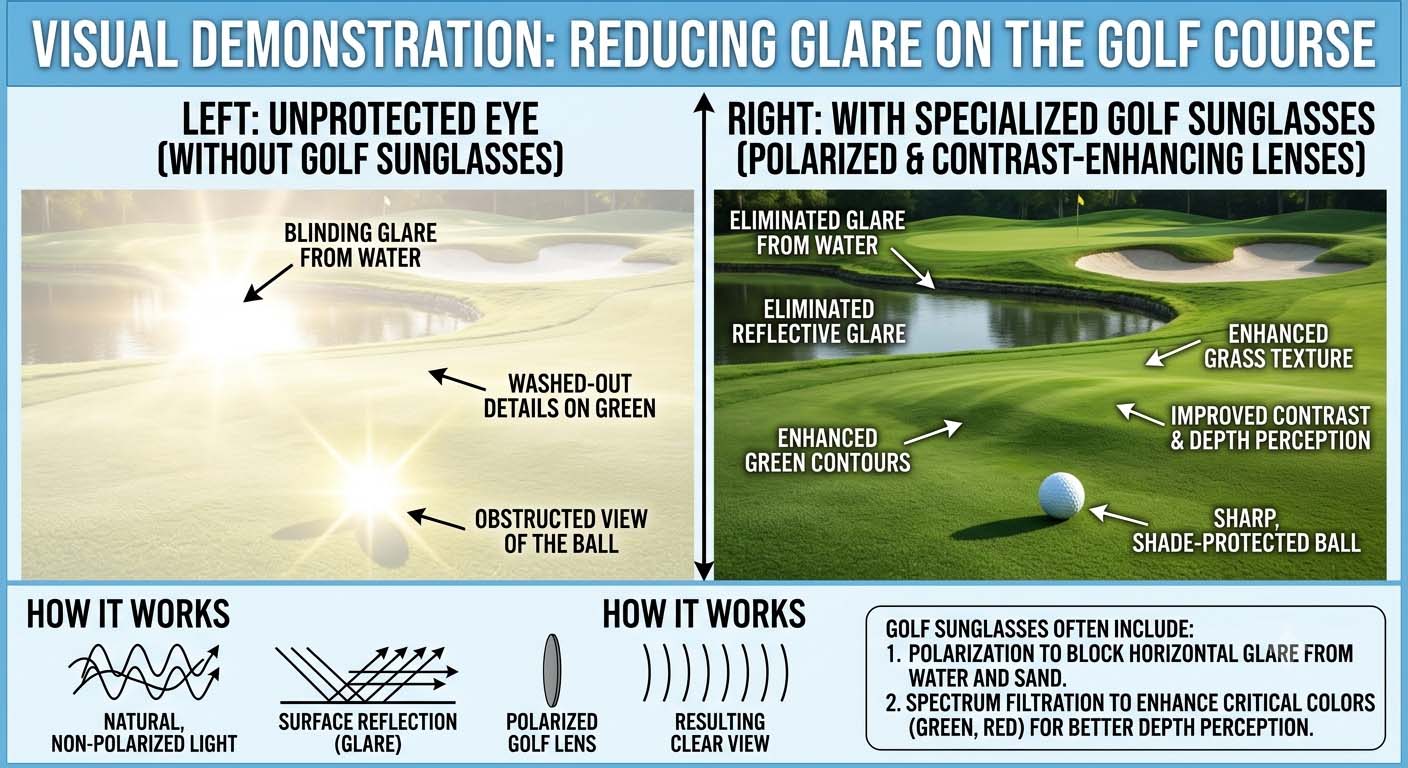
Yes, golf sunglasses help with glare. They are built to cut down the harsh light that bounces off water, sand, and wet grass. But the help they give depends on the lens type and the course you play. A regular pair of sunglasses can make things worse in some situations. This article explains exactly how these glasses work, when they shine, and when you might be better off without them.
How Glare Interferes with Your Golf Game
Glare is more than just a bright spot in your vision. It actively hurts your performance in four clear ways.
Ball tracking gets harder. When the sun bounces off a water hazard or a dew-covered fairway, the ball can disappear mid-flight. You lose sight of it for a split second. That is enough time to misjudge where it lands.
Reading greens becomes guesswork. A putting green has a thin layer of surface sheen. That sheen shows you the grain direction and subtle slopes. High glare wipes out that sheen. You see a flat, uniform surface when the truth is more complex.
Squinting causes fatigue. Your eyes work harder to focus when light is too strong. After nine holes, you feel tired. Your concentration drops. Mistakes happen on the back nine because your eyes are worn out.
Depth perception suffers. Glare reduces the contrast between the ball and the background. You misjudge distance, especially on approach shots. That is why many golfers hit short or long when playing into the sun.
The Mechanics of Glare Reduction in Golf Sunglasses
Golf sunglasses use three main technologies to fight glare. Understanding these helps you pick the right pair.
Polarization
Polarized lenses block horizontal light waves. Most glare comes from light bouncing off flat surfaces like water, sand, and wet grass. By filtering out those waves, polarized glasses make the scene look calmer and less harsh. This works very well on bright, sunny days. But it can remove the surface sheen on greens, which is the trade-off.
Contrast-Enhancing Lens Tints
Lens tints like copper, rose, and amber boost certain parts of the color spectrum. They make greens look greener and reds look more vibrant. This helps you see the ball against the grass and pick up subtle changes in the terrain. Gray lenses do not do this. They just darken everything equally, which reduces contrast.
Anti-Reflective Coatings
Light can bounce off the back of the lens into your eye. This is called back-glare. Anti-reflective coatings stop that. They keep your vision clear even when the sun is behind you. This is a small detail that makes a big difference over a four-hour round.
Why Some Golfers Swear by Non-Polarized Lenses
This is where the conversation gets interesting. Many golfers, including top club fitters and instructors, recommend non-polarized sunglasses for golf. Here is why.
Polarized lenses can hide the green. The same technology that cuts glare on water also cuts the sheen on the putting surface. That sheen is a visual clue. It shows you which way the grass grain grows. Without it, reading the break of a putt becomes harder. You might miss a subtle slope that would have changed your line.
Depth perception can shift. Some golfers report that polarized lenses make the ball look closer or farther than it actually is. This can throw off your distance control on approach shots. Not everyone experiences this, but enough do that it is worth knowing.
Non-polarized contrast lenses offer a middle ground. A good non-polarized lens with a copper or rose tint still cuts a lot of glare. It makes colors pop and improves depth perception. But it leaves enough light and sheen on the green so you can read putts naturally. Many players find this balance works best.
When to choose polarized: If you play a course with lots of water hazards or white sand traps, polarized lenses are a strong choice. The glare from those surfaces is intense. The trade-off on the green might be small compared to the benefit on the fairway.
When to choose non-polarized: If you play a hilly course with fast, undulating greens, non-polarized is often better. You need every visual clue you can get to read those putts correctly.
When Do Golf Sunglasses Help the Most?
Golf sunglasses are not needed on every hole. They help most under specific conditions.
- Early morning and late afternoon tee times. The sun is low in the sky. It hits your eyes directly. Glare is at its worst during these hours.
- Courses with water on three or more holes. Water reflects more light than grass. That glare can blind you during a swing.
- Links and desert courses. White sand and light-colored dirt reflect a lot of light. The ball can be hard to spot against these backgrounds.
- When playing into the sun. If the first nine holes face west and you tee off in the afternoon, sunglasses make a big difference. You will see the ball flight much better.
- Overcast days with bright clouds. Cloud cover does not always kill glare. Bright, thin clouds can scatter light in all directions, creating an almost white sky that is hard on the eyes.
Sunglasses help least when the course is shaded by trees, the sun is directly overhead, or the greens are heavily contoured. In those spots, you might actually play better without them.
Why Many PGA Tour Pros Skip Sunglasses
You see it on television. Many of the best players in the world do not wear sunglasses. This is not because they ignore glare. It is a deliberate choice based on what they value in their vision.
Depth perception is critical. Tour pros hit the ball within a few yards of a target from 150 yards. Any shift in depth perception, even a small one, can cause them to miss. Sunglasses, especially polarized ones, can change how the ball looks in flight. For a pro, that risk is too big.
Inconsistent light transition. A pro moves from a sunny fairway to a shaded green many times in a round. Taking glasses on and off is a distraction. Some prefer to let their eyes adjust naturally rather than deal with the change in tint.
Personal preference and habit. Many pros have worn the same type of glasses or no glasses since they were juniors. They are used to the feel of sunlight on their face. Changing that is hard.
Sponsor obligations. Some pros wear sunglasses because their sponsor pays them to. Others do not. It is not always about performance.
What this means for you. You are not a tour pro. You probably do not need to hit the ball within two yards of the pin. Glare is likely a bigger problem for you than a tiny shift in depth perception. So while the pros skip them, that does not mean you should. The average golfer gains more from glare reduction than they lose from the trade-offs.
How to Choose Golf Sunglasses That Actually Help
Follow this three-step framework to find the right pair for your game.
Step 1: Identify your primary glare source. Look at the courses you play most often. Do they have lots of water? White sand? Do you play mainly in the early morning or late afternoon? Your answer decides whether polarized or non-polarized lenses are better. Water-heavy courses favor polarized. Greenery-heavy courses favor non-polarized contrast lenses.
Step 2: Select the right lens tint. The tint matters more than the brand.
- Rose or light copper: Best for overcast days. They boost contrast in low light without darkening the scene too much.
- Copper or brown: Best for bright, sunny days. They cut glare and make greens pop. This is the most versatile choice for most golfers.
- Gray: Good for very bright, desert courses. But they kill color contrast. Use only if you play on very bright, flat courses with few trees.
- Yellow: Good for low-light or foggy mornings. They brighten the scene and improve depth perception in flat light.
Step 3: Decide on polarization. This is the hardest choice. Use this simple rule: If you care more about fairway glare, go polarized. If you care more about reading greens, go non-polarized. If you are not sure, buy a pair of non-polarized contrast lenses. They help in more situations for most golfers.
Quick checklist before you buy:
- Fit: Do they stay on when you look down at address?
- Weight: Do they feel heavy after 10 minutes?
- Venting: Do they fog up when you walk?
- Scratch resistance: Golf bags and rough cases scratch lenses easily.
- UV protection: Must be 100% UV rated.
Frequently Asked Questions
Can I use regular polarized sunglasses for golf?
You can, but they are not ideal. Regular polarized sunglasses cut glare but they also cut the sheen on greens. This makes reading putts harder. They also use gray or dark tints that reduce color contrast. A golf-specific lens with a copper or rose tint is much better for seeing the ball and the green.
What is the best lens color for high glare?
Copper or brown with a quality anti-reflective coating. This tint cuts the bright light while boosting the greens and reds on the course. It works well in both sunny and partly cloudy conditions. For extreme glare on desert courses, a gray-based lens with a light tint can work, but it will reduce color contrast.
Do sunglasses help with glare on overcast days?
Sometimes yes. Bright, thin clouds scatter light and create a glare that is hard on the eyes. A rose or light copper tint can boost contrast and reduce eye strain on these days. But if the sky is dark and heavy with rain clouds, you likely do not need them.
How do I test if my sunglasses help or hurt my putting?
Go to a practice green. Read a putt without glasses. Note the break and speed. Then put on the glasses and read the same putt. If the green looks flatter or the break seems different, the glasses are changing your depth perception. Do this test with a few putts from different angles before you buy a pair.
Are there cheap golf sunglasses that work against glare?
Yes, but with limits. Budget options with polycarbonate lenses and a copper or amber tint can help. But they often lack good anti-reflective coatings and scratch resistance. They will work for a season or two. The higher price of premium lenses mostly pays for better coatings and longer durability.
Should I wear glasses even if I wear contacts?
Yes, if your contacts do not have built-in UV protection. Standard contacts do not block UV light well. Your eyes need protection from the sun’s rays just like your skin. Look for prescription golf sunglasses or clip-on tints that go over your regular glasses.
Final Takeaway
Golf sunglasses help with glare more than regular sunglasses do. They use specific tints and coatings to cut the light that hurts your game. But they are not perfect. They can change how you see the green and the ball flight. The key is to match the lens type to the courses you play most. For most golfers, a non-polarized copper lens is the safest, most helpful choice. It cuts enough glare to keep you comfortable and focused, without removing the visual clues you need to play your best. Test a pair on your home course before you commit. Your eyes will tell you if they work.