
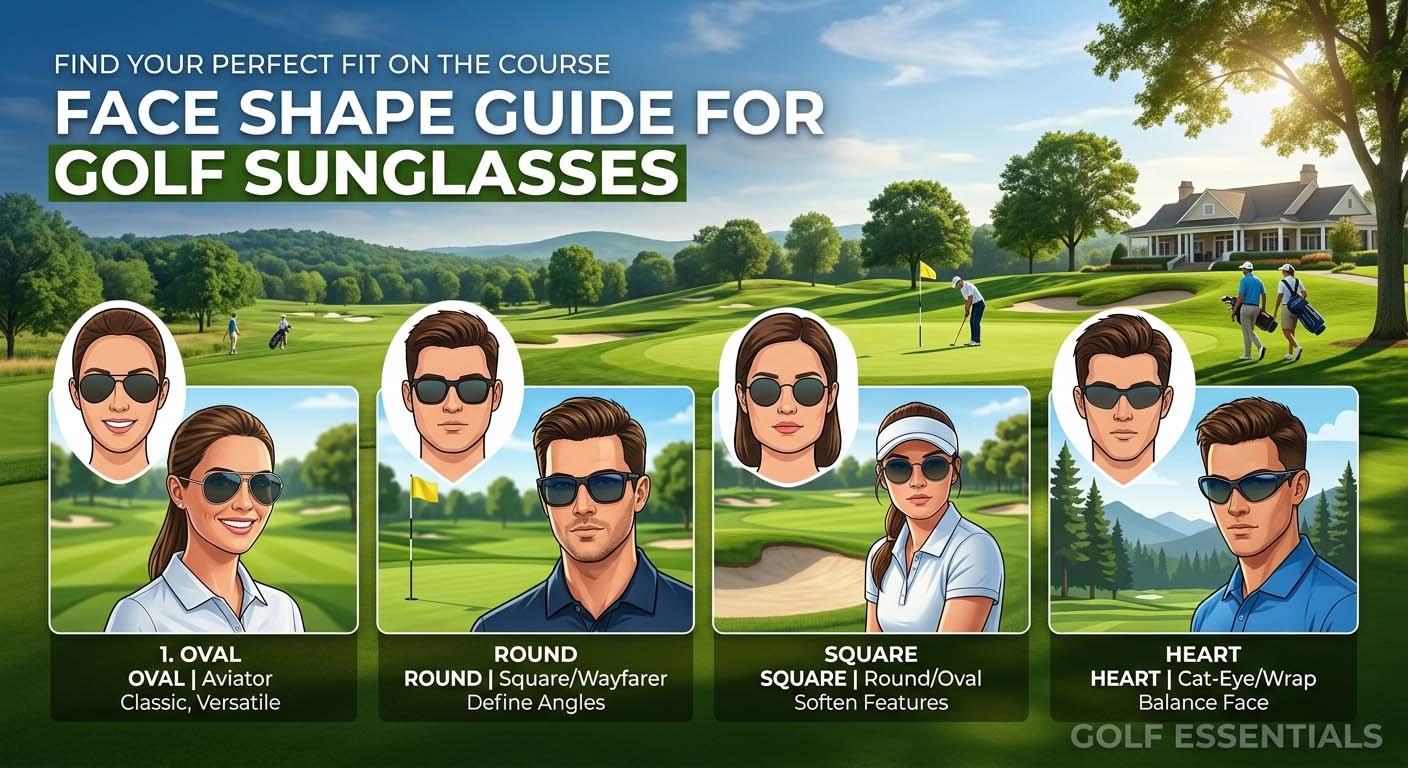
Most face shape guides for sunglasses are written by people who have never taken a swing in a pair of shades. They show you a diagram, tell you to match your shape to a frame style, and call it done. That approach works fine for walking around town. It fails on the golf course.
Golf sunglasses need to do three things that casual sunglasses do not: stay locked on your face during a rotational swing, let you see the ground clearly when you tilt your head down to putt, and block glare from all angles while you stand over the ball. Your face shape directly controls whether a pair of glasses can deliver on these three demands.
This guide goes beyond the typical oval-round-square recommendation. You will learn how to measure your face shape in your actual golf posture, how each shape interacts with frame stability and lens wrap, and which specific frame dimensions work best for your game.
How to Accurately Identify Your Face Shape for Golf Sunglasses?
Standard face shape identification asks you to stand straight, look in a mirror, and measure your forehead, cheekbones, jawline, and face length. That works if you plan to wear the sunglasses while standing still. For golf, you need to take those measurements in your address position.
Measuring for the golf posture
Set your phone on a table at hip height. Stand as you would when addressing a golf ball – feet shoulder-width apart, spine tilted forward from the hips, head neutral, eyes looking forward. Have a friend take a photo from straight ahead. This angle shows your face as it actually appears during play, not how it looks upright.
Now measure the four key features from that photo:
- Forehead width: widest part across your brow bone
- Cheekbone width: widest point across your cheekbones – note if they sit high (close to eye level) or low (closer to the nose)
- Jawline: width at the hinge of your jaw, plus how angular or rounded the jawline appears
- Face length: from the hairline to the chin, divided by the face width at the cheekbones
The golf posture changes two things. First, your cheekbones appear more prominent because your head is slightly lowered. A face that looks oval when standing may look round or heart-shaped when you are bent forward. Second, your jaw appears wider because the neck muscles relax differently. Use these golf-posture measurements for all the recommendations that follow.
Why Golf Sunglasses Fit Differently from Casual Sunglasses
Golf introduces stresses that casual wear does not. Three mechanical factors make the fit requirements unique.
Rotational torque during the swing. A driver swing generates rotational force at the head. Your body rotates, your head stays relatively stable, but the frames experience a twisting force from the temples.
Faces with low cheekbones or a narrow skull shape allow the frames to slip backward along the temples. Faces with wide, prominent cheekbones provide a natural lock that resists this torque.
Looking down at mechanics. When you read a putt, your head tilts forward 30 to 45 degrees. The sunglasses shift forward on your nose. If the nose bridge does not grip well for your face shape, the frames slide down, and you lose peripheral vision right when you need it most.
Temperature and fogging. Walking 18 holes creates a temperature gradient. Your body heats up, sweat forms, then you cool down on shaded fairways.
The combination of moisture and temperature change causes fog on the inside of lenses. Faces with a flatter brow line and wider cheekbones tend to trap more warm air against the lenses, while faces with a deeper eye socket shape allow better airflow.
Each of these factors interacts with face shape differently. That is why a pair of glasses that fits your friend perfectly may slip, fog, or block your vision on the course.
Face Shape and Swing Performance Considerations
Each face shape has specific golf-fit needs. Below are the recommendations based on real-world performance, not style preference.
Oval face shape for golf
An oval face has balanced proportions – forehead slightly wider than the chin, cheekbones the widest point, face length about 1.5 times the width. This shape is the most versatile for sunglasses in general, but for golf, it has a hidden weakness.
What to look for: Oval faces often have a straight nose bridge with moderate height. During the swing, frames can slide forward if the temples do not have enough curve. Look for frames with a wrap angle of at least 8 base curve. The temple should have a rubberized grip or a curved earpiece that hooks behind the ear.
What to avoid: Thin metal temples with no grip. They let the frames rotate during the swing. Also avoid very wide frames – an oval face needs a frame width that matches the cheekbone width exactly, not wider.
Recommended measurements: Frame width 135-145mm, lens height 38-45mm, temple length 130-140mm with a curved end.
Round face shape for golf
A round face has equal width and length, with full cheeks and a rounded jawline. The biggest challenge for round faces is keeping the frames from sliding up the cheekbones during the swing.
What to look for: Longer temples with a strong curve behind the ear. The nose bridge needs adjustable nose pads – round faces often have low bridge height, and molded bridges leave a gap that lets the frames move. A slight wrap (8 base curve) helps the frames stay in place.
What to avoid: Round frames that mirror your face shape. They offer no grip contrast. Also avoid very heavy acetate frames that push down on the cheeks.
Recommended measurements: Frame width 130-140mm (slightly narrow to avoid cheek pressure), lens height 35-40mm, temple length 135-145mm with rubber grip.
Square face shape for golf
A square face has a strong jawline, a broad forehead, and the width and length are roughly equal. This shape offers good stability for golf because the wide jaw and forehead naturally lock the frames.
What to look for: Wider frames that match the jaw width. Square faces can handle more wrap because the brow line is prominent enough to prevent the frame from touching the eye. Look for 8-10 base curve frames for maximum peripheral vision.
What to avoid: Narrow frames that squeeze the temples. They cause headaches during the round. Also avoid very angular frames that repeat the square jaw – a slightly rounded top edge balances the look.
Recommended measurements: Frame width 140-150mm, lens height 40-48mm, temple length 135-140mm, wide nose bridge (18-20mm).
Heart-shaped face for golf
A heart-shaped face has a wide forehead, high cheekbones, and a narrow chin. The high cheekbones are actually an advantage for golf – they create a natural ledge that helps hold the frames in place.
What to look for: Frames with a low nose bridge and adjustable pads. The high cheekbones mean the frame sits slightly higher on the face. A lens with a taller height (45- 50 mm) ensures the lower part of the lens does not cut off your view when looking down at a putt.
What to avoid: Cat-eye or upswept frames that emphasize the forehead width. Also avoid frames with a very high bridge – they will ride up onto the brow bone.
Recommended measurements: Frame width 130-140mm, lens height 44-50mm, temple length 130-135mm, bridge height 15-17mm.
Diamond face shape for golf
A diamond face has a narrow forehead and jaw with wide cheekbones, giving a pointed chin and temples. This is the most challenging shape for golf because the cheekbones are very prominent, and the narrow forehead leaves less surface area for temple grip.
What to look for: Frames with a high base curve (10 base) that wrap all the way around the cheekbones. The temple must have a strong curve and a rubberized tip. Look for a vented nose bridge to prevent fogging, because the eye socket is often deep.
What to avoid: Rimless or semi-rimless frames – they do not provide enough structure to stay stable. Also avoid very wide frames that extend beyond the cheekbones.
Recommended measurements: Frame width 130-140mm (must match cheekbone width exactly), lens height 38-42mm, temple length 135-145mm with silicone grip, bridge width 16-18mm.
The Lens Curve and Face Shape Relationship
Lens base curve describes how much the lens wraps around your face. A 6 base curve is relatively flat, similar to casual sunglasses. An 8 base curve has moderate wrap. A 10 base curve wraps tightly around your face.
For golf, higher base curves are generally better because they block peripheral glare and improve airflow. But face shape determines which base curve actually seals properly.
| Face Shape | Best Base Curve | Why |
|---|---|---|
| Oval | 8-10 | Balanced contours allow a tight wrap without pressure points |
| Round | 8 | Full cheeks need a moderate wrap to avoid cheek pinching |
| Square | 9-10 | Strong brow and jaw support tight wrap |
| Heart | 8-9 | High cheekbones benefit from a wrap, but a narrow jaw needs less curve at the bottom |
| Diamond | 10 | Prominent cheekbones and a narrow forehead need maximum wrap for stability |
A higher base curve also reduces light leaking in from the sides. This is especially helpful on sunny fairways. But if the curve does not match your face, you will get pressure points at the temples or nose, which leads to discomfort by the 14th hole.
Frame Material and Nose Bridge Design for Golf
Material choice matters more for golf than for casual wear because of sweat and movement.
Acetate provides good grip on dry skin but becomes slippery when wet. It is heavier, which can cause frames to slide down on faces with a narrow nose bridge.
Grilamid is lightweight and flexible. It holds its shape well during movement. Works best for round and diamond faces that need consistent temple tension.
O Matter (Oakley’s proprietary material) is designed for athletic use. It stays grippy even when wet and resists deformation. Good for all face shapes, but especially for square and heart faces that need a firm temple grip.
Titanium is lightweight but lacks grip. It works best for oval faces with a stable nose bridge. Not recommended for round or diamond faces that need more hold.
Nose bridge design
Two main types exist: adjustable nose pads (two small pads on metal arms) and molded bridge (a continuous plastic or rubber piece).
Golf-specific recommendation: Adjustable nose pads are better for most face shapes because you can dial in the exact fit. Molded bridges are simpler but often too wide or too narrow for the variety of face shapes.
If you have a round or diamond face, adjustable pads are almost mandatory. If you have a square or oval face with a high nose bridge, a well-designed molded bridge (like Oakley’s Unobtainium) can work well.
Nose pad material also matters. Silicone grips better than plastic, especially when you sweat. Check that the nose pads are replaceable – they wear out after a season of golf.
Testing Your Fit Before the First Tee
You can evaluate any pair of golf sunglasses against your face shape with a simple field test. Do not just put them on and look in the mirror. Perform these steps:
- The dry swing test. Stand in your golf posture. Make three full practice swings. Check if the frames shift more than 2 millimeters from their original position. If they do, the temple grip or nose bridge fit is wrong for your face.
- The putting test. Look down at the floor as if reading a putt. Hold that position for 10 seconds. Can you see the full width of your lower peripheral vision without the frame edge cutting in? If the frame blocks more than the top 10 percent of your view, the lens height is too short for your face shape.
- The fog test. Walk briskly for five minutes (or simulate by doing 20 jumping jacks indoors). Immediately check the lenses for fog. Fog on the lower edge near the nose indicates poor nose bridge ventilation for your face. Fog on the upper edge indicates the brow line is too close to the lenses.
- The comfort test. Wear the glasses for 30 minutes. Remove them. Check for red marks on your nose or temples that last longer than two minutes. Lasting marks mean the fit is too tight for your face shape.
Use this simple scoring system: pass three tests, and the glasses are a good match. Pass four, they are ideal. Pass two or fewer; keep looking.
Golf Lens Technology Selection by Face Shape
Lens tint and technology choices depend partly on how light enters your eye, which is influenced by your face shape.
People with wider faces (square, round) have more space between their eye and the side of the frame. That extra space lets more peripheral light in, which can cause glare. These face shapes benefit from a darker lens tint (15-20 percent light transmission) and a higher base curve to block side light.
People with narrower faces (oval, heart, diamond) already have the lens close to the eye. They can use a slightly lighter tint (20-25 percent transmission) and still get good glare protection.
They also benefit from contrast-enhancing technologies like PRIZM Golf or comparable options because the lens sits close enough to maximize the color enhancement without distortion.
For all face shapes, a dark polarized lens is not always ideal for golf. Polarized lenses can interfere with reading the grain of greens and can cause a slight depth perception shift.
If your face shape requires a high wrap (8+ base curve), choose a lens that is specifically designed for golf – usually a rose or copper base tint that amplifies contrast between grass and sky. This combination works well regardless of face shape.
Frequently Asked Questions
Can I use a virtual try-on tool effectively for golf sunglasses?
Virtual try-on tools show you how frames look on your face from the front. They do not account for movement, sweat, or the downward tilt of your head during a putt.
Use them to narrow down styles that suit your face shape, but never buy golf sunglasses without trying them in real life – or at least buying from a store with a generous return policy.
How often should I replace golf sunglasses if my face shape changes with weight loss or aging?
Significant weight changes of 10 pounds or more can alter how frames sit on your face. The same applies to changes in skin elasticity as you age, the frames may start slipping where they once fit tightly.
Check the fit at the start of each golf season. If you notice more than 2mm of movement during a practice swing, it is time for a new pair.
Do prescription golf lenses change the fit considerations for different face shapes?
Yes. Higher prescriptions add thickness and weight, especially in the center of the lens. Heavier lenses pull the frames down on your nose. If you have a round or diamond face with a low nose bridge, choose a frame with adjustable nose pads and a lightweight material like Grilamid.
Square and oval faces can handle thicker lenses better because the wider nose bridge distributes the weight.
Should I size up or down for golf compared to my casual sunglasses size?
You should generally wear the same frame width as your casual sunglasses. The key difference is the wrap angle and temple grip, not the overall size.
Avoid sizing up; oversized frames let in more light from the sides and can catch wind during the swing. Avoid sizing down; undersized frames may not cover your entire eye area, especially if you have a square or heart-shaped face.