
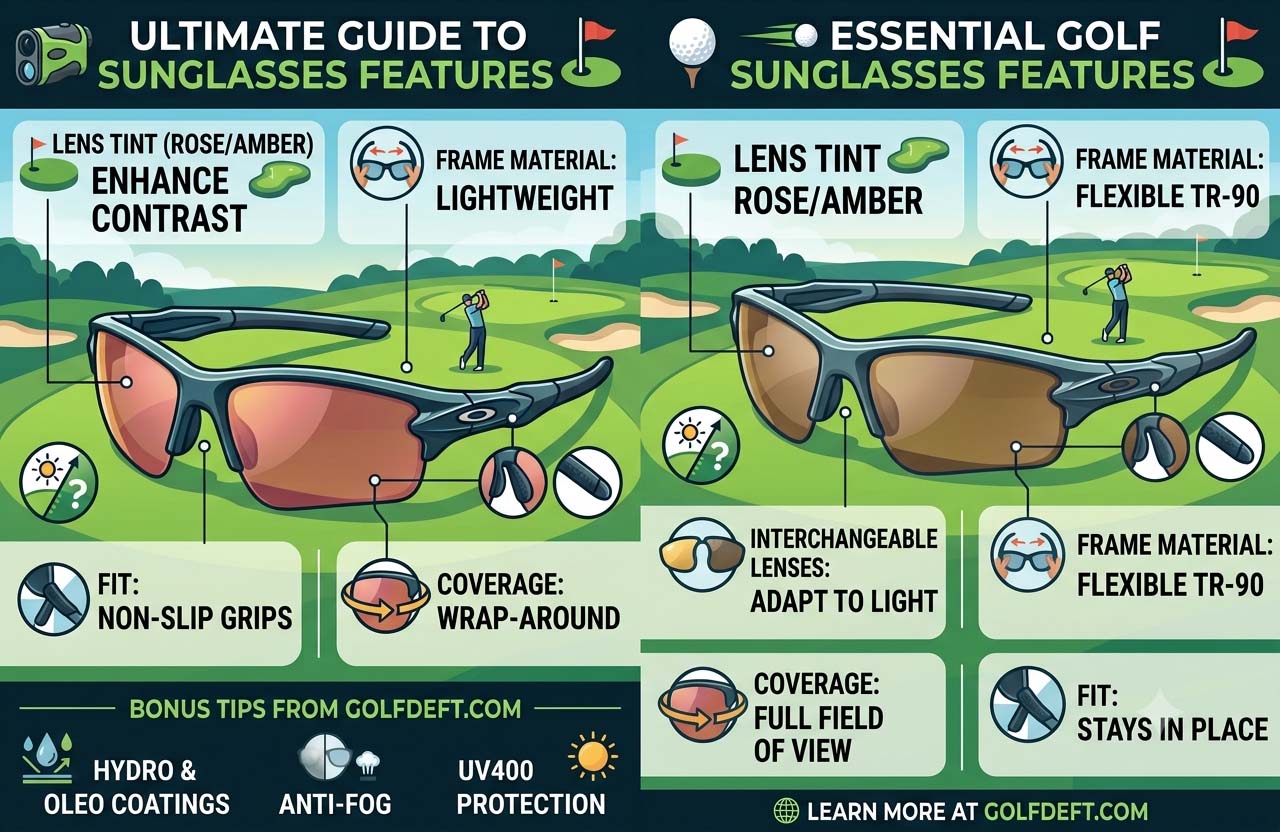
Most golfers treat sunglasses as an afterthought. They grab whatever pair is in the car or buy something that looks sporty. That is a mistake. The wrong sunglasses can ruin your feel for distance, flatten the greens, and make it harder to track the ball in the air.
Golf sunglasses are not accessories. They are visual performance tools. The best ones do four things well: they enhance contrast so you can read the course, they preserve depth perception so you can judge carry distances, they manage light so your eyes stay relaxed, and they stay stable during your swing so you never lose focus.
Here is exactly what to look for so you do not waste money on eyewear that hurts your game.
How Golf Vision Differs from Everyday Vision
Normal vision tasks do not demand what golf does. Driving a car or walking down a street requires general awareness. Golf requires three specific visual abilities that most people never think about until they lose them.
The first is dynamic contrast tracking. You have to follow a small white ball against a bright sky, then against green fairway, then against dark trees or dirt. Your eyes have to adjust instantly between these backgrounds. Standard golf sunglasses that just darken everything make this harder, not easier.
The second is distance judgment without normal depth cues. On a flat fairway, you do not have cars or buildings to gauge distance. You have to read the terrain and trust your eyes. If your lenses distort the terrain or wash out shadows, you will misjudge every carry.
The third is shadow reading for green breaks. Subtle slopes show up as changes in shade. Lenses that flatten contrast erase these visual cues. You will leave putts short or push them past the hole because you could not see the break.
Good golf lenses are designed to enhance these three abilities. Bad ones ignore them.
Understanding Lens Tint Selection by Course Conditions
The most common mistake golfers make is buying a single tint and using it everywhere. Different courses and different light conditions demand different visual strategies.
Rose, copper, and amber tints dominate the golf market for a reason. These colors filter out the green light that dominates grass and sky, which makes the ball, the contours, and the shadows stand out more. The lens essentially creates a higher-contrast image so your brain can process what it sees faster.
Matching Tint to Course Archetype
Desert courses have bright sun, hard-packed fairways, and lots of brown and red tones. A copper or rose tint works well because it enhances the reds and yellows that define the fairway edges and green surrounds. These conditions rarely have overcast skies, so you want a lens that cuts glare without darkening the view too much.
Links courses near the coast have unpredictable light. One hole is bright; the next is overcast. A rose or purple tint filters the blue light that dominates overcast conditions, which helps the ball stand out against gray skies. These lenses also handle the rapid light changes that happen on coastal courses.
Parkland courses with heavy tree coverage create a mix of bright sun and deep shade. A copper or amber tint with moderate light transmission handles both conditions. The key is avoiding lenses so dark that you lose detail in the shadows under the trees.
Coastal courses with high UV intensity need lenses that block harsh light without sacrificing contrast. A base tint of rose or copper with a mirror coating works well. The mirror coating reflects excess light while the base tint enhances the visual information you need.
What Light Transmission Percentages Work
Visible light transmission (VLT) is the percentage of light that reaches your eyes. For golf, the sweet spot is 20 to 30 percent for most conditions. This range blocks enough light to reduce eye strain without making the course look like dusk.
For bright desert or coastal courses, stick to 15 to 20 percent VLT. For overcast or early morning rounds, 30 to 40 percent is better. Some lenses come with a base VLT and add a mirror coating that effectively lowers it by a few percentage points, giving you the best of both.
The Polarization Decision Framework
You will hear two absolute statements about polarization. Some people say never use polarized lenses for golf. Others say they are fine. Both are wrong because the answer depends on the conditions.
Polarized lenses filter horizontal light waves, which is what causes glare off flat surfaces like water, sand, or wet pavement. When you play a course with large water hazards or bright bunkers, polarized lenses reduce that harsh glare significantly. Your eyes stay relaxed, and you see the ball more clearly against reflective surfaces.
But polarization has a downside for golf. It can flatten depth perception and remove the subtle variations in light that tell you how the green slopes. When you cannot read the micro-contours, you miss putts. Polarized lenses also interfere with certain LCD screens, including some GPS devices and range finders.
Here is the practical rule. Use polarized lenses on courses where glare is the main problem: coastal courses with bright water, desert courses with reflective sand, or morning rounds when the sun is low.
Switch to non-polarized lenses on tree-lined parkland courses, undulating greens, or any course where subtle green reading matters more than glare reduction.
If you only buy one pair, choose non-polarized. They work in more conditions and preserve the depth cues you need for good putting.
Optical Quality and Swing Mechanics
Most golfers do not realize that poor lens quality can change how they swing. It sounds strange, but the connection is real.
Lens distortion warps the edges of your vision. When you look straight ahead, the center of the lens might be fine, but the periphery bends the image. Your brain compensates for this distortion by adjusting your alignment. You might set up aimed right of the target because the distortion makes the target look left of where it actually is.
This leads to compensation. You adjust your swing path to try to hit the target you think you see, but you are actually aimed somewhere else. The result is pushed shots, pulled shots, and confusion about why your alignment feels off.
Here is how to test your current sunglasses for optical distortion. Look at any straight line like a door frame or a power line. Move your head side to side while keeping your eyes focused on the line. If the line bends, waves, or shifts as it moves across the lens, the optics are poor. Do not golf with those lenses.
Good golf lenses maintain edge-to-edge clarity. The image should look the same whether you look through the center of the lens or the extreme edge. Peripheral vision matters in golf because you track the ball through your swing. Distortion in the periphery means you lose sight of the ball at the wrong moment.
Course-Specific Lens Strategy
Instead of buying one pair of golf sunglasses and hoping they work everywhere, think about your most common playing conditions and choose accordingly.
Bright desert courses. Choose a copper or rose base tint with a mirror coating. VLT range is 15 to 20 percent. Non-polarized for green reading, but consider polarized if water or sand glare dominates.
Overcast coastal links. Choose a rose or purple base tint. VLT range is 30 to 40 percent. Non-polarized. The goal is to boost contrast in low light, not to block glare.
Shaded parkland courses. Choose an amber or copper base tint. VLT range 20 to 25 percent. Non-polarized. You need enough light transmission to see into tree shadows but enough filtering to handle open sun.
High-altitude mountain courses. Choose a dark copper or gray base tint with strong UV blocking. VLT range 12 to 18 percent. Non-polarized. UV intensity is higher at altitude, and you need strong protection without visual distortion.
Late afternoon or twilight rounds. Choose a rose or amber base tint. VLT range 35 to 50 percent.