
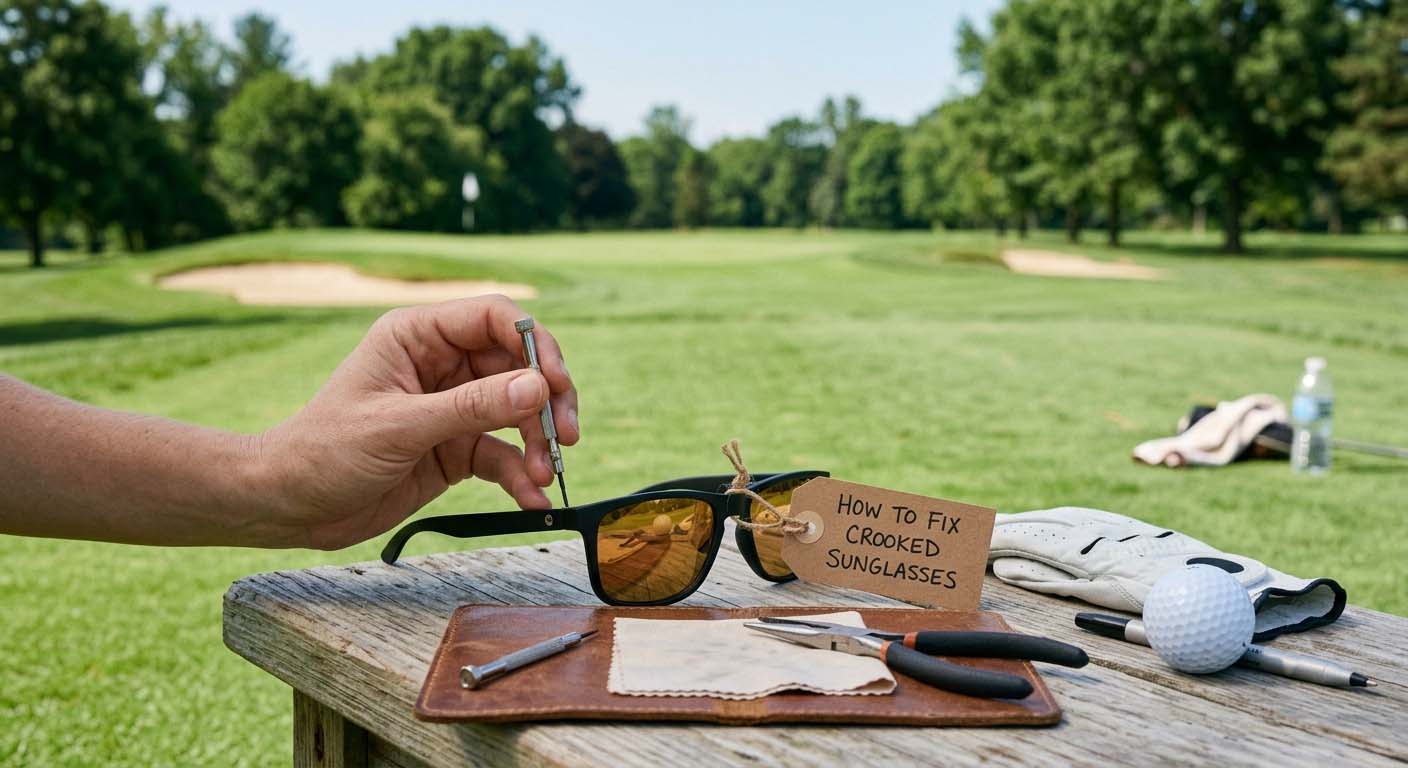
You pull your golf sunglasses out of the bag, put them on, and something is off. One arm sits higher than the other. The frame leans to the right. The lens feels loose in the corner.
You want to fix this fast. But the common advice you find online — boil them, bend them, use pliers — ruins more frames than it saves. Especially for golf frames made from tough, sport-specific plastics like O-Matter or Grilamid.
This guide treats your sunglasses as a system. We will diagnose the exact bend point before you apply any heat. We will work with the material’s limits, not against them. And we will show you how to avoid the one mistake that causes permanent damage: losing lens retention.
Identify the Crookedness Pattern Before You Touch the Frame
Do not grab the arms and start twisting. You need a diagnosis first.
Place your sunglasses face-down on a flat table. Look from above.
Check three things:
- The Table Test: Are both temple arms touching the table surface? If one arm hovers in the air, that arm is bent outward or the opposite hinge is twisted.
- The Front View: Hold the frame at eye level. Does one lens sit lower than the other? That is a frame drop, usually from a warped orbital.
- The Overhead View: Look straight down at the frame. Does it form a C shape or an S shape? A C shape means the entire frame has twisted. An S shape means there are multiple bend points.
One of these will tell you exactly where the problem is. Most crooked golf sunglasses are not caused by a simple bent arm. They are caused by a twisted orbital — the ring that holds the lens — or a hinge that has splayed outward. Forcing the arm back will make an orbital twist worse.
Case Study A: The Bent Temple Arm
This is the fix people search for. It works, but only if the temple arm itself is your problem.
If your table test showed one arm hovering above the table, that arm likely has an outward splay at the hinge or a bend near the ear tip.
Before You Heat: Know Your Material
Your golf sunglasses are probably one of three plastics:
- O-Matter (Oakley): Durable, flexible. Requires moderate heat. Can warp if overheated.
- Grilamid (Nike, Adidas, Rudy Project): Very rigid. Needs more heat but cools quickly.
- Nylon/Polyamide (generic sport frames): Softens easily. Easy to over-bend.
Never use boiling water. The steam and water droplets can stain your lens coatings or warp the lens itself. Instead, use a hair dryer on low heat held 8 to 10 inches from the arm. Keep the heat off the hinge and off the lens area entirely.
The Fix
- Heat the outer section of the temple arm (the part behind the hinge) for 15 to 30 seconds. The plastic should feel warm but not hot to the touch.
- Gently bend the arm inward or outward using your thumbs. Bend in small increments. A 2-degree change is enough to correct most splay.
- Hold the bent position for 10 seconds while the plastic cools. Do not move it while it is still warm.
- Re-check the table test. If the arm still hovers, repeat the heat and bend in 2-degree steps.
If the arm is bent near the ear tip (the curved part that hooks behind your ear), heat only that curved section. Bending the straight part of the arm will change the fit at your temple.
The Hidden Problem: Fixing a Warped Orbital
This is the fix that mainstream guides miss. It is also the most common cause of a crooked golf frame.
You know you have an orbital twist when the front view test shows one lens lower than the other, or the overhead view shows a C shape. The frame itself — not just the arm — has rotated.
How to Identify an Orbital Twist
Hold the frame with both hands. Place one thumb on each lens hinge area. Look at the top edge of the frame. If one side sits lower than the other, the upper orbital has twisted.
The Fix
- Apply low heat to the entire front of the frame, concentrating on the upper orbital where the twist is. Heat for 20 seconds. Keep the heat moving so you do not overheat one spot.
- Grip the frame with both hands, one on each side of the bridge. Your thumbs should be on the top edge of the frame.
- Gently counter-rotate. If the right lens sits lower, rotate the right side upward and the left side downward at the same time. This unwinds the twist.
- Do not force it. A 5-degree rotation every 30 seconds is the rule. Check your progress after each attempt.
- Once the frame looks symmetrical in the front view, let it cool fully for 2 minutes.
This is the highest risk maneuver. Over-rotation can crack the frame or loosen the lens retention system. If you feel resistance, stop and let the plastic cool. Try again with slightly more heat, not more force.
The Lens Retention Trap
You straightened the frame. But now the lens rattles when you shake the sunglasses. It is loose in one corner.
This is the most common complaint after a DIY frame repair. It happens because the frame’s orbital groove — the channel that holds the lens in — has changed shape. The plastic stretched slightly during your bend, and the lens no longer fits snugly.
How to Fix Loose Lenses After Alignment
Many golf frames use a force lock retention system. The frame relies on slight compression to hold the lens. When you bend the frame, you relieve that compression.
To restore it:
- Identify the loose corner. It is usually the upper outer corner of the lens.
- Apply heat to the frame groove directly around that loose corner. Heat for 10 seconds only.
- While the plastic is warm, press the lens gently back into the groove using your thumb. Hold for 15 seconds.
- Let the frame cool. The plastic will shrink back slightly, gripping the lens edge.
If the lens is still loose after two attempts, the groove has stretched too far. You may need a replacement frame or a lens swap. Do not keep heating and pressing — you will deform the groove permanently.
Why Your Golf Frame Crooked in the First Place
Understanding cause prevents future crookedness. It is rarely a single impact.
Three golf-specific causes are common:
- Car trunk heat cycling: Leaving your sunglasses in a hot car during a round. The heat repeatedly softens the plastic, and each cool-down cycle sets a new shape. Over time, the frame develops a permanent warp that is not caused by dropping them.
- Being sat on in a golf bag pocket: You put the sunglasses in the small pocket of your bag. Someone sets a heavy staff bag on top. The frame bends at the bridge.
- Incorrect case storage: Squeezing the sunglasses into a case while a large visor clip or lens wipe is pressed against them. The frame gets a slow, constant pressure that creates a flat spot or bend.
Knowing this, you can prevent recurrence. Store your golf sunglasses in a hard case with no other accessories inside. Never leave them in a car parked in the sun.
The Advanced Rescue: When to Replace Components vs. Bending
Not every crooked frame can be fixed by bending. Some problems require parts replacement.
| Problem | Can You Fix It? | What to Do |
|---|---|---|
| Bent temple arm (simple splay) | Yes, with heat | See bent temple arm section above. |
| Warped orbital (frame twist) | Yes, with caution | See orbital twist section above. |
| Bent bridge (the part over your nose) | No, not reliably | Replace the frame. Bridge bends are nearly impossible to straighten evenly. You will end up with a distorted lens seat. |
| Loose hinge (arm wiggles at the joint) | Yes, with tools | Use a tiny Torx screwdriver (size T6 or T8 depending on brand) to tighten the hinge screw. If no screw exists, a dab of Loctite or epoxy on the hinge pin can stiffen it. |
| Lens itself is bowed (not the frame) | Yes, for polycarbonate | Hold the lens by its edges and gently bend it back to flat. This only works for polycarbonate. Do not attempt with glass or Trivex — they will shatter. |
If your frame has a broken hinge or a crack in the orbital, do not attempt a heat repair. The plastic will not hold. Replace the frame or the arm.
Frequently Asked Questions
My new golf sunglasses are tight on my temples but crooked. Should I bend them wider?
No. A tight temple on one side often pulls the frame crooked. You need to bend the tight temple outward slightly, not bend the other side. First, identify which arm is causing the pressure. Then apply heat to that arm only and bend it outward by a few degrees. Re-check the fit. If the frame is now straight but still tight, bend both arms outward equally.
Can I use pliers to fix a crooked frame?
Only if you wrap the plier jaws in three layers of painter’s tape. Bare metal will gouge the finish and leave permanent marks. Pliers are best for adjusting temple tips or nose pad arms, not the main orbital. Never use pliers on the bridge or the lens area.
How do I fix a crooked frame when the right lens is lower than the left?
This is a frame drop caused by a warped upper orbital. The fix is not just bending the right arm down. You need a counter-rotation: bend the right temple arm slightly upward and rotate the left hinge slightly downward. This unwinds the orbital twist. Apply heat to the entire front of the frame before doing this.
Will heat ruin the anti-reflective coating on my golf lenses?
Yes, if the heat is too direct or intense. Heat degrades the hydrophobic and mirrored coatings. This is why we recommend heating the temple arm frame where there is no lens, or using a very low heat setting on the front of the frame. Keep the heat 8 inches away and move it constantly. If the lens feels more than warm to the touch, you are overheating it.