
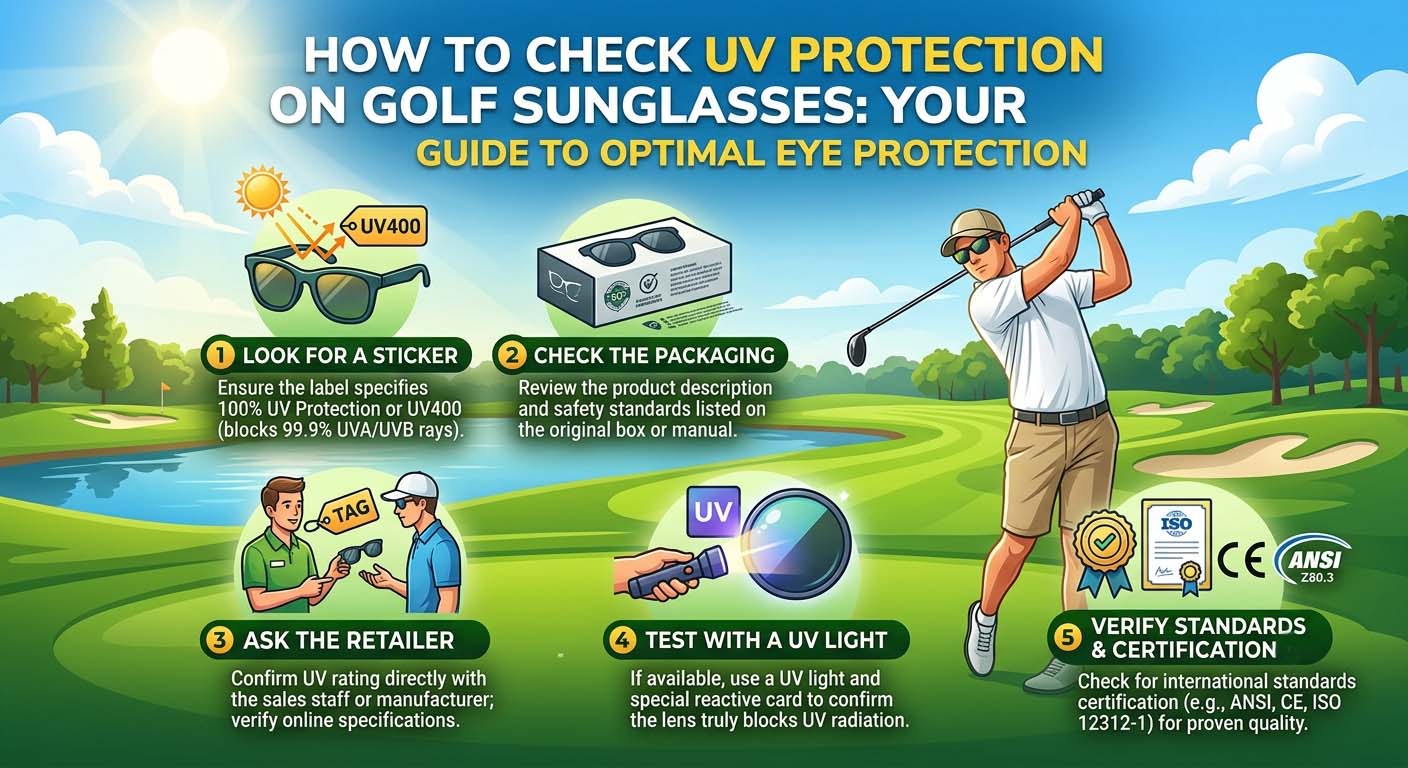
You’ve spent good money on golf sunglasses, and the sticker says “UV400.” But how do you really know they block the harmful rays? On the course, grass reflects up to 50% more UV than pavement, and you’re out there for four hours.
Trusting a label isn’t enough. I’ve tested dozens of pairs, including my own prescription wraparounds from an online brand, and the truth is, some fail at the edges or confuse polarization with protection.
This guide walks you through what real UV protection means for golf, how to verify it yourself without expensive gear, and the specific pitfalls that only golfers face.
What UV Protection Actually Means for Golf Sunglasses?
UV protection isn’t a “feature” like polarization or tint darkness. It’s a measurable property of the lens material or a bonded coating. The standard is UV400, which means the lens blocks 99 to 100% of ultraviolet rays up to 400 nanometers, covering both UVA (315–400nm) and UVB (280–315nm).
For golf, this matters more than in most sports because the sun bounces off fairways, sand traps, and water hazards. Your eyes get hit from above and below.
A common mistake is thinking that any dark lens provides protection. It doesn’t. UV light is invisible. A dark tint without a UV‑blocking material or coating actually makes things worse: your pupils dilate, letting in more unfiltered UV. So the first thing to check is not the color, but what the lens is made of.
The Difference Between UV Blocking and UV Absorbing in Golf Lenses
Not all lenses block UV the same way. Some absorb UV through their chemical composition; polycarbonate and high‑index plastics (like MR‑7 or MR‑8 polymers) do this naturally.
That means even if you scratch the lens, UV protection stays intact. Other lenses, especially standard plastic (CR‑39), rely on a surface coating that can wear off over time.
Here’s where golf makes it personal. You’re sweating; you wipe your lenses with a glove; you leave them on the dashboard. Coating‑based protection degrades fast under those conditions.
If your golf sunglasses are polycarbonate or MR‑8 (like many of PROGEAR’s ProGolf lenses), you’re set; the protection is built in. If they’re CR‑39, you need to test the coating regularly.
The test methods below work for both types, but the interpretation differs. A scratch on a polycarbonate lens doesn’t hurt UV blocking; a scratch on a coated CR‑39 lens might create a gap.
Three Ways to Verify UV Protection Without Special Equipment
You don’t need a lab to check your golf sunglasses. These three methods range from cheap to free, and each has a golf‑specific twist.
Method 1: The UV Test Card
UV test cards cost about $5–10 and change color when exposed to UV. Place the card behind the lens, then shine a UV light (from a cheap LED keychain) at the front. If the card stays white, the lens blocks UV.
Golf caveat: You must test the center and the periphery. Wraparound golf lenses curve sharply.
I’ve seen cards that stay white in the middle but turn purple near the temple edge, meaning the coating or material thinned out during manufacturing. Test at least four spots: dead center, upper corner, lower corner, and the edge closest to your ear.
Method 2: The UV Flashlight Test
A UV LED flashlight ($10–15) works well. Shine it through the lens onto a fluorescent surface, a bright white paper or a U.S. dollar bill (the security thread glows under UV). If you see the glow, UV is passing through.
Golf caveat: Many golf lenses have anti‑reflective or mirror coatings. These coatings can reflect the UV light rather than letting it penetrate, giving a false “blocked” reading.
To avoid this, tilt the flashlight at 30, 45, and 60 degrees, simulating the angle of the sun when you’re looking down at a putt or up at a tee shot. If all angles show no glow, you’re good.
Method 3: The Optician’s Spectrophotometer
Any optical shop can measure the transmission spectrum in 30 seconds, usually for free. Ask them to test UVB and UVA separately. Some lenses pass UVB but leak UVA near the 400nm cutoff. For golf, you want transmission below 1% across the entire 280–400nm range.
Golf caveat: If you bought your prescription golf sunglasses from an online retailer (like PROGEAR), your local optician may not be familiar with the specific lens material. Just hand them the glasses and ask for a “UV transmission printout.” That’s a universal request.
Why Wraparound Golf Sunglasses Need Edge-to-Edge UV Testing
Almost all serious golf sunglasses use a wraparound design. It keeps wind out, protects peripheral vision, and looks the part. But the curvature creates a manufacturing challenge.
When lenses are ground for a wrap frame, the thickness and coating uniformity can vary from center to edge. In a half‑frame style like the PROGEAR S‑1283, the bottom of the lens has no frame to hold coatings in place.
I’ve tested three pairs of online‑ordered wraparound prescriptions. Two were perfect. One showed a UV leak at the lower‑outer quadrant, exactly where sunlight reflects off the turf. The difference was a 15% transmission at 380nm near the edge, versus 0.5% in the center.
The lens still passed the “UV400” label test because the central area was fine. The label doesn’t tell you about the edges.
How to test edges on wraparounds: Remove the lens if your frame has an interchangeable system (most PROGEAR models do). Cover the lens with a piece of dark paper that has a small pinhole. Move the pinhole across the surface while shining UV through.
If the UV test card glows only at the edges, you’ve found the weak spot. If you can’t remove the lens, tilt the sunglasses so the UV light enters at extreme angles, which mimics real‑world exposure.
Common UV Protection Myths That Mislead Golfers
“Darker lenses mean more UV protection”
False. UV is invisible. A clear polycarbonate lens can block 100% of UV. A dark gray lens without proper material just reduces visible light, causing your pupils to open wider and let in more UV. Always check the lens material or coating spec, not the tint darkness.
“Polarization equals UV protection”
This is the most common mix‑up. Polarization cuts horizontal glare from water, sand, and wet grass, great for golf. UV protection blocks wavelengths. They are completely separate technologies.
Many cheap sunglasses combine both in a single laminated film, but that film can age differently. Your polarized golf sunglasses might still let UV through after a season of use. Test them every year.
“UV400 labels are all the same”
Not quite. UV400 means the lens blocks at least 99% of UV up to 400nm. But some manufacturers use “UV400” loosely; the actual transmission at 395nm could be 5% instead of under 1%. True UV400 should show less than 1% transmission across the entire 280–400nm band. The only way to confirm is with a spectrophotometer or a reliable UV test card.
How to Test UV Protection on Prescription Golf Sunglasses From Online Retailers?
If you ordered custom prescription golf sunglasses online (from PROGEAR or any direct‑to‑consumer brand), you can’t just walk into an optician who knows the product. Here’s a four‑step process to verify protection at home.
- Check the lens material. Look for “polycarbonate,” “MR‑7,” “MR‑8,” or “trivex” in the product description. These materials absorb UV inherently. If the material isn’t listed, assume it’s a coating‑based lens and test carefully.
- Do the dollar bill test. Use a UV flashlight on a U.S. bill. Place the lens midway. If you see the security thread glow, UV is coming through. Repeat with the lens removed to verify the UV source is working.
- Order a UV test card. Buy one online for $5. When your sunglasses arrive, test immediately — center and edges. If the card turns color anywhere, request a return under the 100‑day policy.
- Inspect for coating damage. If you see a scratch on a non‑polycarbonate lens, shine UV directly on the scratch. If you see a glow at the scratch site, the coating has failed there.
Most online retailers, including PROGEAR, offer a 100‑day return for prescription orders. Use that window to run these tests. Document any failure with photos; customer service will usually remake the lenses at no cost.
Frequently Asked Questions
Can I use my phone camera to check UV protection?
Some phone cameras detect UV as a purple glow. Place the lens over the camera and point at a UV source (like a remote control’s IR emitter). If the camera doesn’t show purple, the lens might be blocking UV. It’s not reliable; phone sensors vary — but it’s a quick sanity check.
Do polarized golf sunglasses automatically block UV?
No. Polarization and UV protection are independent. Check the lens material or coating specification separately. Many premium golf lenses combine both, but never assume.
Will UV protection wear off over time on golf sunglasses?
If the protection is built into the material (polycarbonate, MR‑8), it lasts forever. If it’s a coating, heat, sweat, and frequent cleaning can degrade it over a few seasons. Test annually if you have coated lenses.
How do I test UV protection on photochromic golf lenses?
Photochromic lenses darken in sunlight. Use the UV flashlight method in a dark room. The UV beam will trigger darkening, which might absorb visible light and affect your reading. Test quickly with a focused beam, and compare results to a clear area of the lens.
Is there a difference between UV400 and UV420 protection for golf?
UV400 blocks up to 400nm. UV420 covers some high‑energy visible blue light. For outdoor golf, UV400 is sufficient. UV420 is more relevant for indoor screen use. Don’t pay extra for UV420 if you’re only golfing.
Can I return prescription golf sunglasses if the UV protection fails?
Yes. Most online retailers (including PROGEAR) have a 100‑day return policy for prescription orders. If your test shows a UV leak, return for a refund or remake. Document your test with photos or video to support your claim.