
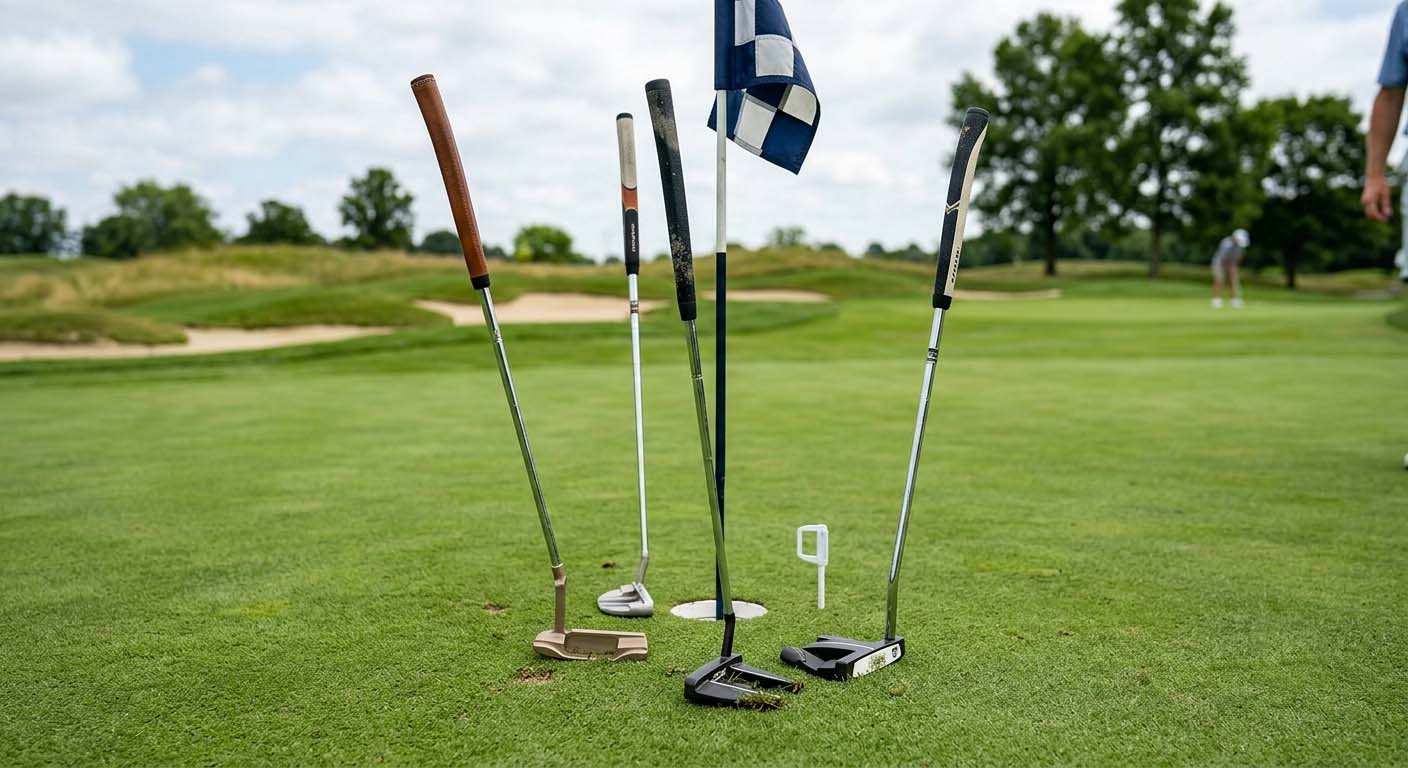
If you watch any tour player on a practice green, you notice something right away: the putter head stays inches off the turf through the entire stroke. It never rises up. It looks effortless, almost as if the putter is glued to the ground.
I spent years trying to copy that look. I would consciously push the putter head low after impact, and every time it felt forced and killed my rhythm. It was only after a session with a good coach that I learned the truth: the low follow-through is a symptom, not a goal.
The best putters in the world do not try to keep the putter low. It happens automatically because their body moves correctly. Once I understood that, my stroke changed completely.
What the Low Follow-Through Actually Looks Like?
From the side, a pro’s putter head traces a shallow arc. At address, the sole sits flat on the ground. During the backstroke, the head lifts slightly because the shoulders tilt and the hands hinge. At impact, it returns to the same height as address. And on the follow-through, it stays within a few millimeters of the turf for the first six to eight inches after the ball.
Here is the key visual: the putter head does not climb up after contact. It continues along the same path until the stroke finishes.
Compare that to an amateur’s stroke. Most weekend players let the putter head rise sharply after impact. The toe or heel catches the ground, or the ball comes off the face hot and unpredictable. The difference is not about arm movement. It is about body position staying constant.
The Mechanics Behind the Low Putter Head
Spine Angle Is Everything
If your upper body raises even a quarter of an inch during the stroke, the putter head rises with it. Pros maintain the same spine angle from address through impact and into the follow-through. They do not stand up, and they do not sink lower.
The feeling is that your chest stays over the ball. When your shoulders rotate, your spine acts as a fixed pivot. If that pivot moves upward, the putter must lift.
Wrist Structure at Impact
Your lead wrist (left wrist for a right-handed golfer) controls the putter face and the height of the follow-through. Pros keep that wrist flat or slightly extended through impact. They do not cup it, and they do not bow it aggressively.
A cupped lead wrist at impact forces the putter head to climb because the toe drops and the heel rises. A flat wrist keeps the sole parallel to the ground, which naturally holds the head low.
I used to think my wrists were quiet. Then I filmed my stroke in slow motion. My lead wrist was breaking down right after impact, sending the putter head into the air. The fix was not to “keep it low.” The fix was to keep the wrist firm through the strike.
Myth vs. Reality: Three Common Mistakes
Myth: Low Follow-Through Means You Trap the Ball
Some golfers think a low follow-through comes from hitting down on the putt. That is wrong. Trapping the ball adds forward shaft lean, which delofts the face and causes the ball to skip. A low follow-through comes from a level strike, not a descending one. The putter head stays low because your body stays level.
Myth: You Need a Putter with More Loft
A higher-lofted putter encourages a scooping motion. If you have 4 or 5 degrees of loft, your instinct is to lift the head to get the ball airborne. Pros use putters with 2 to 3 degrees of loft. That forces them to strike the ball with a slightly ascending or level blow, which naturally keeps the head low.
Myth: Hands Must Be Forward at Impact
You do not need to push your hands ahead of the ball. If your hands are forward, the putter head trails behind and the follow-through gets steeper. Pros keep their hands neutral, directly over or slightly ahead of the ball, but not pressed forward. The low head comes from body position, not hand position.
Equipment That Helps (or Hurts) a Low Follow-Through
| Putter Spec | Effect on Follow-Through Height | What to Look For |
|---|---|---|
| Lie Angle | If the lie angle is too upright, the toe digs and the heel lifts, forcing the head upward. Too flat and the heel digs. | Get fitted so the sole sits flat at address and stays flat through impact. |
| Face Balance vs. Toe Hang | Face‑balanced putters resist twisting, which helps keep the head on a low arc. Toe‑hang putters require more active hand control and can cause the toe to drop on the follow‑through. | If you struggle with a rising follow‑through, try a face‑balanced mallet. |
| Head Weight | Heavier heads (380g+) maintain momentum through impact and resist lifting. Lighter heads are easier to “flip” upward. | Test a heavier putter if you feel the head climbing after the ball. |
| Length | Too long or too short changes your posture. A putter that forces you to stand too tall or too bent over messes with spine angle. | Standard length for most players is 33–35 inches based on height and setup. |
How Green Conditions Change the Follow-Through
This is something almost no one talks about. Pros adjust their follow-through height based on what the greens are doing.
On firm, fast greens, the ball launches quicker and skids less. Pros keep the follow-through low to reduce dynamic loft, which keeps the ball rolling true from the start. On soft, slow greens, they may allow a slightly higher follow-through to add a touch of loft and get the ball up and rolling sooner against the friction.
Grain also matters. On down‑grain putts, the grass lies flat, and the ball rolls fast. A low follow-through prevents the putter from catching the grain and dragging. On into‑grain putts, the grass stands up, and a slightly higher follow-through can help the ball climb over the grain without bouncing.
Drills That Teach the Feel, Not the Look
The most common mistake is trying to force the putter head low. That creates tension and ruins tempo. Instead, practice these three drills that build the conditions for a low follow-through.
The Headcover Drill
Place a headcover on the ground about six inches behind your putter head at address. Make practice strokes without touching the headcover. If you lift the putter head too high on the backstroke, you will brush the headcover. This trains a low, controlled takeaway without thinking about the follow-through.
The Gate Drill
Set two tees in the ground about four inches apart, just in front of your putter head. Place a ball in the center. The goal is to stroke the putt so the putter head passes through the gate without touching the tees. If the head rises, you will hit the tees. This forces a constant height through impact.
The Penny Drill
Place a penny or a coin on the ground about three inches past the ball. On your follow-through, try to brush the coin with the sole of the putter. Do not push the putter into the ground, just a light touch. This teaches the correct follow-through height without forcing it.
I used the penny drill for two weeks. The first few days I could not touch the coin at all. By the end of the second week, I was brushing it every time. My misses went from two feet to six inches.
Troubleshooting: Why Your Putter Still Rises
Even with good mechanics, some things can cause the putter head to lift.
Early Extension
If your hips or lower body move toward the ball during the stroke, your spine angle changes and the putter lifts. Fix: Keep your weight centered and your hips stable. A common cue is to feel that your belt buckle stays in the same spot from start to finish.
Grip Pressure Changes
If you tighten your grip at impact, your forearms tense and your wrists lose their angle. The putter head jumps. Fix: Use a consistent grip pressure throughout the stroke. I use a 4 out of 10 pressure, and I do not squeeze at impact.
Ball Position Too Far Back
When the ball is back in your stance, your shoulders are more open and your hands get ahead. That forces the putter to hit the ball on a descending blow, which makes the follow-through climb. Fix: Center the ball just forward of the middle of your stance, under your left eye.
Frequently Asked Questions
Does a low follow-through change how far the ball rolls?
Not directly. But consistent follow-through height leads to consistent strike location, which is the real key to distance control. If your follow-through is the same height every time, your contact point on the face stays similar, and the ball rolls a predictable distance.
Do any pros use a high follow-through successfully?
Yes. Phil Mickelson has always used a more traditional stroke with a noticeable upward finish. But Phil’s stroke relies on extremely active hands and a lot of practice. For 99% of golfers, a low follow-through produces more consistency because it minimizes wrist movement.
Can putter weight affect follow-through trajectory?
Absolutely. A heavier putter head has more momentum. It wants to continue moving forward along its path rather than lifting. If you use a light putter (under 340g), you have to control the head more actively, and it is easier to let it rise. Many pros prefer putters in the 360–380g range for this reason.
Is the low follow-through the same for long putts and short putts?
The stroke length changes, but the relative path should stay low. On a 40‑foot putt, you take the putter back farther and follow through farther. The putter head still stays close to the ground for the first several inches after impact. The trajectory does not get steeper just because the stroke is longer.
One Final Thought
The best putting advice I ever received was this: stop trying to look like a pro and start moving like one. The low follow-through is not a trick. It is the natural result of a stable body, a quiet wrist, and a putter that fits you.
Next time you watch a tour event, forget about the putter head. Watch the player’s chest. Notice how it stays over the ball from start to finish. That is the real secret. Once you fix that, the putter head will take care of itself.