
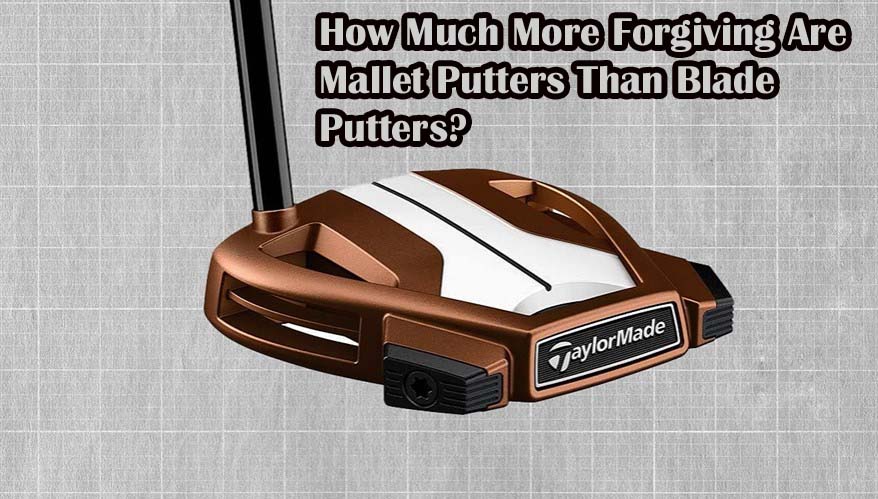
Mallet putters are typically 15-30% more forgiving than blade putters when you miss the center of the face. This means less distance loss and tighter dispersion on mishits. But not every mallet is better than every blade, and the trade-off in feel might not be worth it for your game.
I have tested dozens of putters over the years, from classic blade designs to massive high-MOI mallets. I have seen the numbers and felt the difference. This article gives you the real answer on forgiveness, the specific numbers behind it, and whether a mallet actually helps your putting.
What does forgiveness mean in a Putter?
Forgiveness in a putter is about what happens when you do not strike the ball perfectly in the center of the face. On a perfect center strike, every putter performs about the same. The difference shows up on toe hits and heel hits.
A forgiving putter does two things:
Keeps the ball speed consistent. When you hit the toe of a blade putter, the face twists open, and the ball comes off slower. A forgiving putter resists that twisting motion. The result is that a toe hit and a center hit produce almost the same distance.
Reduces directional error. Off-center strikes also push the ball offline. A more forgiving head twists less, so the ball starts closer to your intended line.
The technical term for this resistance to twisting is moment of inertia, or MOI. Higher MOI equals more forgiveness. This is the critical measurement that separates a blade from a mallet.
The Numbers Behind Forgiveness
Let us look at some realistic numbers to show you exactly how much difference exists between a typical blade and a typical mallet.
Most blade putters have an MOI between 4,500 and 5,500 grams per centimeter squared. A high-end mallet like the TaylorMade Spider or Odyssey 2-Ball can exceed 9,000 g-cm². That is nearly double the resistance to twisting.
Here is what that means in real putting performance. On a 15-foot putt:
One inch off-center on the toe:
– A blade putter loses about 8-12% of the distance. That 15-foot putt comes up 1 to 1.5 feet short.
– A mallet putter loses about 3-6% of the distance. That same putt comes up only 6 to 10 inches short.
On a 30-foot putt, the difference is even larger. A blade might leave you 3 feet short, while a mallet leaves you 1 foot short. That is the difference between a tap-in and a nervous par save.
The Myth of the All-Forgiving Mallet
Here is where most articles get it wrong. They assume every mallet is more forgiving than every blade. That is simply not true.
Some mallets are what I call “blade-like.” They have a compact shape with the center of gravity positioned forward, near the face. These mallets offer minimal forgiveness gain over a traditional blade. A cheap mallet from a starter set can have an MOI below 5,000 g-cm².
Meanwhile, some blade putters use design tricks to increase forgiveness. The Ping Anser 4 comes with adjustable tungsten weighting that pushes the MOI up toward 6,000 g-cm². I have seen a custom-milled blade with heavy sole weighting outperform a budget mallet in my own testing.
The real question is not blade versus mallet. It is high-MOI versus low-MOI. You have to look at the specific model.
Neck Type and Hosel Position
The neck of the putter also matters. A plumber’s neck blade has the hosel near the heel, which creates toe hang and a lower MOI. A center-shafted mallet can have an even distribution of weight around the face, which increases forgiveness.
But a mallet with a long, thin neck can actually reduce MOI because more weight is pulled away from the perimeter.
Forgiveness Versus Feedback: The Real Trade-Off
This is the part that club manufacturers do not talk about. High forgiveness comes at a cost.
When you hit a mallet putter off-center, you feel almost nothing. The head does not twist, the vibration is dampened, and the ball still rolls decently.
That sounds great, but it creates a problem. Your hands and ears do not tell you that you missed the center. You cannot learn to strike the ball consistently.
With a blade putter, a toe miss feels like a toe miss. The head twists in your hands, the sound changes, and you know exactly what happened. That sensory feedback is how you improve. Every good player I know started with a blade or something close to a blade.
Who Should Care About This Trade-Off?
If you are a high handicapper who makes inconsistent contact, a forgiving mallet will probably lower your scores immediately. You do not need to feel every mishit. You need the ball to go somewhere near the hole.
If you are a low handicapper who strikes the ball well, a mallet can actually hurt you. The muted feedback makes it harder to fine-tune your strike.
You lose information. Many mid-to-low handicappers who switch to a mallet find their putting gets worse for a few rounds because they cannot feel what is happening.
The Stroke Type Factor
Forgiveness is not just about the head design. It also depends on your putting stroke.
Most mallet putters are face-balanced. The head sits square to the ground when you balance it on a finger. Face-balanced putters work best with a straight-back, straight-through stroke.
If you have a slight arc to your stroke, which most golfers do, a face-balanced mallet can cause you to push or pull putts.
A blade putter typically has toe hang. When you balance it, the toe drops down. Toe hang putters match an arcing stroke. The head naturally opens on the backswing and closes on the forward swing.
If your stroke type fights the putter, then the forgiveness advantage of a mallet disappears. You make worse contact because the putter does not fit your natural motion. I have seen golfers with a strong arc lose 5 strokes per round after switching to a face-balanced mallet.
Do Mallet Putters Really Make a Difference on Short Putts?
No. Forgiveness matters most on putts longer than 10 feet. On a 3-foot putt, you hit the ball so short and so slowly that even a badly off-center strike does not lose much distance. The face angle at impact is much more important.
If your problem is missing 3-foot putts, a mallet will not fix it. The issue is probably alignment or face control, not forgiveness. You might actually do worse with a mallet because the large head can make alignment harder for some players.
Blade Versus Mallet for High Handicappers
For a high handicapper, I strongly recommend a mallet. Here is the reason.
High handicappers miss the center of the face more often. They also struggle with distance control. A mallet makes both of those problems smaller.
You lose less distance on mishits, so your lags are closer. You also get a larger head that can help with alignment, though that depends on the specific shape.
The trade-off in feedback matters less for a high handicapper because you are not trying to refine your strike. You are trying to make more putts from 15 feet and avoid three-putts. A mallet does that better than a blade.
Do pros use mallets or Blade Putters?
On the PGA Tour, the split is roughly 50-50 between blade and mallet putters. That surprises many people. If mallets were clearly superior, you would expect nearly all pros to use them.
The reason pros still use blades is that they strike the ball in the center almost every time. The forgiveness advantage of a mallet is wasted on them. They prefer the feel, the visual appearance, and the feedback of a blade.
A blade also tends to look smaller at address, which some players find easier to line up.
Pros who switch to mallets usually do it for specific reasons. Maybe they want more stability on long putts. Maybe they trust the alignment lines. But it is never because they think a mallet is universally better.
Frequently Asked Questions
Is it easier to hit with a mallet or a blade putter?
A mallet is easier to hit because it is more forgiving on off-center strikes. For a beginner or high handicapper, a mallet will produce more consistent distance and direction on mishits.
For an experienced player who strikes the center regularly, a blade is not harder to hit but offers less forgiveness when you do miss.
What is the most forgiving putter style?
High-MOI mallets are the most forgiving. Look for putters with weight pushed to the extreme perimeter, such as the Odyssey 2-Ball, TaylorMade Spider, or Ping Fetch.
These designs can have MOI values above 8,000 g-cm², which is nearly double that of a blade. Mid-mallets offer a balance between forgiveness and feel.
Does a mallet putter help on 3-foot putts?
No. Forgiveness is not a factor on short putts. The distance loss from an off-center strike is negligible at 3 feet. Alignment and face control matter much more. If you are missing short putts, a mallet will not solve the problem.
Blade or mallet for a beginner?
A mallet is better for a beginner. You will make more putts and feel more confident. The feedback trade-off does not matter because you are not yet trying to refine your strike. Buy a used high-MOI mallet and focus on distance control.
Can a blade putter be more forgiving than a mallet?
Yes, if the mallet is poorly designed. A cheap mallet with forward weight distribution can have an MOI below 5,000 g-cm². A high-end blade with tungsten inserts or deep sole weighting can exceed 6,000 g-cm². Always check the specific model rather than judging by shape alone.