
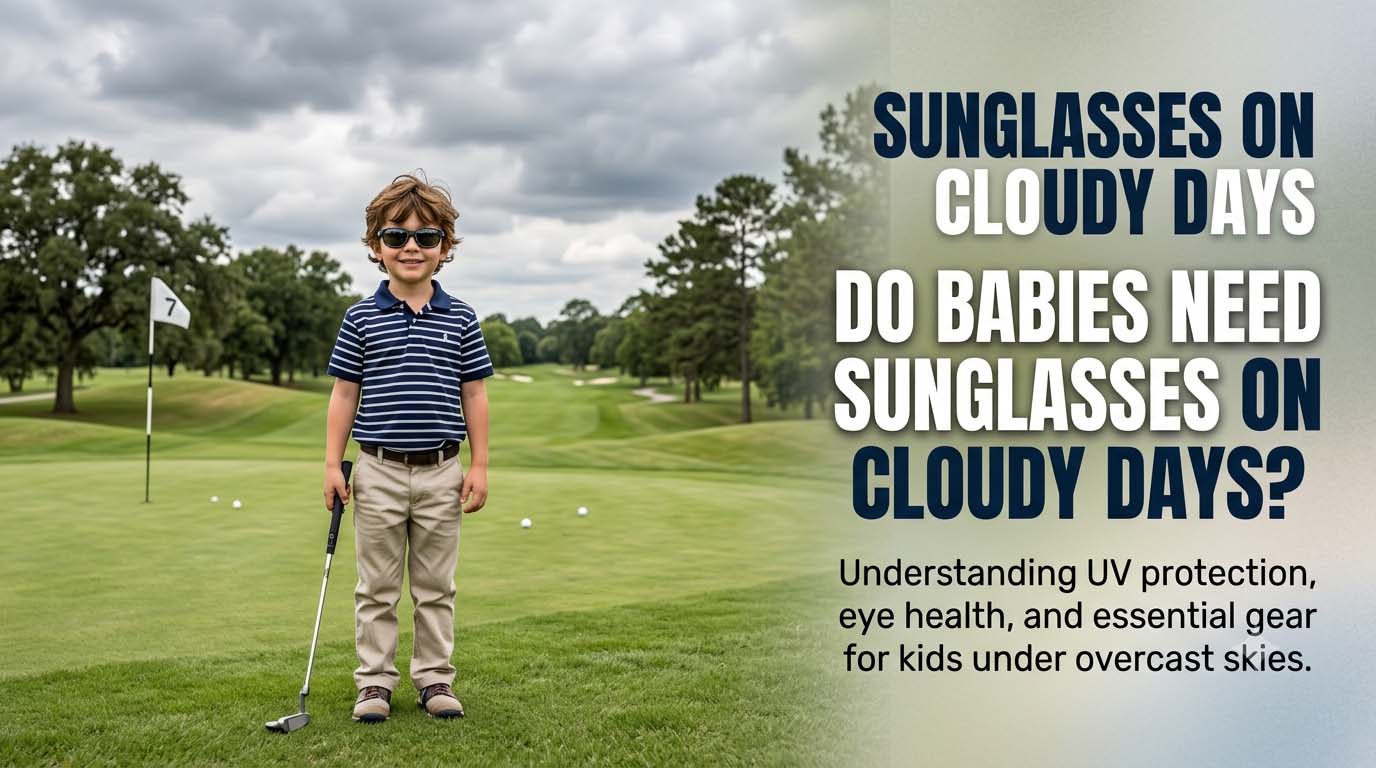
Yes, babies need sunglasses on cloudy days. I know that sounds counterintuitive. When the sky is gray, the sun isn’t blasting, and your baby isn’t squinting. So why bother? The answer comes down to one fact most people don’t realize: clouds block visible light, not ultraviolet radiation. Up to 95% of UV rays pass right through an overcast sky. And because your baby doesn’t feel the brightness, they’ll stare straight up at the clouds for longer, exposing their developing eyes to hidden damage.
Think of clouds like a sheer curtain. You can still see the sun’s glow, but the harmful rays are still coming through. Your baby’s natural instinct to turn away from bright light is disabled on cloudy days. That’s the real danger.
Why Baby Eyes Need Protection Adults Don’t
Your baby’s eyes are not just smaller versions of your eyes. They are structurally different in ways that make them far more vulnerable to UV damage.
Lens transparency. A baby’s crystalline lens is nearly clear. As we age, our lenses naturally yellow and filter out some UV. A baby’s lens lets almost all UV through to the retina. That means the same UV dose that barely affects you can directly hit the sensitive tissue at the back of your baby’s eye.
Pupil size. Babies have proportionally larger pupils than adults. This allows more light—and more UV—into the eye. On a cloudy day, when the pupil is even wider because the visible light is dim, the UV entry is amplified.
Retinal pigment development. The macula, the part of the eye responsible for sharp central vision, builds up protective pigments called lutein and zeaxanthin over the first two to three years of life. Until that pigment layer is complete, the retina has less natural protection against UV-induced oxidative stress.
Lifetime cumulative exposure. The World Health Organization estimates that up to 80% of a person’s lifetime UV exposure happens before age 18. Every unprotected moment on a cloudy day adds to that total. Over years, this accumulation raises the risk of cataracts, macular degeneration, and other eye diseases later in life.
Why Cloudy Days Are Deceptively Dangerous
You might think a cloudy day means low UV. The UV index can still be 5 to 7 under overcast skies. That’s moderate to high. The type of cloud matters too. Thin cirrus clouds can actually scatter UV rays and increase the amount reaching the ground. Thick storm clouds block more, but still let through a significant amount.
Here’s the paradox: on a clear sunny day, you’re likely to be more careful. You keep the baby in the shade, use the stroller canopy, and rush inside when it gets hot. But on a cool, overcast day, you might stay at the park for an hour or two. The comfortable temperature extends your outdoor time, which extends your baby’s UV exposure.
Seasonal factors also play a role. Summer cloudy days deliver more UV because the sun is higher in the sky. But even winter cloudy days can be dangerous if there’s snow on the ground. Snow reflects up to 80% of UV, bouncing it straight into your baby’s eyes from below.
How to Protect a Baby’s Eyes on Cloudy Days Without a Fight
I’ve been there. You buy the cute sunglasses, and your baby immediately yanks them off or screams. Don’t give up. Here are five practical solutions that work, ranked from most effective to least effort.
1. The Sunglasses Solution
Look for a label that says UV400 or 100% UV protection. This means the lenses block both UVA and UVB rays up to 400 nanometers. Wraparound styles are best because they prevent UV from sneaking in from the sides. Choose flexible frames made of soft silicone or rubber that won’t hurt if the baby squirms. Avoid cheap sunglasses without UV labeling—they can do more harm than good. When a dark lens makes your baby’s pupil dilate but doesn’t block UV, even more radiation enters the eye.
2. The Hat Backup
A wide-brim hat rated UPF 50+ blocks about 50% of UV from reaching the eyes. Look for hats with a chin strap so it stays on. This is the easiest option if your baby absolutely refuses sunglasses. Combine a hat with sunglasses for maximum protection.
3. The Stroller Strategy
Standard stroller canopies vary wildly. Some let 30% of UV through. Upgrade to a UV-protective mesh canopy or a clip-on shade rated UPF 50+. These are especially useful when your baby is lying down and looking up at the sky. Pair this with a hat and you’ve covered most angles.
4. The Timing Tactic
UV is highest between 10 a.m. and 4 p.m., even on cloudy days. If you can, schedule outdoor time for early morning or late afternoon. That doesn’t mean you need to stay inside all day, but it’s a smart way to reduce cumulative exposure.
5. The Gradual Introduction
If your baby fights the sunglasses, start indoors. Let them wear the glasses for a few minutes while playing in a familiar room. Make it a game. Then move to the backyard for a short time. Reward cooperation with a favorite toy or activity. Most babies adapt within a week if you’re consistent.
What Happens When Baby Eyes Get UV Exposure
UV damage isn’t just some future worry. It can cause real problems right now.
Acute effects: Photokeratitis is essentially a sunburn of the cornea. It causes pain, redness, tearing, and light sensitivity that lasts 24 to 48 hours. A baby can’t tell you their eyes hurt, but they might rub their eyes, cry more than usual, or avoid light. This is completely preventable with sunglasses.
Chronic effects: Over years, repeated UV exposure can lead to pterygium (a growth of tissue over the white of the eye), early cataracts, and potential retinal damage. Because a baby’s lens is so clear, the retina is more exposed than at any other age. The damage is cumulative and irreversible.
How to Decide: Sunglasses vs. Hat vs. Staying Inside
Here’s a simple guide based on the UV index and conditions. You can check the UV index on your phone’s weather app.
| Scenario | UV Risk | Minimum Protection | Optimal Protection |
|---|---|---|---|
| Overcast summer day, UV index 5 | Moderate | Hat + stroller shade | Sunglasses + hat |
| Light drizzle, UV index 3 | Low-Moderate | Hat only | Sunglasses |
| Dark storm clouds, UV index 1 | Low | None needed | Optional |
| Snowy clouds (winter), UV index 2-4 | Moderate-High (reflection) | Sunglasses + hat | Sunglasses + hat + UV stroller cover |
The Eye Doctor’s Advice on Cumulative Baby Eye Health
Pediatric ophthalmologists recommend UV protection from birth for any outdoor exposure lasting more than 15–20 minutes, regardless of cloud cover. The American Academy of Pediatrics is clear: children under 6 months should avoid direct sun exposure, and if they are outdoors, they need protective clothing, a hat, and sunglasses with UV protection.
I’ve seen parents who think they only need to worry on sunny beach days. The truth is that ordinary, cloudy days add up. Every hour of unprotected exposure contributes to the lifetime total. Protecting your baby’s eyes now is one of the easiest things you can do to reduce their risk of cataracts and vision problems decades later.
Frequently Asked Questions
Can babies wear adult sunglasses in a pinch?
No. Adult sunglasses don’t fit a baby’s face. They leave gaps for UV to enter from the sides. They also often lack proper UV400 labeling and may have visual distortion. Stick to baby-specific sunglasses.
At what age can I stop worrying about cloudy day protection?
You never stop needing UV protection, but the critical sensitivity period is birth to age 3. That’s when the eye structures are still developing. After that, keep using sunglasses and hats for all outdoor time, especially on days with moderate to high UV index.
Does breastfeeding or formula provide any UV protection for baby eyes?
No. Breast milk contains lutein and zeaxanthin, which support eye health generally, but they do not provide acute UV protection. Your baby still needs sunglasses and a hat.
Are blue light blocking sunglasses sufficient?
No. Blue light is different from UV. Blue light glasses may block minimal UV, but they are not designed for that purpose. Always look for a UV400 or 100% UV protection label.
What if my baby has dark skin or eyes – do they need less protection?
Darker irises provide more natural UV filtering, but the lens and retina remain vulnerable. Darker skin reduces skin cancer risk but does not eliminate eye UV risk. All babies, regardless of eye color, need eye protection.
Can I use a regular stroller canopy as UV protection?
Standard fabric canopies vary widely. Some block very little UV. Look for a canopy that is rated UPF 50+ or add a UV-blocking mesh cover. Black fabric blocks more than white, but neither is a substitute for proper UV-blocking material.
What about car windows on cloudy days?
Standard car windshields block UVB but not UVA. Side windows block even less UVA. For long drives, consider UV-blocking window film or use a sunshade in the back seat. Your baby’s eyes are still exposed through the glass, even on a cloudy day.
Final Word
Babies’ eyes are especially sensitive to ultraviolet (UV) radiation, and cloudy skies do not eliminate the risk of harmful UV exposure. Since a significant amount of UV rays can penetrate cloud cover, protecting your baby’s eyes with UV400 sunglasses, a wide-brimmed hat, and plenty of shade is a smart precaution whenever you spend time outdoors.
Choosing well-fitting, high-quality sunglasses not only shields their developing eyes from potential long-term damage but also helps parents understand whether babies should wear sunglasses every day.