
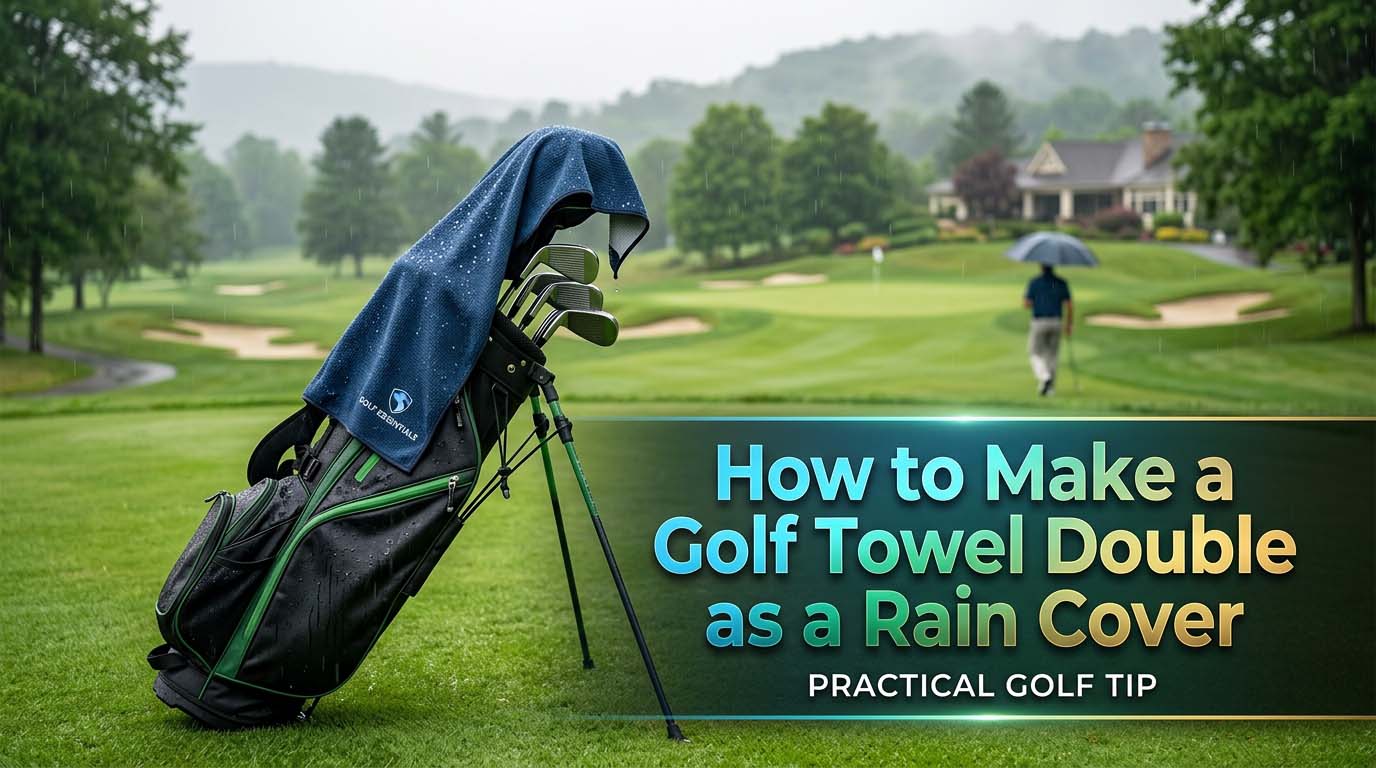
I play most of my golf in the Pacific Northwest, where rain isn’t just a possibility. It’s a schedule. I’ve burned through three rain hoods in four years, and none of them did the one job that matters: keeping my grips dry while still leaving me something to clean my clubs with.
The store-bought fix, a towel with a waterproof membrane sewn inside, costs about four times as much as a regular towel and still comes up short on coverage.
So I built my own. Here’s how to make a golf towel double as a rain cover with a standard towel and materials you probably already own.
Why a Wet Towel Fails as a Rain Cover
You might think the answer is simple: throw a towel over the clubs and go. It’s not. The problem comes down to what a towel actually does. A golf towel is built to absorb water.
That’s its whole purpose. When you drape a dry towel over your bag, it keeps the rain off for a few minutes. Then the outer fibers fill up, and water starts to pull through the fabric toward your grips. Within fifteen minutes, you’ve made a wet sponge and set it on top of your clubs.
Wet fabric doesn’t stop water. It conducts it. For a towel to work as a rain cover, you have to get a waterproof layer between the towel and the bag. That single idea is the whole trick.
Choosing the Right Towel for Dual Use
Before you add that layer, you need the right base towel. Most cheap golf towels are one square of cotton, and they won’t work for this project. You need a towel that does two different jobs, and you need it big enough to actually cover the bag.
Start with the material. Bamboo-blend towels and synthetic DryTech towels absorb fast and dry quickly, which makes them ideal for the inner layer, the part that touches your grips.
Waffle-weave cotton is better for the outside, because the open weave scrapes mud off a club face more effectively than a smooth surface. If you can find one towel with both sides, grab it. A waffle-weave exterior and a bamboo interior is the best combination I’ve found.
Then check the size. A standard golf towel around 16 by 24 inches won’t cover a stand bag. You need at least 40 by 18 inches to drape over the opening without leaving gaps on the sides. Staff bags need more, closer to 30 by 60.
| Material | Best For | Weakness |
|---|---|---|
| Bamboo / DryTech | Wiping grips and hands dry | Doesn’t scrape stubborn mud well |
| Waffle-weave cotton | Cleaning mud off club faces | Holds water longer and turns heavy when wet |
Create the Waterproof Barrier with a DIY Insert
This is the step that makes the whole thing work. You’re building a three-layer system. The outside layer of the towel catches rain and cleans mud. The middle layer blocks water from moving through. The inside layer stays dry, so you have somewhere to wipe your grips when you pull a club.
The cheapest barrier is a clear shower curtain liner. Buy the plastic kind, not the fabric kind. It costs a few dollars and gives you enough material for two or three towels. An emergency rain poncho works the same way. Both are thin, fully waterproof, and cut easily with scissors.
Lay your towel flat with the back facing up. Cut the liner to the same size as the towel and lay it on top. Fold the towel’s edges over the liner by about an inch, then fix them in place with heavy-duty fabric snaps placed every six inches.
Snaps beat glue or stitching because you can open them, pull out the liner, and machine-wash the towel like normal.
There’s one alternative worth trying. A silver windshield sun shade, the bubble-wrap type, makes a stiffer barrier that holds a shape over the bag instead of draping flat. It gives the cover structure, which helps keep the towel up off the grips.
The tradeoff is weight and bulk. I use a sun shade for my staff bag and a shower liner for my carry bag.
The Zero-Gap Drape and Anchor Technique
The strongest waterproof layer in the world won’t help if the towel ends up on the ground. And this is where most DIY attempts fall apart.
A carabiner clipped through the towel loop and onto the bag’s handle leaves the towel loose. Wind gets under it, it billows like a sail, and the whole thing slides off the rain hood.
Here’s the anchor method that actually holds:
- Fold the towel lengthwise into a long strip, with the waterproof layer facing inward. The doubled edge at the top seats over the club heads and gives the cover some stiffness.
- Drape the strip across the bag opening so it runs from the driver down to the wedges.
- Pull the bag’s rain hood compression straps over the towel, not under it. Those straps are built to hold a hood in high wind, so they lock a towel down without any trouble.
- Secure both bottom corners with a gear tie. Wrap it around the corner of the towel and the bag’s handle or towel ring, then twist it tight. A gear tie works better than a carabiner because it cinches down to whatever size you need and won’t slide along the fabric.
- Add a Velcro strap around the towel and the bag’s top handle as extra insurance against sliding.
I’ve walked eighteen holes in sideways wind and rain with this setup, and the towel didn’t shift a single club position.
The Active Play Cycle
A rain cover doesn’t just sit on the bag. You’ll spend the whole round pulling clubs out from under it, and that’s where this design earns its keep. The workflow has three phases.
- Stationary. While you walk or wait, the towel works as a full rain hood. The outer layer takes the rain, the barrier stops it, and the inner layer stays bone dry.
- Shot. Unclip the top corner of the towel, reach inside, and wipe your grip with the dry inner layer. That single wipe keeps your hands from sliding off the club. After you hit, use the wet outer layer to scrape mud off the club face. Fold the towel into a sling and hang it from your strap while you play the shot, then drape it right back over the bag.
- Puddles. In a heavy downpour, the outer layer will eventually soak all the way through. When it does, flip the towel 180 degrees on the next hole. The end that was hanging near the base of the bag is still relatively dry, so it becomes the new top. You’ve just doubled your dry surface without wringing anything.
That cycle is the real reason the barrier matters. A normal towel forces you to choose: keep your clubs dry, or clean them. This setup does both at the same time.
Make the Waterproof Layer Permanent
Once you’ve tested the insert method and confirmed the size works for your bag, you might want to make it permanent. It’s not hard, and the result is better than anything I’ve seen in a pro shop.
The sewing route is the most durable. Pick up a sheet of TPU-coated ripstop nylon — the same fabric used in ultralight backpacking shelters. Cut it to size, pin it to the back of a microfiber towel, and sew a straight stitch around the edges.
The microfiber side dries fast and stays absorbent for wiping grips. The TPU side blocks water completely.
If you don’t sew, use a glue-on backing. Seam Grip and Aquaseal are flexible waterproof adhesives made for outdoor gear, and either one will bond a 1mm neoprene sheet to the back of a towel.
Neoprene adds two useful things: it pads the club heads against bumps, and its slight compression lets the cover hug the bag’s opening more tightly.
The real advantage of building your own is size. You can make a cover that reaches every corner of a staff bag, something no store-bought rain hood manages. And when the towel side finally wears out, you just replace the towel instead of buying a whole new unit.
Questions You Might Have
Will this ruin my golf towel?
The insert method won’t. Fabric snaps unsnap, the liner comes out, and the towel goes through the wash like normal. The permanent methods change the towel for good, but they don’t ruin it.
You just end up with a towel that has a waterproof side. Start with the insert version on a towel you already own, and only upgrade to sewing or gluing once you’re sure the size works for your bag.
Can I use a microfiber towel instead of a cotton one?
Yes, and for this project microfiber is actually the better choice. It dries faster and weighs less when wet, which matters if you’re carrying the bag. The tradeoff is that microfiber holds less total water, so it soaks through sooner in a downpour.
Cotton holds more water but takes forever to dry and gets heavy enough to pull the cover off the bag. Use microfiber for the inner layer and waffle-weave cotton for the outer layer.
How do I keep the waterproof layer from floating inside the towel?
A loose liner will bunch up and drift. Fix it with one dot of fabric glue in the center of the liner before you fold the edges over. Let it cure overnight, and the liner stays centered. If you want to keep the liner fully removable, add two extra fabric snaps in the middle of the long edges instead of using glue.
Is it legal to use a modified towel in a tournament?
Yes. Under the equipment rules, a towel is not a conforming club, so you can modify it however you need.
A towel with a waterproof backing doesn’t help with alignment or measuring, so there’s nothing illegal about it. I’ve played in club tournaments and one state amateur qualifier with this setup and never been questioned.