
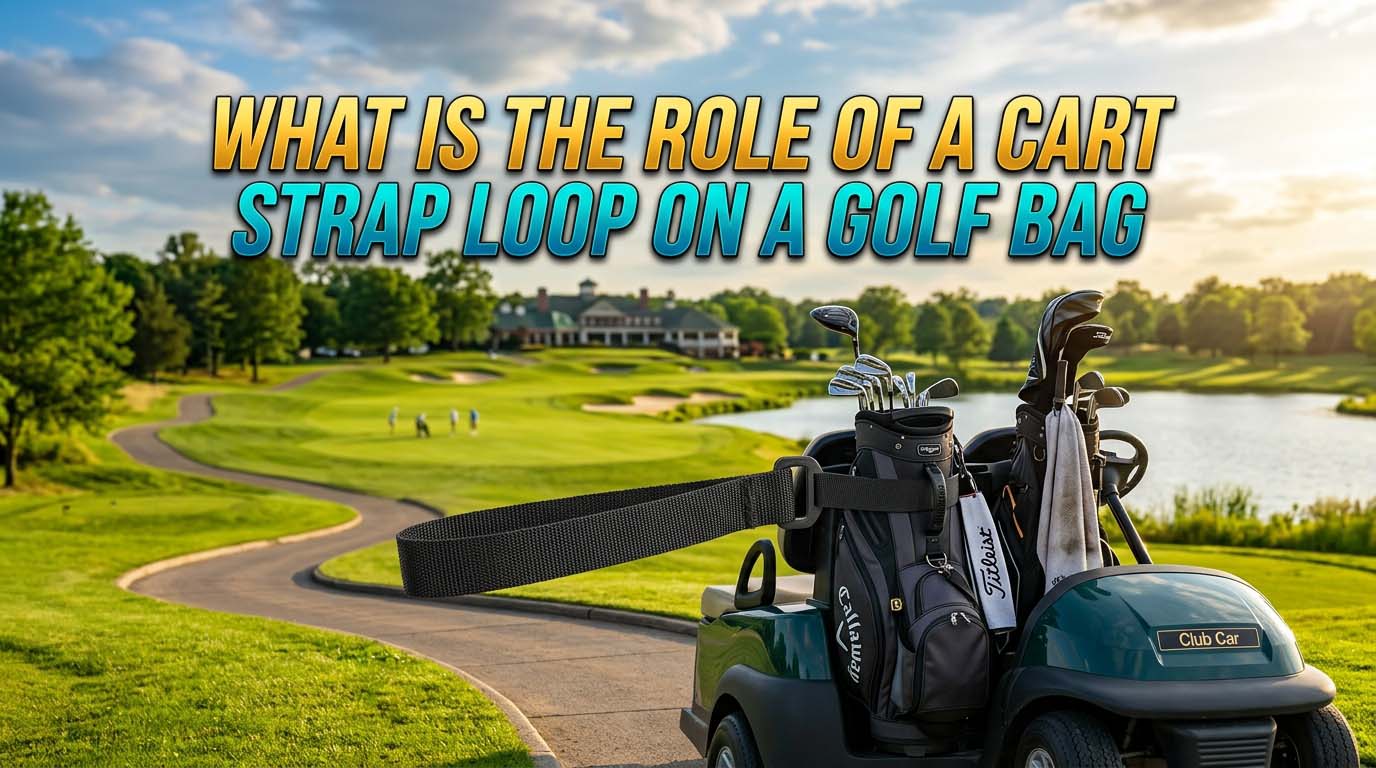
If you have ever loaded a golf bag onto a cart and watched it slide sideways or tip over on the first bump, you already know the value of a cart strap loop. This small nylon or leather loop is sewn onto the bag’s spine, usually near the top or middle.
Its only job is to give the cart strap something solid to grab. Without it, the strap can slip off the bag’s smooth surface, letting the whole thing wobble.
I have used bags with and without this loop. The difference is night and day. On bags that lack the loop, I have had to improvise by wrapping the strap around a handle or a D-ring. That works okay for a few rounds, but over time it wears out the stitching and puts stress on parts never meant to take that load. The loop is a simple solution that keeps everything steady.
The Primary Role of a Cart Strap Loop
The main job is to keep the bag fixed to the cart frame. When you thread the cart strap through the loop and pull it tight, the loop becomes a fixed anchor point.
The strap cannot slide up or down the bag. This stops the bag from rotating or tilting, especially when you are driving over uneven ground.
A stable bag means your clubs stay organized. They do not rattle against each other as much. The pockets also stay where they are supposed to be.
If the bag twists, a pocket that was facing you might end up facing the cart wheel, and you could snag a zipper or catch a pocket flap on something. That small loop prevents a lot of frustration.
Beyond stability, the loop protects the bag’s structure. If you wrap a strap around a plastic handle or a club divider, you are putting torque on a part not designed for it. Over a season, that can crack plastic or stretch nylon seams.
The loop is reinforced to handle the tension, so the stress goes into the bag’s frame, not its weak points.
Different Loop Designs and Their Purpose
Not all loops are the same. Most bags have a single loop sewn on the back of the bag, roughly halfway down or near the top handle. Some premium bags use two loops – one at the top and one at the bottom.
The dual‑loop setup gives you the option to strap the bag in two places, which helps on push carts where the bag sits low and can sway.
The material matters too. Nylon loops are light, dry fast, and work well in wet conditions. Leather loops, like the ones found on Vessel or other high‑end bags, look classic and age well.
But leather needs occasional conditioning and can get stiff if soaked. I prefer nylon for everyday use because it stays flexible no matter the weather.
Placement can be specific to the type of cart. On a riding cart, a single loop near the top is usually enough because the bag sits upright and the strap goes across horizontally. On a three‑wheel push cart, the bag leans back, so a lower loop helps keep the bottom from shifting forward.
Some manufacturers add a loop to the bottom of the bag for exactly this reason. If you own a push cart, look for a bag with two loops.
How to Properly Use the Loop on Any Cart
The method is simple, but a few small details make a big difference.
- Find the loop on your bag. It is usually on the back, between the shoulder straps or near the top handle. If you have two loops, pick the one that matches the height of the cart strap.
- Thread the strap through the loop. Do not just lay the strap over the bag and tighten it. The strap must pass through the loop so the loop acts as a stop.
- Pull the strap tight, but not too tight. You want the bag snug against the cart frame. Overtightening can compress the bag’s internal frame, making zippers hard to open and closing off pocket space.
- Check for twists. A twisted loop weakens the hold and can wear the fabric unevenly. Straighten the loop before you cinch the strap.
- For push carts: If your bag has a lower loop, use it. Many push carts have a strap that wraps around the bottom of the bag. Thread that strap through the lower loop to stop the bag from rocking side to side.
I have seen people skip the loop entirely and just wrap the strap around the bag body. That works until a sharp turn shifts the bag.
Once the strap slips off the smooth fabric, the bag can fall sideways, and your clubs hit the ground. Using the loop is a two‑second step that prevents a much bigger problem.
Cart Strap Loop vs. Cart Strap Sleeve
Some newer golf bags come with a padded sleeve along the back. This is a wide fabric channel that the strap passes through. The sleeve covers the entire strap path and distributes pressure across a larger area. Both the loop and the sleeve secure the bag, but they work differently.
The table below shows the key differences:
| Feature | Cart Strap Loop | Cart Strap Sleeve |
|---|---|---|
| How it holds | Creates a single anchor point | Distributes strap force across the whole back |
| Stability | Good for vertical hold; can allow slight rotation | Excellent; prevents almost all bag movement |
| Bag compatibility | Works on any bag that has the loop | Only on bags designed with the sleeve |
| Ease of use | Very easy; thread and tighten | Slightly more involved; need to feed strap through the channel |
| Protection from wear | Keeps strap off bag body, but loop itself can wear | Padded sleeve protects the bag from strap abrasion |
If your bag has both a loop and a sleeve (some premium models do), use the sleeve as the primary anchor because it gives the most stability. Then use the loop as a secondary point if you want extra security.
If you only have one or the other, either will do the job. The sleeve is better for pure stability, but the loop is simpler and works with any strap.
Mistakes That Compromise Your Bag’s Performance
Even with a good loop, people make errors that shorten the bag’s life or reduce security. Here are three I have seen most often:
- Using a handle or divider instead of the loop. I have done this myself when the loop was hard to reach. The handle is not reinforced to take lateral tension. After a few rounds, the stitching starts to pull, and eventually the handle can break off. Always use the dedicated loop.
- Overtightening the strap. A tight strap feels secure, but too much force compresses the bag’s internal structure. On a stand bag, this can prevent the legs from deploying properly. On a cart bag, it can make the main pocket zipper hard to pull. Give the strap a firm pull, not a full body weight heave.
- Ignoring the loop on a push cart. Many golfers use a push cart but never bother to thread the strap through the loop. They just lay the strap over the bag and tighten it. On a push cart, the bag leans back, and the strap is at an angle, which lets the bag slide side to side. Using the loop eliminates that sway and saves the bag’s bottom from rubbing against the cart frame.
These mistakes seem small, but they cause real damage over time. A loop costs almost nothing to use and prevents repairs that can cost a new bag.
Frequently Asked Questions
Can I add a cart strap loop to a bag that doesn’t have one?
Yes, but it is not always simple. Aftermarket loops exist that sew into a reinforced seam, or they clip onto a D-ring. If you sew it yourself, make sure the stitching goes through a strong part of the bag, like the seam between panels. Some manufacturers offer attachment kits. Keep in mind that modifying a bag can void its warranty.
Why do some premium bags use leather loops?
Leather loops look classic and age well, developing a patina over time. They also hold up to repeated tightening without fraying as quickly as some nylon loops.
The downside is that leather can get stiff after rain and may crack if not conditioned. Nylon dries faster and stays flexible, so it is more practical for regular play in wet weather.
Does the loop affect how a stand bag sits on the ground?
Not directly. The loop is on the back of the bag and does not interact with the legs. However, if you strap the bag to a cart and the strap pulls the loop sideways, it can twist the bag’s frame.
When you later set the bag on the ground, the legs may not deploy evenly. Always make sure the strap pulls straight against the loop, not at an angle.
Should I use the loop if my cart has a strap sleeve?
If your cart has a built‑in strap sleeve (a padded slot that the strap passes through), use the sleeve first; it holds the bag more securely.
The loop becomes a backup. If the sleeve is too loose and the bag still wiggles, you can add the loop as a secondary anchor. Using both is overkill for most situations, but it does not hurt.