
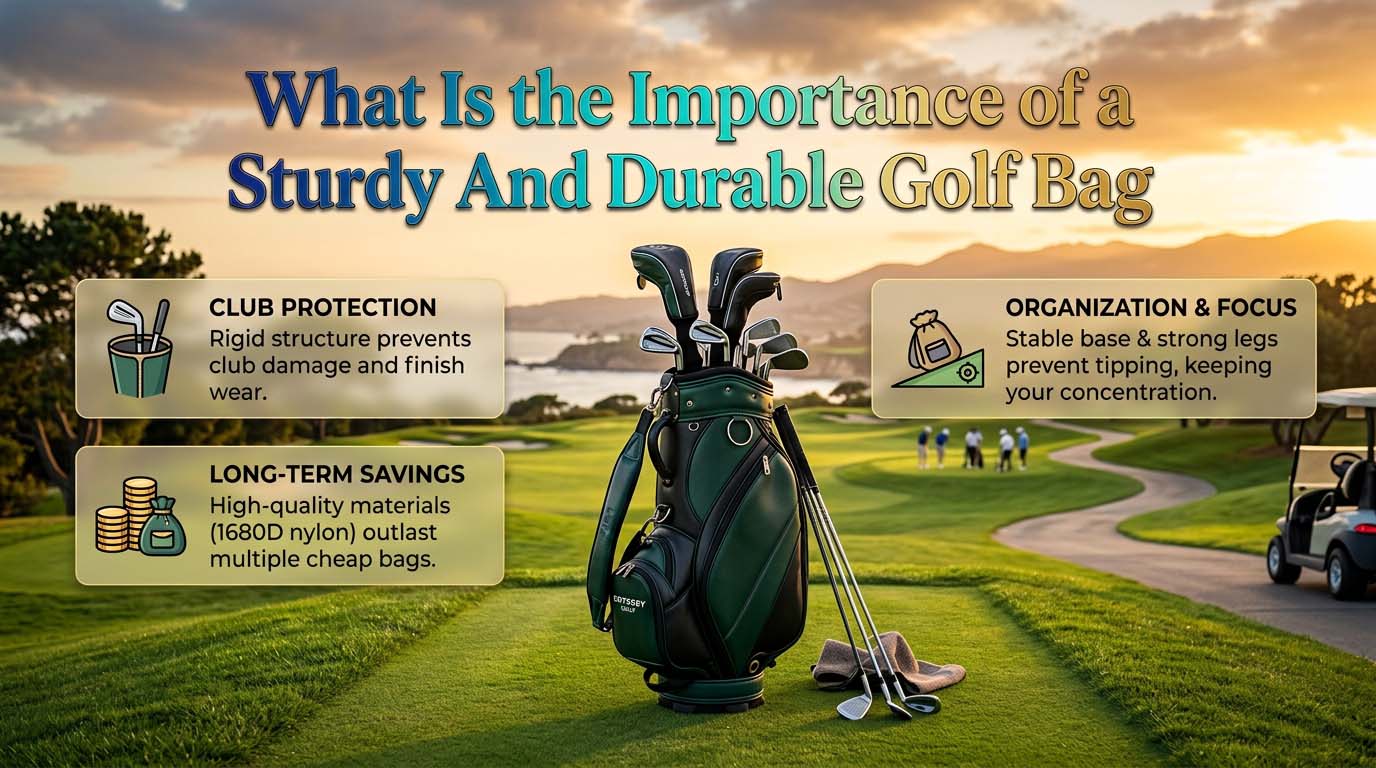
A sturdy golf bag protects your club investment, saves money long-term, and prevents mid-round failures. Learn why durability matters more than brand names.
A golf bag’s job is simple: carry your clubs from the car to the course and back. But when the zipper jams on the fourth hole, the base sags so the bag tips over, or a strap snaps mid-round, that simple job fails.
A sturdy, durable golf bag is the difference between enjoying eighteen holes and fighting your equipment the whole way.
The short answer to why it matters is this: your clubs cost much more than your bag. A sturdy and durable golf bag protects that investment, saves you money over time, and removes one more distraction from your game.
The direct benefits of a sturdy bag on your game and your wallet
Club protection starts with the bag structure
A flimsy bag does not hold its shape. When the top cuff bends, or the dividers collapse, club shafts rub together. That rubbing wears off the finish, creates chatter marks, and can even bend shafts over time.
A rigid top cuff with full-length dividers keeps each club separate. The head covers stay in place instead of falling off when the bag is moved.
The bottom of the bag matters just as much. A reinforced base prevents clubs from pushing through the fabric when you set the bag down hard.
It also keeps moisture from wicking up into the grips when you set the bag on wet grass. Wet grips mean slippery hands, and slippery hands mean bad shots.
Organization stability keeps your focus on the shot
Every golfer has watched a cheap bag fall over after setting it down on a slight slope. You then spend thirty seconds picking up clubs, putting head covers back on, and re-organizing. That break in focus costs you a shot or two per round.
A bag with a wide, stable base and proper leg mechanism (for stand bags) stays upright. You grab the club, take the shot, and put it back without thinking about the bag.
Cart bags have their own stability issues. A bag that shifts on the cart platform makes it harder to pull clubs in and out.
The bag should sit flat and stay put, even when the cart is moving over uneven ground. Non-slip strips on the bottom and reinforced cart strap loops prevent that sliding.
Long-term cost savings that add up fast
Let’s run the numbers on real-world use. A cheap bag costs around $100 and lasts about two years before the zipper fails, the base tears, or a strap breaks. That’s five replacements over a decade, costing $500 total.
A high-quality bag costs $300 and lasts ten years or more. You save $200 in the long run, plus you avoid the hassle of buying and breaking in a new bag every two years.
But the real savings come from protecting your clubs. A damaged shaft costs $100 to replace. A scratched driver face loses resale value quickly. Over ten years, a cheap bag can cost you two or three times its purchase price in equipment damage and replacements.
Resale value holds with a well-maintained bag
Golfers who upgrade equipment regularly often sell their used bags. A durable bag with minor wear still fetches 40 to 60 percent of its original price on the secondhand market. A bag with broken zippers or torn fabric is worth nothing.
The good news is that high-end materials like 1680D nylon and reinforced stitching show wear much more slowly, so your bag holds value longer.
How does sturdiness affect different bag types and use cases?
Stand bags: the walking golfer’s test
Stand bags take the most abuse. The legs deploy hundreds of times per season. The double strap must carry weight evenly without popping rivets. The base must be wide enough to keep the bag stable when the legs are out.
Weak points to watch for on stand bags include:
- The pivot point where legs attach to the bag frame. This joint takes the most stress and often breaks first on cheap bags.
- The retracting mechanism that pulls legs back in. A weak spring or plastic housing fails after a few seasons.
- The base plate. A thin plastic base cracks when set down on uneven ground or rocks.
- The top strap mounting points. These need reinforced stitching and metal rivets, not just fabric loops.
Cart bags: the rider’s workhorse
Cart bags sit on a platform and get tossed around in the back of a golf cart. The main stress points are:
- The cart strap loop. This loop needs wide, reinforced fabric so the strap does not cut into it over time.
- The base. A flat, non-slip bottom keeps the bag from rotating on the cart platform.
- The handle. Cart bags get picked up by the handle constantly. A flimsy plastic handle snaps, while a thick rubber or padded handle lasts for years.
- The pockets. Cart bags have many pockets, and each zipper face is a potential failure point.
Travel bags: surviving baggage handlers
Travel bags face the worst conditions. Airline baggage systems can destroy a weak bag in one trip. A durable travel bag needs:
- A hard or heavily padded base that protects the club heads from impact.
- A reinforced top that does not collapse when stacked under other luggage.
- Lockable zipper heads that survive the bag being thrown.
- Extra-strong carry handles with multiple grip points.
The anatomy of a durable golf bag – what to look for
Materials: denier ratings and fabric types
The denier (D) rating measures fabric thickness. Higher numbers mean tougher material, but also heavier weight. Here is the general rule:
| Denier Rating | Typical Use | Durability Level |
|---|---|---|
| 600D | Entry-level bags, lightweight stand bags | Low to medium. Fine for occasional use but wears quickly. |
| 1200D | Mid-range cart bags, most stand bags | Medium to high. Good balance of weight and toughness. |
| 1680D | Premium cart bags, travel bags | High. Very resistant to tears and abrasion. |
| Nylon vs. Polyester | Both used in golf bags | Nylon is stronger and more abrasion-resistant. Polyester fades slower in sunlight but tears more easily. |
Synthetic leather looks great but scratches easily. It is more about style than raw durability. High-denier woven nylon is the best bet for a bag that will get beat up.
Construction techniques that make the difference
Two bags made of the same material can have very different lifespans based on how they are built. Look for:
- Bar-tacked stress points. These are tight, short stitches that reinforce strap attachments, zipper ends, and pocket corners. A flat seam will tear long before a bar-tacked one.
- Double-stitched or triple-stitched seams. Single stitching pulls apart under load. Double stitching gives a backup line if the first one fails.
- Welded or taped seams. These prevent water from seeping through the stitching holes, which causes fabric rot over time.
- Reinforced top cuff. The top ring that holds the clubs should be rigid plastic or metal. A flexible cuff bends and lets clubs fall out.
Hardware: zippers, buckles, and connectors
Zippers are the most common failure point on golf bags. A broken zipper makes a pocket useless. Look for bags with YKK brand zippers.
They are the industry standard for a reason; they last two to three times longer than generic zippers. Metal zipper teeth are stronger than plastic ones but can corrode. Coated zippers resist water better.
Buckles and strap connectors should be metal or thick plastic. Thin plastic clips snap in cold weather. Metal hardware lasts forever but adds weight.
The Base: the most overlooked part
The base gets the most abuse from setting the bag down, dragging it over curbs, and storing it on concrete. A single-layer fabric base will wear through in a year. A double-layer or polyethylene plastic base lasts five to ten years. The best designs add a rubber bottom that grips surfaces and resists moisture.
Common misconceptions about durability
Heavier always means more durable
Not true. Modern fabrics like Dyneema and high-denier ripstop nylon are very tough yet lightweight. A carbon fiber frame and 1680D nylon bag can match or beat a heavy leather bag in durability while weighing half as much. The trade-off is cost – advanced materials are expensive.
Leather is the best material for a bag
Full-grain leather looks premium and lasts decades if oiled and stored properly. But in real golf conditions- rain, mud, sunlight, constant movement- synthetic leather often outlasts real leather.
It does not crack, does not require conditioning, and resists water better. The best synthetic leathers also hold color longer.
A waterproof bag is automatically durable
Waterproofing is a coating or membrane on the fabric. That coating can delaminate, crack, or wear off over time.
The bag’s underlying structure- the fabric denier, stitch quality, and frame – is what determines durability. A waterproof bag with weak zippers and thin fabric is still a short-lived bag.
Price guarantees durability
High price does not always mean high durability. Some premium brands charge for design and status, not material quality.
Mid-range brands like Sun Mountain, Ogio, and Callaway often outlast more expensive competitors because they focus on durability over flash. Always check the material specs and read reviews that mention six-month or one-year wear.
How to test a bag’s durability before you buy?
In-store checklist
If you can touch the bag before buying, do these tests:
- Pull on every strap with moderate force. Listen for popping sounds and look for loose stitching.
- Open and close each zipper twenty times. Feel for snags, hesitation, or rough spots.
- Flex the base by bending it with your hands. A good base does not flex easily.
- Press down on the top cuff. It should not bend or deform.
- Check the inside of the bag for rough edges. Look for unfinished seams that can snag head covers.
- Lift the bag by the handle. The handle should feel solid, not hollow or wobbly.
Online research strategies
When buying online, you cannot test the bag directly. Instead:
- Search reviews for the words “zipper failure,” “base tear,” “strap broke,” or “seam rip.” If multiple reviews mention the same problem, it is a design flaw.
- Look for reviews written after six months or one year of use. Initial reviews often miss long-term problems.
- Check the manufacturer’s warranty. A one- to three-year warranty shows confidence. A six-month warranty is a red flag.
Warranty as a clue
Warranty length is not a perfect indicator, but it helps. Most warranties cover manufacturing defects but not normal wear and tear.
A longer warranty means the company believes the bag can survive normal use for that long. Pay attention to what is excluded; many warranties do not cover zippers, straps, or broken zipper teeth, which are the most common failures.
Frequently Asked Questions
How long should a durable golf bag last?
With proper care, a high-quality bag lasts five to ten years. A stand bag that is carried every round may show wear at the five-year mark. A cart bag that stays on a cart may last eight to ten years. Store the bag indoors, clean zippers with a brush, and keep it dry to extend lifespan.
Can a lightweight bag be as durable as a heavy one?
Yes, if it uses modern high-tech fabrics like 1680D ripstop nylon or Dyneema. Carbon fiber frames also provide strength without weight. These materials cost more but offer the best of both worlds. A cheap lightweight bag will not be durable, but an expensive lightweight one can be.
Does a bag’s durability affect how well it holds up in extreme heat or cold?
Yes. PVC-coated fabrics become brittle in freezing temperatures. Nylon retains flexibility in cold weather. UV rays break down polyester and nylon over time, so look for bags with UV-resistant coatings if you play in sunny climates. Hot car trunks degrade cheap materials faster than premium ones.
What is the most common failure point on a golf bag, and how does durability prevent it?
Zippers fail most often. A durable bag uses heavy-duty zippers, usually YKK brand, with metal or coated teeth. The second most common failure is the base seam tearing. Durable bags double-stitch and tape this seam. The third is strap breakage. Durable bags use bar-tacked connections and thick webbing.
Should I buy a bag with a hard or soft base for durability?
Hard base wins for durability. A polyethylene or hard rubber base does not sag, does not absorb moisture, and protects clubs from ground impact. A soft fabric base is lighter but wears through faster and lets water soak in. If you walk or store the bag on concrete, get a hard base.
Is the warranty length a reliable indicator of a bag’s durability?
Generally yes, but read the fine print. Many warranties exclude wear and tear, which covers zipper failure and strap breakage, the most common issues. A three-year warranty that covers only the frame gives less confidence than a one-year warranty that covers all parts. Warranty is one clue among many, not a guarantee.