
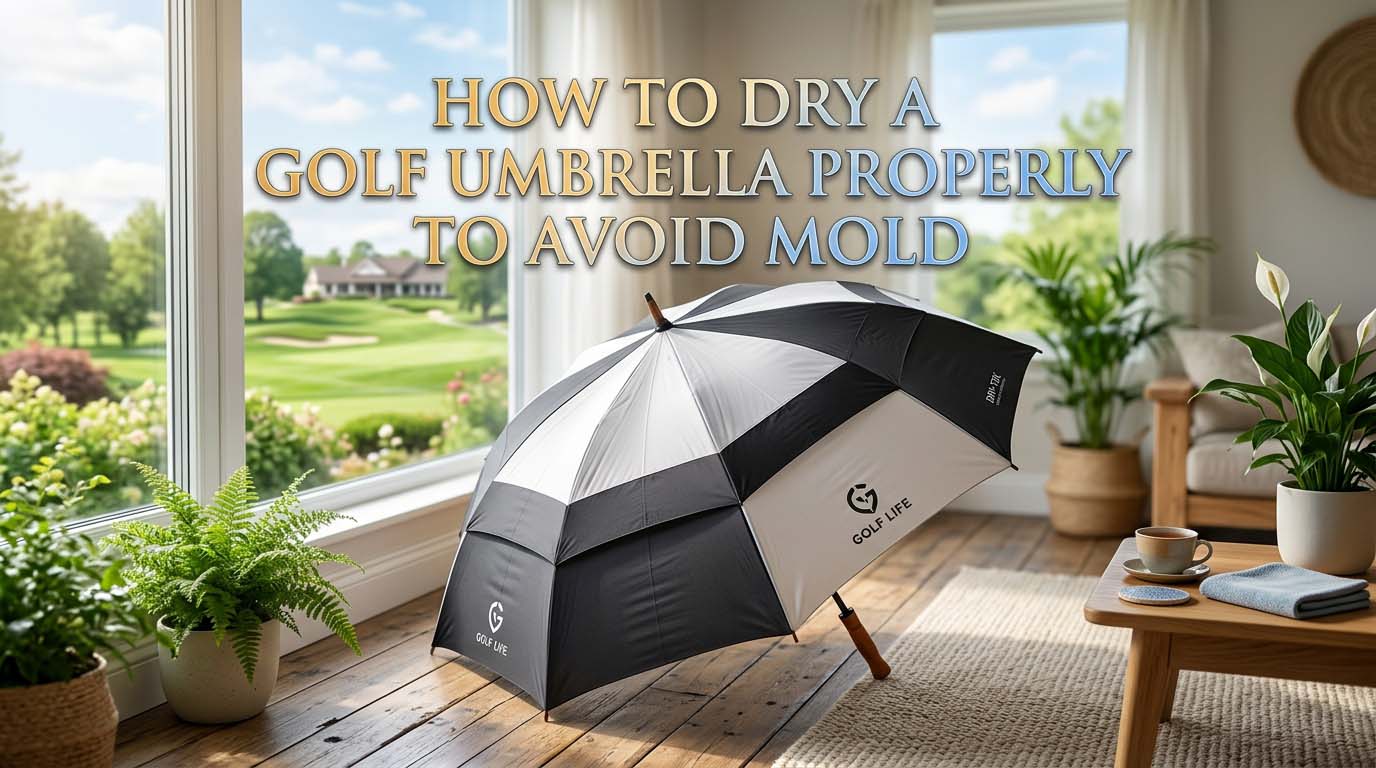
Open the umbrella fully after every use. Invert it so the handle points up and the canopy tip points down. Place it in front of a fan or near a dehumidifier for 12 to 24 hours. Never collapse a golf umbrella that still feels cool or damp to the touch.
That coolness means hidden moisture, and hidden moisture is what triggers mold.
If you remember only this:
- Invert the umbrella so gravity drains water away from the tip pocket.
- Use a fan or dehumidifier to dry every seam and fold.
- Do not store the umbrella until it passes the tactile dryness test.
Why Golf Umbrellas Are More Prone to Mold Than Standard Umbrellas
Mold needs three things: trapped moisture, organic matter, and time in a warm, humid place. A golf umbrella returning from a rainy round has all three. The canopy holds roughly twice as much water as a compact umbrella.
The thick fabric feels dry on the outside while moisture hides in the inner seams, the tip pocket, and around the frame joints. The dirt, pollen, and grass dust picked up on the course act as food for spores.
The danger window is short: mold spores can start establishing themselves inside a folded, damp umbrella within 24 to 48 hours. If you store it wet overnight, you are giving mold a head start. Golf umbrellas live in enclosed spaces- the boot of a car, a golf bag, a locker- places that stay warm and dark, perfect for mold growth.
Water hides in four spots especially:
- The seam tapes along each panel
- The fabric pocket at the very tip of the canopy
- The joints where the ribs meet the shaft
- The area where the canopy attaches to the shaft
The Complete Drying Routine for a Wet Golf Umbrella
- At the course: While the umbrella is still open, shake it to flick off surface water. Hold it by the tip and give it a few quick shakes. Use a gloved hand to remove any mud or grass stuck to the fabric.
- On arrival home: Open the umbrella fully in the most ventilated space you have — a bathroom with an exhaust fan, a covered porch, or a garage. Do not close it.
- Dry the frame first: Wipe the shaft, handle, and joints with a clean, dry microfiber cloth. Rust starts on the frame before the canopy shows any mould.
- Remove bulk water from the canopy: Use a towel and dab the fabric. Do not rub — rubbing can damage the water-repellent coating. Pay extra attention to the inner side of the canopy.
- Invert the umbrella: Turn it so the handle faces up and the canopy tip points down. This is the most effective step. Gravity pulls water out of the tip pocket. If you hang it by the wrist strap, water pools in that pocket instead.
- Add active airflow: Position the inverted umbrella in front of a fan. If you live in a humid area, run a dehumidifier in the same room. A fan alone can cut drying time from 24 hours to 4 hours.
- Test for complete dryness: Run your thumb along the seams and press the tip pocket. If it feels cool, damp, or darker in colour, it is not dry. Only collapse the umbrella when every part feels room-temperature and bone-dry.
What Not to Do
- Never dry on a radiator or with a hairdryer. Heat degrades the canopy coating and the seam adhesive.
- Never use a washing machine or tumble dryer. Both destroy the frame and finish.
- Never use fabric softener on the canopy. It strips the water-repellent treatment.
- Never leave the umbrella in direct sunlight for a full day. UV damages polyester and pongee finishes. An hour of sun is fine for killing surface spores, but let airflow do the real work.
How to Dry a Golf Umbrella Indoors Without a Garden or Balcony
Not everyone has space to open a 68-inch umbrella. Here are ways to dry it in a flat, apartment, or small house.
- Shower rod suspension: Invert the umbrella and hang it by the handle from a shower rod or sturdy hook. Let the tip hang over the tub. Turn on the bathroom exhaust fan. Gravity does the draining, and the fan pulls moisture out.
- Fan-and-dehumidifier setup: Prop the umbrella upside-down over the back of a chair. Position a standing fan to blow upward through the inside of the canopy. Run a small dehumidifier in the same room. This is the closest you can get to a steady breeze indoors.
- Clothes drying rack hack: Open the umbrella partway and nestle it across the rungs of a clothes airer. Spread the panels so air reaches each go. This works best for spot-drying after heavy rain.
- Towel extraction technique: Wrap the open umbrella in a large microfiber golf towel. Apply light pressure with your hands. The towel wicks out the bulk of the water before you start the fan. This cuts total drying time by half in apartments.
- Speed-drying for a next-morning tee time: If you have only a few hours, do the towel extraction and then the inverted fan setup. The umbrella will be dry enough to survive one night in a bag. But do not make this a habit; shortcuts work once, not every time.
Drying Your Golf Umbrella Between Rounds and On the Go
Your umbrella may spend more time in the car or golf bag than in your hands. Here is how to handle those situations.
- At the course: Look for a clubhouse drying area. Many courses have a covered corner near the pro shop where you can open an umbrella. The worst thing you can do is roll a wet umbrella into your golf bag.
- In the car: Lay the open umbrella across a back-seat floor mat. Wedge the tip toward the door. Place a microfiber towel under the tip pocket to catch drips. Crack a window for airflow.
- Car towel tip: Keep a dedicated packable microfiber towel in the boot. Use it to dry the umbrella before the drive home. That same towel works for drying grips.
- If you must store a damp umbrella in the boot temporarily: Leave it loosely rolled. Crack a window or vent. Make it the first thing you remove when you get home. A damp boot is a perfect warm, dark environment for mold.
- Storage between rounds in the golf bag: The rule is simple: the umbrella goes back into the bag only after it passes the tactile dryness test. If you are unsure, leave it open in the garage overnight rather than zip it into the bag damp.
Protective Coatings and Fabric Treatment That Reduce Mold Risk
A clean, well-maintained canopy sheds water so fast that drying becomes a non-issue. Most golf umbrellas come with a factory water-repellent coating, but that coating wears off after a season of regular use. Wind, rain, and repeated folding break it down.
You can restore the beading effect with a durable water repellent (DWR) spray made for outdoor textiles. These sprays make water slide straight off the fabric instead of soaking in. Less absorbed water means faster drying and much lower mold risk.
How to apply DWR spray on a golf umbrella:
- Dust off the dry canopy with a soft brush.
- Apply the spray evenly in a well-ventilated area. Hold the can about 15 cm from the fabric.
- Wipe off any excess with a clean cloth.
- Let it cure for at least two hours (check the product label).
- Spot-test on an inner panel first to ensure no discolouration.
Reapply before the wet season and again after about 10 to 12 heavy rain rounds. You will know it is time when water stops beading on the canopy and instead darkens the fabric.
As for fabric types: pongee tends to dry fastest, nylon sits in the middle, and polyester traps the most water in seams. But coating matters more than material. A treated polyester canopy dries faster than an untreated pongee one.
How to Kill Mold and Odour on a Golf Umbrella That Already Smells
If you see dark grey, green, or black spots concentrated along the seams and fold lines, that is active mold. A musty smell without visible spots is usually a milder bacterial or mildew issue.
The cleaning sequence:
- Open the umbrella fully outdoors. Brush dry spores off the canopy with a soft brush. Do this before any water touches it — wetting the spores spreads them.
- Prepare a solution of one part white vinegar to three parts cool water. Alternatively, use an oxygen-based cleaner (never bleach). Apply with a soft cloth or spray bottle.
- Let the solution sit for 10 to 15 minutes. Gently scrub affected seams with a soft nail brush.
- Rinse thoroughly with clean water to remove all residue.
- Follow the complete drying routine above. Ideally, keep the umbrella in front of a fan until every seam is bone-dry.
Health note: Handling a heavily moldy canopy can irritate your eyes and airways, especially if you have allergies or asthma. Wear a dust mask and gloves.
When to give up: If a dark, musty smell returns after two thorough cleanings, or if the fabric feels brittle or rotted at the seams, the umbrella is beyond saving. Mold may have invaded the seam tape, which you cannot fully sanitise. Replace the umbrella instead of endlessly re-cleaning it.
Frequently Asked Questions
Can I dry my golf umbrella upside down?
Yes, and it is the preferred method. Inverted means handle up, canopy tip down. This drains the tip pocket. Hanging it by the wrist strap traps water in that pocket and creates a mold hot spot.
How long does it take for a golf umbrella to dry completely?
With an active fan, roughly 4 to 8 hours. In still indoor air, 12 to 24 hours. With a dehumidifier running, about half that. Use the tactile test: run a thumb along the seams and the tip pocket. Any coolness means it is not dry yet.
Can I leave my golf umbrella in the car trunk all season?
Only if it is completely dry. A damp umbrella in a warm trunk is a perfect mold incubator. A fully dry umbrella in a breathable sleeve is acceptable in cooler months. Summer trunk heat degrades canopy coatings over time. Bring it inside between weekend rounds when possible.
Should I spray my golf umbrella with a waterproofing treatment before the season starts?
Yes. Pre-season treatment prevents water absorption in the first place, which halves drying time and dramatically lowers mold risk. Reapply when water stops beading. Always spot-test first to check for discolouration.
Is mold on a golf umbrella harmful to my health?
For most people, it is an odour nuisance. But trapped spores inside a closed umbrella can trigger irritation in asthma or allergy sufferers. Cleaning and fully drying resolve most cases. Repeated heavy mold means replacement.
Is drying with sunlight better than drying with a fan?
Sunlight evaporates surface moisture quickly but damages canopy coatings and seam adhesive when prolonged. A fan or dehumidifier dries the internal seams and folds where mold actually starts. Best approach: a brief hour in the sun to kill surface spores, then finish with active airflow.