
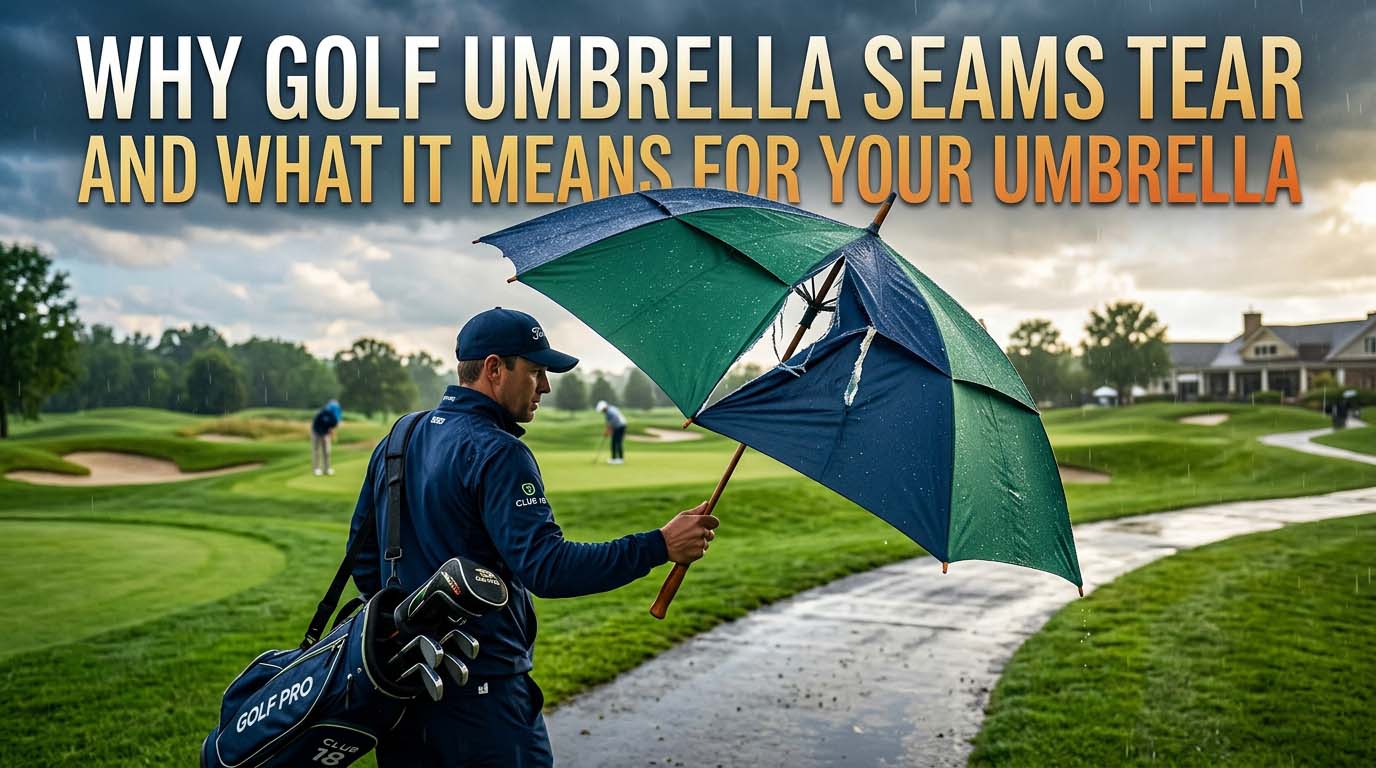
You pull out your golf umbrella on a rainy round, and as you open it, you hear that awful ripping sound. A seam has split. Maybe it happened after a gust of wind, or maybe it just gave way on first use.
Either way, you want to know why this happened and whether you can fix it or need a new umbrella. I’ve repaired and tested dozens of umbrellas over the years, and the answer almost always comes down to one of three root causes: wind fatigue, weak materials, or a manufacturing defect.
In this guide, I’ll walk you through each cause so you can diagnose your tear, decide what to do next, and avoid the same problem on your next umbrella.
The Three Main Culprits Behind Seam Tears
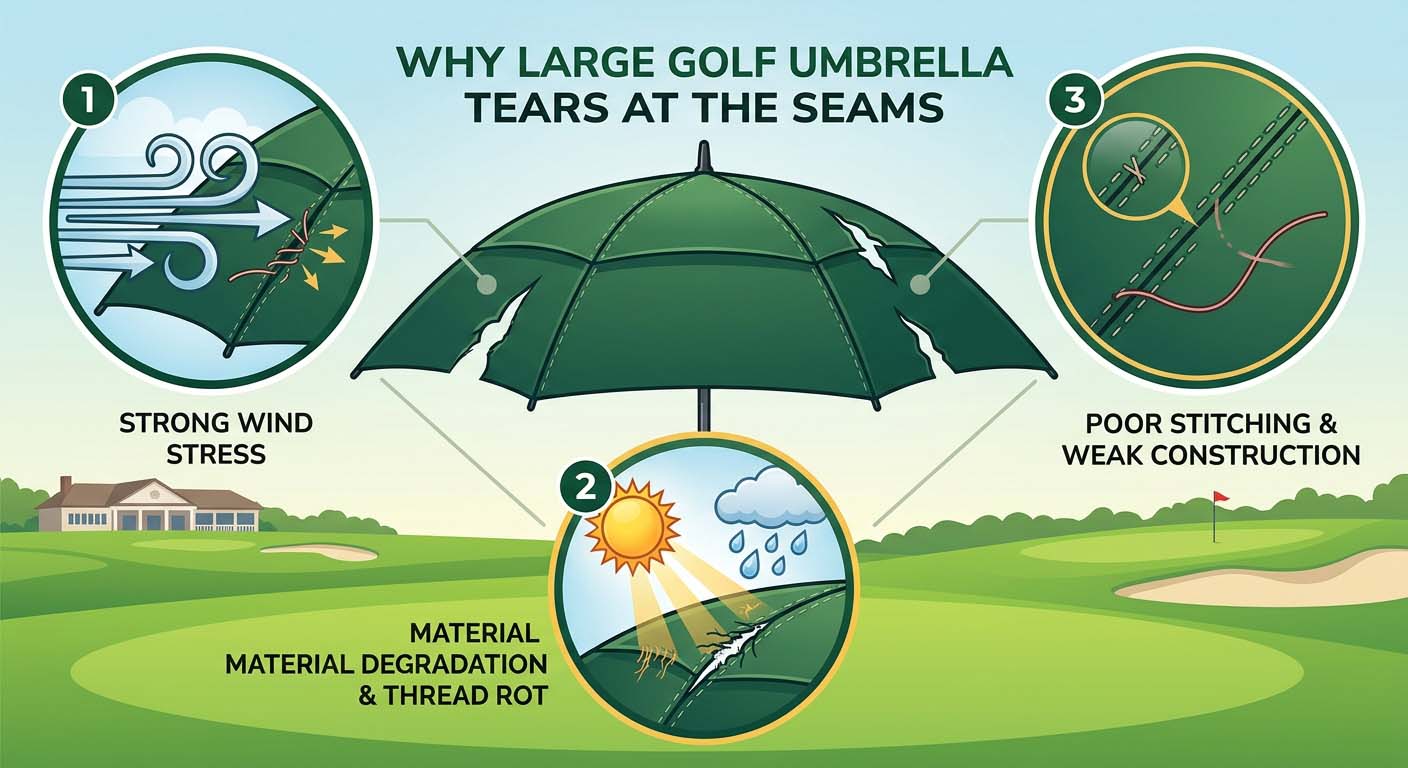
Golf umbrellas are big, often 60 inches across or more. That large surface area catches wind like a sail. When the wind hits, the canopy tries to flip. The seams take the brunt of that force. But not all seam failures happen the same way.
Here are the three most common causes I see, and how to tell which one applies to your torn umbrella.
Wind Stress and Flapping
This is the number one reason seams tear. Even if an umbrella is well‑made, repeated exposure to strong gusts will gradually loosen the stitches.
The fabric between the ribs flaps back and forth, and each flap pulls on the seam thread. Over time, the thread stretches, weakens, and eventually snaps.
If your tear is near where the canopy attaches to a rib, or if the seam looks frayed rather than cleanly sliced, wind stress is likely the culprit.
Golf umbrellas aren’t designed to handle hurricane‑force winds. Most wind ratings are for steady wind, not gusts that can double in speed for a second. If you used the umbrella in exposed conditions with sudden gusts, a seam failure suggests you pushed it beyond its design limits.
Material Degradation
Thread doesn’t last forever. UV rays from the sun break down the fibers, making them brittle. Moisture can also rot the thread if you store the umbrella wet. If your umbrella is a few years old, or if you’ve left it in a hot car trunk, the stitching may have lost its strength. A seam that rips easily without much force suggests the thread itself has deteriorated. Look at the damaged area – if the thread looks faded, fuzzy, or breaks when you tug it gently, material age is the cause.
Construction Defects
Sometimes the problem is the umbrella itself, not the conditions. I’ve seen brand‑new umbrellas tear on the first open because of skipped stitches, uneven tension, or using low‑quality thread on high‑stress seams. To check for a defect, inspect the rest of the umbrella. Are there loose loops of thread anywhere? Does the seam look uneven or puckered? If the tear happened during normal opening or light wind, and the fabric is still intact, the manufacturer likely used poor stitching. This is frustrating, but it also means you may have a warranty claim.
How to Tell if Your Umbrella Can Be Repaired or Should Be Replaced
Once you know the cause, you can decide on the best course of action. Here’s a simple decision framework I use:
- Repair is worth a try if: the tear is along the seam, but the fabric itself is not torn, and the ripped section is no longer than a few inches. You can sew it back by hand or use a specialized seam sealer like Seam Grip. Also check if the umbrella has a warranty – many golf umbrellas come with a lifetime warranty that covers seam defects.
- Replace if: the seam has ripped multiple ribs apart, the fabric next to the seam is also torn, or the thread is brittle and crumbling. In these cases, a repair will be temporary at best. It’s safer and more cost‑effective to buy a new umbrella that is built to handle your conditions.
I’ve repaired plenty of wind‑stress tears, but I always tell people: if the tear happened from a manufacturing defect, you should return or exchange it. Don’t settle for a patch on a product that was poorly made from the start.
The Most Overlooked Factor – Stitch Material and Pattern
Most people never look at the stitching on their umbrella until it breaks. That’s a mistake. The type of thread and how it’s sewn make a huge difference in seam strength. Budget umbrellas often use standard polyester thread with a single‑row straight stitch. This is cheap to produce, but it fails quickly under stress. Wind‑resistant umbrellas use bonded nylon thread (stronger and more UV‑resistant) and often a double‑row or zigzag stitch that distributes force over a wider area.
Next time you’re shopping for a golf umbrella, flip over the canopy and examine the seams. If you can see only one line of stitching and the thread feels thin, expect it to tear sooner.
A double‑stitched seam with thicker thread is a sign of a more durable umbrella. I’ve used a double‑stitched model for three seasons of heavy wind, and the seams are still tight.
Real‑World Wind Testing – Why Even “Windproof” Umbrellas Fail
You might have seen “windproof” or “wind‑resistant” labels on umbrella packaging. Those claims are measured in a lab with steady wind speeds, often around 30 mph. But real‑world wind is rarely steady.
Gusts can spike to 50 mph for a second, and if you’re standing near a building or an open field, the wind can swirl and catch the canopy from the side. A seam tear in these conditions doesn’t mean the umbrella is junk. It means the wind exceeded the rating.
I once tested a reputable golf umbrella in a 40 mph gust; the seam popped right at the rib connection point. The umbrella was fine after I reinforced that seam with a few stitches, but it taught me that no fabric can resist sudden extreme wind every time.
If your tear happened in a strong gust, accept that the conditions were beyond what the umbrella could handle, and look for a model with a higher wind rating or a reinforced frame if you face gusty weather often.
Frequently Asked Questions
Can I use superglue to fix a torn seam?
No. Superglue dries hard and makes the fabric brittle. It will cause more tears next time you open the umbrella. Use a fabric glue designed for nylon or a seam sealant like Seam Grip. It stays flexible and bonds the threads together without stiffening the canopy.
Why did my umbrella tear when I first opened it?
That is almost always a manufacturing defect. The thread was already weakened, or there were skipped stitches. If it’s brand new, take it back for a refund or warranty replacement. Do not try to fix it yourself.
Will a tear in one seam eventually cause the whole canopy to fail?
Yes. Wind will propagate the tear to adjacent panels unless you repair it quickly. A small seam tear can become a large rip in just one more gust. I recommend sewing or sealing the tear as soon as you notice it.
Does the color of my umbrella affect seam durability?
Yes, indirectly. Dark colors like black or navy absorb more heat from the sun. In hot climates, that heat can accelerate degradation of the thread.
Lighter colors reflect sunlight and keep the canopy cooler, which helps the thread last longer. It’s a small factor, but worth considering if you live in a sunny area.