
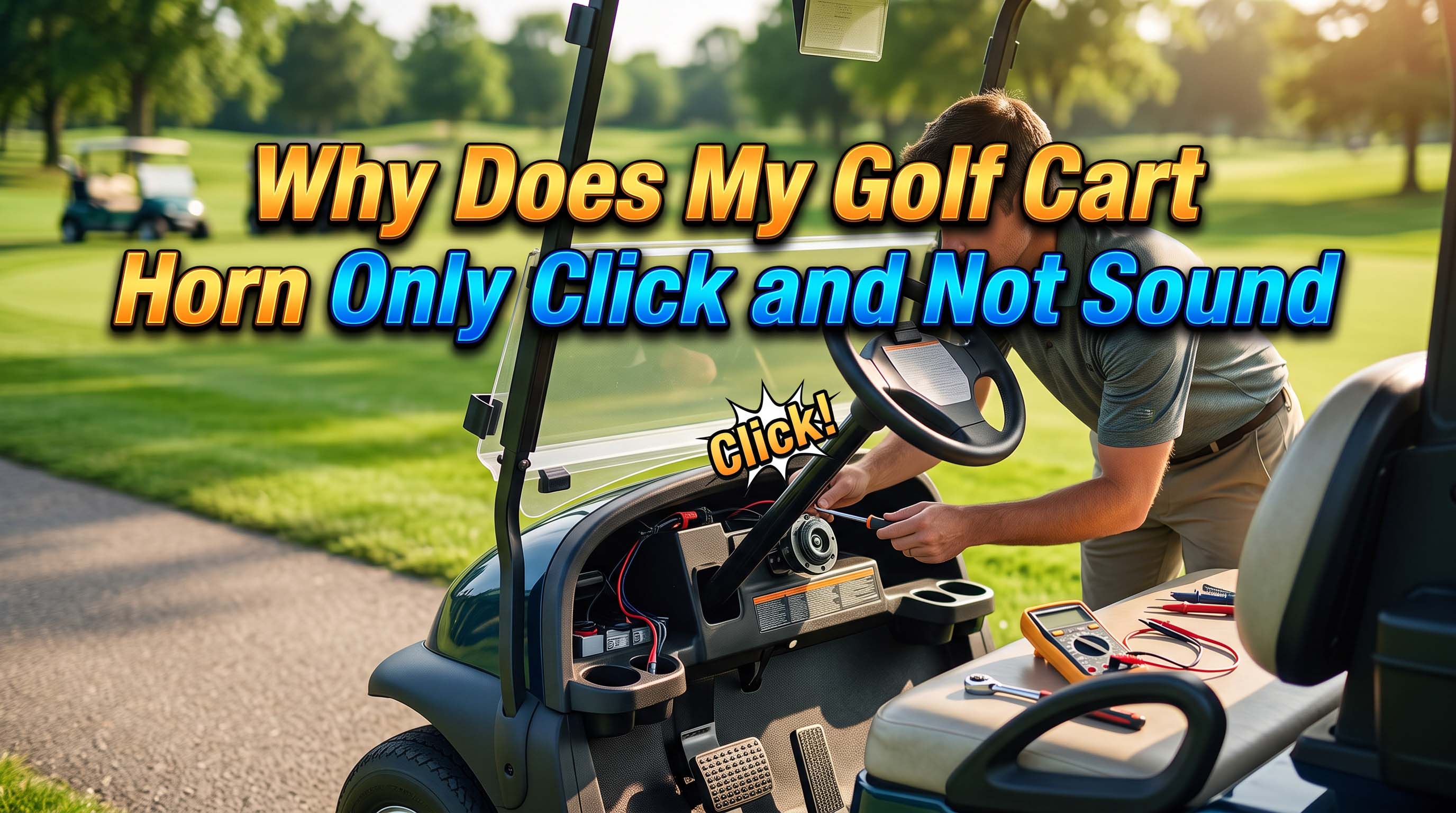
When you press the horn button on your golf cart and hear a faint click instead of a loud honk, you might assume the whole system is broken. That click is actually the best clue you could ask for.
It tells you that power is flowing through part of the circuit and that your problem is isolated to a specific section of the wiring or the horn itself.
This is an electrical issue you can solve at home. You do not need to take the cart to a shop. You do not need to replace parts randomly. You need a basic multimeter, about thirty minutes of time, and a logical approach to testing.
Understanding the Clue Behind the Click
The electrical path for your horn starts at the button on the steering wheel. Power travels down the steering column, through a relay, and finally reaches the horn. When you press the button, the relay closes and makes a metallic clicking noise. That click is the sound of the relay switch physically closing.
Here is what the click tells you: the relay is working. The relay has power coming in and is responding to the button press. If the relay were dead, you would hear nothing at all when pressing the horn.
So if the relay is fine, why is the horn silent? There are only three possible reasons:
- The horn itself is jammed or burned out and cannot move its diaphragm.
- The wiring between the relay and the horn has a break or corrosion.
- The ground wire for the horn is not connected to bare metal on the frame.
One thing to note: a horn relay click sounds different from the solenoid click you hear under the seat when you press the gas pedal. The solenoid makes a heavier thunk.
The relay makes a lighter, quicker click. Knowing which click you hear prevents you from chasing the wrong problem. If the cart moves when you press the pedal, the solenoid is fine, and you are dealing with the horn circuit only.
Simple Checks Before Digging Deeper
Before you break out the multimeter, spend five minutes doing a visual inspection. Many golf cart horn problems come from obvious physical damage that a quick look will reveal.
Check the fuse first. Pull it out of the holder and hold it up to the light. The metal strip inside should be intact. If you see a break or a dark burn mark, that is your problem. Replace the fuse with the correct amperage rating.
Look at the horn terminals. Corrosion on the electrical connections can stop power from reaching the horn even when the relay is working perfectly. If you see green or white crusty buildup, clean the terminals with a wire brush and reconnect them.
Trace the wiring harness from the relay to the horn. Golf carts sit low to the ground, and rodents love to chew on the wiring. Look for frayed wires, bite marks, or any place where the insulation is rubbed through and exposing bare copper.
Also check your battery voltage. A weak 12-volt accessory battery can pull in the relay and make it click, but it might not have enough amperage left to push the horn diaphragm. If the cart has been sitting for weeks, charge the battery fully and test the horn again. Sometimes the fix is that simple.
How to Test the Horn Itself
Now you need to determine whether the horn is the problem or the wiring is the problem. This is the single most useful test you can perform.
Disconnect the horn from the wiring harness. Locate the two terminals on the horn itself. Take a pair of jumper wires and connect one terminal to the positive side of a 12-volt battery. Connect the other terminal to the negative side.
If the horn blasts loudly, the horn mechanism is perfectly fine. The problem lives somewhere in the wiring between the relay and the horn connector.
If the horn clicks or stays silent, the horn itself is defective. The internal diaphragm is seized or the coil inside is burned out. You need a replacement horn. They are relatively inexpensive and mount with one bolt.
Here is a tip that most people miss: the horn has polarity. If you connect the jumper wires backward, a good horn may only click instead of honking. If you get a click in this direct test, reverse the wires and try again before declaring the horn dead.
How to Test the Horn Relay
If the horn works when you feed it directly, move to the relay. The relay is usually located in the dashboard area or under the front cowl. You can hear it click when you press the horn button, so you already know it is receiving power and closing its internal switch.
Standard relay terminals are numbered. Terminals 85 and 86 are the coil that activates the relay. Terminals 30 and 87 are the switch path that carries power to the horn.
Set your multimeter to DC voltage. Place the black lead on the negative battery terminal. Use the red lead to probe terminal 87 while a helper presses the horn button. If you read battery voltage at terminal 87, the relay is sending power out and your problem is downstream in the wiring to the horn.
If you read nothing at terminal 87, probe terminal 30. Terminal 30 is the input side that receives power from the fuse. If you have power at 30 but nothing at 87 when the button is pressed, the relay contacts are burned or worn. Replace the relay.
If you have no power at terminal 30, you have a blown fuse or a broken wire between the fuse box and the relay.
How to Trace the Wiring and Ground Connections
A bad ground causes more clicking horn problems than any other issue. The horn needs a solid return path to the battery negative terminal. If that path is broken through rust or a loose bolt, the horn cannot complete the circuit.
Use your multimeter set to continuity mode. Attach one lead to the negative battery terminal. Attach the other lead to the black wire that connects to the horn. Press the horn button. If you get a continuous beep from the meter, the ground path is good.
If there is no continuity, find where the ground wire bolts to the cart frame. This is usually a spot where a black wire ends in a ring terminal around a bolt. Loosen the bolt, scrape the metal surface clean with sandpaper until it is shiny, and reattach the wire. Paint or rust on that mounting point blocks the electrical connection completely.
Now check for voltage drop. Just seeing 12 volts at the horn connector is not enough. The voltage needs to remain at 12 volts when the circuit is under load. Press the horn button and read the voltage at the horn connector. If the meter shows something like 9 volts or lower, you have corrosion inside the wire or a loose connection somewhere in the path. The relay clicks because it gets enough power to close, but the voltage drops too low to drive the horn.
Club Car, EZGO, and Yamaha Differences
Club Car
Most Club Cars have the horn button in the center of the steering wheel. The relay lives in the dashboard bucket behind the plastic trim. The horn mounts on the frame rail near the front of the cart. Check the wiring where it passes through the steering column access hole in the floorboard. The wire can chafe against the metal edge and short out over time.
EZGO
Newer EZGO models use a clock spring in the steering column just like a car. Older models used a simple coiled wire that wrapped around the column. The horn itself is usually under the front cowl near the passenger side. The ground wire often connects to a bolt on the frame underneath the floor mat, which is a spot that sees a lot of moisture and corrosion.
Yamaha
If your Yamaha has a turn signal module, the horn circuit often runs through it. A failing turn signal module can interrupt the horn signal. On gas models, the horn connector sits close to the engine and can melt from heat exposure. Inspect the connector for discoloration or deformed plastic.
Steering Column and Clock Spring Troubleshooting
If your horn works when the wheels are straight but only clicks or stays silent when you turn the wheel, you have a clock spring problem.
The clock spring is a flat ribbon cable inside the steering column. It maintains electrical continuity between the steering wheel button and the wiring harness while the wheel rotates. The ribbon flexes every time you turn the wheel. Over hundreds of thousands of rotations, the ribbon can crack or break.
Testing is simple. Park with the wheels straight and press the horn. Then turn the wheel to the left and right while pressing the horn repeatedly. If the horn behaves differently based on wheel position, the clock spring is broken.
Replacing a clock spring requires removing the steering wheel. This is a straightforward job on most carts without an airbag. If your cart has a driver airbag, the clock spring is part of the airbag system and you should be extremely careful. Disconnect the battery and wait at least ten minutes before touching the steering column to allow the airbag capacitor to discharge.
Replacing Faulty Parts and Preventing Future Failures
Replacing a golf cart horn takes about ten minutes. Remove the single mounting bolt, disconnect the two wires, and install the new horn in the same position. If the replacement horn uses a different connector, cut the old connector off and splice the wires with butt connectors or solder.
To keep the horn working for years, take a few preventative steps. Apply dielectric grease to the relay socket terminals and the fuse holder contacts. This prevents oxidation and keeps the connections clean.
Ensure every ground wire connects to bare metal. If the previous owner bolted a ground wire to a painted surface, remove it, sand the paint off, and reattach. A ground bolted to painted metal will fail sooner or later.
Use a small amount of waterproof tape around the horn connector if the cart lives outdoors. Moisture is the biggest enemy of the entire horn circuit.
Frequently Asked Questions
Why is my relay clicking but the horn is silent?
The relay clicking means it has power and the switch inside is closing. The problem is either a broken wire between the relay output and the horn, a bad ground connection, or the horn itself is seized. Testing the horn directly with a 12-volt source will tell you which part is at fault.
Does the golf cart need to be in a specific mode to test the horn?
No. The ignition switch should be in the run position to power the accessory circuit, but you do not need to put the cart in tow mode or neutral. The horn is an accessory circuit independent of the drive system.
Can a bad fuse cause the relay to click?
No. A blown fuse removes power from the relay entirely. If you hear a click, the fuse is good and the relay is receiving power. The fuse only protects the input side of the relay circuit.
Why does my horn sound weak before it stops working entirely?
This is a classic voltage drop progression. Corrosion builds up slowly on the connections or the ground bolt. The horn keeps working but gets less and less current. Eventually the resistance gets high enough that the horn stops sounding while the relay can still click closed. Cleaning all connections and ground points will restore full volume.
Tools you need: a multimeter, a pair of jumper wires, a wire brush, sandpaper, and dielectric grease. With these and the steps above, you can isolate the failure and fix your horn in less than an hour. The click you hear is not the end of the road. It is the start of a clear diagnosis.