
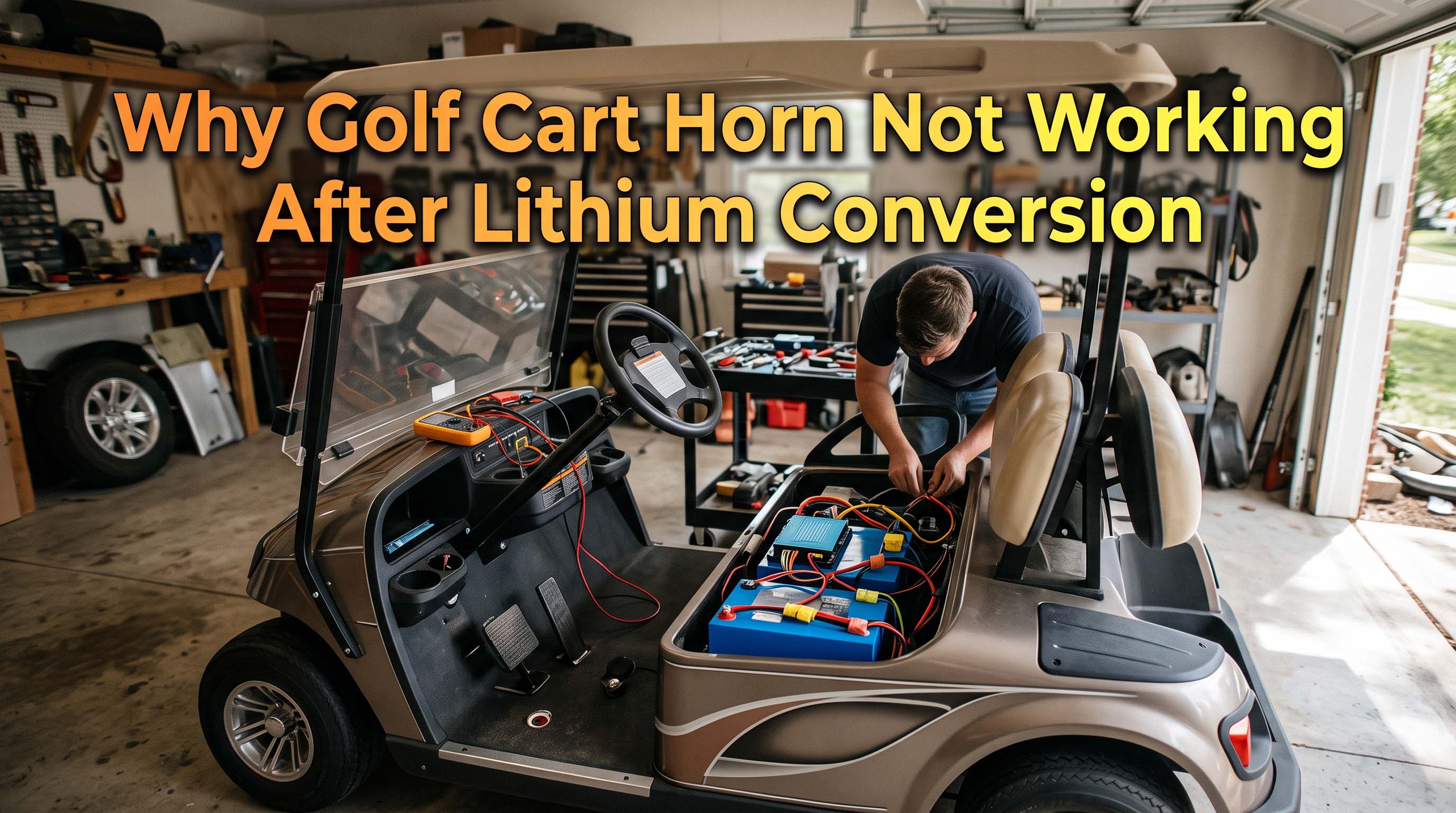
You finish your lithium battery conversion, turn the key, and push the horn button. Nothing. The cart moves fine, the lights come on, but the horn is completely dead. This is one of the most common issues after a lithium swap, and in most cases the horn itself did not break. The conversion changed how the accessory circuit gets power, and the horn is simply the first part of that circuit to show the problem. This guide explains why golf cart horn not working after lithium conversion happens and walks you through exactly how to find and fix the fault.
How Lithium Conversion Changes Your Cart’s Electrical System
Lead-acid golf carts usually have a simple way to power 12-volt accessories. A 48V cart has six 8-volt batteries, and tapping across a few batteries gives you 12V. Some carts even include a small separate 12V battery just for accessories. The negative side of that system is normally bolted to the metal frame, so the frame itself acts as the return wire for the horn, lights, and other parts.
Lithium packs work differently. A 48V lithium battery is one sealed unit with a single positive and a single negative terminal. There is no center tap that gives 12V. The battery management system (BMS) inside the pack protects the cells by controlling what can draw power and when. Many lithium packs also keep the negative terminal isolated from the chassis. That means the old ground path through the frame no longer exists.
To power a 12V horn after a lithium conversion, you need a DC-DC converter. This device takes the pack voltage and steps it down to a steady 12V. If the converter is missing, wired wrong, or never switched on, the horn gets no power at all.
| Feature | Lead-Acid Cart | Lithium Cart |
|---|---|---|
| 12V accessory power | Center tap or separate battery | DC-DC converter required |
| Ground path | Chassis grounded | Negative often isolated |
| Voltage stability | Drops as batteries drain | Steady until BMS cutoff |
| Accessory protection | Only a fuse | BMS can shut off power |
Top Three Reasons the Horn Stops Working After Lithium Conversion
Once you understand the change described above, the causes become obvious. These three problems account for nearly every case of horn failure after a lithium swap.
Missing or Defective DC-DC Converter
Most conversion kits include a voltage reducer, but some do not. If you used to power the horn from a 12V tap in the lead-acid pack and that tap no longer exists, the circuit is simply open. Even when a converter is installed, it can still be the problem. A weak converter might show 12V when nothing is running but drop below 10V the moment the horn tries to draw current.
BMS Low-Voltage Cutoff Disabling the Accessory Output
Lithium BMS units are designed to protect the battery from damage. When the pack voltage drops near the empty threshold, the BMS opens the circuit. On many packs, this cuts power to everything, including accessories. If your horn worked right after charging but stopped after some driving, the BMS likely shut down the accessory path. Some BMS modules also have a dedicated accessory output that can be disabled by a low-voltage cutoff setting, an over-current event, or a sleep command.
Broken Ground Path Because the Pack Negative Is Isolated
The horn needs a complete loop from the positive side through the horn and back to the negative side. On a lead-acid cart, that return path often goes through the bolt holding the battery negative cable to the frame. A lithium pack with an isolated negative cannot complete that loop. If the horn’s ground wire still connects to the frame, and the frame is no longer tied to the battery negative, the horn cannot work.
Troubleshooting the Horn Circuit Step by Step
You do not need to be an electrician to diagnose this. Work through these steps in order and you will find the fault. A digital multimeter helps, but the first two steps need no tools beyond your eyes and hands.
- Look at the horn and its wires. Pull the two wires off the horn and clean the spade terminals. Corroded connectors cause more failures than the horn itself.
- Check the fuse. The horn usually has its own fuse in the fuse block. Pull it and hold it up to the light. A blown fuse has a visibly broken filament or reads open on a multimeter.
- Measure voltage at the horn. Turn the key to run mode and press the horn. Use a multimeter to measure voltage between the positive wire at the horn and the negative wire at the horn. You should see about 12V from the converter.
- Move back to the converter if there is no voltage. Measure between the converter’s positive output and negative output. You need roughly 12V to 14V, and it should stay steady while the horn button is held down.
- Test the ground connection. Set the multimeter to continuity or ohms. Connect one probe to the horn’s negative wire and the other probe to the converter’s negative output terminal. A good connection reads near zero ohms.
- Test the horn itself. Connect the horn directly to a known good 12V source, such as a car battery or a charged 12V battery. If it makes noise, the horn is fine and the problem is in the wiring. If it stays silent, replace the horn.
How to Fix Each Horn Failure Scenario
Fix the Missing or Weak DC-DC Converter
If your cart came without a converter, install one rated for your full accessory load. Add up the amperage of the horn, lights, and every other 12V part, then choose a converter with at least 20% extra capacity. When you install it, wire the positive input to the battery positive through a fuse and the negative input to the battery negative. The 12V output goes to your accessory fuse block. The horn’s positive wire connects there, and the horn’s negative wire must also reach the converter’s negative output.
Fix the BMS Cutoff
Start by checking the BMS app or display if your pack supports one. Look for a low-voltage cutoff setting or an accessory output setting. Some BMS units let you lower the cutoff voltage or disable the cutoff specifically for accessories. If your BMS has a physical accessory output wire that is unused, connect your horn circuit to that output and configure it in the BMS. If your BMS has no accessory output at all, the cleanest fix is to wire the horn through a relay triggered by the key switch. The horn then draws power directly from the DC-DC converter, and the BMS never sees the horn’s load.
Fix the Ground Path
Never rely on the chassis as the return path for a lithium pack. Run a dedicated ground wire from the converter’s negative output to a small bus bar, then connect the horn’s negative wire to that same bus bar. If you still need the frame as a ground for lights or other parts, connect the converter negative to the frame at one clean, rust-free point, and use that same point as the ground reference for every accessory.
Less Obvious Causes of Horn Failure
Voltage Tolerance of the Horn Itself
Most golf cart horns are 12V units, but some aftermarket horns are rated for a narrow voltage range. A DC-DC converter can put out 14.4V or more during normal operation, especially if it is a charging-style unit. That higher voltage can make an electronic horn silent or produce a weak, flat sound. Check the label on the horn. If it says 12V only, install a small voltage stabilizer or wire the horn through a relay so the converter voltage only triggers the relay coil instead of feeding the horn directly.
Inrush Current Tripping the BMS
Electronic horns with a built-in capacitor draw a sharp spike of current the instant you press the button, sometimes several times their normal draw. The BMS can read that spike as a short circuit or over-current event and cut all power. The fix is a simple automotive relay. Use the horn button to energize the relay coil, and let the relay contacts carry power from the converter to the horn. The BMS only sees the small, steady draw of the relay coil.
Keyed Power and the Converter Enable Wire
Many DC-DC converters have an enable or ignition wire. When that wire has no power, the converter produces no output. If you connected the enable wire to the key switch, the horn will only work when the key is in the run position. That is normal behavior. But if you were used to pressing the horn with the key off on the old lead-acid pack, you may simply be testing it the wrong way now. Turn the key on and test again. Some converters also allow you to connect the enable wire to the positive input if you want the accessories to run all the time.
Avoid This Problem on Your Next Lithium Conversion
The best time to solve this is before you disconnect the last lead-acid battery. Take a photo of the old wiring layout and label every wire that feeds the horn, lights, and other accessories. Buy the DC-DC converter before you need it, and size it for anything you might add later. When you run the new wires, keep the positive and negative pairs twisted together. That reduces voltage drop and prevents the ground faults that cause so many problems in converted carts.
Once the lithium battery is in place, test the horn before you secure all the wiring panels. If you find the horn dead at that point, tracing the circuit takes two minutes. If you wait until everything is bolted back together, the same job takes an hour. A quick test also gives you peace of mind that the conversion was done right.
Frequently Asked Questions
Does a lithium battery pack need a separate 12V battery for accessories?
No. A DC-DC converter takes the main pack voltage and creates a steady 12V supply for the horn and other accessories. Some people keep a small lead-acid auxiliary battery for the same purpose, but it needs its own charger, adds weight, and defeats part of the reason for going lithium. A quality converter is the simpler and cleaner option.
Can I wire the horn directly to the main pack if I only have one battery?
You can, but only if the horn is rated for the pack voltage. A 48V horn exists, but most golf cart horns are 12V. Wiring a 12V horn to a 48V battery will destroy it instantly. Even if the horn is rated for the pack voltage, the BMS can cut power when the pack is low, and you lose the stable voltage that a converter provides.
Why does my horn work sometimes but not always?
The most common cause is the BMS low-voltage cutoff. When the pack voltage sits near the cutoff threshold, the BMS opens the circuit and the horn goes dead even though the cart still moves. A loose relay can cause the same symptom, so check the relay and its connectors before blaming the battery.
My horn makes a weak sound after conversion. What is wrong?
Undervoltage is the usual culprit. Measure the output of the DC-DC converter while pressing the horn. If the voltage drops below 11V, the converter is too small or the wiring is too thin. Use thicker wire or a larger converter. A bad ground connection also drops voltage under load, so clean and tighten every ground point in the circuit.
1 thought on “Why Golf Cart Horn Not Working After Lithium Conversion”