
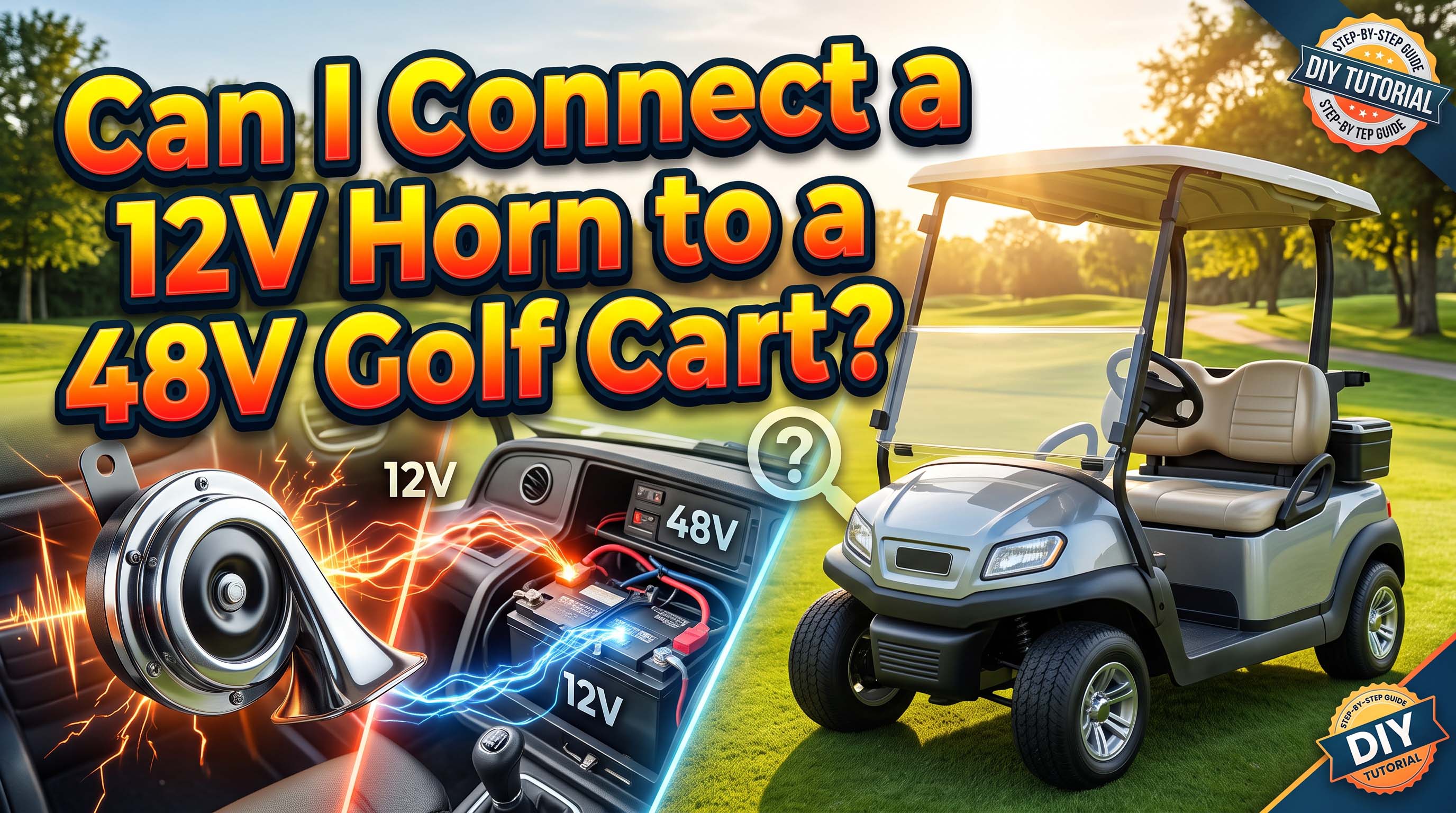
I have wired more horns into golf carts than I can count, and this question comes up every time someone finishes a 48V lithium conversion or picks up a used cart with a dead factory horn. The good news is this is a simple, well-trodden project.
The bad news is there are two ways to do it: one that works for years, and one that cooks the horn on the first honk.
This guide walks you through the whole thing, why a direct hookup fails, the three ways to do it right, exactly which parts to buy, and the step-by-step wiring so you only have to do this once.
A 12V Horn Will Work on a 48V Golf Cart With a Voltage Reducer
So can I connect a 12V horn to a 48V golf cart? Yes, as long as the horn is powered through a 48V-to-12V voltage reducer, sometimes called a DC-DC step-down converter. Wiring the horn directly to the 48V battery pack will destroy it almost instantly.
Keep three things in mind before you start:
- Connecting the horn directly to the 48V battery kills it. A 12V horn is not built to handle four times its rated voltage.
- A DC-DC voltage reducer is the correct bridge. It steps battery voltage down to a steady 12V-class output, which is what all 12V accessories expect.
- A 48V-specific horn is the only converter-free route. Fewer choices, but electrically simple.
If you own a 48V lithium golf cart conversion, a used cart with an upgraded battery pack, or a DIY build, this situation probably sounds familiar. The old workaround of tapping one battery in a series bank is gone with modern packs, and the voltage reducer is the clean replacement.
Why Directly Wiring the Horn to the 48V Battery Fails
People try it anyway, and the result is always the same. A 12V horn is designed for roughly 12 to 14 volts. A “48V” golf cart is not a steady 48 volts. A lead-acid pack sits around 50 to 52 volts when fully charged, and a 48V lithium pack can climb to 54.6 volts or higher. That is close to four times what the horn can handle.
The horn’s electromagnetic coil overheats in seconds. The internal contacts can weld shut. The diaphragm burns out. Sometimes the horn gives one loud, distorted blast before going silent.
I once watched a friend wire his horn straight to the pack “just to test it,” and the puff of smoke was almost instant.
Some people also believe extra voltage makes a horn louder. It does not. You cannot get more volume by overpowering a component; you just cook the coil before it has time to sound properly.
The real question is whether you do it safely, and the safe answer is yes, with a voltage reducer between the battery and the horn.
Three Ways to Power a 12V Horn From a 48V Cart
You have three realistic paths. They are not equal in cost, effort, or reliability, so here is how each one works.
DC-DC Voltage Reducer Is the Reliable Solution
Using a reducer is the route I recommend for almost everyone. The reducer takes the full 48V battery voltage and steps it down to a stable 13.5V DC output that 12V accessories are designed for.
Golf cart owners call it a voltage reducer; marine, RV, and solar builders call it the same thing by a different name: a DC-DC step-down converter.
Factory 12V Accessory Circuit May Be Hidden in Your Cart
Before you buy anything, check whether your cart already turns 48V into 12V. Many modern Club Car, EZGO, and Yamaha carts ship with a factory DC-DC converter that powers headlights and dash components.
If yours has one, you can tap into that existing 12V circuit instead of installing a new converter. The next section shows exactly how to check.
A 48V Horn Removes the Converter From the Equation
If you have not bought a horn yet, a 48V horn is electrically the simplest choice. It connects directly to the cart’s existing 48V horn wiring with no converter at all.
The tradeoffs are real, though: far fewer models to choose from, and the tone may not match the familiar automotive horn sound. You also lock yourself into 48V if you ever reconfigure the cart.
| Option | Parts needed | Difficulty | Best for |
|---|---|---|---|
| DC-DC voltage reducer | Reducer, wiring, fuses | Moderate | Most owners; also powers future accessories |
| Factory 12V circuit | Fused tap | Easy | Carts that already have a 12V converter |
| 48V horn | Horn only | Easy | New builds where the horn has not been bought yet |
Check Your Golf Cart for an Existing 12V Converter First
Most people buy a reducer when they already have 12V power sitting behind the dash. That is wasted money, so check before you spend. Start with the owner’s manual’s electrical section.
Then look under the dashboard and near the battery compartment for a small finned metal box labeled something like “48V in / 12V out.” Finally, check whether the cart already runs 12V headlights, dash lights, or a radio off a separate fuse panel. Any of those is a sign a converter is already on board.
If your cart has one, the job shrinks from a full converter install to a simple fused tap. But capacity matters.
If that converter is already running headlights, taillights, and a stereo, add up the amps before adding a horn. A horn pulls roughly 3 to 8 amps, and that extra load can push a small factory converter past its limit.
Here is the rule I use: if I cannot confirm the existing 12V source’s amp rating, I buy a dedicated reducer for the horn. It costs less than replacing a fried factory converter.
What to Look For in a DC-DC Voltage Reducer for a Horn
Not all reducers are built the same, and the cheap ones earn their price in frustrating ways. These five details matter.
- Input voltage range. Make sure the unit accepts the full voltage swing of your battery. A reducer rated for 40–90V DC input handles lead-acid and lithium 48V packs, including charging spikes and the voltage ripple some motor controllers feed back.
- Output voltage and stability. Look for a nominal 12V to 13.5V output. Cheap converters let the output sag under load, which is exactly why a horn sounds weak even when everything is wired correctly. A stable regulated output is the detail that separates a horn that sounds like a horn from one that sounds like a dying goose.
- Amp rating and horn math. A single 12V horn draws about 3 to 5 amps continuously, with a brief higher surge when you first press the button. A 10A converter handles the horn comfortably. A 25A converter handles the horn plus lights, a radio, and a USB charger later. If the budget allows, buy the bigger one — it is cheaper than buying a second converter when you add accessories.
- Ignition trigger wire. Insist on a converter with a KEY ON or trigger input. This wire connects to the cart’s ignition, so the converter only powers on when the key is in the run position. Without it, the converter draws standby current every hour the cart sits parked.
- Build quality. A finned aluminum housing, a covered wiring harness, and short-circuit protection are signs of a unit that will last. They cost a little more up front and save you from a dead converter in a muddy cart at the hunting lease.
Step-by-Step Guide to Wiring the Horn to a 48V Reducer
Here is the exact sequence I use for a clean, safe install. Most quality reducers use a standard color code: yellow for positive input, black for negative input, orange for the key-on trigger, red for positive output, and black for negative output. Confirm the labels on your unit before you connect anything.
- Disconnect the battery. Remove the main negative terminal from the 48V pack first. This is not optional — 48V can deliver a serious shock and will weld a wrench to a frame in a heartbeat.
- Mount the reducer. Pick a clean, dry, ventilated spot away from motor heat and standing water. The frame rail near the battery tray is the usual location. Point the finned housing out for airflow.
- Wire the reducer input to the battery pack. Connect the yellow positive and black negative input leads to the main 48V terminals. Put an inline fuse on the positive input lead, sized to the converter’s input current. Keep input leads short and protected with wire loom.
- Connect the key-on trigger wire. Run the orange lead to the cart’s ignition switch so it receives switched power in the run position. This is the wire that keeps the converter from draining the battery while parked.
- Wire the reducer output to the horn. Connect the red positive output and black negative output to the horn terminals. Add a dedicated inline fuse — 5 to 10 amps is typical for a single horn — on the positive output lead.
- Ground correctly. Return the horn’s negative wire to the reducer’s negative output instead of bolting it to the frame. Frame grounds on golf carts are unreliable because of painted surfaces, corrosion, and stray currents from the motor controller.
- Secure, test, and verify. Route all wiring away from pinch points and heat. Use heat-shrink connectors, not electrical tape. Reconnect the battery, turn the key on, and press the horn button.
Horn-Specific Wiring Details Most Installers Forget
A reducer install for lights is not the same as a reducer install for a horn. These three details make the difference between a horn that works for years and one that quits after two weeks.
Relay Placement for the Horn
Golf cart horn buttons are small switches, and most are not rated for the current a coil horn draws.
A standard 12V automotive relay solves this: the horn button only triggers the relay coil with a tiny current, and the relay’s heavy contacts feed the horn directly from the reducer output. Your factory button stays happy, and the horn gets clean, full voltage.
Loss of Horn Function May Be Due to the Converter’s Idle Output
Some low-cost converters do not reach full regulated output until they see a minimum load or a moment after power-on.
The first honk comes out weak or delayed, and it feels like a bad install. A quality reducer holds stable output even with no load, so the horn responds instantly.
If you already have a cheap converter and this happens, a small always-on LED indicator on the output is a workaround.
Fusing and Wire Gauge
Fuse both sides of the system. The primary fuse on the 48V input protects the reducer; the secondary fuse on the 12V output protects the horn wiring. Use 14 AWG wire for short horn runs and 12 AWG for long runs up to the front of the cart.
Thin wire acts like a narrow straw; the horn cannot pull enough current through it, and the voltage drop makes the horn sound weak.
Common Mistakes When Connecting 12V Accessories to 48V Carts
These are the five mistakes I see most often when someone is working on a cart in their garage. Learn from other people’s smoke.
- Beating the battery pack. Tapping one 12V battery in a series-wired lead-acid 48V bank was the old hack for powering 12V accessories. It unbalances the pack, shortens the tapped battery’s life, and it is impossible on a modern single-block 48V lithium battery. A dedicated reducer is the correct approach.
- Skipping the key-on trigger. A converter left permanently connected to the battery draws standby current all day. Wire the trigger to the ignition so the whole system is truly off when the cart is off.
- Undersizing the converter. A 5A converter might power a horn on paper, but the surge on every honk pushes it to its limit. The converter heats up, the output sags, and the horn sounds weak. Buy one size up — a 10A or 25A unit gives you headroom and room for accessories.
- Running everything off the horn’s circuit. When you add a radio or lights later, do not daisy-chain them off the horn wire. Run a small 12V accessory bus bar from the reducer so every device has its own fuse.
- Using the frame as a return path. A chassis ground works poorly on a golf cart for the same reason it works poorly on a boat: dissimilar metals, paint, corrosion, and stray currents. Return every 12V negative wire to the converter’s negative output.
Frequently Asked Questions
Can I use a regular 12V car horn on my golf cart?
Yes. Any standard 12V automotive horn runs fine through a voltage reducer on a 48V cart. There is no special golf cart horn required. Compact and motorcycle horns are popular choices for cart installs because they mount in tight spaces.
Do I need a relay to install a golf cart horn?
It depends on the horn button. If the horn’s current draw is below the button’s rating, a relay is optional but still cheap insurance. If you are adding a loud aftermarket air horn or dual horns, a relay is mandatory to protect the switch.
Can I power other 12V accessories from the same reducer as the horn?
Yes, as long as the combined draw stays below roughly 80 percent of the converter’s rated output. A 25A reducer, for example, comfortably runs a horn, LED headlights, and a radio with headroom to spare.
That is why buying a 25A model over a 10A model makes sense if you plan any future 12V additions.
Will a voltage reducer drain my golf cart battery when parked?
Only if it is wired without the key-on trigger. With the trigger connected to the ignition, the converter is completely de-energized when the key is off. Without it, the converter draws standby current, and you will notice the pack losing charge over a couple of weeks.
Why does my horn sound weak even though it is connected to a reducer?
Diagnose in this order. Check that the horn’s connections are clean and tight. Make sure the output wire gauge is not undersized for the run length.
Verify the reducer’s output is not sagging under the horn’s current draw. And check the horn button itself; corroded contacts add resistance and drop voltage.
Is a resistor an acceptable way to drop 48V down to 12V for a horn?
No. A resistor dumps the excess voltage as heat, cannot maintain a stable 12V output as the horn’s current changes, and becomes a fire hazard under sustained use. A DC-DC voltage reducer is the only safe way to convert 48V battery power into clean 12V accessory power.