
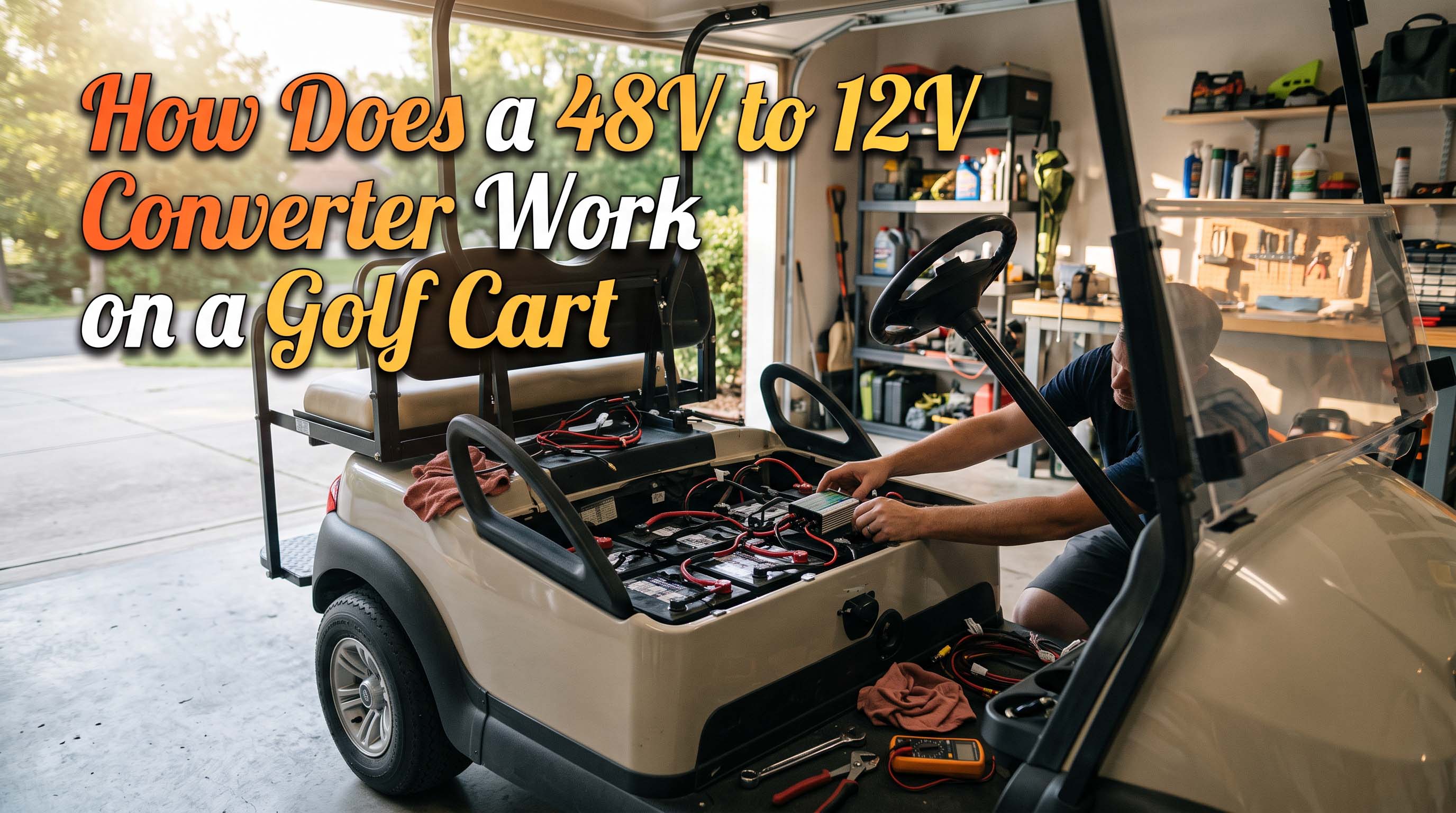
A 48V-to-12V converter works by rapidly switching the incoming 48V battery power on and off at a very high frequency, then passing that pulsed current through components that smooth it into a steady, safe 13.5V output for 12V accessories.
In technical terms, it is a DC-DC buck converter. In practical terms, it is a smart electronic transformer that delivers exactly the voltage your lights, radio, and USB chargers need, without tapping a single battery cell.
If you’ve upgraded your golf cart to a 48V lithium battery, or you’re planning one, this is the component that makes your 12V accessories possible. Here’s a complete look at how it works, how to wire it, and what to expect in real use.
Why a 48V Golf Cart Cannot Power 12V Accessories Directly
Every golf cart accessory you can buy- LED headlights, soundbars, USB chargers, horns, turn signals- is built around a nominal 12V supply. These devices expect to see something between 10.5V and 14.5V. That range covers a car battery at rest and a car alternator while running.
A 48V golf cart battery pack is a different world. A fully charged 48V lithium pack sits between 50.4V and 54.6V, roughly four times the rated input voltage of your 12V accessories.
Connect a 12V light bar directly to that pack, and the result is instant and destructive: fried LED drivers, popped fuses, burned stereo boards, melted wire insulation. Even if an accessory survives the initial connection, its internal power supply will run far outside its design range and fail quickly.
This is why the converter isn’t a nice-to-have. It’s the only safe bridge between a 48V pack and the 12V devices on your cart.
The Step-Down Process Inside a 48V to 12V Converter
So how does a 48V to 12V converter work on a golf cart in detail? The answer involves fast switching, magnetic fields, and a small reservoir of charge.
The Job Is To Drop Voltage Without Wasting Power
The simplest way to drop 48V to 12V would be a resistor. A resistor holds back the excess voltage, and it works fine for tiny loads like a single LED indicator. But it also burns off all the excess energy as heat.
At the kind of current a stereo and a set of headlights draw, a resistor would get hot enough to melt its own wiring and the enclosure around it.
A converter takes the opposite approach. Instead of burning off the excess, it chops the incoming power into pieces and reassembles it at a lower voltage. This is what engineers call stepping down instead of burning down.
Switching the Current On and Off at High Frequency
Inside the converter is a semiconductor switch called a MOSFET. It turns the 48V input on and off anywhere from 50,000 to 200,000 times per second. When the switch is on, energy flows through the converter. When the switch is off, energy flows through a different path inside the circuit.
The ratio of on-time to off-time is called the duty cycle. It’s the lever that sets the output voltage. For a 48V input and a 13.5V output, the switch stays on roughly 28% of the time. If the battery voltage changes, the converter automatically adjusts the duty cycle to hold the output steady.
Think of a faucet opened and closed very quickly. The average flow is much lower than the full pipe pressure, but the water isn’t wasted in the process.
How an Inductor and Capacitor Smooth the Pulsing Energy
The on/off switching produces a choppy, square-wave voltage that no accessory could use directly. Two components clean it up.
An inductor, a coil of wire, stores energy in a magnetic field while the switch is on, then releases that energy into the output while the switch is off.
A capacitor on the output acts as a tiny reservoir, filling in the gaps between pulses. Together, they convert the chopped waveform into a smooth, continuous DC voltage.
That smooth output is what makes this device a converter rather than a crude reducer. It delivers clean power that behaves like the output of a running alternator.
Why the Output Reads 13.5V Instead of 12V
The first time you put a multimeter on a converter’s output, you’ll see 13.5V and wonder if something is wrong. Nothing is wrong.
Golf cart accessories are designed around automotive charging systems, which run at 13.5V to 14.4V while the vehicle is running.
A converter that outputs 13.5V mimics that condition. LED lights run at full brightness. Radio clocks and presets hold their memory. And the output has room to sag slightly under heavy load without dropping below the minimum voltage your accessories can tolerate.
How a 48V to 12V Converter Connects to the Golf Cart Wiring
Once you understand the internal process, the wiring makes sense. A typical converter has five wires, and each one maps to a specific job.
The positive input wire connects to the main positive terminal of your 48V battery pack. The negative input wire connects to the main negative terminal.
These two wires carry full battery power into the converter. On the other side, the positive output wire feeds your 12V accessory fuse block, and the negative output wire connects to the accessory negative bus or your cart’s common ground.
The fifth wire is the one that confuses most people. It’s a thin trigger wire, often orange, labeled KEY ON.
This wire connects to the key-switched ignition circuit of the cart. When the key is on, the trigger wire sends a small signal to the converter telling it to wake up. When the key is off, the converter goes to sleep.
Why does this matter? If you skip the trigger wire and connect the converter directly to battery power, it runs every moment the battery is connected.
That means it draws its idle current around the clock, slowly draining your pack while the cart sits. The trigger wire is the converter’s on/off switch, and it exists to prevent that drain.
Two more wiring details deserve attention.
First, the input negative and output negative are often separate circuits. On many converters, both wires are black, which is why you’ll hear people talk about the two black wires. Don’t assume they’re the same wire, and don’t assume an output negative can ground to the frame. Read the printed label on the side of the converter.
On most quality units, the output negative comes back to the converter’s own output negative terminal, not to the chassis.
Second, fuses belong on both sides. The 48V input side needs a fuse sized to the converter’s maximum input draw to protect the wire in case of a short circuit. The 12V output side needs a fuse sized to the accessory circuit it feeds.
The output fuse protects the wire from the converter to your fuse block, and each accessory run needs its own fuse at the block. Never rely on the cart’s existing 12V wiring to protect the input side.
Wire colors vary by manufacturer, so always verify against the printed label before connecting anything. But the most common convention across the market is: yellow for 48V positive input, black for 48V negative input, orange for the key-on trigger, red for 13.5V positive output, and black for 13.5V negative output.
How To Calculate the Converter Size Your Cart Needs
Converters are rated in amps. You’ll see 15A, 25A, 40A, and 60A models. The right size depends entirely on what you plan to run.
The math is simple. Amps equal watts divided by volts. So add up the wattage of every accessory you want to power, divide by 12, and you have your current draw.
Here’s a realistic table of typical draws for common golf cart accessories:
| Accessory | Typical Current Draw |
|---|---|
| LED headlights (pair) | ~2A |
| Tail lights and turn signals | ~1A |
| Horn | ~1A |
| Stereo or soundbar | 5–10A |
| Dual-port USB fast charger | 4–6A |
| Small fan | 1–2A |
| LED light bar | 3–8A |
| Winch | 20A+ (see below) |
Here’s a typical example. Headlights at 2A, tail lights at 1A, a stereo at 8A, and a USB charger at 5A add up to 16A. A 25A converter handles that load with comfortable headroom. A 15A converter would be running at its limit and likely overheating on a hot day.
Use the 80% rule: never run a converter at more than 80% of its rated continuous output. A 25A unit should carry around 20A of continuous load. That keeps internal temperatures reasonable and extends the converter’s service life.
Watch out for surge loads. A stereo with a subwoofer can spike well above its average draw on bass hits. A winch can pull enormous current at peak. If you plan to run a winch from a converter, you need either a converter rated for that peak current or a separate 12V auxiliary battery dedicated to the winch.
Most golf cart winches are better served by their own 12V battery, charged through a battery isolator.
A bigger converter doesn’t consume more power just because it’s bigger. It only draws what the load demands.
However, a massively oversized converter can be less efficient at very low loads, and it takes up more mounting space. Size for your load plus 25% to 40% headroom, not for bragging rights.
Efficiency, Heat, and Battery Drain in Real Use
Product pages don’t talk about what happens after the converter is installed. Here’s what you actually experience.
Where the “Lost” Power Goes
No converter is 100% efficient. Quality units run between 85% and 95%. The difference between input power and output power becomes heat.
At 20A of output, a 90% efficient converter is dissipating roughly 25 to 30 watts of heat. That’s enough to make the case uncomfortably hot to touch on a warm day. It’s also why the converter body is a finned aluminum heatsink and not a sealed plastic box.
Mounting Location and Airflow
Mount the converter where air can move across the fins. Orient the fins vertically so heat can rise and draw cooler air from below. Don’t bolt it inside a sealed plastic battery box; it will go into thermal shutdown on a hot summer afternoon.
Keep it away from the motor controller and other high-heat areas of the cart. If your cart lives outdoors in a wet climate, mount it where rain can’t hit it directly. Most converters don’t carry a waterproof rating, so a protected location under the seat or behind the dash is ideal.
The Idle Drain Problem
Every converter draws a small amount of current just to stay alive. This quiescent draw is typically 10 to 50 milliamps. That number sounds tiny, but a converter left powered permanently will slowly drain a battery pack over weeks of storage.
This is the practical reason the trigger wire exists. When it’s connected to the key-on circuit, the converter sleeps when the cart is off. When it’s not connected, the converter never sleeps, and your pack pays the price.
Lithium batteries make this worse in a subtle way. A lead-acid pack gradually loses voltage as it drains, giving you warning that something is wrong.
A lithium pack holds its voltage almost flat until it suddenly drops off a cliff. By the time you notice the drain, the battery may already be too low to start the cart.
What Quality Isolation Looks Like
Cheap converters cut corners on regulation and isolation. The symptoms are easy to recognize: audible whine in the stereo that changes pitch with motor speed, LED lights that flicker when the cart is under load, or USB devices that drop connection intermittently.
A quality converter holds its output voltage steady from no-load to its rated maximum. That steady regulation is the entire difference between a real DC-DC converter and a passive voltage reducer.
If you’re troubleshooting electrical noise or flicker in your accessories, the converter is the first place to look.
Common Installation Mistakes and Misconceptions
There is a lot of bad advice floating around golf cart forums and social media groups. Here are the mistakes that come up the most.
Tapping one battery in the pack for 12V. This worked on old multi-battery lead-acid packs, sort of, but it caused that one battery to discharge deeper than the rest, which killed the whole pack over time.
With a single-block 48V lithium battery, there is no accessible 12V tap at all. On any battery, it’s a fire risk and a warranty killer. The converter exists to replace this practice.
Connecting the trigger wire to battery power to test the converter. This bypasses the entire purpose of the trigger. The converter stays awake permanently and bleeds the pack. Connect the trigger to the key-switched circuit, not to full battery power.
Grounding the output negative to the frame. Golf carts often have a floating negative system, meaning neither battery terminal is tied to the chassis.
If the converter’s output negative is a separate circuit from its input negative, grounding it to the frame creates an unintended current path that can cause corrosion, noise, or worse. Read the label on the converter and follow its wiring diagram.
Believing a bigger converter is always better. Oversizing pushes the converter into an inefficient operating range if your accessory load is small, and it adds unnecessary mounting space. Size for your actual load with 25% to 40% headroom. That’s it.
Skipping the input fuse. In a short circuit on the 48V side, there is nothing to stop hundreds of amps of current from melting the wiring before the output fuse ever sees a problem. The input fuse is not optional.
Assuming the cart’s built-in 12V output can handle everything. Many modern carts have a small 12V feed for a few LED lights or a horn, typically rated at 1 to 2 amps. That is not a substitute for a converter. Loading a stereo and light bar onto that circuit will fry the cart’s controller output.
Frequently Asked Questions
Can I use a 48V to 12V converter on a 36V golf cart?
It depends on the input range of the specific unit. Many converters accept a wide input range, such as 40V to 90V. A 36V pack at full charge sits around 40V, which falls below that floor. Check the label.
A unit rated for 24V to 60V input will work on both 36V and 48V packs. Never assume a converter with a fixed 40V minimum will not work on a 36V battery.
How much battery range do I lose by running a converter?
It depends entirely on your accessory load. A stereo drawing 10A for one hour consumes 10 amp-hours from the 48V pack. On a typical 100Ah pack, that’s around 10% of usable range.
The converter’s own efficiency losses add a few extra watts of heat, not meaningful range loss. Lights and stereos draw a fraction of what the drive motor draws.
Do I need a separate fuse block for the 12V side?
Yes. The converter’s output fuse protects the wire from the converter to the fuse block. Each accessory run needs its own fuse at the block, sized to the wire gauge and load of that run. This way, one faulted accessory doesn’t kill power to everything else on the cart.
What happens if my accessories draw more amps than the converter is rated for?
The converter overheats, the output voltage sags, and eventually it shuts down thermally or trips its protective fuse or circuit breaker. Some cheap units simply fail. Always circuit-protect based on the converter’s rating, not the load’s rating.
Can I install a 48V to 12V converter myself?
A qualified DIYer can, provided they understand the wiring diagram, use proper inline fuses, and torque all battery connections correctly.
The main hazards are shorting the 48V pack, which can deliver hundreds of amps in a fault, and misconnecting the trigger wire. If you’re not fully confident in automotive electrical work, professional installation is the safe choice.