
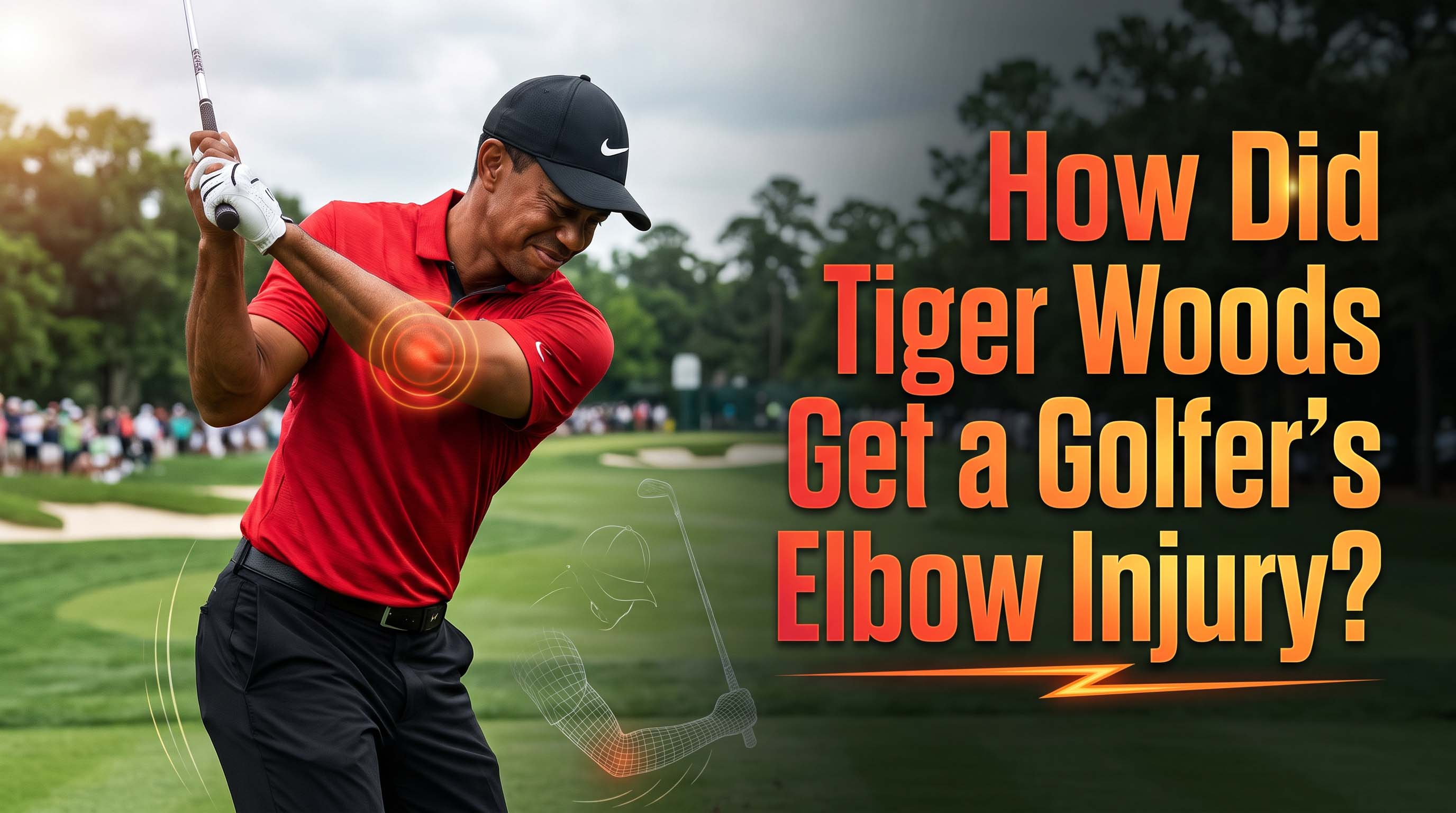
Tiger Woods developed golfer’s elbow in his left arm through years of repetitive strain, not from a single bad swing. The condition involved the flexor tendons in his left forearm, which attach at the inner side of the elbow. His powerful swing, heavy practice schedule, and the ripple effects of earlier knee and Achilles injuries all pushed those tendons past their limit.
By the time the pain forced him out of competition, the damage had been building for a long time.
When Did Tiger Woods Develop Golfer’s Elbow
The injury became publicly known in May at the Players Championship. Woods was clearly in discomfort during the event, and his form suffered. The strain reappeared at the US Open in June.
It became serious enough that he withdrew from the AT&T National later that month. The injury raised questions about his readiness for the Open Championship in July.
What Golfer’s Elbow Actually Is
Golfer’s elbow is an overuse injury that affects the tendons on the inner side of the elbow.
These tendons attach the forearm flexor muscles to a bony bump called the medial epicondyle. When the flexor muscles are overworked, the attachment point develops small tears.
The body responds with inflammation and pain. The medical name, medial epicondylitis, points directly to this location. Tennis elbow damages the opposite side of the joint, the outer bump, and comes from a different set of muscles.
How the Golf Swing Creates Elbow Strain
The lead arm does the heavy lifting in a golf swing. For a right-handed player, that is the left arm. During the downswing, the wrist is cocked and then unloads rapidly into the ball.
The flexor muscles on the underside of the forearm fight to control this motion while the club’s momentum pulls the wrist into extension. That stretch against an active muscle is called eccentric loading. It is the most stressful type of contraction for tendons. Every full swing repeats it.
A golfer who hits hundreds of balls a day puts the inner elbow through thousands of these loading cycles.
The trailing arm, the right arm for a right-handed player, does not absorb this same stress because it leads the backswing and follows through ahead of the body. This is why golfer’s elbow almost always appears in the lead arm.
Factors in Tiger Woods’ Swing That Contributed
Woods had one of the most aggressive swings of his era. His club head speed was elite, and he held his wrist angles deep into the downswing, releasing late and violently.
This technique keeps the flexor tendons under tension for longer than a smoother, earlier release would. It produces power, but it also raises the load on the inner elbow with every shot. Between 2012 and 2013, Woods played a demanding tournament schedule.
He also practiced heavily between rounds, often hitting large buckets of balls. The combination of high swing speed, a late release, and high practice volume stacked stress on the left arm week after week.
The Compensatory Chain from Prior Injuries
Woods’ left elbow did not fail in isolation. His left knee had been through multiple surgeries, and his left Achilles tendon had also caused problems.
Those injuries changed how he moved. With less stability in his left leg, he planted harder on that side and altered the rotation of his hips. His torso tilted differently. His upper body had to make adjustments to square the club face.
The left arm was forced into a more rigid position through impact to protect the weaker lower body. This put the elbow under tension it was never designed to handle. Over the years, the flexor tendons accumulated micro-damage.
The elbow became the weak link at the end of a long chain of compensation that started in his leg.
The Specific Trigger Point in 2013
Nothing about Woods’ schedule in early that year signaled trouble. He played the Masters in April and continued into the spring without a break. He was also managing a fresh problem in his left knee during this stretch.
The extra strain from that issue, on top of his normal workload, pushed the elbow from nagging discomfort into acute pain in May. It was not one shot or one swing. It was the final push on a structure that had been weakening for years.
How Tiger Woods Managed the Injury
After stepping away from the tour, Woods relied on anti-inflammatory medication and regular treatment to calm the inflamed tendons.
He avoided full practice swings for a period, then slowly returned. About a week before the Open Championship, he started chipping and putting again. He practiced daily, but carefully.
The main worry at Muirfield was the deep rough. Hitting from thick grass forces the wrists to work harder, which pulls directly on the injured tendons. Woods returned to competition at the Open and managed the injury throughout the tournament with ongoing care.
Frequently Asked Questions
Did Tiger Woods have to change his swing because of golfer’s elbow?
After the injury, Woods made adjustments with his coaches. Under Sean Foley and later Chris Como, he shortened his backswing and began relying more on hip and torso rotation. This reduced the load on his arms and wrists and helped protect the elbow from repeat damage.
Is golfer’s elbow common among professional golfers?
Yes. Elbow overuse injuries are one of the most frequent problems on tour. Golfer’s elbow is more common than tennis elbow among golfers because the lead arm is loaded eccentrically during every full swing. Players who practice for hours each day face the highest risk.
How long did Tiger Woods take off after the injury?
He withdrew from the AT&T National in late June and returned for the Open Championship in mid-July. That gave him about a month away from competition. He did not stop all activity, but he limited full swings until the pain settled.
Could Tiger Woods have prevented this injury?
Prevention would have required changes before the pain started. Strengthening the forearm flexors, warming up properly, using lighter shafts or a lower swing weight, and reducing practice volume all help.
In Woods’ case, the earlier knee and Achilles problems made full prevention difficult. His body was already compensating, and those movement patterns kept adding stress to the elbow no matter what he did in practice.