
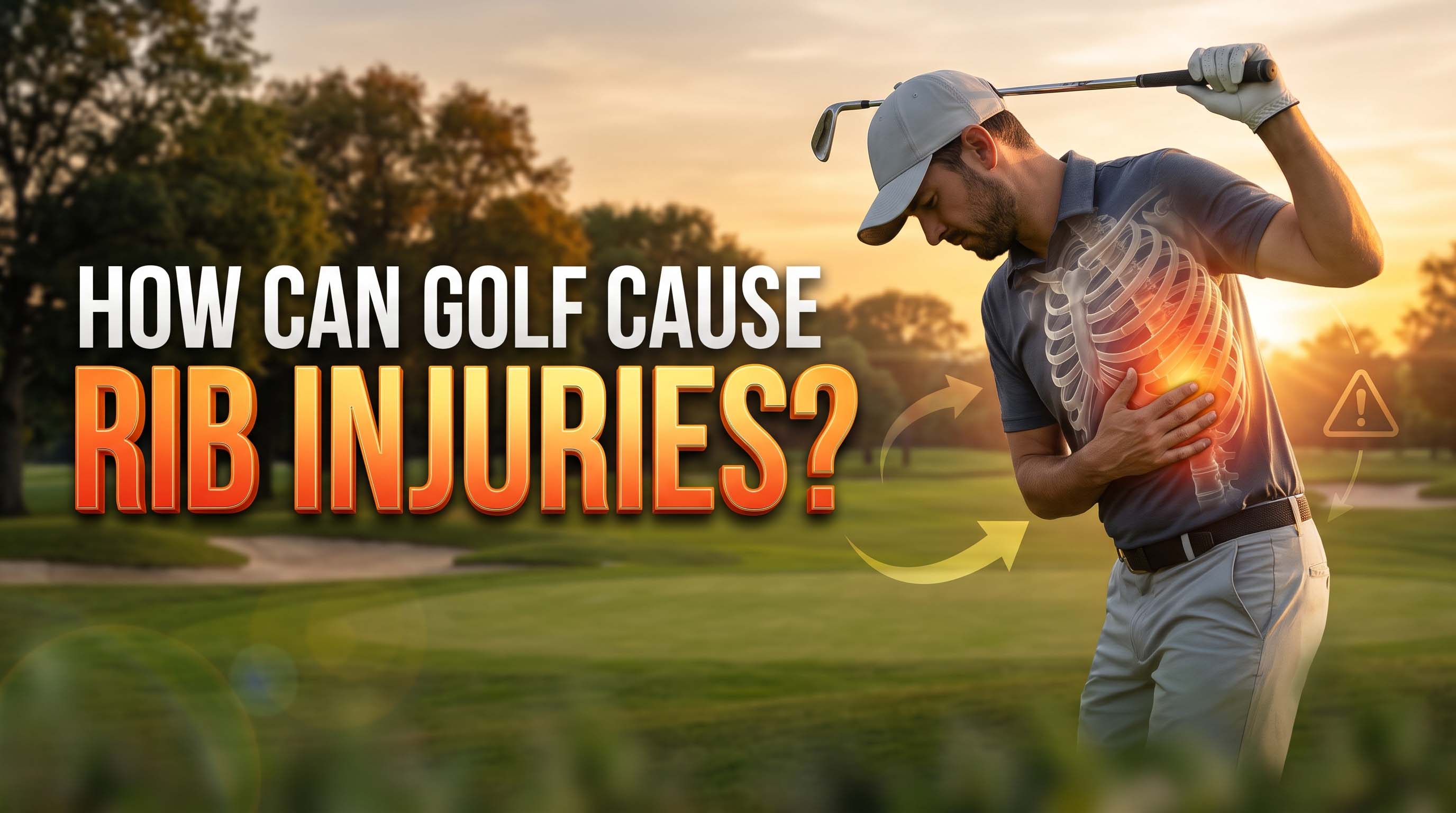
I have seen plenty of golfers who felt something pop or ache in their side during a round and had no idea why it happened to their ribs. The short answer is that the golf swing creates rotational torque, repetitive eccentric loading of the intercostal muscles, and sudden deceleration forces that can overload the rib cage. Let me walk you through the exact mechanism, the types of injuries you might face, and how to tell them apart.
The Golf Swing: A Mechanical Explanation for Rib Stress
Golf causes rib injuries through a combination of rotational torque, repetitive eccentric loading of the intercostal muscles, and sudden deceleration forces during the swing. The ribs are not designed to handle the twisting and compression that a full swing delivers hundreds of times per session.
What happens inside your rib cage during each phase
Your rib cage connects to your spine at the costovertebral joints, and each rib is linked to the next by intercostal muscles. The serratus anterior muscle attaches to the ribs and controls scapular movement. When you swing, these structures get stretched, compressed, and suddenly released.
- Takeaway: The trail side intercostals stretch as your torso rotates away from the target.
- Top of backswing: The lead side ribs compress while the trail side ribs reach maximum stretch.
- Downswing initiation: The oblique muscles contract rapidly, pulling directly on rib attachments.
- Impact: Ground reaction force transmits through your arms and into the rib cage — especially bad on a fat shot or off a mat.
- Follow-through: The lead side ribs experience sudden deceleration stress as your body stops rotating.
Most rib injuries in golf happen on the lead side (left side for right-handed golfers) because that side undergoes the most tension during the backswing and compression during the follow-through. The trail side can also get injured, but it is less common.
Acute versus chronic injury
An acute rib injury comes from one violent event — hitting a tree root, a fat shot that jars the club, or a clumsy fall. A chronic injury builds up from repetitive microtrauma over weeks or months. Amateurs often fall into the chronic category because they keep swinging with poor mechanics that load the ribs unevenly.
Types of Rib Injuries Common in Golf
Not all rib pain is the same. Here is a quick comparison so you can figure out what you might be dealing with, and it’s very common injured
| Injury Type | Key Symptom | Location | Feels Like |
|---|---|---|---|
| Intercostal muscle strain | Sharp pain with deep breath or twisting | Side of rib cage, between ribs | Tightness that improves with rest |
| Rib stress fracture | Persistent ache at one spot, worsens with rotation | Posterior angle near spine | Deep bone pain that does not go away |
| Costochondritis | Tenderness at rib-to-sternum junction | Front of chest, near breastbone | Mimics heart pain, hurts with pressing |
| Rib contusion | Bruising visible, pain on touch | Anywhere on rib cage | Bruised feeling after impact |
| Costovertebral joint sprain | Pain near spine when rotating | Back, along the spine | Sharp catch with twisting |
Red flag: If you cannot take a deep breath, have any deformity, feel radiating pain down your arm, or run a fever, get to a doctor immediately.
How to Know If You Have a Rib Stress Fracture vs. Muscle Strain
This is the question I hear most often from golfers who felt a pop on the course. The difference matters because a stress fracture requires total rest from golf for weeks, while a muscle strain can heal with active recovery.
- Stress fracture: Localized point tenderness that you can press with one finger. Pain with deep breathing. Pain persists even when you sit still. X-rays often look normal for the first two weeks — an MRI is the only way to confirm it early.
- Muscle strain: Diffuse soreness over a larger area. Worse with specific movements but feels better when you stop. Often a sensation of tightness or a pulled feeling rather than a sharp pinpoint pain.
If you have any doubt, see a sports medicine doctor. Returning too soon with a stress fracture can lead to a complete rib fracture that takes months to heal.
Why Some Golfers Are More at Risk Than Others
Your swing mechanics, body limitations, and equipment choices directly affect your rib injury risk. Here is a self-audit checklist. Check the boxes that apply to you.
- Do you hit more than 100 balls per session?
- Do you have limited hip rotation (cannot rotate past 45 degrees from a seated position)?
- Do you frequently hit fat shots or practice off hard mats?
- Do you have a history of rib or chest wall pain?
- Do you skip warm-up or start hitting full swings cold?
If you checked three or more, you are in the high-risk group.
Swing mechanics that overload the ribs
Overswinging — especially when you flex your rib cage forward at the top — increases stress on the posterior ribs. Casting, which is releasing your wrist angle too early in the downswing, shifts torque from your hips to your torso and ribs. Poor pelvis rotation forces your thoracic spine to twist more than it should, and your ribs take the extra load.
Physical limitations
Poor thoracic spine mobility means your rib cage cannot rotate freely, so the ribs bend under stress instead of moving with the spine. Weak oblique muscles cannot absorb the rotational force. Limited hip rotation shifts the twist upward. Poor core endurance makes you compensate with your ribs late in a round.
Equipment factors
Clubs that are too short or too heavy force you into a hunched posture that compresses the rib cage. A shaft that is too stiff transmits more shock through the handle and into your arms and chest. Playing on hard ground or mats increases the impact vibration that reaches your ribs.
Immediate Treatment and Recovery Timeline
If you suspect a rib injury, stop golf immediately. Continuing to swing will make it worse.
Phase 1: Acute (first few days)
- Relative rest — avoid any twisting or heavy lifting.
- Ice the painful area for 15 minutes every few hours.
- Gentle stretching of the intercostals (side bends, no rotation).
- Take anti-inflammatories only if cleared by your doctor.
Phase 2: Recovery (next one to four weeks)
- Guided breathing exercises to maintain rib cage mobility without strain.
- Thoracic mobility drills — foam rolling, open book stretch.
- Gradual return to rotational movements, but only if pain-free.
Phase 3: Return to golf (varies by injury)
- Intercostal muscle strain: 2 to 4 weeks.
- Rib stress fracture: 6 to 12 weeks — no golf at all during this time.
- Costochondritis: 4 to 6 weeks.
Start with half swings and soft turf. Work with a professional to smooth out your mechanics before going back to full power.
Preventing Rib Injuries Through Swing and Body Work
Prevention is not about avoiding the sport. It is about building a body and a swing that can handle the forces involved.
Dynamic warm-up
Before you hit a single ball, do rotation drills. T-spine rotations, cat-cow stretches, and side bends wake up the rib cage. Practice slow swings at half speed to let your intercostals adapt.
Core strengthening with anti-rotation exercises
Standard crunches do not help. You need exercises that resist rotation, because that is what the ribs experience. Pallof presses, cable chops, and bird-dog holds build stability that keeps your rib cage from twisting too far.
Thoracic mobility
Your spine should rotate, not your ribs. Foam rolling your upper back, doing open book stretches, and practicing deep breathing in a rotated position all help.
Swing modifications
Shorten your backswing — if you already have limited hip rotation, a longer backswing only adds torque to your ribs. Widen your stance to allow more hip rotation. Smooth out your tempo so you are not jerking into the downswing. A professional can help you find the right adjustments.
Equipment check
Get fitted for club length and lie angle. Consider softer core golf balls if you practice off mats. Replace worn grips so you are not squeezing harder to hold the club.
Common Myths About Golf and Rib Injuries
Myth: Rib injuries only happen to professionals.
Reality: Amateurs get more stress fractures because their mechanics put uneven load on the ribs. Pros have trained bodies and efficient swings. You are more vulnerable if you hit too many balls with poor form.
Myth: You cannot do much to prevent rib injuries.
Reality: Proper swing mechanics, mobility work, and a good warm-up drastically reduce your risk. It is one of the most preventable golf injuries.
Myth: A week of rest fixes everything.
Reality: Intercostal strains need active recovery — gentle stretching and breathing exercises — not just passive rest. A stress fracture needs many weeks of total rest from golf, not a few days.
Frequently Asked Questions
Can I golf with bruised ribs?
Not safely. A bruised rib can turn into a fracture if you keep playing. Wait until you are pain-free with rotation and can take a deep breath without discomfort. That usually takes at least two weeks.
What does intercostal muscle strain feel like?
A sharp pain on the side of your rib cage that gets worse when you breathe in deep, twist your torso, or press between the ribs. It often happens on the lead side during the backswing. You might hear or feel a pop at the moment it tears.
How long do golf-related rib injuries take to heal?
Muscle strains heal in two to four weeks. Stress fractures take six to twelve weeks. Costochondritis takes four to six weeks. The biggest risk is returning too soon — that can turn a strain into a chronic problem or a stress fracture into a complete break.
What exercises should I avoid with a rib injury?
Avoid any rotational loading: medicine ball twists, Russian twists, cable rotations. Avoid heavy overhead pressing and bench press, because they compress the rib cage. And obviously, no golf swings until you are cleared.
Could my rib pain be something else?
Yes. Costochondritis mimics heart pain. Slipped rib syndrome causes a catching sensation. Nerve entrapment from the thoracic spine can refer pain to the ribs. If your pain comes with shortness of breath, radiates down your left arm, or is triggered by exertion, see a doctor to rule out cardiac issues.