
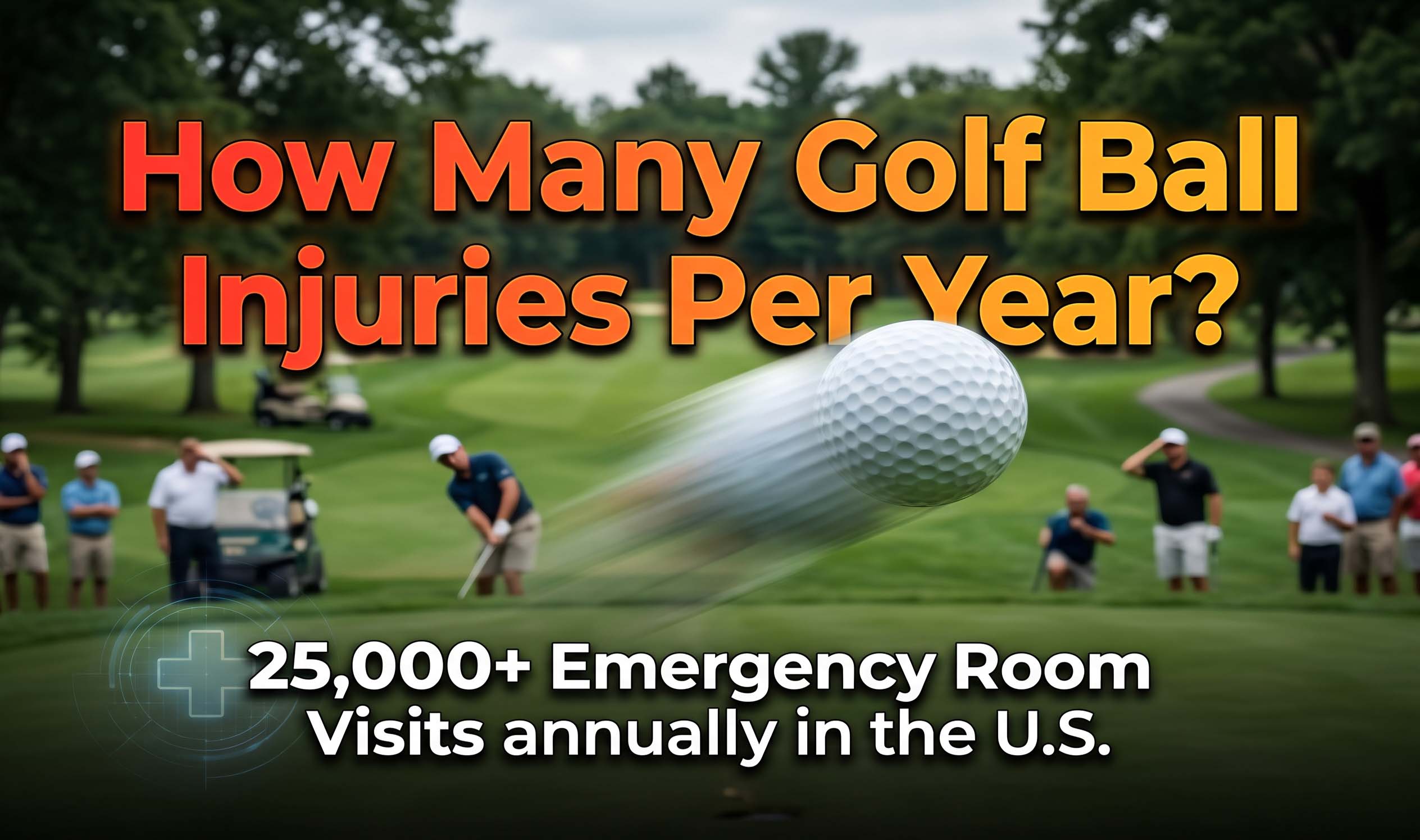
If you have ever flinched after a wayward tee shot, you have probably wondered just how common golf ball injuries really are. Looking for the exact answer to how many golf ball injuries per year there are in the United States, the number is roughly 25,000 to 30,000 emergency room visits specifically from being struck by a golf ball.
You have likely seen the number 40,000 thrown around a lot. That specific figure comes from a widely cited Golf Digest study, but it actually lumps together injuries from both golf balls and flying club heads.
When you isolate ball impacts alone, the annual emergency room count drops closer to the range backed by the U.S. Consumer Product Safety Commission.
Where the Numbers Come From
Most of the data on golf injuries comes from two main sources. The table below breaks down what each study covers so you can see exactly where the confusion comes from.
| Source | Scope | Annual Estimate | Notes |
|---|---|---|---|
| Golf Digest (2009 Study) | Golf balls + Flying club heads | 40,000 ER visits | This is the most cited figure, but it mixes two different injury types into one number. |
| CPSC (NEISS Data) | Golf ball impacts only | 25,000 to 30,000 ER visits | This is more specific to ball-related injuries and often used in injury reports. |
Remember that these numbers capture only emergency department visits. A lot of people catch a stray ball on the arm or leg and just ice it at home. As a result, the true number of people hit by a golf ball every year is almost certainly higher than hospital records show.
How Bad Are They? The Real Severity
A golf ball weighs about 46 grams and can come off the clubface at over 150 miles per hour. When that energy hits a person, it can do a lot more than leave a bruise. The most common areas hit are the head and face, which carry a high risk for concussion or fractures.
Eye Injuries Are a Big Concern
Eye injuries from golf balls are one of the most serious subcategories. The American Academy of Ophthalmology estimates that roughly 2,500 to 3,000 golf ball-related eye injuries happen in the U.S. every year. These can lead to permanent vision loss.
Fatalities Are Rare But Documented
Deaths from being hit by a golf ball are very rare, but they do happen. Global estimates put the number at around 2 to 5 deaths per year. These tragic events usually involve a skull fracture or a ball striking a vulnerable area like the temple.
For perspective, lightning strikes on golf courses killed 9 people in the U.S. over ten years.
There is a common myth that getting hit by a golf ball always results in a minor bruise. Medical journals have documented cases of traumatic brain injuries, orbital fractures, and internal organ damage. The severity of this type of injury is often underestimated by casual players.
Your Real Risk Per Round
A raw number like 30,000 sounds big, but it lacks context. To understand your actual risk, you need the denominator: how many rounds of golf are played each year.
In the United States, golfers play roughly 500 million rounds annually. If you divide the 30,000 ball-related ER visits by 500 million rounds, you get a rate of 0.00006 per round.
This translates to roughly a 1 in 16,667 chance of a ball-related emergency room visit every time you play 18 holes. That is an extremely low probability, but it is not zero. It highlights exactly why basic safety habits on the course matter.
Who Is Most at Risk?
When people picture a golf ball injury, they usually imagine a spectator getting hit in the stands. The data actually tells a very different story.
- The Golfer Themselves: The majority of injuries happen to the golfer who was hit by their own ball. This usually happens after a bad shot, a shank, or a ricochet off a tree or cart path.
- Children: Kids account for about 20% of golf ball ER visits. They are often bystanders on a course or in a yard who are not paying full attention to the game.
- Spectators and Course Workers: This group makes up the remainder of the injuries. Staying behind ropes and designated safe zones is the best protection for them.
How to Avoid an Injury
None of this means you should stop playing. It just means you should take the same simple precautions that experienced golfers already follow.
- Yell “Fore” Immediately. Do not hesitate. The split second someone looks back at the sound of a shout can be the difference between a close call and a hospital visit.
- Watch Your Own Ball. Do not take your eye off your shot until it stops. If you are not sure where it went, assume it might come back at you.
- Keep Your Head Up. If you hit a bad shot, do not look down in frustration. Watch where the ball is heading so you can react if it hits a tree and ricochets.
- Protect the Kids. If children are on the course, make sure they know to stay behind the ropes and keep their eyes on the ball. Some players choose to wear eye protection for driving range sessions or crowded courses.
Frequently Asked Questions
How many golf ball deaths per year?
Global estimates suggest roughly 2 to 5 deaths per year directly caused by being struck by a golf ball. Most of these fatalities result from severe head trauma.
Are kids more likely to be hit by a golf ball?
Yes, children account for roughly 20% of golf ball-related emergency room visits. They are often bystanders at courses or in backyards who may not be watching the flight of the ball.
How many golf ball injuries involve the eye each year?
The American Academy of Ophthalmology estimates that roughly 2,500 to 3,000 golf ball-related eye injuries occur in the U.S. every year. These injuries are serious and can lead to permanent vision loss.
Do golf ball injuries happen more on driving ranges or the course?
On-course injuries are far more common than those on a driving range. The open space on a course compared to the netting found at most driving ranges contributes to this higher rate.
What is the 60/40 rule in golf?
This is a common source of confusion. The 60/40 rule is not a safety rule at all. It is a strategic shot selection concept discussed in golf strategy guides and has nothing to do with avoiding getting hit by a ball.