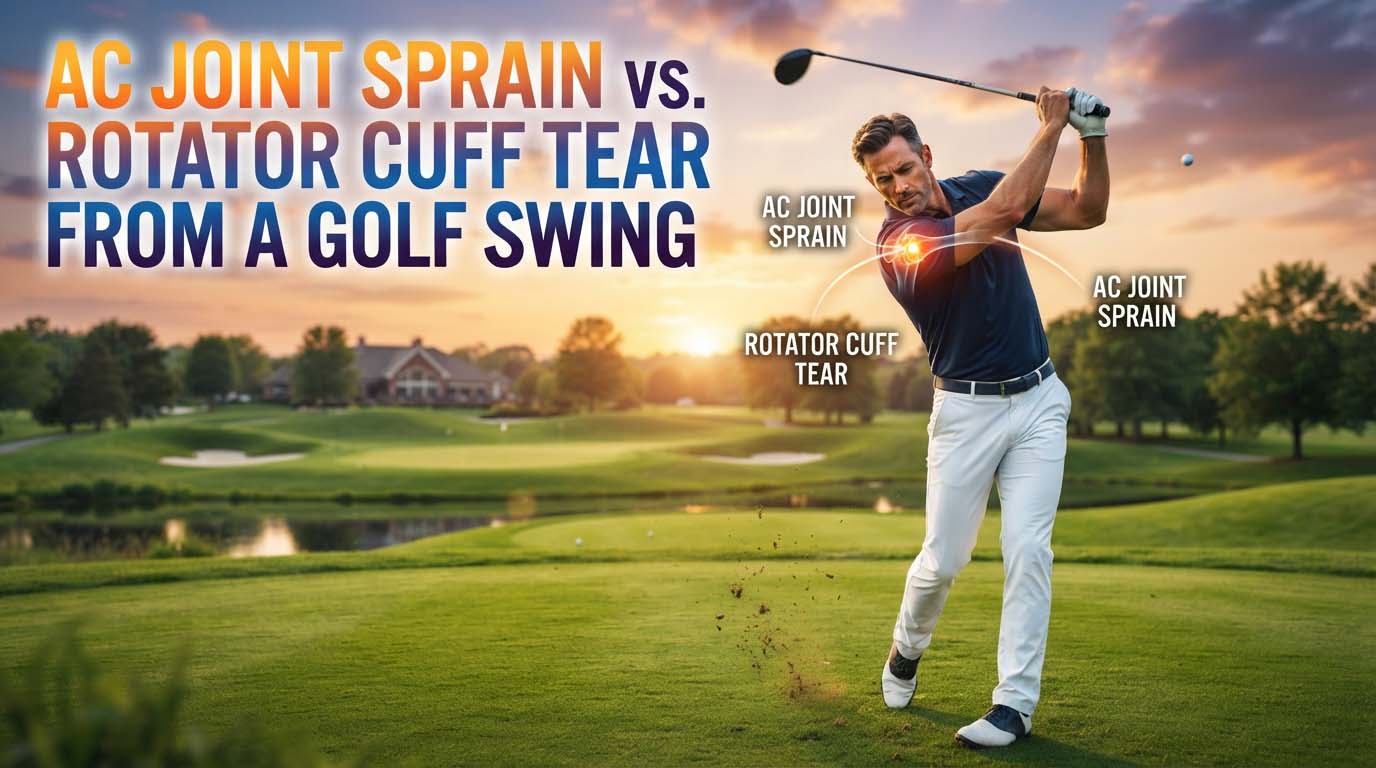
If you are a golfer dealing with shoulder pain, the first question is always the same: what exactly did I do? It usually comes down to two very different possibilities. An AC joint sprain involves the ligament connecting your collarbone to your shoulder blade at the top of your shoulder.
A rotator cuff tear involves the set of four tendons that stabilize the ball-and-socket joint deep inside.
Looking for Discounts on What is the Difference Between an AC Joint Sprain and a Rotator Cuff Tear from a Golf Swing?
Check out the latest price drops, clearance offers, and top-rated deals currently live on Amazon.
Check Live Discounted Prices on Amazon →These two injuries feel completely different, happen in different phases of your swing, and require totally different recovery plans. Here is how to tell them apart based on your golf swing.
The Main Difference Between an AC Joint Sprain and a Rotator Cuff Tear
The AC joint acts as a shock absorber for the shoulder complex. It is susceptible to compression forces and direct trauma. The rotator cuff acts as a force transducer. It is susceptible to eccentric overload and impingement.
When it comes to golf, one is often an acute event, like hitting the ground or slipping. The other is usually an overuse injury tied to the mechanics of your swing.
| Comparison | AC Joint Sprain | Rotator Cuff Tear |
|---|---|---|
| Pain Location | Top of the shoulder, right where the collarbone meets the shoulder blade. Very point-specific tenderness. | Deep inside the front or side of the shoulder. Pain often radiates down the arm. |
| Primary Cause in Golf | Compression from a tight swing arc or trauma from hitting the ground with the trail arm. | Eccentric loading during the X-factor stretch, or impingement from poor scapular mechanics in the lead arm. |
| Swing Phase | Often hurts on the trail side at the top of the backswing or during impact. | Often hurts on the lead side during the acceleration phase or follow-through. |
| Recovery Outlook | Often managed with rest, bracing, and activity modification in weeks. | Demands long-term rehab, sometimes surgery. Return to full golf requires months of work. |
Understanding the Anatomy of the Golf Shoulder
To understand the difference, you need to know what each structure does during the golf swing.
The AC Joint: The Roof
The acromioclavicular joint sits on top of the shoulder. It connects your collarbone to a part of your shoulder blade. Its main job is to transfer force from your arm to your torso. In the golf swing, this joint takes a lot of compressive load.
This is especially true for the trail arm. At the top of the backswing, your trail shoulder is fully retracted. This scrunches the AC joint, and if your swing arc is too tight, that compression can sprain the ligament binding it together.
A direct fall on the point of the shoulder is the most common acute cause for golfers, but so is an awkward swing where you jam the club into the ground.
The Rotator Cuff: The Stabilizer
The rotator cuff is a group of four muscles and their tendons that wrap around the head of the upper arm bone. They keep the ball centered in the socket throughout the swing. For a right-handed golfer, the lead shoulder is the high-risk area.
The modern golf swing demands extreme adduction and internal rotation from the lead shoulder. When your core rotation pulls your lead arm across your body, the rotator cuff tendons are fighting to keep the joint stable.
If your scapula is not riding smoothly on your ribcage, those tendons get pinched or overloaded. That constant fight is where the tear starts.
How the Golf Swing Diverges for Each Injury
This is where you can really start to figure out what you are dealing with. Pay attention to when the pain hits during the swing.
The Trailing Shoulder AC Risk Zone
The Backswing: If you feel a sharp pinch on the very top of your trail shoulder at the peak of your backswing, you are likely compressing your AC joint. The retraction of the shoulder blade drives the collarbone against the acromion.
If your thoracic spine is stiff, you compensate by squeezing your shoulder blades harder, which cranks up the pressure on this joint.
Ground Contact: A duffed shot or hitting a hidden root with your trail arm creates a sudden shockwave.
That force travels up the shaft, through your arms, and can shear the AC ligaments instantly. This is why amateurs see this injury more than pros, the swing path is less consistent.
The Leading Shoulder Rotator Cuff Risk Zone
The Transition: This is the most dangerous moment for the lead shoulder. You have finished your backswing, and you are starting your downswing. Your hips are already turning toward the target, but your upper body is still wound up.
This creates massive eccentric load on the rotator cuff tendons. They are trying to control the deceleration of your arm while being stretched to their limit.
The Reverse C Posture: During the downswing and impact, many golfers extend their spine into a reverse C shape.
This forces the lead shoulder into a position of impingement, narrowing the space under the acromion and grinding the rotator cuff tendons against the bone. Over time, the fraying becomes a tear.
Muscle Fatigue: The serratus anterior in the lead arm has constant low-level activity throughout the entire swing.
When it fatigues, your scapula cannot properly tilt, and the rotator cuff has to work even harder to stabilize the joint. This overwork leads to micro-tears that can build up over a long season.
The Golfers Diagnostic Checklist
Golf Shoulder Pain Finder
AC Joint Sprain vs. Rotator Cuff Tear — click each step to match your swing & symptoms
1. Which shoulder hurts?
Trail shoulder (right for RH): Points toward AC Joint Sprain (backswing compression / ground shock).
Lead shoulder (left for RH): Points toward Rotator Cuff Tear/Strain (downswing transition / follow-through).
2. Where is the sharpest pain?
Top bump (collarbone meets shoulder blade): Classic AC Joint point tenderness.
Deep inside front/side (may radiate down arm): Classic Rotator Cuff deep ache (harder with seatbelt or jacket).
3. Which swing phase & onset matches?
Top of backswing / fat shot / sudden hit: AC Joint compression or turf shock.
Transition / Reverse C / gradual buildup or catch: Rotator Cuff eccentric overload, impingement, or fatigue.
4. Self-Check & Recovery Timeline
Cross-body adduction hurts on top: Likely AC sprain — often weeks to recover with rest, ice, decompression, optional brace, slightly flatter arc & lighter grip.
Drop-arm pain/weakness/clicking: Likely rotator cuff — often months of rehab (banded external rotations, Y-T-W-L drills, then tee half-swings) or surgery if full tear.
Educational guide only—not a medical or MRI diagnosis.
Try these simple tests. They are not a substitute for an MRI, but they will point you in the right direction so you know what to tell your doctor.
Checklist for AC Joint Sprain
- Your pain is directly on top of the shoulder. You can feel the bump of the collarbone and it hurts to touch it.
- The cross-body adduction test is painful. Grab your opposite shoulder with your hand and pull. If you feel a sharp pinch on the top of your hurting shoulder, it is likely an AC joint issue.
- You got hurt in a single instant. A bad swing, a fall, or a heavy bag catch on the course.
Checklist for Rotator Cuff Tear
- Your shoulder feels like a deep ache on the inside. It hurts to reach for a seatbelt or to put on a jacket.
- The drop arm test is painful or impossible. Raise your fully extended arm out to the side. Lower it down slowly under control. If you cannot do it without dropping the arm or wincing in pain, your rotator cuff is compromised.
- You feel a click or catch deep inside the joint during your swing. This is often the frayed tendon catching on bone or tissue.
- Pain is worst during the acceleration phase of your lead side, just before impact and through the ball.
A Roadmap for Recovery and Return to Golf
Recovery looks very different for these two injuries. It is important to know the path so you can set realistic expectations for your time on the course.
Managing an AC Joint Sprain
Your main focus is decompression. You need to rest the ligament first. Anti-inflammatory medication can help with the initial swelling.
When you return to the course, a shoulder brace or compression sleeve can provide the stability you need. You might need to flatten your swing arc a little.
A steeper shoulder turn puts less pressure on the trail side AC joint. You can also adjust your grip. A wider stance and lighter grip pressure can help absorb the shock of impact rather than sending it straight through the joint.
Rehabilitating a Rotator Cuff Tear
This injury demands respect. If you have a full-thickness tear, you are likely looking at surgery and a long road back. For partial tears, heavy rehab is the answer. You need to rebuild external rotation strength and scapular stability.
You will be doing a lot of banded work and prone Y-T-W-L drills. You cannot swing a club at full speed for several weeks.
When you do return, start with partial swings. Put the ball on a tee and take half-speed swings. Let your core generate the power, not your arm. The lead shoulder needs to be a stable base, not a power source.
Stressproofing Your Shoulder Against Future Injury
The best way to handle these injuries is to prevent them. The modern swing is risky, but you can mitigate the danger.
Warm up the shoulder specifically. Do not just hit the first tee cold. Use banded rotations and prone Y-T-W-L exercises to activate the rotator cuff and fire up the stabilizing muscles.
Strengthen the cuff before the swing. Eccentric external rotation work is your best friend. Control the weight on the way back, and let the tendon adapt to high loads.
Work on thoracic mobility. If your upper back is stiff, your shoulders pay the price. A T-spine that rotates well takes the pressure off the AC joint and the rotator cuff. A swing coach can help balance your X-factor.
Check your equipment. A club that is too heavy or has a grip that is too small can force you to hold on too tightly, transmitting more force into the shoulder joint. Even a change in club length can affect the lie angle and alter how your shoulder loads up in the address phase.
Frequently Asked Questions
Can a golf swing cause both an AC joint sprain and a rotator cuff tear simultaneously?
It is possible but not very common. It usually requires a specific high-energy trauma, like falling hard on an outstretched arm while holding a club. In most golf injuries, one structure takes the brunt of the force and the other remains relatively intact.
Does the recovery time differ between a Grade 1 AC sprain and a small rotator cuff tear?
Dramatically. A Grade 1 AC sprain can often be managed with rest and a brace, allowing a return to light golf in a few weeks. A small rotator cuff tear demands months of careful rehab. The rotator cuff tendon has very poor blood supply and heals slowly.
What immediate steps should I take during a round if I feel sharp shoulder pain?
Stop swinging hard immediately. If you suspect an AC sprain, try to keep your arm close to your body to reduce the leverage on the joint. Ice the painful area.
See a sports medicine doctor or a physiotherapist who understands golf. Do not try to swing through the pain, because you will just turn a sprain into a tear.
Does the lead shoulder or trail shoulder get injured more often for each condition?
Yes, there is a clear pattern. AC joint sprains happen more frequently on the trail shoulder because it takes the brunt of compression at the top of the backswing and from ground impact.
Rotator cuff problems are heavily weighted toward the lead shoulder because it does the eccentric work in the transition and the adduction in the follow-through.
Final Word
Shoulder pain ruins a good round fast, yet knowing whether you pinched the top joint or strained the deeper tendons changes everything. Pay attention to where it hurts and which part of your swing triggers it. Get properly checked, give your body time to heal, and you will be back swinging pain-free soon.