
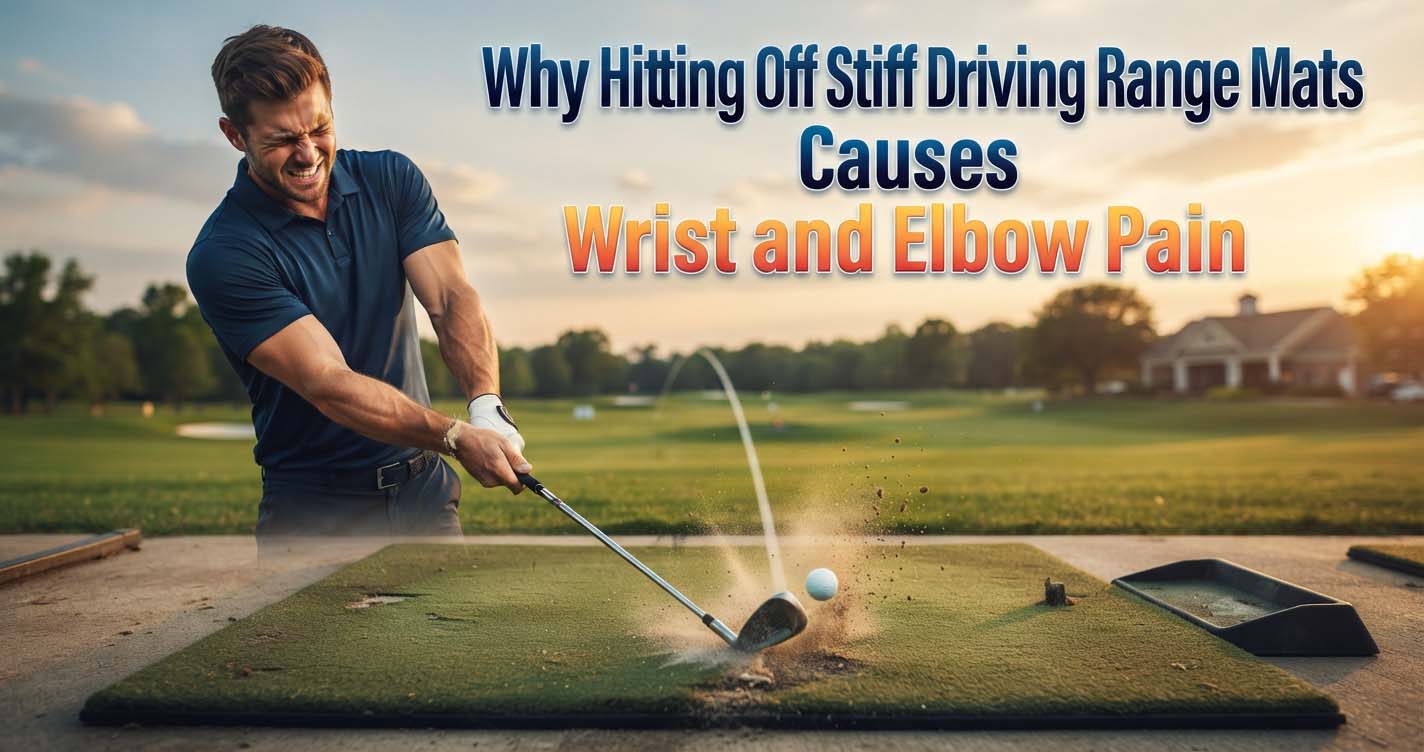
You found that forum thread, the one where someone describes the exact ache in their wrist and the dull vibration in their elbow. The replies probably validated the experience but offered little else. You are not alone in this, and the issue is not necessarily your swing. It is the surface you are hitting off.
I spent a summer hitting off a mat so old and compacted it looked polished. By August, my lead wrist hurt constantly, and my lead elbow ached for days after practice. I thought it was tendonitis from overuse. It was. But the root cause of the inflammation was the mat itself, not the volume of practice.
Looking for Discounts on Why Hitting Off Stiff Driving Range Mats Causes Wrist and Elbow Pain?
Check out the latest price drops, clearance offers, and top-rated deals currently live on Amazon.
Check Live Discounted Prices on Amazon →The issue is straightforward. A stiff mat does not absorb the energy of the club. It reflects it right back up the shaft and into your hands, wrists, and elbows. Your small stabilizing muscles and tendons are forced to absorb this shockwave. This is the mechanical reason for the pain.
The Physics of Impact
Think about a divot on a fairway. When you hit a ball off real turf, the clubhead drives into the ground. The turf compresses, the dirt gives way. This is a gradual deceleration. The kinetic energy of the swing dissipates into the ground over a few inches.
Now think about a range mat, especially a hard rubber one. The clubhead hits the mat and stops dead. The deceleration is instant. Energy cannot disappear. It has to go somewhere. It travels up the metal shaft of the club as a high-frequency shockwave.
The type of mat matters a lot. Bristle mats allow the synthetic tines to bend and break away, offering some of that gradual deceleration feel.
Solid rubber mats or worn-out carpets offer the least forgiveness. They create a high-frequency impulse that the human body is very bad at handling.
Why Your Wrist and Elbow Take the Blame
Your body has a specific job at impact: stabilize the club. The smaller the joint, the harder it has to work to do this. Your hands are the first contact point. The vibration rattles the grip. To keep the club face square, your forearm muscles have to tense up hard to fight that rattle.
Your Wrist: The Stabilizer
The complex of small ligaments and cartilage on the pinky side of your wrist is tasked with stabilizing your forearm bones against your hand. When a high-frequency shock hits, this structure absorbs the brunt of it.
Over many swings, this becomes a repetitive strain injury. That is why the pain often sits right where the wrist meets the hand on the outside of the joint.
Your Elbow: The Anchor
The shockwave travels up the bones of the forearm. At the elbow, the muscles that control your wrist and fingers attach to the bony bumps on the inside and outside of your arm. To fight the club vibration, these muscles fire hard, pulling on their attachment points.
This is the direct mechanism for “golfer’s elbow” or “tennis elbow.” The mat is the trigger that forces this over-contraction on every single swing.
The Real Problem Is How the Mat Changes Your Swing
The forum user mentioned that their distance was worse on the mat. This is a huge clue. A stiff mat changes your swing mechanics without you realizing it, and those changes contribute just as much to the pain as the raw impact does.
Because the ball sits high on a stiff mat (it does not settle into the surface like it does on grass), your body makes small compensations to hit the ball solidly and avoid the sting of the strike.
- You grip the club harder. Your brain tells you to hold on tight to prevent the club from rattling in your hands. This creates constant tension in your forearms, tiring out the muscles that need to be relaxed to swing freely. A death grip is a direct path to tennis elbow.
- You scoop or flip the club. Subconsciously, you try to avoid stubbing the club into the hard surface. This leads to a scooping motion that puts the wrists in a weak, extended position at impact and strains the tendons.
- You stand up out of the shot. To avoid the jarring impact at the bottom, your body lifts up slightly. This changes your angle of attack and forces your arms to do the work your body rotation should be doing.
The pain is a combination of the raw vibration and the poor swing mechanics you adopt to cope with the mat.
How to Tell If the Mat Is the Problem
Before you blame your body or change your swing, check the mat. Here is a simple diagnostic routine.
- The Slap Test: Hit the mat with an open hand. If it stings and feels like hitting concrete, it is too hard for extended practice.
- The Shine Test: Look at the surface. A mat that is shiny or polished from constant use is packed down and has lost its forgiveness.
- The Ball Lie Test: Place a ball on the mat. If it looks like it is sitting on a tabletop, you will feel every bit of the impact. A good mat allows the ball to sit slightly down in the fibers.
- Age: Most mats have a shelf life. After a season or two of heavy traffic, they compact into a dense, hard layer that behaves like a concrete slab.
What You Can Do to Keep Practicing
You do not have to stop practicing. You just have to account for the surface.
Switch Surfaces
If your range has a grass strip next to the mats, hit off that. Even hitting from the fringe where the mat meets the grass is better than the center of a hard mat. Using a rubber tee can also help cushion the ball and provide a small amount of shock absorption at the start of the strike.
Drop the Grip Pressure
Your instinct is to squeeze tight to control the vibration. Fight it. Try swinging with a 4 out of 10 grip pressure. If you feel the club moving in your hands at impact, that is a good thing.
It means the vibration is being dumped into the shaft of the club instead of your joints. You can handle a loose club in your hands much better than you can handle micro-tears in your tendon.
Rotate Your Practice
Do not hit 100 balls off a stiff mat. Hit 30. Then go chip. Then hit 30 more. Let your body recover between sets. The cumulative effect of the shock is what creates the inflammation. Breaking up the volume keeps the inflammation from taking hold.
Frequently Asked Questions
Does the distance loss I feel on mats mean I am hitting the shot wrong?
Not necessarily. Stiff mats create a false energy transfer. Because the club stops so abruptly, a lot of the swing’s kinetic energy is wasted on the impact shock instead of going into the ball.
The club can also bounce or deflect at impact. You might be swinging perfectly and getting poor results simply because of the surface.
Are there specific mats designed to reduce joint impact?
Yes. Look for bristle or hybrid mats. Bristle mats have synthetic blades that mimic grass and allow the club to pass through, absorbing the energy gradually. Flush mount mats that sit in concrete are almost universally hard.
If you practice at a public range and the mats are solid rubber slabs, that is a red flag for wrist and elbow health.
Can a wrist brace fix the problem, or do I need to change the mat?
A brace can help manage existing inflammation by supporting the joint, but it will not stop the root cause. The root cause is the physics of the strike. A brace treats the symptom. If you must use the mat, a brace is better than nothing, but finding a softer hitting surface is the real solution.
Is this injury more common on dry mats than wet mats?
Dry mats are much worse. Wet mats have a slicker surface that allows the club to slide slightly on impact, which absorbs a small amount of energy.
Dry mats grab the clubhead and stop it instantly, sending the full force up the shaft. If your local range mats are dry, hitting when they are damp makes a real difference.