
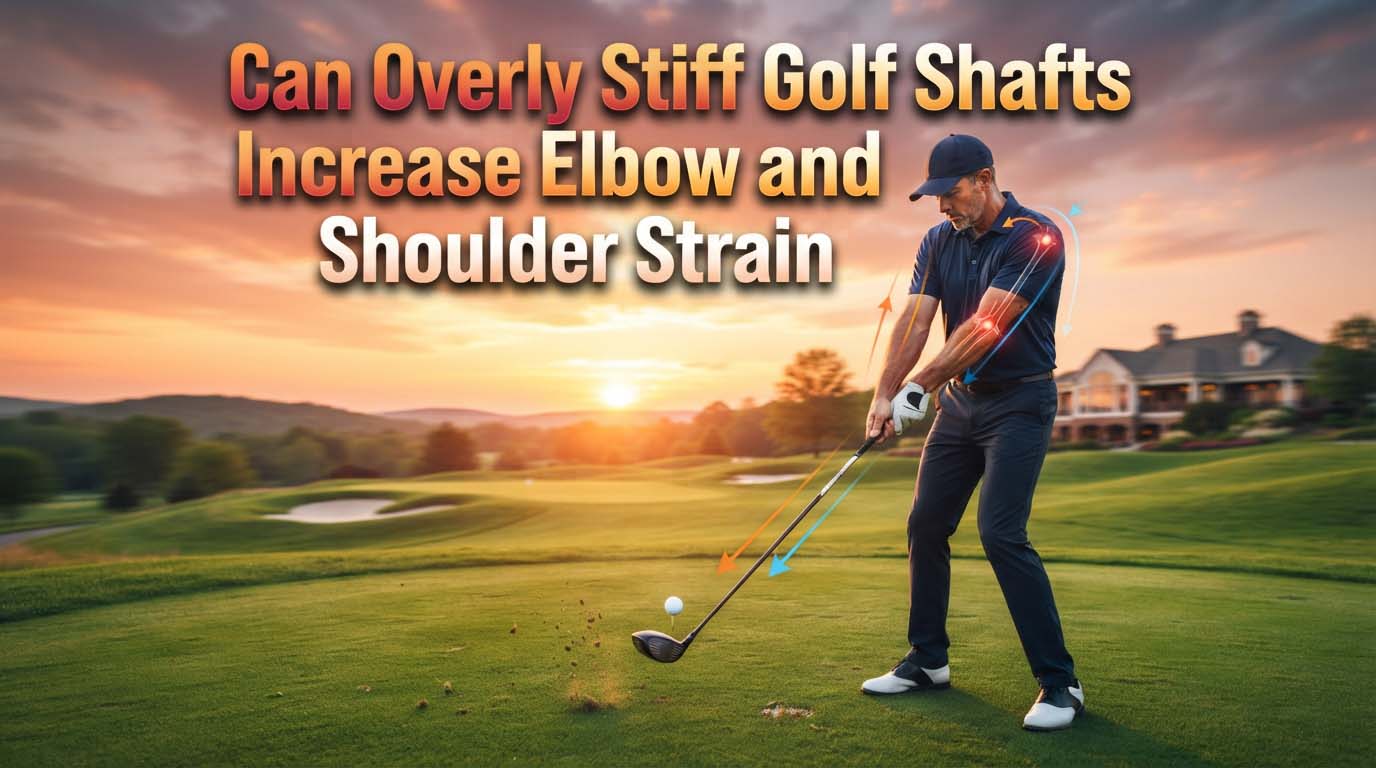
If you have been dealing with nagging elbow pain or a tight shoulder that shows up halfway through the front nine, you might have already started blaming your clubs. And you could be right. Most advice focuses on swing mechanics or strengthening your forearms and rotator cuffs, but it often ignores the direct mechanical conversation happening between your body and your equipment.
Specifically, your shaft stiffness. Overly stiff shafts can absolutely increase strain on your elbows and shoulders. The reason comes down to how the club handles energy, and how your joints have to compensate when that energy goes somewhere it should not.
Looking for Discounts on Can Overly Stiff Golf Shafts Increase Elbow and Shoulder Strain??
Check out the latest price drops, clearance offers, and top-rated deals currently live on Amazon.
Check Live Discounted Prices on Amazon →I have watched players fight a stiff shaft for a full season before realizing the club was the culprit.
The first time I saw someone switch from stiff steel to a mid-flex graphite and literally say “my elbow feels different,” I knew the available advice was missing a major piece of the puzzle.
The Load-Unload Cycle and Mechanical Mismatch
A golf shaft is a spring. On a good swing for your strength and speed, it stores energy in the downswing and releases it into the ball at impact.
But when the shaft is too stiff for your swing speed, what fitters call playing outside your flex profile, it does not load correctly. It stays straight. Instead of the shaft bending and snapping back, the club stays rigid through the release and impact zone.
When that happens, your body absorbs the shock that the shaft was supposed to manage. The torque spike goes up the lead arm and across the shoulders. This is the fundamental mechanical mismatch that turns a well-fit club into a pain generator.
Research on upper body injuries in golfers consistently finds that the lead side takes the brunt of the force, especially at ball impact and follow through.
What the research often leaves out is how equipment stiffness dictates the magnitude of that force. A stiff shaft that never flexes turns the club into a rigid lever. Every ounce of ground reaction and ball compression shoots straight up the kinetic chain.
How an Overly Stiff Shaft Loads the Lead Elbow
The lead elbow (left arm for a right-handed player) acts as the fulcrum for the clubface. When the shaft is properly matched, the flex absorbs some of the eccentric load. With an overly stiff shaft, the lead wrist and forearm have to fight the clubface all on their own.
The flexors and extensors are forced to overcompensate just to keep the club stable at impact.
This creates a perfect storm for medial epicondylitis, what we commonly call golfer’s elbow. The shock that does not get absorbed by the shaft has to go somewhere. It lands on the attachment point of the forearm muscles on the inside of the elbow.
There is also a kickback effect. When a shaft flexes properly, it kicks forward and dampens the rebound off the ball. When it is too stiff, that rebound snaps directly into the joint. You feel it as a sharp jolt in the elbow on every solid hit. Over a round, that jolt adds up to serious irritation.
The Effect on the Trailing and Lead Shoulder
The shoulders face two distinct problems depending on the shaft stiffness profile and where the load concentrates.
The Trail Shoulder
For the trail shoulder (right shoulder for right-handers), an overly stiff shaft requires significantly more force to generate clubhead speed. The latissimus dorsi and pectoralis major have to pull harder against a rigid resistance.
This overloads the posterior rotator cuff and the lat, leading to fatigue and strains that feel like classic overuse injuries but are actually direct byproducts of fighting the club through every swing.
The Lead Shoulder
The lead shoulder has a different burden. Its job is to stop the club. A properly fitted shaft decelerates more smoothly as the flex unloads. A stiff shaft has higher momentum and transfers more energy back up the arm.
The lead shoulder has to fire the rotator cuff harder and faster to decelerate the club and keep the joint stable. This constant high-load braking is a fast track to labral irritation and subacromial impingement.
The Critical Role of Flex Point Location
Stiffness is not just one number. Where the shaft bends changes which joint takes the hit. You can have two shafts with the same overall stiffness feel that load the body completely differently based on their kick point.
| Flex Point | Primary Joint Loaded | Common Issue |
|---|---|---|
| High Kick (Stiff Tip) | Lead Elbow / Wrist | Sharp shock at impact, epicondylitis |
| Low Kick (Stiff Butt) | Trail Shoulder / Lats | Heavy pull at transition, rotator cuff strain |
If your elbow is the problem, look for a softer flex or a lower kick point that lets the shaft do the bending for you. If your trail shoulder is barking, a lighter swing weight or a higher kick point can help reduce the rotational load.
Graphite Versus Steel and Vibration Dampening
Material science matters just as much as the flex profile. Stiffness describes how much the shaft bends. Vibration dampening describes what you feel when you hit the ball.
A steel shaft is incredibly dense. It transmits pure, unfiltered impact shock. A stiff steel shaft is the highest risk combination for joint strain because it combines a rigid lever profile with zero dampening. The vibration literally rings up through the metal and into your bones.
Graphite shafts have a built-in dampening effect. They can be designed to feel quite stiff under load while still filtering out that high-frequency sting at impact.
This is why a player can sometimes move to a higher, more efficient graphite flex and feel better, even though the profile is technically stiffer. The dampening masks the harshness.
Do not just look at the flex number. Look at the material. If you are a steel player with sore elbows, a modern graphite shaft with a similar bend profile might actually save your joints simply because it filters the vibration.
Spotting Compensation Patterns
Here is where it gets confusing. Sometimes the pain is not from the direct shock of the stiff shaft, but from the bad swing habits it forces you into.
The Stiff Shaft Cast
When you cannot hold the lag because the club is too stiff, you flip the club early with your wrists. This puts a massive load on the wrist extensors and the lateral elbow. The pain looks like tennis elbow, but the root cause is a swing compensation triggered by a bad flex match.
The Heavy Shaft Pull
To get the stiff shaft to move, you might start pulling down hard with your trail arm at the transition. This overloads the lat and rotator cuff on the trail side. It feels like a shoulder overuse injury, but it started because the club would not dynamically load correctly.
Use this checklist to figure out what is really going on:
- Check your last equipment change. Did the pain start immediately after a new set of clubs or shafts?
- Map the pain to the swing phase. Does your trail shoulder burn at the top or through impact? Does your elbow jolt on contact?
- Change your grip pressure. If loosening your grip significantly changes the feeling in your elbow, the shock is coming through the shaft.
- Test a different flex. Hit 10 balls with a properly fitted regular or soft flex shaft. If the pain pattern changes, the equipment is the variable.
Frequently Asked Questions
If my swing speed is slow, am I safer with senior flex shafts?
Generally, yes. A senior or soft flex shaft loads much more easily at lower swing speeds. This ensures the club absorbs and releases energy instead of passing it to your body. For players with a history of elbow epicondylitis, a softer flex acts as a safety valve.
You lose some clubhead speed, but you gain a massive reduction in joint torque. It is often the most effective quick fix for recurring elbow pain.
Can I mix flexes in my set to balance strain?
Absolutely. This is an advanced fitting strategy that more players should consider. You can use a softer shaft in your wedges and woods, where you hit more often and with higher torque, to dampen shock.
Keep a stiffer flex in your scoring clubs where feedback and stability matter most. It recognizes that the 6th hole and the 18th hole do not put the same stress on your body.
Does counterbalancing a heavy stiff shaft reduce shoulder load?
It can. Adding weight to the butt end of the club changes the swing weight. A counterbalanced stiff shaft feels lighter at the head, which reduces the deceleration load on the lead shoulder.
However, it can increase the rotational inertia, potentially loading the trail shoulder differently. It is a specific tool for a specific problem, and it is worth testing if you feel like the club is running away from you through impact.
Is my trail shoulder pain from the shaft or a swing flaw?
Look at the timing. If the pain peaks during the takeaway while setting the club, it is likely a mobility or swing mechanics issue. If the pain peaks in the late downswing or at impact, it is likely your trail shoulder fighting the shaft stiffness.
A stiff shaft makes the club heavier to rotate, which directly taxes the posterior shoulder muscles that supply power.
You do not have to choose between playing well and playing without pain. The golf shaft is a critical piece of equipment that directly dictates how much load your elbows and shoulders have to manage.
An overly stiff shaft is a common, hidden source of joint strain. The fix is not always to swing easier or lift more weights. It might just be a fitting conversation. Look at your flex profile.
Look at your material. Pay attention to whether your pain is coming from direct shock or a compensation pattern.
When you match the shaft to your swing speed and injury history, you stop treating your body as the shock absorber and start letting the club do its job.