
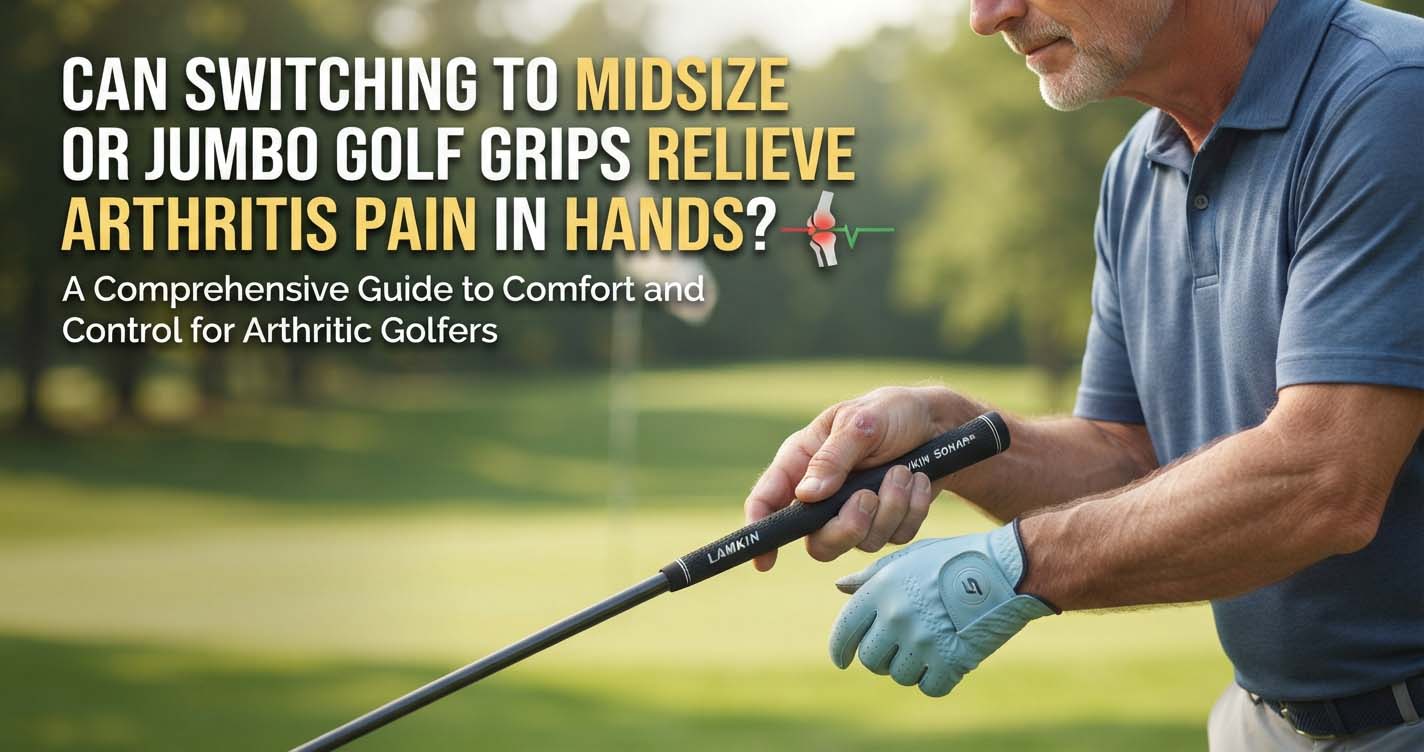
If you have arthritis in your hands, every swing feels different. The vibration from impact shoots through your fingers. Gripping the club tightly for control makes the pain worse. You wonder if changing your grips could help, or if it is just another golf myth.
Here is the truth: switching to a midsize or jumbo grip can relieve arthritis pain for most golfers. But you have to choose the right size and material. A grip that is too large can make your pain worse.
Looking for Discounts on Can Switching to Midsize or Jumbo Golf Grips Relieve Arthritis Pain in Hands?
Check out the latest price drops, clearance offers, and top-rated deals currently live on Amazon.
Check Live Discounted Prices on Amazon →This article explains exactly how grip size affects arthritic joints, which size fits your condition, and what you give up for comfort.
How a larger grip changes the physics of your swing
A standard grip forces your fingers to wrap tightly around a small diameter. This creates high pressure points at your finger joints and the base of your thumb. With arthritis, those pressure points become pain sources.
A larger grip spreads the pressure over a wider surface area. Think of it like lying on a hard floor versus a soft mattress.
The force stays the same, but the distribution changes. Your hand muscles do not have to squeeze as hard to hold on. Less squeezing means less stress on inflamed joints.
Why reducing grip pressure is key to joint relief
Most golfers grip the golf club at a 6 or 7 on a scale of 1 to 10. With arthritis, that tension level directly aggravates your joints. A midsize or jumbo grip allows you to grip at a 4 or 5 and still control the club.
The extra material also dampens vibration. When you hit a shot off-center with a standard grip, the shock travels straight into your hand bones. Thicker grips absorb some of that shock before it reaches your joints.
This matters most for golfers with osteoarthritis, where bone-on-bone contact causes the pain.
The difference between midsize and jumbo for arthritis relief
Midsize and jumbo grips aren’t the same. They provide different levels of relief and come with different trade-offs.
Midsize grips are about 1/16 to 1/8 inch larger in diameter than standard. They offer noticeable comfort without changing your swing too much. Your fingers still wrap around the grip in a natural position. This size works well for golfers with mild to moderate arthritis who still want to shape shots.
Jumbo grips are up to 1/4 inch larger than standard. They provide maximum cushioning and vibration dampening. But they also change how your hands work during the swing. The larger diameter makes it harder to release the club through impact. This can rob you of clubhead speed and distance.
The hidden risk of the jumbo claw
Here is what many golfers do not know: a grip that is too large can actually increase arthritis pain.
When the grip is too big for your hand size, your fingers cannot wrap around it fully. Instead, your fingertips get pushed back toward your palm. This creates a claw-like position.
That claw position forces your finger joints to work harder just to hold on. For someone with rheumatoid arthritis, where finger joints are already swollen and weak, this extra strain can make gripping painful. The relief you expected turns into a new source of discomfort.
The sweet spot is a grip that fills your palm without forcing your fingers into an unnatural curl. Your middle fingers should just barely touch your palm when you hold the club.
Arthritis types matter: Osteoarthritis vs. rheumatoid arthritis
Most golf articles treat arthritis as one condition. It is not. The type of arthritis you have determines which grip size and material will help.
For osteoarthritis, where cartilage wears down and bones rub together, the main problem is impact pain. Midsize or jumbo grips made from soft rubber compounds absorb shock well.
The extra cushioning reduces the jarring sensation at contact. Grips with a softer feel, like those with gel layers or air chambers, work best for this type.
For rheumatoid arthritis, an autoimmune condition that causes joint inflammation and swelling, the main problem is weakness and grip security. A jumbo grip can be impossible to hold if your finger joints are swollen.
The large diameter gives you nothing to grip against. A midsize grip with a non-slip texture is usually better. The texture helps you hold on without squeezing hard.
A critical decision based on your condition
Before you buy new grips, figure out which type of arthritis you have. If you are not sure, ask your doctor. Your grip choice depends on this answer.
- Osteoarthritis: Soft, cushioned midsize or jumbo grip. Look for compounds labeled “soft” or “comfort.”
- Rheumatoid arthritis: Midsize grip with texture. Avoid extra soft materials that require more squeezing to hold.
What you sacrifice for comfort: shot shape and distance
Comfort comes with a cost. The same grip that relieves your pain also changes how the club behaves.
A larger grip reduces hand and wrist action during the swing. This can be good if you tend to hook the ball or get too handsy. But for most golfers, the release of the club through impact creates clubhead speed. If you restrict that release, you lose distance.
For a golfer with arthritis who already has a slower swing speed due to pain or stiffness, a jumbo grip can make the game unplayable. You might gain comfort in your hands but lose 10 to 20 yards off the tee. That trade-off may not be worth it.
Midsize grips have a smaller effect on release. Most golfers lose only 2 to 5 yards with midsize compared to standard. The comfort gain often outweighs the distance loss.
How to test and choose your ideal grip size
You do not have to guess which size works. Use these two simple tests at a golf shop or with a friend’s clubs.
The finger-to-palm test: Hold the grip as you normally would. Look at your top hand. Your middle fingers should just barely touch your palm. If they dig into your palm, the grip is too small. If they do not touch at all, the grip is too large.
The grip pressure test: Take your normal grip and rate your grip pressure from 1 to 10, where 1 is barely holding on, and 10 is squeezing as hard as you can. Aim for a 4. If you cannot maintain a 4 with a standard grip without the club slipping, move up to midsize or jumbo.
Compound selection for arthritic hands
The material matters as much as the size. Three options exist:
- Soft rubber: Best for osteoarthritis. Examples include Lamkin Sonar and Golf Pride Tour Velvet +4. These absorb shock well.
- Cord or hybrid: Better for rheumatoid arthritis, where hands get sweaty or slippery from medication. The cord texture gives you traction without squeezing.
- Wrap-style grips: Provide a uniform feel without taper. Good for golfers who want consistent thickness top to bottom.
Beyond the grip: adding tape and wraps for a custom fit
You do not have to buy a full set of jumbo grips. A cheaper and more precise option exists: adding extra wraps of tape under the lower hand.
Most grips have a taper, meaning they are thicker at the top and thinner at the bottom. For arthritic golfers, the bottom hand often hurts more because it takes more pressure during the swing.
Adding 2 to 4 wraps of tape under the lower portion of the grip creates a built-up feel there. This relieves pressure on the bottom hand without making the entire grip oversized.
This technique works well for golfers with arthritis only in one hand. You can customize each club to match your pain points.
Can I use a midsize grip if I have arthritis in my wrists instead of my fingers?
Yes. Wrist arthritis responds well to midsize grips because they reduce the amount of wrist movement needed during the swing.
A larger grip naturally limits wrist hinge. This can relieve strain on arthritic wrist joints. Jumbo may be too restrictive for wrist motion, so stick with midsize unless you have severe wrist pain.
Will adding a thicker grip help with the numbness I feel in my pinky and ring finger
Numbness in the pinky and ring finger is often ulnar nerve entrapment, not arthritis. Thicker grips can help by reducing the pressure on the ulnar nerve at the base of your hand.
Midsize grips often provide relief because they prevent the nerve from being compressed against the shaft. But if the numbness persists, see a doctor. A grip change may not address all nerve issues.
Are JumboMax grips better for arthritis than SuperStroke grips?
It depends on your needs. JumboMax grips are larger overall and have a unique tapered shape that some arthritic golfers find comfortable.
SuperStroke grips are more uniform from top to bottom and come in softer compounds. For osteoarthritis, SuperStroke’s softer materials may work better.
For rheumatoid arthritis with weakness, JumboMax’s larger diameter might be too much to hold. Test both before buying.
Can grip size actually cause arthritis in a healthy hand
No. Grip size does not cause arthritis. Arthritis is caused by genetics, joint injury, or autoimmune conditions.
But using the wrong grip size can make existing arthritis symptoms worse or cause temporary hand pain that mimics arthritis. This is why getting the right size matters for pain management, not disease prevention.