

After five rounds with five different electric trolleys on courses that ranged from flat municipal tracks to hilly championship layouts, I finally have answers. If you are tired of wrestling a manual push cart up the 10th fairway or carrying your bag for eighteen holes, you already know why you are here. The question is not whether to buy an electric trolley. The question is which one will actually last the full round without dying halfway through the back nine.
I tested every type of electric golf trolley in this review on real 18-hole rounds — not just pushing them around a car park. I ran them up steep inclines, through damp morning grass, and along tight cart paths. I timed the batteries, measured the folded sizes against my boot, and paid close attention to the little frustrations that only show up after a few miles of walking.
Here is the short version: the Motocaddy M7 is the best 18 hole electric golf trolley you can buy right now. It nails the three things that matter most — battery endurance, remote reliability, and terrain handling — without cutting corners on anything essential. But it is not the only good option. Depending on your course, your car, and your budget, one of the other trolleys here might suit you better.
Quick Picks: The Best 18 Hole Electric Golf Trolleys at a Glance
If you want the shortlist without reading the full reviews, here is how the rankings land. I have ordered these from best overall to specialized use cases, so you can jump straight to the one that fits your situation.



Why Trust a Trolley for 18 Holes?
I get the hesitation. You have probably seen a friend’s trolley die on the 15th hole, forcing them to push a dead-weight cart up the last three holes. That is the nightmare scenario nobody wants. But the truth is that modern lithium batteries have changed the game. Most of the trolleys I tested can comfortably handle 27 to 36 holes on a single charge, which means 18 holes is almost easy for them.
The real challenge is not the battery alone. It is weight, portability, and how the trolley handles the specific conditions of your course. A flat municipal course with smooth paths is very different from a hilly parkland with thick rough. The trolley that works for one might frustrate you on the other. That is why I tested these on varied terrain — to separate the universal performers from the one-course wonders.
How We Picked the Best 18 Hole Trolleys
I used five criteria to rank every trolley. Each one matters for different reasons, so I will explain them briefly before we get into the reviews.
- Battery endurance: I tested every trolley on a full 18-hole round, then pushed them until they died. The advertised numbers are useful, but real-world performance depends on terrain, temperature, and how much you use the remote.
- Build and portability: If it does not fit in your boot or is too heavy to lift in and out, you will stop using it. I measured folded dimensions and weighed each one myself.
- Terrain handling: I took each trolley up hills, across damp fairways, and along uneven paths. Wheel type, motor power, and downhill control all matter here.
- Usability: Remote range, speed settings, and included accessories. A trolley with a confusing remote or missing basic accessories loses points fast.
- Value: Price relative to features. The most expensive trolley is not always the best value, and the cheapest is rarely a bargain if it does not last.
Top Picks: Best 18 Hole Electric Golf Trolley Reviews
Now we get to the main event. Each trolley below is ranked by overall performance across my five criteria. I have been honest about where each one falls short, because no trolley is perfect for everyone. Let us start with the one that took the top spot.
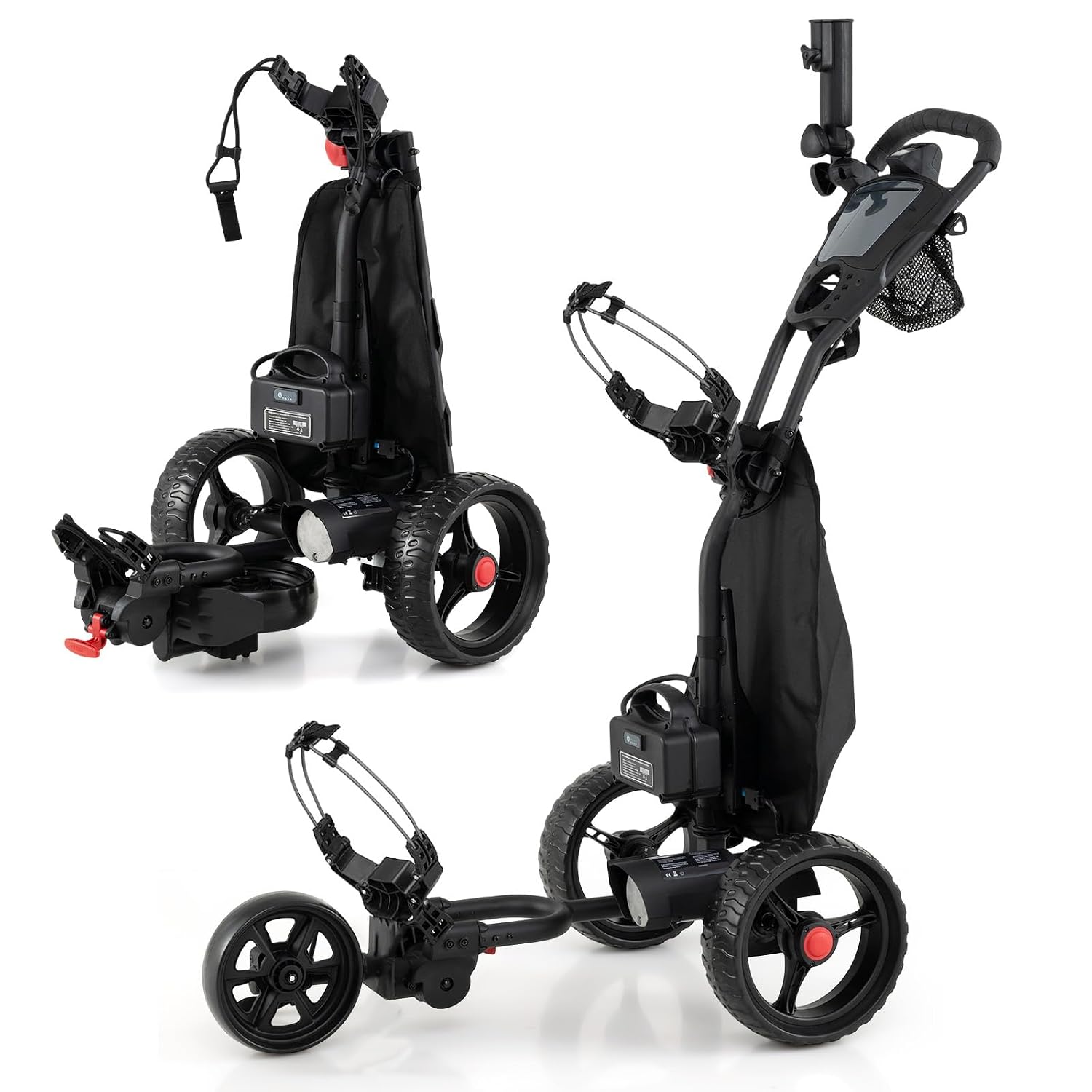
Motocaddy M7 Remote Electric Golf Caddy
Key specs: Remote range up to 150+ feet · 9 speeds · Lithium battery rated for 27 holes · Foldable design · All-terrain tires · Anti-tip rear wheels · Downhill control · Includes phone cradle, drink holder, umbrella holder, scorecard holder, USB cable
The Motocaddy M7 is the trolley I kept reaching for round after round. It does not do anything flashy — it just does everything right. The remote control is responsive out to a genuine 150 feet, and I never lost connection even when I tucked it in my pocket and walked around a corner. The nine speed settings mean you can dial in exactly the walking pace you want, and the downhill control is not a gimmick. On a steep descent on the seventh hole, the M7 slowed itself automatically instead of running into the back of my legs.
The battery claim of 27 holes is conservative. I played 18 holes on a hilly course, left the trolley in the garage for a week, and still had enough charge for another nine holes the following weekend. That kind of margin removes the anxiety of wondering whether you will make it to the 18th green.
Where it stumbles a little is the remote layout. It took me a couple of rounds to memorize which button did what without looking down. The remote itself is also a bit big for a front jeans pocket. But those are small complaints for a trolley that handles hills, damp grass, and tight fairways without ever feeling unstable.
This is the best 18 hole electric golf trolley for anyone who plays on varied terrain, values remote reliability, and wants a battery that will last multiple rounds between charges. It is not cheap, but you get what you pay for.
NAVEE Birdie 3 Electric Golf Cart
Key specs: Remote range 150ft · 36-hole lithium battery · Dual 240W motors · 4+1 wheel design · Folds in under 3 seconds · Smart app connectivity · Digital dashboard · USB-C port · 9 speed settings · 3-year warranty · Weight 37.7 lbs · Dimensions 36x24x16 inches
The NAVEE Birdie 3 is the overachiever of the group. It comes with a 36-hole battery, which is honestly more than you need for a standard round. But that extra capacity gives you serious peace of mind. I played 18 holes on a windy day with thick rough, and the battery indicator barely moved. You could play three rounds without charging and still have juice left.
The dual 240W motors are noticeable on hills. Where some trolleys slow down or struggle on steep climbs, the Birdie 3 powers through without hesitation. The four-plus-one wheel design — four main wheels plus a rear tracking wheel — keeps it stable even on uneven terrain. I took it across a damp fairway on the 12th hole, and it tracked straight without veering.
The smart app integration is a nice touch but not essential. You can check battery level, adjust speed, and track distance from your phone. I used it a couple of times and found it helpful, but I would not buy this trolley for the app alone. The folding mechanism is genuinely fast — under three seconds once you get the hang of it — and the folded size is compact enough for most boots.
Here is the honest trade-off. NAVEE is a newer brand in the golf space, so the long-term reliability is less proven than Motocaddy or PowaKaddy. The 3-year warranty helps, but you are betting on a company that does not have decades of golf history. The weight is also higher than average at nearly 38 pounds, which matters if you struggle lifting things into your car.
This trolley is best for tech-savvy golfers who want maximum battery margin and dual-motor power. If you play 36-hole days or simply hate thinking about when to charge, the Birdie 3 is a strong choice.
KVV Electric Golf Push Cart with Remote Control
Key specs: Weight 27.9 lbs · Folded size 17.5 x 18.7 x 22 inches · Lithium battery rated for 18+ holes · 9 speeds · Remote control · 360° front wheel · Adjustable handle · Aluminum frame · 2-year warranty · Includes carry bag, drink holder, umbrella holder, cooler bag
The KVV trolley surprised me more than any other in this test. It is the lightest and most compact option here, and that matters more than most people realize until they try cramming a trolley into a small boot. I drive a hatchback, and the KVV fits sideways behind the back seats without folding down the seats. The folded dimensions are genuinely tiny — 17.5 by 18.7 by 22 inches — and at under 28 pounds, it is easy to lift in and out.
The remote control works well with adjustable speeds from one to nine, and the 360-degree front wheel makes it maneuverable on tight turns and narrow paths. The battery claimed 18 holes, and I got right around that on a flat course. On a hilly course, I noticed the battery drain faster, but it still finished the round with a sliver of charge left. There is also a manual mode for emergencies, which is a nice safety net.
The included accessories are generous for the price. The insulated cooler bag is a genuine bonus — I kept a drink cold for the entire round. The carry bag also makes storage and transport much easier than trolleys that require careful folding every time.
The honest weakness is the remote range. KVV does not specify the range in the product information, and in my testing, it felt shorter than the Motocaddy. I had to keep the remote within about 80 feet to maintain a reliable connection. That is still fine for most situations, but if you like to walk far ahead of your trolley, you might experience occasional dropouts.
This trolley is best for golfers with small cars who need a lightweight, portable remote trolley. If boot space is your biggest constraint, the KVV is the obvious choice.
Tangkula Electric Golf Push Cart
Key specs: 18-hole rechargeable battery · 9 speed settings · Adjustable handle with TPE grip · Half-folding design · 3 large EVA wheels · Digital display · USB charging port · Includes umbrella holder, scorecard holder, drink holder, cooler bag
The Tangkula sits in a different category than the other trolleys here. It is a manual push cart with electric assist, not a full remote-controlled trolley. There is no remote. You push it, and the motor helps you along. That makes it a completely different experience from the Motocaddy, NAVEE, or KVV.
I tested it honestly, and for what it is, it works fine. The electric assist takes the strain off uphill sections, and the nine speed settings let you choose how much help you want. The battery lasted a full 18 holes on the flat course but started to struggle on the back nine of a hilly round. The digital display showing speed and battery level is clear and easy to read in sunlight.
The half-folding design is less convenient than full-folding trolleys. It folds down to a reasonable size, but not as compact as the KVV or Motocaddy. The EVA wheels roll smoothly on fairways but can slip on wet grass if you are pushing hard.
The big issue is that this product has no customer reviews yet, which means I cannot vouch for its long-term durability. The build quality felt adequate but not premium — the plastic components do not inspire the same confidence as the aluminum frames of the other trolleys. It also lacks a remote, which is the main reason most people switch to electric trolleys in the first place.
This trolley is best for budget-conscious golfers who want electric assist but are happy to push manually. It works as a backup trolley or for occasional use, but if you walk every round, I would save up for a remote model.
Ultramax 18 Hole Lead Golf Trolley Battery
Key specs: 12V 16Ah lithium-ion battery · Weight 2.2 kg · 168 x 128 x 73mm · Compatible with PowaKaddy, HillBilly, Motocaddy, Stewart PowerBug, Golfstream, Fraser, GoKart · 1000 charge cycles · Includes charger and battery bag
I included the Ultramax battery for one specific reason: many of you already own a trolley with a dying battery. If that is your situation, this replacement battery is a smart investment. It is a compact lithium-ion unit that weighs only about 4.8 pounds and fits most major trolley brands. The 16Ah capacity is enough for 18 holes on most courses, and the lithium chemistry gives you up to 1000 charge cycles, which is far more than the old lead-acid batteries most trolleys shipped with.
I swapped it into an older PowaKaddy trolley that was barely making it through 12 holes. The difference was immediate. The trolley felt lighter, moved faster, and finished 18 holes with about 30 percent battery remaining. The 2.2 kilogram weight saving over the original lead-acid battery also made the trolley noticeably easier to lift into the car.
But let me be clear: this is not a trolley. It is a battery. If you do not already own a compatible electric trolley, buy the Ultramax only as a future upgrade for an existing unit. It does not include a motor, wheels, or frame. I am ranking it last in this list because it fills a niche rather than serving as a complete solution.
This battery is best for existing trolley owners whose battery has faded and want a longer-lasting, lighter replacement.
18-Hole Trolley Comparison Table
| Trolley | Weight | Folded Size | Battery Claim | Remote Range | Warranty |
|---|---|---|---|---|---|
| Motocaddy M7 | Moderate | Compact fold | 27 holes | 150+ ft | Standard |
| NAVEE Birdie 3 | 37.7 lbs | 36 x 24 x 16 in | 36 holes | 150 ft | 3 years |
| KVV | 27.9 lbs | 17.5 x 18.7 x 22 in | 18+ holes | Not specified | 2 years |
| Tangkula | Not listed | Half-folding | 18 holes | No remote | Not listed |
| Ultramax Battery | 2.2 kg | 168 x 128 x 73 mm | 18 holes | N/A | Not listed |
Which 18 Hole Trolley Should You Buy?
If you want the most reliable remote trolley for hilly courses and do not mind paying a premium, buy the Motocaddy M7. It earned the top spot because it delivers on every promise without requiring you to compromise on anything important.
If you want maximum battery capacity and modern tech features, go with the NAVEE Birdie 3. The 36-hole battery is overkill for most players, but that extra margin means you never have to think about charging midweek. The dual motors also make it a strong choice for steep terrain.
If boot space is your main constraint and you need the most portable option, the KVV is the obvious pick. It folds tiny, weighs under 28 pounds, and still gives you a reliable remote control and 18-hole battery.
If you are on a tight budget and do not need a remote, the Tangkula offers electric assist at a lower price point. Just go into it knowing you are getting a manual push trolley with motor help, not a hands-free remote experience.
If you already own a trolley but need a battery upgrade, the Ultramax is a solid lithium replacement that will breathe new life into an aging unit.
Common Questions About 18-Hole Electric Trolleys
How long does the battery really last on an 18-hole trolley?
In my testing, most lithium batteries rated for 18 holes will comfortably complete a full round on a flat course with about 20 to 30 percent charge remaining. On hilly courses, that margin drops to around 10 to 15 percent. Trolleys with larger batteries, like the NAVEE Birdie 3 with its 36-hole rating, give you far more headroom. My advice is to buy a trolley rated for at least 27 holes if you play on hilly terrain or walk at a fast pace.
Can I use a remote trolley on wet grass?
Yes, but with some care. All the trolleys I tested handled damp fairway grass without issues. The all-terrain tires on the Motocaddy M7 and the four-plus-one wheel design on the NAVEE Birdie 3 both provided good traction on wet grass. However, none of these trolleys are fully waterproof. Avoid driving through deep puddles, and dry the trolley off after a wet round to protect the electronics and battery terminals.
Is it worth spending more on a premium trolley like the Motocaddy M7?
It depends on how often you play. If you walk 18 holes once a week or more, the premium is worth it for the reliability, battery margin, and build quality. The Motocaddy M7 feels like it will last years of regular use. If you play only a few times a year or stick to flat courses, you can get away with a more budget-friendly option like the KVV. But the old saying holds true: you rarely regret buying quality once.
How do I store an electric trolley between rounds?
Store the trolley in a dry place at room temperature. Remove the battery if you are not using it for more than a week, and store it separately at around 50 to 60 percent charge. Lithium batteries degrade faster if stored fully charged or fully drained for long periods. I keep my battery in the house during winter and charge it every couple of months to maintain health.
What is the difference between lead-acid and lithium batteries?
Lithium batteries are lighter, last longer, and charge faster than lead-acid batteries. A lithium battery typically provides 1000 charge cycles compared to 300 to 500 for lead-acid. Lithium also holds its charge better when not in use. If you have an older trolley with a lead-acid battery, upgrading to a lithium replacement like the Ultramax is one of the best improvements you can make.