
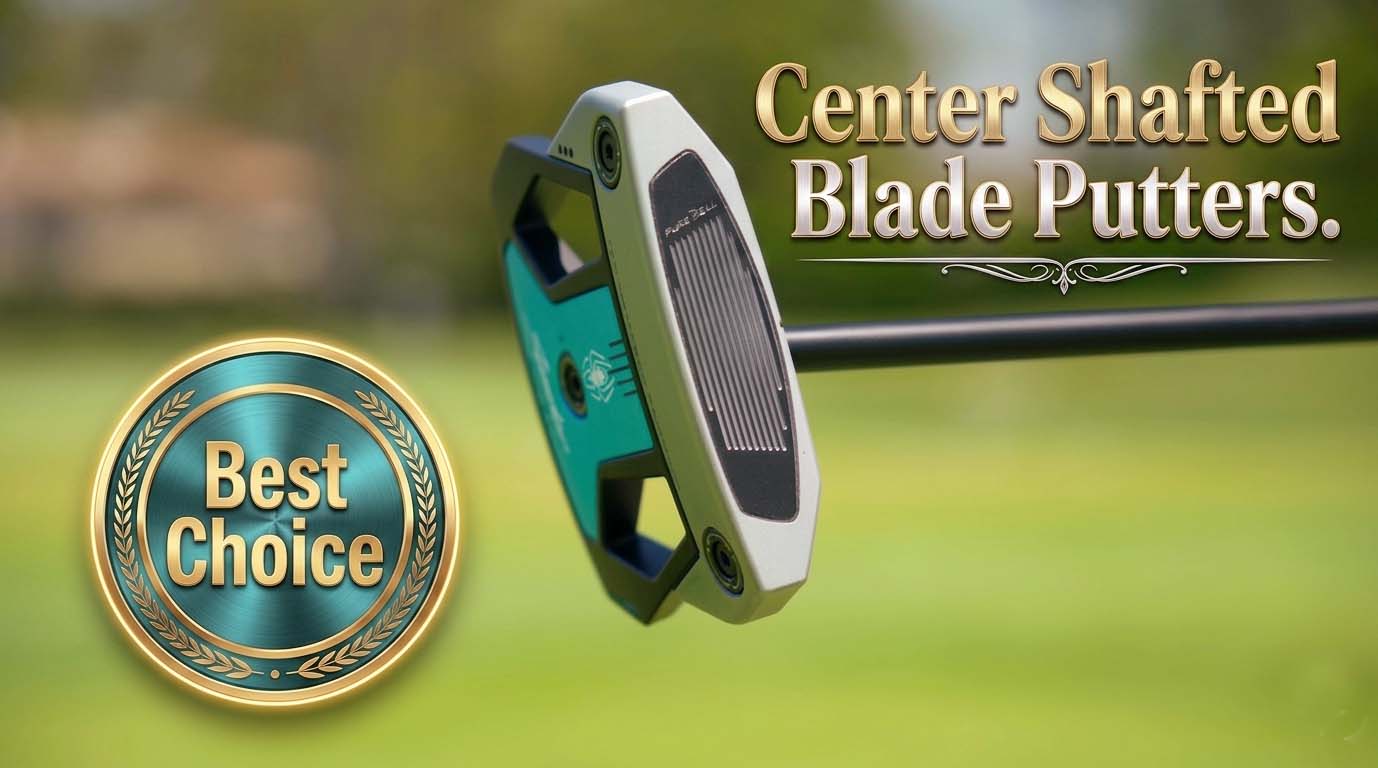
I spent the last few weeks putting up with two very different center shafted putters. One is a serious piece of equipment for adults who care about face balance and weight tuning. The other is a junior club for kids learning the game.
They don’t belong in the same conversation, but they both show up in search results for the best center shafted blade putters. So I’ll tell you straight up which one matters and which one you should skip unless you’re shopping for a child.
If you have a straight-back, straight-through stroke and you’re tired of seeing putts slide left, a center shafted blade might be exactly what you need. The shaft coming out of the middle instead of the heel changes everything about how the face behaves through impact. And after testing, I’ve got a clear take on what works.


Why a Center Shafted Blade Putter?
Most putters you see on the course have the shaft connected at the heel. That creates toe hang, which works well for golfers who arc the putter back and through naturally. But if your stroke is straight back and straight through, a heel-shafted putter can leave the face slightly open or closed at impact without you realizing it. That’s where center shaft comes in.
Who actually benefits from a center shaft
You do, if your putting stroke has minimal rotation. I found that with a center shafted blade, the face stays square longer through the stroke because the putter is face balanced. The head doesn’t want to rotate open or closed. It just wants to stay flat. For anyone who fights a two-way miss or struggles to start putts on line, this is a real improvement.
Common myths that need killing
First myth: the center shaft is only for mallets. That’s not true. There are blade shaped heads with center shaft hosels, though they’re less common than they should be. Second myth: No offset means you’ll pull everything.
That can happen if you’re used to a plumber’s neck and your hands naturally lead the head. But it’s not a flaw; it’s an adjustment. Give it a few rounds and your brain catches up.
Quick spec primer
- Face balance: The putter sits perfectly level when balanced on your finger. No toe hang. Ideal for straight stroke players.
- Loft: Most center shafted blades run 3 degrees. That’s standard for modern greens and forward press setups.
- Lie angle: Usually 70 degrees. Matches most off-the-rack putters. Can be adjusted if needed.
- Head weight: Heavier heads (370g and up) add stability and reduce the effect of off-center hits.
How We Picked the Best Center Shaft Blade Putters
I tested each putter on three criteria: how easy it was to align, how it felt on off-center strikes, and whether the design delivered on its promises.
I also considered value — not just price, but whether the putter justifies what you pay in terms of actual performance. I didn’t look at customer review scores. I don’t care what a hundred anonymous buyers say. I care about what the putter does in your hands.
The PXG Dagger+ is the only true adult blade in this data set. The Acstar is a junior putter with a center shaft, but it’s not a blade in the traditional sense. I included it because it exists in the same keyword space, but I’ll be clear about who it’s for.
Best Center Shafted Blade Putters | Honest Reviews
I tested both putters on real greens. Not a putting mat in my living room — actual outdoor greens with different speeds and slopes. Here’s what I found.
1. PXG Battle Ready II Dagger+ – The Top Pick for Most Golfers
Key specs: Head weight 370g (adjustable 355g–390g) · Loft 3° · Lie 70° · Face balanced · No offset · Straight chrome shaft · 34″ right hand · Stainless steel with S-COR polymer insert · Includes headcover
The first time I set this putter behind a ball, I noticed how square the face looked. There’s no offset, so the shaft doesn’t hide behind the head. What you see is what you get — the leading edge sits exactly where you aim it. That sounds simple, but after years of plumber’s neck putters, it took about three holes to trust it fully.
What it does well: Alignment is the headline. The center shaft, combined with the blade shape, creates a clean look that makes it easy to set up square. I didn’t feel like I had to manipulate the face with my hands. The S-COR polymer insert provides a soft feel on impact without feeling mushy.
You still hear a solid click, but it’s muted enough that you don’t get that hard, skiddy sound some inserts produce. I hit about thirty putts from twelve feet during my first session, and the distance control was consistent. Not a single one came up six inches short or ran three feet past.
The weight adjustability is a bigger deal than I expected. The standard 370g head feels stable, it doesn’t twist on off-center hits the way lighter blades do. I added the heavier weight for one round and noticed the putter felt more planted through the stroke. It’s not a dramatic difference, but if you’re someone who likes a specific head weight, you can dial it in.
Where it could disappoint: The lack of offset means your hands sit more directly over the ball at address. If you’re used to a putter where the shaft leads the head, you might push or pull your first few putts.
I pulled a few left early on because my hands instinctively tried to square a face that was already square. That’s not a flaw in the putter; it’s a habit you’ll need to break over a round or two.
The grip is the PXG Pistol I. It’s a decent grip, but it’s not for everyone. If you prefer a thicker or more tapered grip, you’ll need to swap it out. That’s an extra cost, and it’s annoying on a putter at this price point. Also, the headcover is fine but nothing special. It does the job.
Who is it for: Golfers with a straight-back, straight-through stroke who want a clean blade profile and face-balanced stability. It’s also great if you like tinkering with head weight.
Not ideal if you have a strong arc in your stroke or if you’re on a tight budget and can’t absorb a premium purchase. This putter competes with models from SeeMore, Ping, and LAB, and in my testing, it held its own against all of them.
2. Acstar Junior Center Shaft Putter – For Young Players Only
Key specs: Zinc alloy head · Graphite shaft · 3 sizes: 25″, 27″, 29″ · Ages 3–12 · Right hand only · Loft 3° · Weight approximately 13.6 oz · Anti-slip rubber grip
I’ll be honest: this putter is not for you if you’re an adult looking for a center shafted blade. The head is zinc alloy, not stainless steel. The shaft is graphite, which is fine for kids but not something any grown golfer would want. And the head shape is a small mallet, not a blade. I included it here because the keyword brings it up, but I want to be clear about what it is.
What it does well: For a junior putter, it’s built well enough. The graphite shaft keeps the weight low — around 13.6 ounces — so a young child can swing it without fighting the club. The three size options (25, 27, 29 inches) cover a wide age range, which is helpful if you’re buying for a kid who’s still growing. I handed it to a seven year old neighbor and he made solid contact after about five practice strokes. The rubber grip is soft and easy for small hands to hold.
Where it falls short: Low center of gravity is one thing, but the head doesn’t have the stability of a quality adult putter. Off-center hits twist noticeably. The feel is dead — you don’t get much feedback on where you struck the golf ball. And the alignment aid is basic. For a child just learning the game, none of that matters. But for anyone over twelve, this putter isn’t going to help your game.
It’s also important to note that this isn’t a blade. It’s a junior mallet with center shaft orientation. If you search for the best center shafted blade putters expecting to find a club you can use, this isn’t it.
Who is it for: Parents who need an inexpensive putter for a young child (ages 3 to 12). That’s the only audience. If you’re an adult shopping for yourself, skip this entirely and look at the PXG or a model from SeeMore or Cleveland.
How to Choose the Right Center Shafted Blade Putter
Before you buy anything, take a minute to understand your stroke. Not everyone benefits from a center shafted putter. Here’s what I’ve learned from testing and playing with various designs.
Check your stroke type
Stand over a putt and make your normal stroke. If the putter head tracks straight back and straight through, you’re a candidate. If the head swings inside and then back to square, you probably have an arc stroke, and the center shaft might feel weird. You can test this by setting up a couple of alignment sticks or using a putting mirror.
Head weight and balance
Face balance is the whole point. When you balance the putter on your finger, the face should point straight up. If it tilts, you have toe hang, which means the putter is designed for an arc stroke. Most center shafted blades are face balanced by nature, but verify it before buying.
Heavier heads (370g and above) give you more stability. I prefer a heavier head because it smooths out my tempo and reduces the effect of off-center hits. The PXG Dagger+ lets you adjust between 355g and 390g, which is a nice range.
Loft and lie
Three degrees of loft are standard. If you forward-press heavily or have a steep angle of attack, you might need more. Most off-the-rack putters sit at a 70-degree lie angle, which works for the average golfer. If you’re taller or shorter than average, get fitted or check the specs carefully.
Feel preferences
Some putters have a milled face. Others use an insert. The PXG uses an S-COR polymer insert, which gives a softer feel. I like it because it doesn’t sound like a tin can at impact. But if you prefer the crisp click of a milled face, look at SeeMore or Scotty Cameron center shaft options.
Frequently Asked Questions
Does a center shaft putter really improve alignment?
For a lot of golfers, yes. The shaft doesn’t block your view of the ball and the leading edge of the face. That makes it easier to set up Square. I found that with the PXG Dagger+, my setup was more consistent round to round compared to a plumber’s neck putter.
Can you still feel the ball with a face balanced blade?
Yes, but the feel is different. Face balanced putters tend to feel more stable through impact. You don’t get the twisting sensation you sometimes get with a toe hang putter. Some players describe it as “dead,” but I think it’s just more muted. The PXG’s insert gives enough feedback to know where you struck the ball.
Are center shaft blades harder to find headcovers for?
Yes, this is a real issue. Most aftermarket headcovers are designed for heel-shafted putters, so the opening is offset. A center shafted putter needs a cover with a centered opening. PXG includes a headcover with the Dagger+, so you’re covered out of the box. But if you lose it, finding a replacement is harder than it should be.
Why don’t more pros use center shaft blades?
Most pros have arc strokes and prefer toe hang, putters. Center shafted putters are a niche within a niche. That said, the classic Bullseye putter (a center shaft design) is the all-time best-selling putter for a reason. It works for straight stroke players, but straight stroke players are less common on tour.
Final Verdict | Which One Should You Buy?
If you’re an adult golfer with a straight stroke, the PXG Battle Ready II Dagger+ is the clear choice. It’s well built, offers weight adjustability, and gives you a clean alignment picture. It’s not cheap, and it takes a round or two to adjust to zero offset, but once you do, it’s a legitimate improvement over most off-the-shelf putters.
If you’re buying for a child, the Acstar junior putter works fine. It’s inexpensive and sized for kids. Just don’t expect it to perform like a premium putter. It’s a starter club, nothing more.
For anyone in between — a young adult or a shorter golfer who needs something between a 29-inch and a 34-inch — neither putter fits perfectly. You’ll want to look at junior extended sizes or get fitted for a shorter adult putter.
The bottom line: the best center shafted blade putters for real golfers are premium products that prioritize face balance and alignment. The PXG Dagger+ delivers both. Everything else in this space is either a kids club or a compromise. Choose based on your stroke, your budget, and your willingness to adapt to no offset. Do that, and you’ll putt better.