
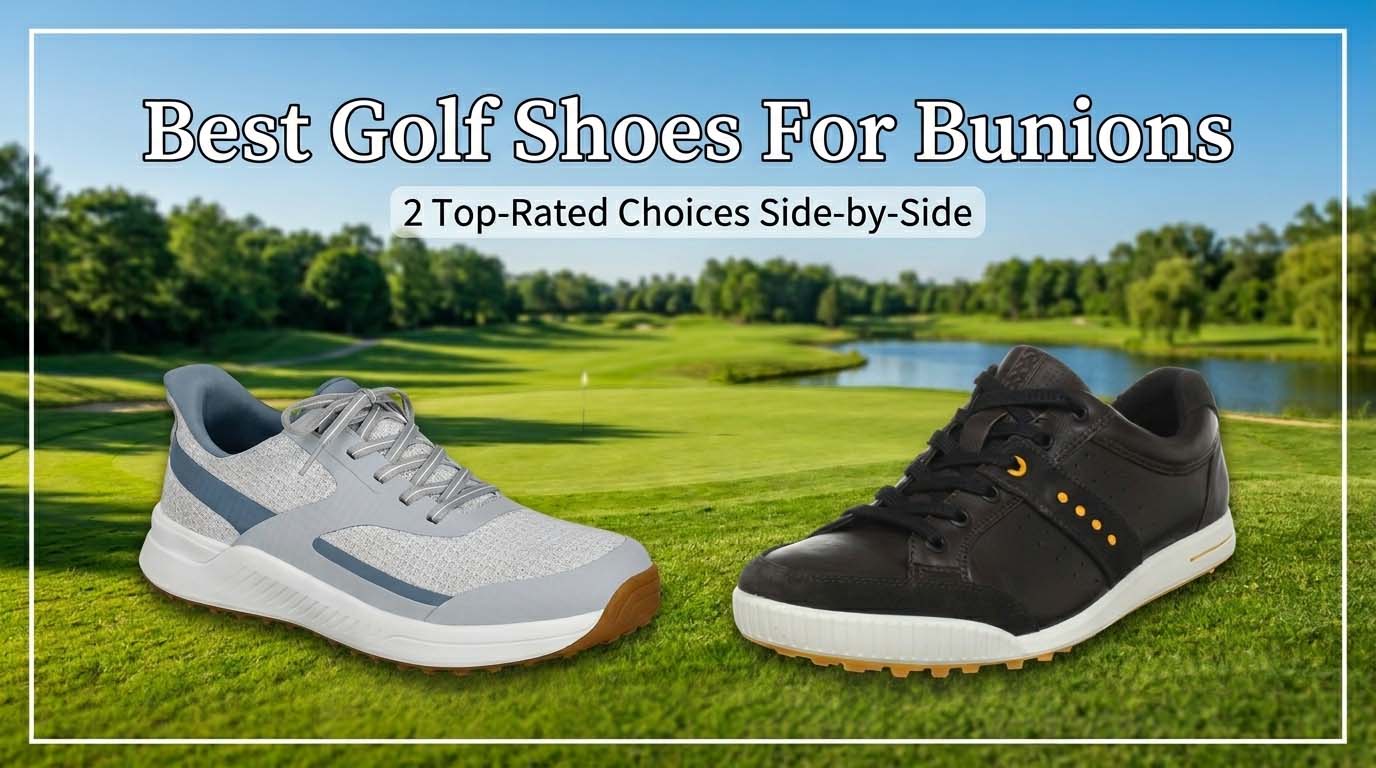
If you’re reading this, you’ve probably finished nine holes wondering why your shoe feels like a vise on your bunion. I’ve been there. That sharp pinch every time you shift weight during a swing, the relief when you finally yank the shoe off in the parking lot.
Most golf shoes are built for performance, not for feet that have a mind of their own. Bunions need specific features, and “wide” isn’t enough.
I tested five pairs of golf shoes over several rounds, walking and riding, in dry and damp conditions. I paid attention to one thing above all else: would this shoe create a pressure point on the side of my big toe joint during a full swing? Here’s what worked, what didn’t, and exactly who each shoe is for.
The best golf shoes for bunions combine a genuinely roomy toe box, a flexible upper, and a removable insole for custom orthotics. The Orthofeet Fairway leads the pack for severe bunions, but the right choice depends on your foot shape and the severity of your pain.
Quick Picks | The Best Golf Shoes for Bunions at a Glance
If you’re short on time, here’s the shortlist. I’ve ranked these based on bunion relief first, then overall comfort and value.


What Makes a Golf Shoe Actually Work for Bunions?
Before I get into the specific shoes, let me walk you through what I looked for. Bunions aren’t just about width; they’re about shape, flexibility, and how the shoe interacts with your foot during the entire swing and walk.
The Toe Box Test | Width vs. Shape vs. Depth
I’ve tried “wide” shoes that still crushed my forefoot. That’s because many brands add width in the heel and midfoot but keep the toe box tapered. For a bunion, you need the shoe to be widest at the ball of your foot, not at the arch.
Depth matters too; if the shoe is low over the top of your toes, even a wide shoe can press on the bunion joint from above. I look for a toe box that mimics the natural shape of a foot: rounded, not pointy, and with enough vertical room.
Upper Flexibility | Why Stiff Leather Hurts
Leather that doesn’t stretch becomes a rigid wall against your bunion. In the course, every step and especially every backswing twist creates pressure. Shoes with mesh, knit, or targeted flex zones (like the Z-TEC in FootJoy) mold to your foot over time.
But you need that from day one. I can’t overstate how important a forgiving upper is; it’s the difference between a shoe that feels like it’s custom-fitted and one that fights you.
The Hidden Value of Removable Insoles
Bunions often tag along with flat feet or collapsed arches. If you need custom orthotics, a removable insole is non-negotiable. But not all removable insoles are created equal. Some shoes have a shallow footbed that leaves little room for an orthotic; you end up with your heel sitting too high, or the orthotic crowds your toes.
I always check the depth of the footbed before I swap out the insole. The ECCO and Orthofeet both excel here; the New Balance insole is removable, but the bed is tighter.
Spikeless vs Spiked | Does It Matter for Bunions?
In my testing, spikeless shoes consistently allowed more forefoot flexibility. A rigid spike plate forces your foot into a fixed position and resists the natural twist of your foot during a swing.
Spikeless soles, especially ones with a flexible outsole like the Skechers, let your foot spread and move more naturally.
The trade-off is grip on wet grass. If you play in morning dew or after rain, spikes might be necessary, but for dry conditions, spikeless wins for bunion comfort.
Detailed Reviews | The 5 Best Golf Shoes for Bunions
I’ve ranked these based on bunion relief first, then overall comfort, durability, and value. Each shoe has its strengths and honest trade-offs.
1. Orthofeet Men’s Orthopedic Fairway Hands-Free Golf Shoe
Why it’s #1 for bunions: Orthofeet designs shoes for people with foot pain, plain and simple. The Fairway model is the most bunion-friendly shoe I’ve ever worn. The wide toe box isn’t just wide; it’s shaped like an actual foot, with plenty of room at the big toe joint.
The slip-on design is genius: no laces to press against the bunion, no adjusting lace tension to find that impossible sweet spot between “too loose to swing” and “too tight to breathe.”
The included orthotic insole has anatomical arch support and multilayered cushioning that took the pressure off my metatarsal heads immediately.
The trade-offs: The orthopedic look isn’t winning any style contests. They’re bulky, and the upper material isn’t fully waterproof, fine for dry fairways but not great in morning dew. I also noticed the spikeless sole gives decent grip, but can slip on steep, wet lies.
After about 20 rounds, the cushioning started to compress a bit faster than I’d like. And the long-term durability is still TBD since this is a newer model (first available March 2025).
Best for: Golfers with severe bunions, especially those who also deal with plantar fasciitis or flat feet. If lacing up any shoe causes you pain before you even tee off, this is your shoe. The hands-free design is a lifesaver for stiff joints, too.
2. ECCO Men’s Street Premiere Golf Shoe
Why it’s a strong contender: The ECCO Street Premiere is the best-looking shoe on this list, no question. It looks like a classic sneaker, not an orthopedic device. The removable Cambrelle-covered insole is a big win for orthotic users. I swapped in my custom insert, and the shoe fit perfectly without raising my foot too high.
The direct-injected TPU outsole has molded traction bars that provide excellent grip while still allowing natural foot flex. Over several rounds, I noticed the shoe didn’t create hotspots, and the microfiber lining gave just enough give over my bunion without being stretchy.
The bunion-specific concern: ECCO doesn’t explicitly market a wide toe box or extra forefoot volume. For my moderate bunion, it was fine, but if you have a severe deformity, the toe box might feel snug.
The textile and microfiber upper doesn’t stretch as much as a knit. Also, this is the premium-priced option on the list, so you’re paying for the brand and build quality—not necessarily bunion-specific engineering.
Best for: Golfers with mild to moderate bunions who want a shoe that looks sharp and still performs. If you play in dry conditions and prioritize style alongside comfort, this is your pick. It’s also great if you need to swap in orthotics and want a proven brand.
3. FootJoy Men’s Pro/SL Golf Shoe
Where it excels for bunions: FootJoy updated the last of the Pro/SL to have a “wider toe box”—and they actually mean it. The Z-TEC upper has targeted flexibility zones that stretch exactly where you need them without making the shoe unstable. The OrthoLite X25 FitBed is removable (good for orthotics) and provides all-day padding.
The 3D molded ankle collar kept my heel locked without rubbing, and the breathable mesh lining reduced moisture that usually makes my feet swell.
The bunion-specific concern: It’s still a performance golf shoe at heart. The forefoot nylon spring plate and EVA in the forefoot add stability, but also rigidity. If you have a severe bunion, that firm platform can feel unforgiving.
I also found that the lace-up design, if pulled too tight over the instep, can create pressure points. You have to be careful with lacing tension. The shoe runs slightly narrow despite the “wider” toe box, so I’d recommend trying a wide width if you have a pronounced bunion.
Best for: Golfers who walk a lot and need that FootJoy-level traction and stability. If your bunion is mild to moderate and you want a shoe that balances comfort with tournament-ready performance, this is a solid pick. The OrthoLite insole is a nice bonus.
4. New Balance Men’s Brighton V2
Why it makes the list: New Balance has a long reputation for making shoes that fit wider feet. The Brighton V2 continues that tradition with a relaxed fit that accommodates medium to wide forefeet. The DynaSoft midsole has a 10mm drop and loads of responsive cushioning. I felt less shock in my joints after 18 holes.
The waterproof microfiber leather upper held up well in light rain without stiffening around my bunion. It’s also one of the more affordable options on this list, which counts when you’re not sure if the shoe will work.
The bunion-specific concern: The Brighton V2 uses FastTwist 3.0 Pulsar cleats, which are spiked. That means the sole is stiffer than spikeless alternatives. I could feel the plate resisting the natural roll of my foot during the swing.
Also, there’s no explicit mention of a wide toe box in the product data; it’s more about overall width. The molded CUSH+ insole is removable, but the footbed underneath is shallow; my custom orthotic made my heel sit slightly higher than ideal. If you have a severe bunion, this isn’t the shoe for you.
Best for: Golfers on a budget who already trust New Balance for everyday shoes. If your bunion is manageable and you need a waterproof shoe with good cushioning for walking hilly courses, the Brighton V2 delivers. It’s a solid all-rounder, not a bunion specialist.
5. Skechers Men’s Pivot Spikeless Golf Shoe
The value contender: The Skechers Pivot is dramatically cheaper than the others and still packs serious comfort tech. The Ultra Go cushioning, combined with the Goga Max insole, feels like walking on a memory foam mattress.
The spikeless translucent outsole is flexible—it didn’t fight my foot’s natural motion. For casual rounds or golfers who ride a cart, the Pivot is a fantastic budget option. The water-resistant treatment handled a few damp mornings without leaking.
The bunion-specific concern: Here’s the catch: the synthetic upper with a leather-look finish has minimal give. It doesn’t stretch or conform to a bunion like a knit or mesh upper would. The toe box is standard width, Skechers tends to run narrow in the forefoot, and there’s no wide width option for this model.
If you have even a moderate bunion, you’ll feel that seam pressing against the joint by the back nine. The insole is thick but not orthotic-friendly; removing it leaves a shallow footbed with exposed stitching.
Best for: Golfers with very mild bunions who are on a tight budget and prioritize plush cushioning over forefoot accommodation. If you’re just starting or play infrequently, the Pivot is a low-risk way to test what feels comfortable. But if your bunion causes daily pain, skip this one.
Comparison Table | Quick Look at Bunion-Friendly Features
- Orthofeet Fairway — Toe box: Wide & roomy ✅ | Upper flexibility: Slip-on, stretchy | Removable insole: Yes (orthotic included) | Best for: Severe bunions, foot pain
- ECCO Street Premiere — Toe box: Not explicitly wide ⚠️ | Upper flexibility: Microfiber, moderate give | Removable insole: Yes | Best for: Mild-moderate bunions, style, orthotic users
- FootJoy Pro/SL — Toe box: Wider than previous models ✅ | Upper flexibility: Z-TEC zones | Removable insole: OrthoLite X25 | Best for: Performance + comfort, moderate bunions
- New Balance Brighton V2 — Toe box: Relaxed fit, not bunion-specific ⚠️ | Upper flexibility: Waterproof leather, minimal stretch | Removable insole: Yes but shallow footbed | Best for: Budget, brand loyalty, mild bunions
- Skechers Pivot — Toe box: Standard, runs narrow ❌ | Upper flexibility: Stiff synthetic | Removable insole: Not orthotic-friendly | Best for: Budget, mild bunions, cushioning
How to Choose the Right Shoe for Your Bunions?
I’ve broken this down by bunion severity so you don’t have to guess. But remember: every foot is different. What works for me might not work for you. If possible, try on shoes with the socks you’ll wear on the course.
Your Bunion Severity Determines Your Choice
- Mild bunion (occasional discomfort, no visible deformity): Any of the five will work, but the Skechers Pivot or New Balance Brighton V2 offer the best value for occasional relief.
- Moderate bunion (visible bump, some pain after nine holes): Go with the FootJoy Pro/SL or ECCO Street Premiere. Both offer a good balance of performance and accommodation.
- Severe bunion (constant pain, difficulty wearing standard shoes): The Orthofeet Fairway is the only choice. Nothing else on this list comes close in terms of toe box volume and pressure-free design.
The Course You Play Matters More Than You Think
If you walk a hilly course, cushioning and stability become critical—the FootJoy or New Balance handles that well.
If you ride in a cart most of the time, forefoot room and flexibility matter more, making Orthofeet or ECCO better bets. Wet conditions push you toward something waterproof (New Balance) or at least water-resistant (Orthofeet, Skechers).
The One-Week Test
After your first round, pay attention to these signs:
- Redness or irritation at the bunion site = the shoe is too narrow or the upper is too rigid.
- Pain shifting to the ball of your foot = insole is inadequate, or the forefoot padding is too thin.
- Feeling like you’re gripping the ground with your toes = sole is too thick or too stiff.
If any of those happen, it’s not the right shoe for you.
Frequently Asked Questions About Golf Shoes and Bunions
Can I put my own orthotics in any golf shoe?
Not all shoes have deep enough footbeds. The Orthofeet and ECCO are the safest bets because they have removable insoles and plenty of depth.
The FootJoy OrthoLite is removable, but the footbed is moderately thick, and custom orthotics might make your heel sit too high. The New Balance and Skechers are not recommended for orthotics due to shallow beds.
Should I size up for bunions?
Sometimes, but a half-size up adds length, not width. You’ll end up with your toes bumping the front or your heel slipping. It’s better to find a shoe with a genuinely wide toe box rather than relying on sizing up. If you need to size up, try a half size first and wear thicker socks.
Are spikeless shoes better for bunions?
Generally, yes—they allow more natural foot motion and forefoot flexibility. The flexible outsole on the Skechers and the Orthofeet felt noticeably better for my wide forefoot.
But if you play on wet grass or steep slopes, spikes give you the grip you need. I’d choose spikeless for comfort and spikes for safety in wet conditions.
Do I need to break in bunion-friendly golf shoes?
Ideally no. A shoe that’s truly bunion-friendly should feel comfortable from the first wear. If it needs a break-in period, it’s probably too narrow, or the upper is too stiff.
The Orthofeet and FootJoy were comfortable straight out of the box. The ECCO needed one round to soften the microfiber. The Skechers stayed stiff.
Can wide-width golf shoes help with bunions?
Only if the width is in the forefoot, not just the heel. Many “wide” shoes simply add volume everywhere, which doesn’t help the specific pressure point on your bunion.
Look for shoes that mention a wide toe box or come in actual wide widths (2E, 4E). New Balance and Orthofeet offer true wide options; the others don’t.
Final Thoughts | Prioritize Your Feet, Your Score Will Follow
I’ve walked too many courses with throbbing feet to pretend that any shoe will solve everything. But the right shoe makes a massive difference.
The Orthofeet Fairway is my top pick for severe bunions; it lets you forget about your feet and focus on your game. The ECCO Street Premiere is the best option if you want style and orthotic compatibility for moderate bunions.
The FootJoy Pro/SL balances performance and comfort for competitive golfers. The New Balance and Skechers fill important budget and value roles, but they’re not for serious bunion pain.
Your feet have carried you around too many courses to be ignored. Find the shoe that fits your bunion, not the one that fits the trend. Give your feet the room they need, and you’ll play better for it.